

In Brief
- Developing a FinTech app like Cash App can cost from $40,000 to $400,000+, depending on features, complexity, integrations, and compliance requirements.
- Core functionalities such as digital wallets, peer-to-peer payments, bank linking, transaction management, and card support influence development costs.
- Security, KYC/AML requirements, payment integrations, fraud prevention, and financial data protection add to the overall development effort.
- Advanced capabilities such as AI-powered financial assistance, cryptocurrency support, analytics, and automated fraud detection require additional investment.
- An MVP-first approach can help businesses launch essential financial services while keeping the initial development scope and budget manageable.
FinTech apps have changed how users send money, make payments, manage funds, and access financial services through their smartphones. Apps like Cash App combine digital wallets, peer-to-peer payments, bank and card connections, transaction management, and other financial services within a single platform. Building a similar application, however, involves more than developing standard mobile app features. It requires secure financial transactions, reliable backend infrastructure, third-party integrations, identity verification, fraud prevention, and compliance with applicable financial regulations.
The cost to develop a FinTech app like Cash App depends on the functionality, technology stack, platforms, integrations, security requirements, and development team involved. A basic payment application with essential wallet and transfer features will require a different investment from an advanced FinTech platform supporting cryptocurrency, AI-driven financial insights, international transfers, virtual cards, and sophisticated fraud monitoring. Understanding these cost factors can help businesses define the right scope, prioritise features, and plan a realistic development budget.
How Much Does It Cost to Develop a FinTech App Like Cash App?
The cost to develop a FinTech app like Cash App can range from $40,000 to $400,000+, depending on the app’s complexity, financial services, security requirements, integrations, platforms, and compliance needs. A basic payment app with essential transaction features requires less development effort than an advanced platform with cryptocurrency, AI, international transfers, and sophisticated fraud detection.
| App Type | Estimated Cost | Typical Scope |
| Basic FinTech Payment App | 40,000–100,000 | Wallet, registration, P2P payments, bank/card linking, transaction history |
| Mid-Level FinTech App | 100,000–250,000 | Advanced payments, notifications, APIs, card management, analytics, stronger security |
| Advanced FinTech App | 250,000–400,000+ | AI, cryptocurrency, international transfers, fraud detection, advanced analytics, scalable infrastructure |
Basic FinTech Payment App
A basic FinTech app focuses on essential financial transactions such as user registration, digital wallets, bank or card linking, peer-to-peer payments, transaction history, and notifications. It is suitable for businesses looking to validate a payment-focused product with a controlled initial feature set.
Mid-Level FinTech App
A mid-level application can include advanced payment workflows, multiple financial integrations, card management, analytics, enhanced security, and an admin dashboard. Development also requires more extensive testing and backend infrastructure to support growing transaction volumes.
Advanced FinTech App
An advanced Cash App-like platform can combine multiple financial services with AI, cryptocurrency, international payments, fraud monitoring, personalised insights, and virtual or physical cards. Such applications require more complex architecture, integrations, security controls, compliance processes, and scalable infrastructure.
What Makes Cash App-Like FinTech App Development Expensive?
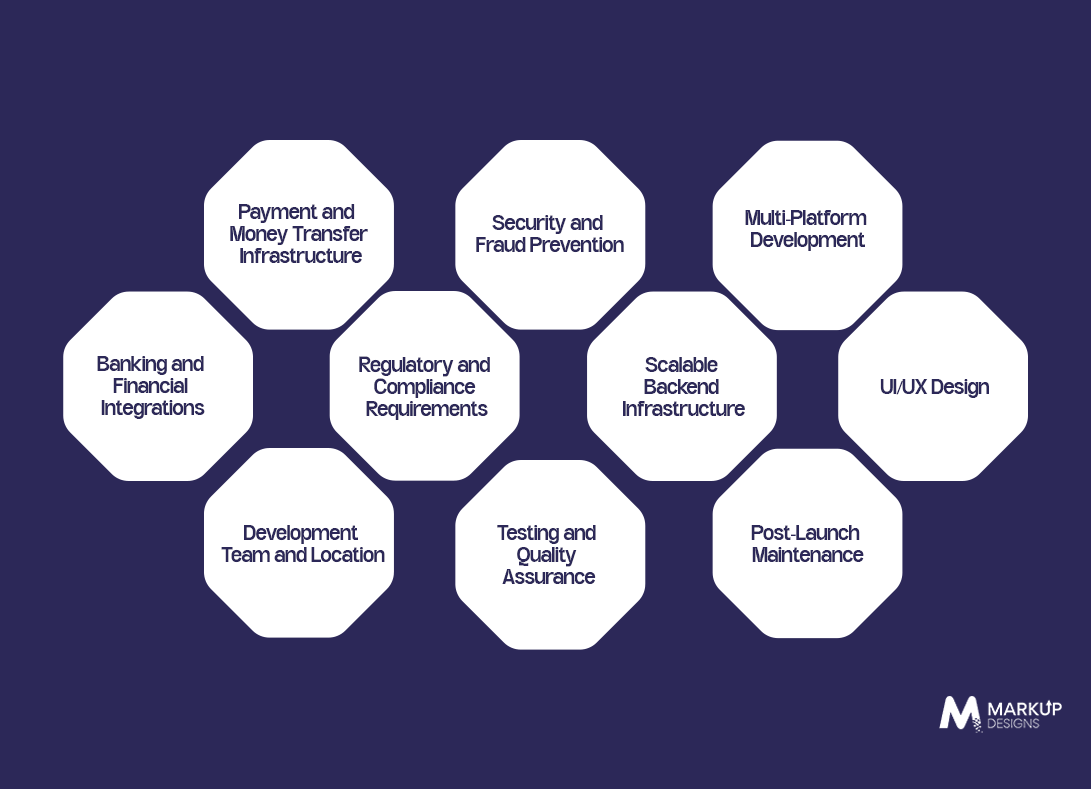
Payment and Money Transfer Infrastructure
Financial applications require reliable infrastructure for processing, validating, tracking, and reconciling transactions. The complexity increases when the app supports multiple payment methods or transaction types.
Banking and Financial Integrations
Connecting banks, payment providers, card networks, KYC services, and other financial platforms adds development and integration work. API capabilities, documentation, testing, and provider requirements can also affect costs.
Security and Fraud Prevention
FinTech applications handle sensitive financial and personal information, making security a core development requirement. Encryption, authentication, access controls, transaction monitoring, and fraud detection all add to development effort.
Regulatory and Compliance Requirements
KYC, AML, payment security, data protection, and other applicable financial requirements need to be considered during development. Compliance requirements can vary based on the services and markets supported by the application.
Multi-Platform Development
Building separate native applications for iOS and Android can require additional development and testing resources. Cross-platform technologies can reduce duplicated development work where they meet the application’s technical requirements.
Scalable Backend Infrastructure
The backend must support transactions, user accounts, financial records, notifications, integrations, and growing user volumes. A scalable architecture requires careful planning of databases, APIs, cloud infrastructure, and system performance.
UI/UX Design
FinTech interfaces need to make financial actions clear and easy to understand. User flows for payments, transfers, balances, verification, and transaction history require careful UX planning.
Development Team and Location
Development costs vary according to the team’s expertise, location, engagement model, and the technical complexity of the project. FinTech applications may also require specialists in security, compliance, backend engineering, and financial integrations.
Testing and Quality Assurance
Financial applications require extensive testing of payment flows, authentication, APIs, transaction records, security controls, and edge cases. Testing effort increases as the number of financial services and integrations grows.
Post-Launch Maintenance
Ongoing costs can include bug fixes, security updates, infrastructure management, API changes, compliance updates, performance optimisation, and new feature development.
Key Features of a Cash App-Like FinTech App
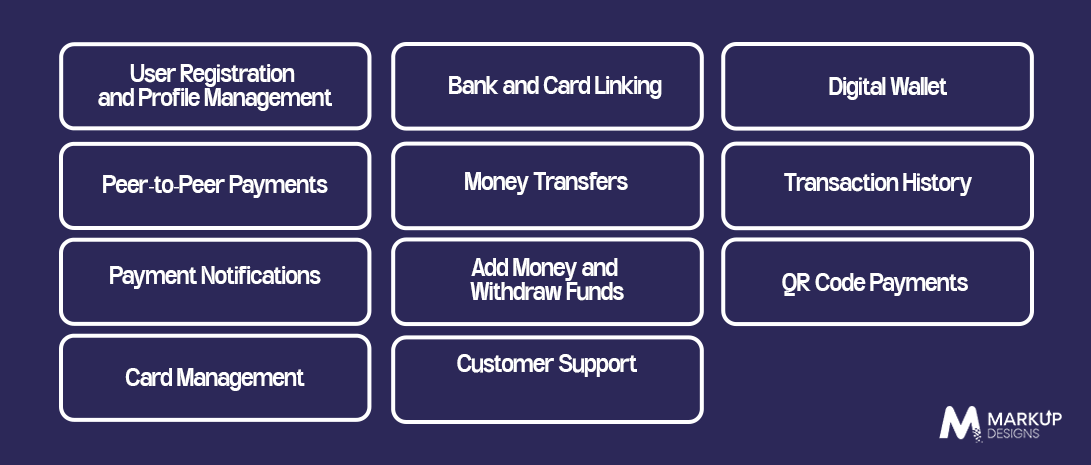
User Registration and Profile Management
Allow users to create accounts, manage personal information, complete verification, and securely access their financial services.
Bank and Card Linking
Enable users to connect supported bank accounts or cards for adding funds, making payments, and withdrawing money.
Digital Wallet
Provide users with a secure wallet to view balances, manage funds, and access transaction-related services.
Peer-to-Peer Payments
Allow users to send and receive money directly through the application using supported payment methods.
Money Transfers
Support transfers between users and connected financial accounts while maintaining transaction records and status updates.
Transaction History
Give users a clear record of payments, transfers, deposits, withdrawals, and other financial activities.
Payment Notifications
Send real-time or relevant notifications for completed transactions, incoming payments, failed payments, and account activity.
Add Money and Withdraw Funds
Allow users to add funds through supported methods and transfer available balances to linked accounts.
QR Code Payments
Enable QR-based payment interactions for supported merchant or user transactions.
Card Management
Allow users to view, manage, activate, freeze, or control supported virtual or physical cards.
Customer Support
Provide in-app support through FAQs, chat, ticketing, or other channels to help users resolve payment and account-related issues.
Advanced Features for a Cash App-Like FinTech App
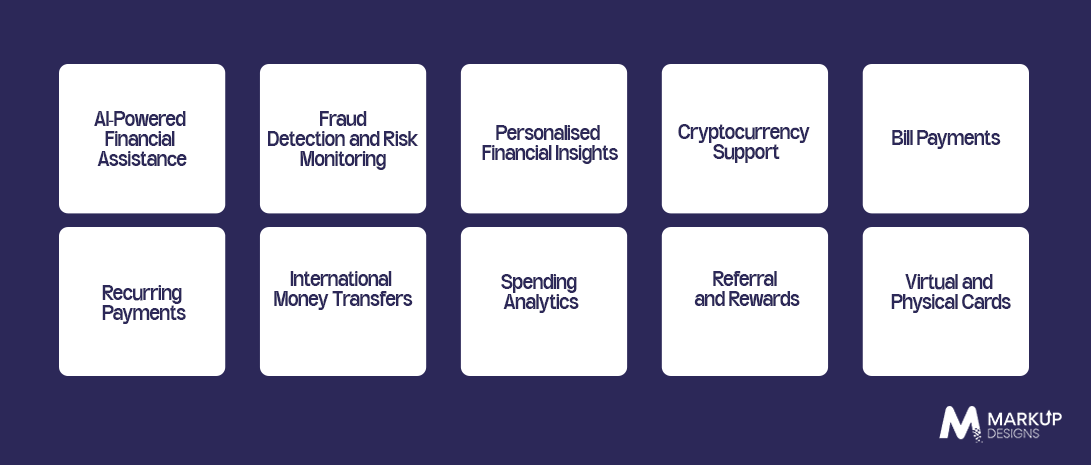
AI-Powered Financial Assistance
Use AI to answer financial queries, guide users through app functions, and provide contextual assistance.
Fraud Detection and Risk Monitoring
Analyse transactions and account activity to identify unusual patterns and support fraud prevention.
Personalised Financial Insights
Provide users with relevant insights based on spending, transaction, and account activity.
Cryptocurrency Support
Allow users to buy, sell, hold, or transfer supported digital assets where legally and technically applicable.
Bill Payments
Enable users to pay supported utility, subscription, and other recurring bills through the application.
Recurring Payments
Support scheduled or recurring payments for subscriptions, bills, and other authorised transactions.
International Money Transfers
Enable cross-border transfers with appropriate currency, payment, compliance, and transaction capabilities.
Spending Analytics
Present spending patterns, transaction summaries, and financial activity through dashboards and reports.
Referral and Rewards
Encourage user acquisition and engagement through referral programmes, rewards, or eligible promotional offers.
Virtual and Physical Cards
Provide digital or physical payment cards with features such as activation, controls, transaction monitoring, and card management.
Cash App-Like FinTech App Cost Breakdown
The overall budget is distributed across several development components, with the exact cost depending on the scope and complexity of each area.
| Development Component | Cost Considerations |
| UI/UX Design | User flows, financial dashboards, payment screens, prototypes |
| Mobile App Development | iOS, Android, or cross-platform development |
| Backend Development | APIs, transactions, accounts, wallets, business logic |
| Admin Panel | User, transaction, payment, security, and system management |
| Payment Gateway Integration | Payment processing, transaction handling, refunds |
| Banking API Integration | Bank accounts, financial data, verification, transfers |
| Security Implementation | Authentication, encryption, access control, fraud prevention |
| Testing and QA | Functional, API, payment, security, performance testing |
| Deployment | App-store release, cloud setup, production configuration |
| Maintenance and Support | Updates, monitoring, fixes, security, compliance, enhancements |
Technology Stack for a Cash App-Like FinTech App
Mobile App
Technologies such as Swift/SwiftUI, Kotlin/Jetpack Compose, Flutter, or React Native can be selected according to platform and development requirements.
Frontend
React, Next.js, Angular, or Vue.js can support web-based interfaces such as financial dashboards and administrative portals.
Backend
Node.js, Python, Java, or .NET can be used to build APIs, transaction logic, authentication services, and financial workflows.
Database
PostgreSQL, MySQL, or MongoDB can support user information, transaction records, financial data, and application operations based on the architecture.
Cloud Infrastructure
AWS, Microsoft Azure, or Google Cloud can provide infrastructure for application hosting, databases, storage, monitoring, and scalability.
APIs and Integrations
Payment gateways, banking APIs, KYC/AML services, card services, notification providers, analytics tools, and other third-party APIs can be integrated based on the application’s requirements.
Security Technologies
Security implementation can include multi-factor authentication, biometric authentication, encryption, secure APIs, role-based access controls, transaction monitoring, and fraud detection mechanisms.
Compliance and Security Requirements
A Cash App-like FinTech application needs security and compliance measures to protect financial information, secure transactions, and meet applicable regulatory requirements. The specific controls depend on the services offered, markets served, payment flows, and regulatory obligations.
KYC and AML
Implement identity verification and transaction controls to support Know Your Customer (KYC) and Anti-Money Laundering (AML) requirements where applicable.
PCI DSS
Follow relevant PCI DSS requirements when the application processes, stores, or transmits payment card data.
Data Encryption
Use encryption to protect sensitive financial and personal information during transmission and storage.
Multi-Factor Authentication
Add multiple authentication factors to strengthen account security and reduce the risk of unauthorised access.
Biometric Authentication
Support fingerprint, facial recognition, or other device-supported biometric authentication where appropriate.
Transaction Monitoring
Monitor transaction activity to identify unusual patterns, suspicious behaviour, and potential security issues.
Fraud Prevention
Use risk controls, transaction rules, device monitoring, and fraud detection mechanisms to identify and respond to potentially fraudulent activity.
Data Privacy and Protection
Apply appropriate privacy and data protection controls to how user information is collected, processed, stored, accessed, and retained.
How to Develop a FinTech App Like Cash App?
Step 1: Define the Business Model and Target Users
Identify the financial services the app will provide, target users, supported markets, revenue model, and core business objectives.
Step 2: Identify Core Financial Services
Determine whether the application will support P2P payments, digital wallets, card services, bill payments, money transfers, cryptocurrency, or other financial services.
Step 3: Define Features and User Workflows
Map the key user journeys for registration, verification, adding funds, sending money, receiving payments, withdrawals, and transaction management.
Step 4: Design the UI/UX
Create intuitive interfaces for financial actions, account management, transaction history, notifications, and support while keeping security requirements in mind.
Step 5: Select the Technology Stack
Choose suitable mobile, backend, database, cloud service, API, and security technologies based on the application’s functionality, platform requirements, and scalability needs.
Step 6: Integrate Banking and Payment Services
Connect payment gateways, banking APIs, KYC providers, card services, notification systems, and other required financial integrations.
Step 7: Develop the App and Admin Panel
Build the user-facing application, backend services, financial workflows, and admin panel for managing users, transactions, security, and system operations.
Step 8: Implement Security and Compliance Controls
Integrate authentication, encryption, access controls, transaction monitoring, fraud prevention, and applicable compliance requirements into the application.
Step 9: Test Financial Transactions and Workflows
Test payment flows, transfers, authentication, integrations, security controls, transaction records, performance, and failure scenarios before launch.
Step 10: Launch, Monitor, and Maintain
Deploy the application, monitor transactions and system performance, resolve issues, apply security updates, and introduce improvements based on business and user requirements.
Factors That Influence FinTech App Development Cost
App Complexity
More financial services, workflows, integrations, and advanced functionality increase development effort.
Number of Platforms
Supporting iOS, Android, web, or multiple platforms affects development and testing requirements.
Feature Set
Core payment features require less effort than advanced capabilities such as AI, cryptocurrency, international transfers, or automated fraud detection.
Third-Party Integrations
Banking APIs, payment gateways, KYC providers, card networks, analytics, and other integrations can add development and testing costs.
Security and Compliance
Security controls, identity verification, transaction monitoring, and applicable regulatory requirements can significantly affect project scope.
Geographic Availability
Supporting multiple countries can introduce additional currencies, payment methods, financial regulations, languages, and compliance requirements.
Development Team
Costs vary based on the team’s location, expertise, technology skills, and experience with FinTech applications.
Scalability Requirements
Applications designed to handle large transaction volumes and growing user numbers require more robust architecture and infrastructure.
Maintenance and Updates
Ongoing security updates, API changes, compliance requirements, infrastructure management, and feature improvements contribute to long-term costs.
How to Reduce the Cost of Developing a FinTech App
Start With an MVP
Launch with essential financial features to validate the product before investing in advanced functionality.
Prioritise Core Financial Features
Focus the first release on the services and workflows that directly support the application’s primary use case.
Use Reliable APIs and SDKs
Use established financial APIs and SDKs where appropriate to reduce the need to build every supporting service from scratch.
Choose Cross-Platform Development Where Suitable
Cross-platform technologies can reduce duplicated development effort when they meet the application’s performance and security requirements.
Build Compliance Into the Architecture
Consider security and compliance requirements from the beginning rather than adding them after development.
Plan for Scalability From the Start
Design the architecture to accommodate increasing users, transactions, integrations, and services without unnecessary redevelopment.
Post-Launch Costs of a FinTech App
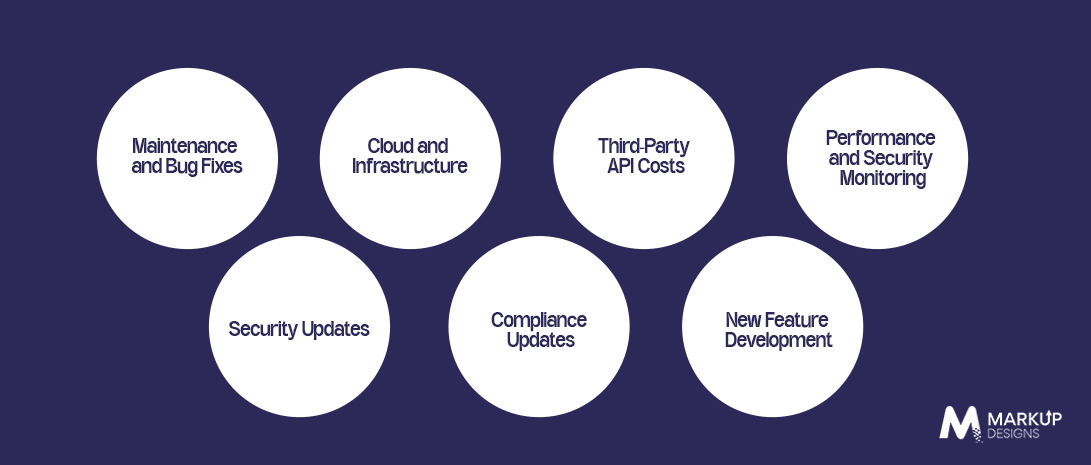
Maintenance and Bug Fixes
Resolve application issues and keep financial workflows functioning correctly after launch.
Security Updates
Apply security patches, dependency updates, vulnerability fixes, and improvements to security controls.
Cloud and Infrastructure
Manage hosting, databases, storage, monitoring, backups, and infrastructure scaling as usage grows.
Compliance Updates
Update the application and operational processes when applicable financial, privacy, or security requirements change.
Third-Party API Costs
Budget for ongoing charges associated with payment providers, banking APIs, KYC services, communication tools, and other integrations.
New Feature Development
Add new financial services, payment methods, user features, and integrations as the product evolves.
Performance and Security Monitoring
Continuously monitor application performance, infrastructure, transactions, and security events to identify and address issues.
Future Trends in FinTech App Development
AI-Powered Financial Assistants
AI can support financial queries, customer assistance, transaction guidance, and personalised financial experiences.
Real-Time Payments
Faster payment infrastructure is enabling more immediate transfers and transaction confirmations across supported markets.
Open Banking
Open banking APIs can enable secure connections between financial applications, banks, and third-party financial services where supported.
Embedded Finance
Financial services can be integrated directly into non-financial platforms, creating payment, lending, insurance, or wallet experiences within broader digital products.
Digital Wallets
Digital wallets continue to support payments, stored value, cards, transfers, and other financial services through mobile applications.
Blockchain and Digital Assets
Blockchain-based services can support selected use cases involving digital assets, payments, settlement, and financial transactions where applicable.
Biometric and Passwordless Authentication
Device-based biometrics and passwordless authentication can provide convenient account access while strengthening authentication.
Automated Fraud Detection
AI and machine learning can help analyse transaction patterns and identify potentially suspicious activity in real time.
Build a Secure FinTech App Like Cash App
Build a secure, scalable, and user-focused FinTech application around your financial services, target users, and business objectives. Our team can help with product planning, development, financial integrations, security, and ongoing optimisation.

Conclusion
Developing a FinTech app like Cash App requires careful planning across financial functionality, security, compliance, integrations, infrastructure, and user experience. The development cost can range significantly depending on whether the application provides basic payment services or advanced capabilities such as AI, cryptocurrency, international transfers, and automated fraud detection.
A practical approach is to start with clearly defined financial services and an MVP that addresses the core user requirements. Businesses can then expand the application with additional payment methods, financial services, integrations, and advanced technologies as the product evolves. Building security, compliance, and scalability into the architecture from the beginning can also provide a stronger foundation for long-term FinTech development.
FAQ
1. How much does it cost to develop a FinTech app like Cash App?
A FinTech app like Cash App can cost around $40,000 to $400,000+, depending on the app’s complexity, features, platforms, financial integrations, security requirements, compliance needs, and scalability. Advanced applications with AI, cryptocurrency, international transfers, and sophisticated fraud detection can require a higher investment.
2. How long does it take to develop a Cash App-like FinTech app?
Development can take around 3 to 12+ months, depending on the scope of the application. A basic payment MVP may take a few months, while a feature-rich FinTech platform requires more time for development, integrations, security implementation, compliance, and testing.
3. What features should a Cash App-like app have?
Core features can include user registration, identity verification, bank and card linking, digital wallets, peer-to-peer payments, money transfers, transaction history, notifications, withdrawals, and customer support. Advanced applications may also include AI assistance, fraud detection, cryptocurrency, international transfers, analytics, and virtual cards.
4. How much does it cost to develop a basic FinTech payment app?
A basic FinTech payment app may cost approximately 40,000–100,000, depending on the required features, platforms, integrations, security controls, and development team. A detailed estimate requires defining the application’s financial services and technical scope.
5. What technologies are used to develop FinTech apps?
FinTech apps can be developed using technologies such as Swift, Kotlin, Flutter, React Native, React, Node.js, Python, Java, .NET, PostgreSQL, MySQL, AWS, Azure, and Google Cloud. The final technology stack depends on the application’s features, platforms, integrations, security requirements, and scalability needs.
Author's Perspective
From a development perspective, a Cash App-like product should not be approached as a standard payment application. Financial workflows, security controls, regulatory requirements, third-party integrations, and transaction reliability need to be considered from the early planning stages. Defining the core financial use case first and then expanding the platform in phases can help businesses manage development complexity while creating room for future services.
Discuss Your Project NowGaurav Goyal
Global Sales- VP
Related Posts

How to Build a FinTech App in the...

BNPL App Development: Features, Costs & Market Opportunities
FinTech Cybersecurity: Essential Controls for Secure Financial Applications
Insights Are Valuable & Execution is Priceless
You’ve read about the digital future. Now, let’s build the infrastructure to take you there. Move your strategy from the page to the product.
Design Your Solution Now
Contact Us
Schedule The Appointment At Your Convenience Date And Time.
30 Min
Web Conference
Time Zone
Indian standard time (08:30pm)

Thanks For Getting In Touch!
You’ve Taken The First Step Toward Transforming Your Digital Presence. Our Experts Will Reach Out Shortly To Take It Forward.
Launch Your Dream Project
Provide a brief overview of your project, and our specialists will evaluate your requirements. We will connect with you to explore how the right digital solutions can help you launch faster.