
In Brief
- Mobile game development is being revolutionised by technology, bringing us smarter gameplay, automation, customisation of user experience, and data-driven decision-making.
- Artificial intelligence enables developers to create intelligent NPCs (non-player characters), adaptive difficulty levels, procedural content generation, gaming analytics, and fraud detection tools.
- Generative AI is becoming indispensable for game makers in the process of creating game content, characters, and environments.
- Implementation of AI allows companies to decrease game development expenses and improve the efficiency of the games’ performance.
- Game developers face many challenges in terms of game production and testing with the help of AI, including development costs, operating the games on mobile, and data privacy.
The introduction of artificial intelligence in gaming has led to a transformation in game development, game testing, and gameplay, which includes the use of smart NPCs and artificial intelligence devices that can now be used in gaming. With smart NPCs and adaptive gameplay, AI enables developers to deliver a gaming experience that is adaptive to player behaviors, providing automatic testing services and thus allowing game manufacturers to take away the burden of tedious tasks, making it possible to analyse big data received during gaming sessions more effectively.
The increasing use of AI technologies is taking the mobile gaming development process to the next level with the help of generative AI technologies, which facilitate the creation of gameplay assets, including character dialogue, world, sound, etc. However, the inclusion of AI in mobile game processes requires developers to take into consideration various aspects of the game, including the objectives of the game, device specifications, data needs, security, and costs. This blog considers the impact of artificial intelligence on the mobile game development process, describing its major advantages and disadvantages along with the technological requirements.
How Is AI Changing Mobile Game Development?
AI is impacting mobile game design and development, giving developers the ability to automate a variety of design processes while offering insight into player behaviour as well as content generation to help developers create games that are more responsive to gamers. Its influence is felt all the way through the game development process, from early game design to post-development optimisation.
Smarter Game Development Workflows
AI can help with otherwise repetitive coding, the development of gaming logic, debugging, asset management, and game design processes. Such help not only reduces manual labour but also helps game developers to focus on game design, functionality, and player experience.
More Personalised Player Experiences
AI can help in discovering the way players play games so as to tailor the gameplay and introduce recommendations and challenges based on the data provided. This means that games created for mobile devices will be more suited to players’ needs.
Faster Content Creation
AI has huge potential in terms of content creation. It can help with game assets, different environments, characters, dialogues, sounds, etc. Developers will be able to accelerate content production while maintaining control over the final product.
Intelligent Game Testing and Optimisation
AI can analyse gameplay scenarios, identify potential issues, automate testing, and evaluate player interactions across different conditions. These capabilities can help dedicated development teams detect problems earlier and continuously optimise the game after launch.
How Is AI Used in Mobile Game Development?
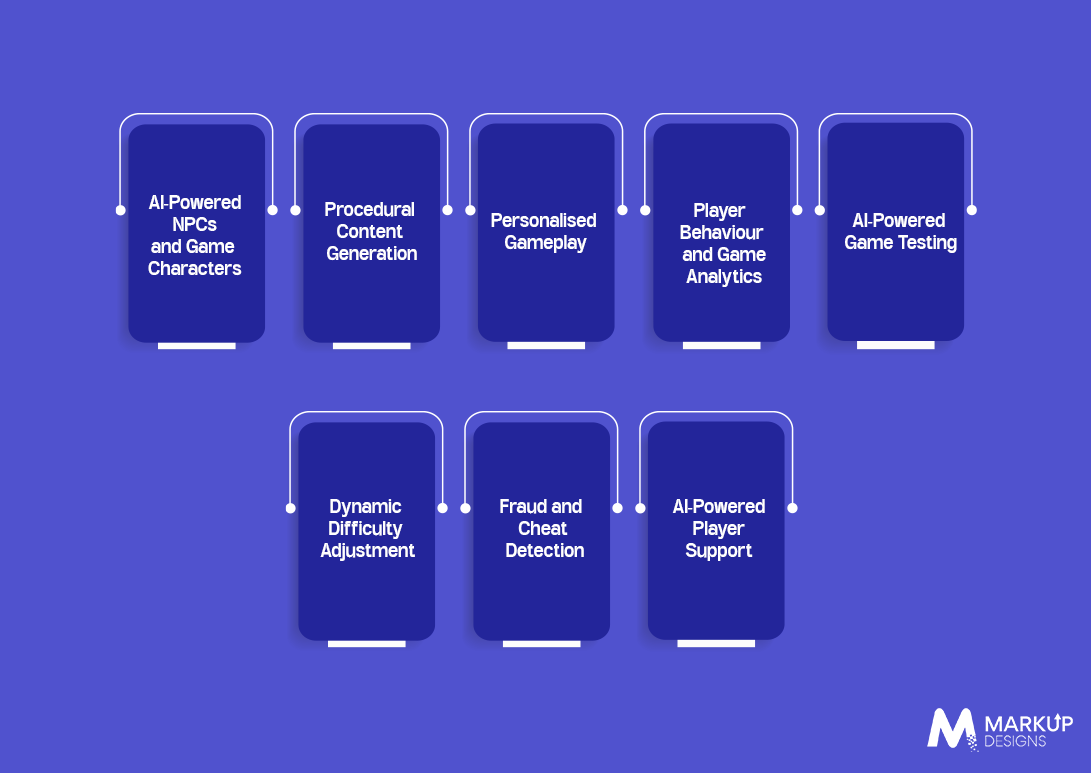
AI can be utilized in various components of a mobile game, including character behavior and content generation, as well as analytics, testing, safety, and player assistance.
AI-Powered NPCs and Game Characters
AI is responsible for enabling game characters and non-player characters to act actively based on players’ actions instead of fixed behavior. Developers can apply the possibilities offered by AI to create characters that are more intelligent in movement and decision-making processes.
Procedural Content Generation
AI can be employed to create levels, locations, missions, and other elements of a game based on already established algorithms and identified patterns. It helps create diverse content and at the same time reduces the level of human participation in the process.
Personalised Gameplay
AI uses the behavioral data of players to provide recommendations, challenges, rewards, or experiences in such a way that the gameplay will fit their preferences. Personalization of mobile games makes it possible to offer different experiences based on particular goals of users.
Player Behaviour and Game Analytics
AI can process large volumes of gameplay data to identify patterns in player behaviour, engagement, progression, and spending. Developers can use these insights to understand how players interact with the game and make data-driven improvements.
AI-Powered Game Testing
AI can automate repetitive testing scenarios and analyse gameplay across different devices, levels, and player actions. It can help identify bugs, performance issues, UI problems, and unexpected game behaviour before and after launch.
Dynamic Difficulty Adjustment
AI can monitor player performance and adjust game difficulty based on skill level, progression, and behaviour. This can help developers create challenges that remain appropriate for different types of players.
Fraud and Cheat Detection
AI can identify unusual gameplay patterns, suspicious transactions, automated activity, and other behaviours that may indicate cheating or fraud. These systems can help developers monitor game integrity and protect competitive and monetised environments.
AI-Powered Player Support
AI chatbot development and virtual assistants can respond to common player questions, provide gameplay guidance, and help resolve basic account or support issues. This can provide faster assistance while reducing the workload on human support teams.
How Is Generative AI Transforming Mobile Game Development?
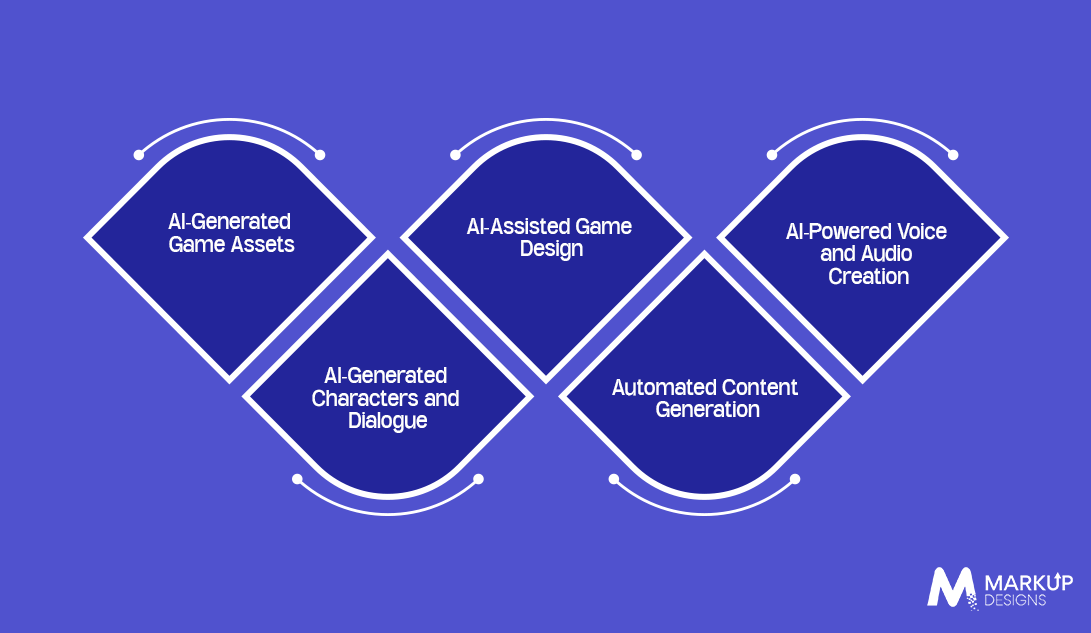
Generative AI is expanding the role of AI beyond analytics and automation by helping developers produce new game content. It can support creative workflows while allowing game designers and artists to review, modify, and control the final output.
AI-Generated Game Assets
Generative AI can assist with creating concepts for characters, environments, textures, objects, and other visual assets. Developers can use these outputs as starting points for production or as references during the design process.
AI-Generated Characters and Dialogue
AI can help developers create character concepts, dialogue variations, story elements, and interactive conversations. This can support games that require a large volume of character interactions or narrative content.
AI-Assisted Game Design
Generative AI can support brainstorming for game mechanics, missions, levels, storylines, and gameplay concepts. Developers can use AI-generated ideas during the design process while applying human judgement to determine what fits the game’s vision.
Automated Content Generation
AI can generate variations of levels, missions, challenges, items, and other gameplay elements based on predefined requirements. This can help teams expand game content without manually designing every variation.
AI-Powered Voice and Audio Creation
AI can assist with generating voice content, sound effects, music concepts, and other audio elements. These capabilities can support rapid prototyping and content creation, while production teams can review outputs for quality, consistency, and licensing requirements.
What Are the Benefits of AI in Mobile Game Development?
AI can create value across both the development process and the final player experience, particularly when its use cases are aligned with specific business and gameplay objectives.
Faster Game Development
AI-assisted development and automation can reduce the time required for repetitive tasks such as testing, content creation, analytics, and certain development activities. This can help teams move through development cycles more efficiently.
Lower Content Production Effort
AI can support the creation of multiple content variations, design concepts, dialogue, assets, and other game elements. This can reduce the manual effort involved in producing large volumes of content.
Improved Player Engagement
AI can help games respond to player behaviour through personalised experiences, adaptive challenges, recommendations, and dynamic content. More responsive gameplay can create experiences that better match individual player preferences.
Personalised Gaming Experiences
AI allows developers to tailor gameplay elements based on player activity, preferences, skill level, and progression. Personalisation can be applied to challenges, rewards, recommendations, and other in-game experiences.
Better Game Quality and Testing
AI-powered testing can analyse more gameplay scenarios and identify issues that may be difficult to detect through manual testing alone. This supports continuous quality improvement across different devices and gameplay conditions.
Data-Driven Game Decisions
AI can analyse player, gameplay, engagement, and monetisation data to identify patterns and trends. Development and product teams can use these insights to make more informed decisions about game updates and features.
Improved Player Retention
AI can help identify changes in player behaviour and support personalised experiences, recommendations, challenges, and engagement strategies. Developers can use these insights to understand where players may lose interest and optimise the experience accordingly.
How to Implement AI in Mobile Game Development?
AI implementation should begin with a clear business or gameplay objective rather than adding AI simply as a technology feature. A structured approach helps developers select appropriate models, integrate them effectively, and evaluate their impact on the player experience.
Step 1: Identify the Right AI Use Cases
Start by identifying specific areas where AI can create measurable value, such as NPC behaviour, personalisation, testing, analytics, content generation, or cheat detection. The selected use cases should align with the game’s objectives and target audience.
Step 2: Define Data and Technical Requirements
Determine what data the AI system needs, where that data will come from, and how it will be processed and stored. Developers should also consider device capabilities, backend requirements, privacy, security, and performance limitations.
Step 3: Select AI Models and Technologies
Choose AI models, machine learning frameworks, APIs, and development technologies based on the selected use cases. The decision should consider accuracy, performance, scalability, integration requirements, and ai development costs.
Step 4: Integrate AI Into the Game
Integrate the selected AI capabilities with the game engine, backend systems, APIs, analytics platforms, and other required components. Developers should ensure that AI features work effectively without negatively affecting gameplay performance.
Step 5: Test AI Performance and Player Experience
Test AI behaviour, accuracy, responsiveness, resource consumption, security, and overall gameplay impact. Testing should include different devices, player scenarios, network conditions, and edge cases.
Step 6: Launch, Monitor, and Optimise
After deployment, monitor AI performance, player behaviour, game metrics, infrastructure usage, and potential issues. Models and AI-powered features can then be continuously refined based on real-world data and player feedback.
What Technology Stack Is Used for AI-Powered Mobile Games?
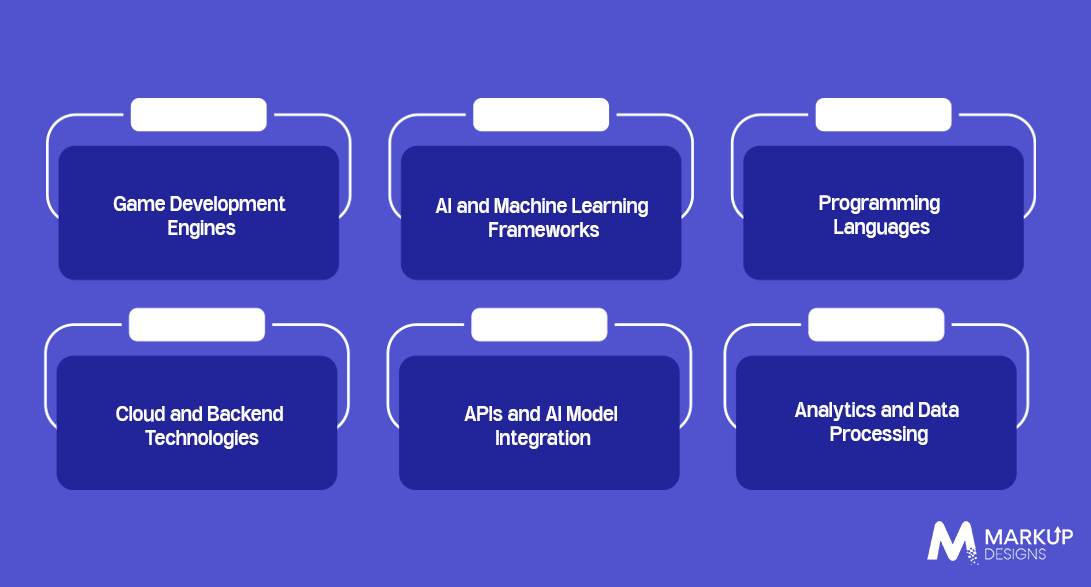
The technology stack for an AI-powered mobile game depends on the game’s platform, AI requirements, backend architecture, and complexity. A typical stack combines game engines, programming languages, AI frameworks, cloud infrastructure, APIs, and analytics tools.
Game Development Engines
Game engines such as Unity and Unreal Engine provide the core environment for developing mobile games. They can be integrated with AI systems to support gameplay logic, character behaviour, graphics, physics, and other game components.
AI and Machine Learning Frameworks
Frameworks such as TensorFlow, PyTorch, and other ML libraries can support model development, training, inference, and AI experimentation. The appropriate framework depends on the AI use case and deployment requirements.
Programming Languages
Languages such as C#, C++, Python, Java, and Kotlin can be used across different parts of AI-powered mobile game development. The choice depends on the game engine, mobile platform, backend architecture, and AI implementation.
Cloud and Backend Technologies
Cloud platforms and backend technologies can provide the computing power, storage, APIs, authentication, databases, and scalable infrastructure required for AI-powered gaming features. They are particularly useful when AI processing cannot be efficiently performed directly on mobile devices.
APIs and AI Model Integration
AI APIs and model-serving systems can provide capabilities such as generative AI, natural language processing, computer vision, recommendations, and voice processing. Developers can integrate these services into games based on their specific functional requirements.
Analytics and Data Processing
Analytics platforms and data-processing technologies help collect and analyse gameplay, engagement, retention, and monetisation data. These insights can support AI models and help developers continuously improve the game experience.
What Challenges Does AI Bring to Mobile Game Development?
While AI can improve development efficiency and player experiences, integrating it into a mobile game also introduces technical, financial, and creative challenges. Developers need to evaluate these considerations before selecting AI models and deciding where they should be used.
Development and Infrastructure Costs
AI-powered features can increase development costs because they may require specialised expertise, model development, cloud computing, data processing, APIs, and ongoing optimisation. The overall investment depends on the complexity and scale of the AI capabilities being implemented.
Data Privacy and Security
AI systems may process player behaviour, account information, gameplay data, and other sensitive information. Developers need to establish appropriate data collection, storage, access controls, and security practices while meeting applicable privacy requirements.
AI Performance on Mobile Devices
Running AI models directly on mobile devices can consume processing power, memory, battery, and storage. Developers need to determine which AI workloads should run on-device and which should be handled through cloud or backend infrastructure.
Model Accuracy and Reliability
AI models can produce inaccurate, inconsistent, or unexpected outputs. Developers need to test models across different gameplay scenarios and establish monitoring and fallback mechanisms to maintain a reliable player experience.
Intellectual Property and AI-Generated Content
AI-generated assets, dialogue, music, voices, and other content can create questions around ownership, licensing, training data, and commercial usage rights. Development teams should review the terms and legal considerations associated with the AI tools and content they use.
Balancing AI With Human Creativity
AI can support game development but does not replace the need for human game designers, developers, artists, writers, and other creative professionals. Human oversight remains important for maintaining the game’s creative direction, quality, storytelling, and overall player experience.
How Much Does It Cost to Integrate AI Into a Mobile Game?
The cost of integrating AI into a mobile game can vary significantly based on the type of AI functionality, game complexity, data requirements, development approach, and infrastructure. A basic AI feature requires a very different investment from a game built around advanced AI systems.
AI Integration Cost by Complexity
Basic AI Features
Basic AI integration services may include simple NPC behaviour, recommendation logic, basic analytics, or predefined AI interactions. These features generally require less development and infrastructure compared with advanced AI systems.
Mid-Level AI Capabilities
Mid-level implementations may involve personalised gameplay, advanced NPC behaviour, AI-powered analytics, automated testing, or API-based generative AI features. These projects require greater integration, testing, and backend capabilities.
Advanced AI-Powered Games
Advanced AI-powered games may use machine learning, generative AI, intelligent game agents, real-time personalisation, computer vision, or complex adaptive gameplay. These solutions typically require specialised AI expertise, larger data pipelines, scalable infrastructure, and continuous model optimisation.
Factors Affecting AI Integration Cost
AI integration costs are influenced by the complexity of the game, number of AI features, model requirements, data volume, third-party APIs, game engine, backend architecture, cloud infrastructure, security requirements, testing, and development team expertise.
Ongoing AI and Infrastructure Costs
AI-related expenses continue after the initial development phase. Businesses may need to budget for cloud computing, AI model or API usage, data storage, monitoring, model updates, security, maintenance, and optimisation as the number of players and AI interactions increases.
What Is the Future of AI in Mobile Game Development?
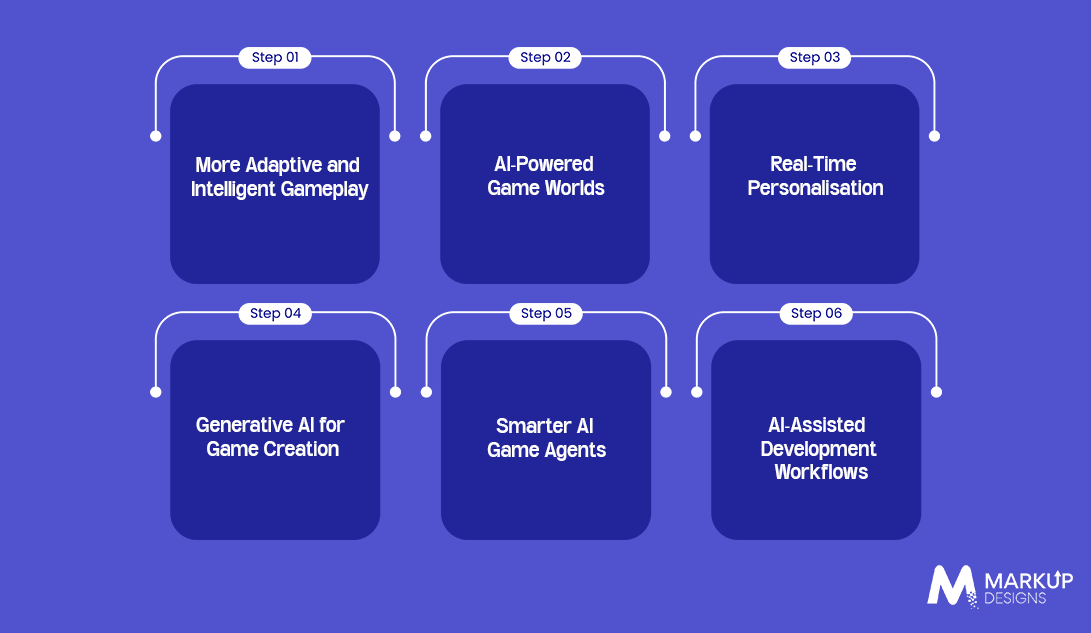
AI is expected to become increasingly integrated into both game development workflows and player-facing experiences. As AI models and mobile hardware evolve, developers can explore more responsive, personalised, and content-rich gaming environments.
More Adaptive and Intelligent Gameplay
Future mobile games can use AI to continuously adapt gameplay based on player behaviour, skill, preferences, and progression. This can create experiences that respond dynamically rather than following the same gameplay path for every player.
AI-Powered Game Worlds
AI can support game worlds that dynamically generate environments, events, missions, characters, and interactions. This could allow developers to create more varied experiences while reducing the manual effort required for every content variation.
Real-Time Personalisation
AI can enable games to analyse player activity and make real-time adjustments to recommendations, challenges, rewards, and content. Personalisation can become more contextual as AI systems process a wider range of gameplay signals.
Generative AI for Game Creation
Generative AI is expected to play a larger role in creating game assets, narratives, dialogue, audio, environments, and other content. Development teams can use these tools to accelerate ideation and production while maintaining human review and creative direction.
Smarter AI Game Agents
AI game agents can become more capable of understanding game environments, player actions, objectives, and changing conditions. This can support more dynamic NPCs, opponents, companions, and other interactive characters.
AI-Assisted Development Workflows
AI can become increasingly integrated into coding, debugging, testing, asset creation, documentation, analytics, and other development activities. This can help development teams automate repetitive work and spend more time on game design and innovation.
Why Choose Markup Designs for AI-Powered Mobile Game Development?
Markup Designs helps businesses develop AI-powered mobile games by combining game development, AI/ML, automation, backend engineering, and scalable cloud technologies. From AI strategy and game design to development, integration, testing, and post-launch optimisation, our team builds intelligent gaming experiences aligned with business and player requirements.
Build Smarter Mobile Games With AI
Use AI to create more adaptive gameplay, intelligent game characters, personalised experiences, and efficient development workflows. Markup Designs helps businesses turn AI-powered gaming concepts into scalable mobile applications.

Conclusion
AI is becoming an important technology across the mobile game development lifecycle, from creating game content and intelligent characters to testing, personalisation, analytics, and post-launch optimisation. Its value depends on how effectively developers connect AI capabilities with the game’s objectives, technical requirements, and player experience.
For businesses planning an AI-powered mobile game, the focus should be on selecting practical use cases, preparing the right technical foundation, managing ongoing costs, and maintaining human oversight. A well-planned AI strategy can help development teams explore new gameplay possibilities while building mobile gaming experiences that can evolve with player needs.
FAQ
1. How is artificial intelligence changing how mobile games are built?
Machine learning algorithms are improving mobile games by making non-player characters more realistic, making the gameplay more adaptive, generating content automatically, and making the development process more efficient.
2. In what specific ways is AI integrated into mobile game development?
AI can be used in various ways, including automating testing, designing characters, creating game worlds, improving the quality of NPCs, and making decisions in the game.
3. Is there potential for AI-generated content in mobile gaming?
Absolutely. AI can help develop assets for games in the form of building characters, graphics, environments, sounds, and even stories.
4. How does AI contribute to boosting player loyalty?
Thanks to the use of AI, players’ actions can be studied better and the entire gameplay improved since it can be adjusted based on the player’s preferences, suggestions, experiences, and decisions.
5. Which AI technologies are most efficient in mobile gaming?
Different AI technologies used in mobile games include neural networks, computer vision systems, machine learning, natural language processing technologies, and many others based on the game requirements.
6. How much will it take to implement AI into a mobile game?
The price will depend on what AI features are needed, the game’s complexity, the type of model needed, the needed integrations, data, infrastructure, security, and the ability of the developers to do such work. In general terms, simple AI system use does require more investment than sophisticated AI technology.
7. What are the problems in using AI in mobile development?
The main problems include costs of development and infrastructure, privacy concerns, performance of mobile devices, accuracy of the model, intellectual property issues, maintenance, and the right balance of machine automation and human creativity.
Author's Perspective
AI should not be regarded as a technology but as something that enhances the gaming experience instead. The most successful implementation of AI technology starts with having a clear gameplay or business goal and then finding out where AI can really help improve development, personalisation, automation, and gamification. If the right balance of AI functionality and features, technical planning, and human creativity is found, one can create mobile games that are highly flexible and adaptable.
Discuss Your Project NowJupinder Singh Arora
Founder and CEO
Related Posts
How to Build Production-Ready Applications with AI Coding...
Cost, Benefits & Business Impact: Generative AI vs....
Enterprise AI Agents: Practical Use Cases Driving Business...
Insights Are Valuable & Execution is Priceless
You’ve read about the digital future. Now, let’s build the infrastructure to take you there. Move your strategy from the page to the product.
Design Your Solution Now
Contact Us
Schedule The Appointment At Your Convenience Date And Time.
30 Min
Web Conference
Time Zone
Indian standard time (08:30pm)

Thanks For Getting In Touch!
You’ve Taken The First Step Toward Transforming Your Digital Presence. Our Experts Will Reach Out Shortly To Take It Forward.
Launch Your Dream Project
Provide a brief overview of your project, and our specialists will evaluate your requirements. We will connect with you to explore how the right digital solutions can help you launch faster.