
In Brief
- Healthcare IT outsourcing enables hospitals to get professional help in the areas of software development, cloud computing, cybersecurity, AI, IT integration, and IT support without having all of these abilities in-house.
- The main advantages of this model include reduced expenses, faster technology implementation, increased security and compliance, scalable IT resources, and more time for doctors and nurses to take care of patients.
- There are several ways to outsource your company’s technology, including project-based outsourcing, dedicated development team, managed IT services, staff augmentation, and full outsourcing, depending on what you need and your strategic plans.
- Effective outsourcing includes proper planning regarding data security, healthcare compliance, legacy systems integration, communications, vendor management, and service agreement terms. The price of outsourcing is influenced by the scope of the project, the size of the development team, integration, technology needs, and support.
- The right outsourcing vendor will help you upgrade legacy systems, adopt AI and cloud technology, improve digital infrastructure, and create scalable and secure solutions.
Healthcare is becoming increasingly dependent on technology. From electronic health records and telehealth applications to patient applications, cloud computing solutions, and AI-based software, healthcare organizations require dependable technologies to provide superior care quickly. At the same time, maintaining such solutions in-house is expensive and complex, considering that there is a shortage of healthcare IT specialists.
Outsourcing can help healthcare organizations in this situation significantly. By partnering with a qualified technology partner, organizations can benefit from having specific knowledge and solutions without hiring an entire IT department.
However, outsourcing is not all about cutting costs. Outsourcing could help healthcare organizations become more secure, update their old IT infrastructure, grow, and concentrate on treating patients.
In this blog post, we will talk about the concept of healthcare IT outsourcing, reasons for choosing this model, benefits and risks associated with it, various types of outsourcing, implementation process, cost, and circumstances under which outsourcing would be most effective. We will also cover how to pick a proper technology partner for transforming the healthcare industry.
What is Healthcare IT Outsourcing?
Healthcare IT outsourcing means hiring an external technology partner to manage specific IT functions or complete technology projects for a healthcare organization. Instead of handling every technical requirement with an internal team, providers can bring in outside experts for software development, cloud management, cybersecurity services, system integration, data management, and other technology needs.
What makes healthcare IT outsourcing different from general IT outsourcing is the nature of healthcare data and operations. Healthcare providers deal with sensitive patient information, strict privacy requirements, complex clinical workflows, and systems that often need to work together seamlessly. Any technology solution must therefore be secure, reliable, and designed around healthcare requirements.
Outsourcing can take different forms. A hospital may outsource a complete software development project, while another provider may use an external team for ongoing IT support or cybersecurity monitoring.
The goal is not simply to hand over IT responsibilities. It is to gain the right expertise, improve technology capabilities, and build a stronger digital foundation for better healthcare delivery.
Why Are Healthcare Providers Turning to IT Outsourcing?
Healthcare professionals face increasing pressures to deliver better care to their patients, along with rising costs of operations and technological challenges. On the other hand, healthcare technology has become increasingly dynamic, and it is becoming increasingly challenging for all organizations to maintain the necessary skills and infrastructure internally.
Several factors are encouraging providers to consider outsourcing:
- IT skill shortage: The shortage of professionals in the fields of healthcare software, cybersecurity, cloud, and AI is becoming increasingly difficult.
- Increased cyber threats: Healthcare organizations require robust cybersecurity measures to protect patient and clinical data.
- Outdated technology: Outdated technology may impede the functioning of operations and integration with modern solutions.
- Digital transformation: Providers are increasingly using telemedicine, mobile applications, AI, cloud computing, and other technological solutions.
- Cost pressures: Outsourcing will save the organization money on building an internal technology department and investing in infrastructure.
- Scalability needs: An external team can help meet increased demand when the organization grows or introduces new products.
As a result, outsourcing is increasingly becoming a strategic technology decision rather than simply a way to reduce IT expenses.
Key Benefits of Healthcare IT Outsourcing
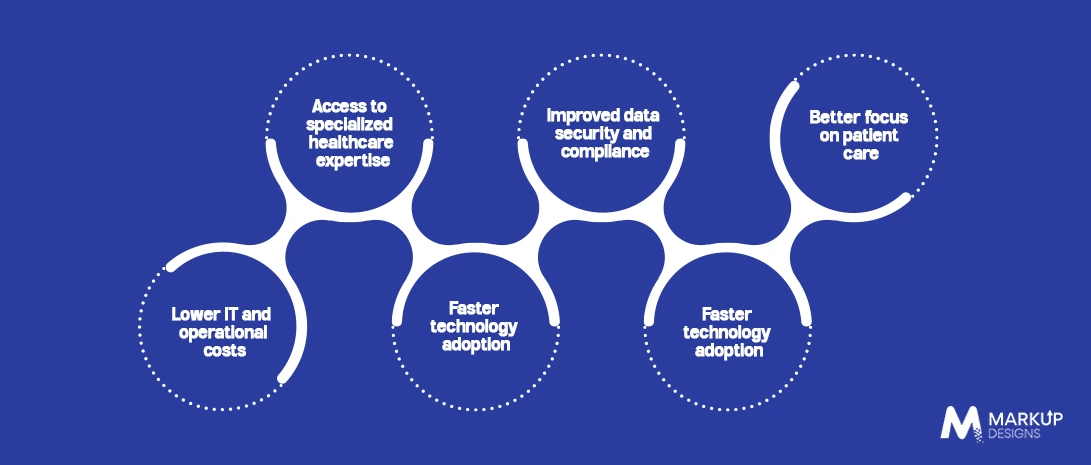
Healthcare IT outsourcing can offer both short-term operational benefits and long-term technology benefits. If done right through a suitable partner, it will allow healthcare organizations to develop their technology solutions while their in-house teams remain concentrated on other healthcare operations.
Key benefits include:
1. Lower IT and operational costs
Lower the cost of personnel, infrastructure, and technology management.
2. Access to specialized healthcare expertise
Collaborate with those who know about health software, cloud computing, cybersecurity, artificial intelligence, and integration.
3. Faster technology adoption
Adopt the latest health technologies without having to wait several years before you are able to do so.
4. Improved data security and compliance
Provide better data protection and comply with health privacy regulations.
5. Scalable IT infrastructure
Increase or decrease technology capacity as needed by your business.
6. Better focus on patient care
Make your team able to work more on clinical issues while IT specialists work on IT requirements.
The biggest advantage is often the combination of expertise, flexibility, and speed that outsourcing can bring to a healthcare organization.
Healthcare IT Outsourcing Models
Healthcare organizations have the flexibility to select an appropriate outsourcing model depending on their technological requirements, project size, budget, and internal expertise level. Some common outsourcing models are:
- Project-based outsourcing: Suitable for particular projects, such as apps, portals, or software updates.
- Development teams: Appropriate for those companies that require maintaining a long-term relationship with a dedicated team of specialists in healthcare technology.
- IT managed services: Includes monitoring, managing IT infrastructure, cybersecurity, cloud services, and technical assistance.
- Staff augmentation: Hiring of specialists to supplement the internal team due to a particular skills shortage.
- End-to-end outsourcing: An external company oversees a particular technological process, including development, integration, maintenance, and support.
Choice of the proper approach depends on the level of control that the provider wants to keep, the complexity of its IT environment, and the nature of its needs – one-time or permanent.
Build Smarter Healthcare Technology
Partner with Markup Designs to develop reliable healthcare software, integrate modern technologies, and strengthen your digital capabilities with expert IT outsourcing support.

How Does Healthcare IT Outsourcing Work?
IT outsourcing in the healthcare industry is successful when done through a structured and systematic process, where the first step is identifying the needs of the provider before coming up with a corresponding outsourcing strategy.
A typical process includes:
- Evaluate IT requirements: Examine existing systems, IT infrastructure, processes, security gaps, and technology objectives.
- Establish the scope: Determine which IT services or projects need outsourcing and set timelines, budgets, and anticipated results.
- Choose an IT partner: Consider the partner’s experience in healthcare, its technical skills, security expertise, communication, and track record.
- Develop a plan: Prepare a plan for developing, migrating, integrating, or managing IT services.
- Implement and test: Implement the needed systems and conduct tests related to security, performance, and integration.
- Monitor and optimize: Measure system performance post-deployment and continually optimize the systems to meet changing business and healthcare needs.
A systematic process allows for reducing disruptions and makes it easier for healthcare organizations to stay in control of their IT operations.
Challenges and Risks of Healthcare IT Outsourcing
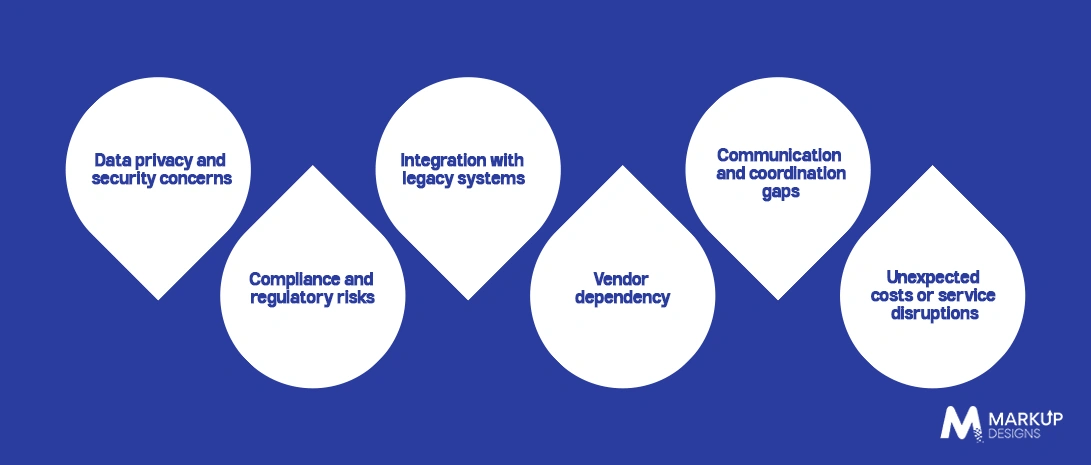
While outsourcing has many benefits, health care organizations need to be aware of the potential problems that can occur. This is because, in the case of health care, sensitive information is involved, as well as activities that are crucial for operations.
Common risks include:
1. Data privacy and security concerns
The confidentiality of patient data should be ensured at all stages – during development, storage, and transfer.
2. Compliance and regulatory risks
External solutions and services need to be in compliance with relevant health care regulations and privacy guidelines.
3. Integration with legacy systems
Integrating new systems with legacy systems can be a difficult task.
4. Vendor dependency
Dependence on one particular vendor can result in some problems for the project.
5. Communication and coordination gaps
Different groups of people working from different locations can sometimes cause difficulties in collaborating.
6. Unexpected costs or service disruptions
Unclear project description and requirements can lead to extra costs.
These risks can be mitigated by means of good contractual relationships, SLAs, security measures, audits, communication, and partner selection.
How Much Does Healthcare IT Outsourcing Cost?
The cost of healthcare IT outsourcing is not static because each organization has its own specific technology needs. A small healthcare application development effort would obviously cost more than managing IT for a large hospital chain.
Several factors influence the overall cost:
- Scope and Complexity of the Project
- Number of developers and IT experts needed
- Type of health-care application
- Integrations and data migration
- Security and compliance issues
- Cloud architecture and other third-party technologies
- AI and Automation needs
- Maintenance and support
The outsourcing approach also influences the cost of the service. The project-based approach is usually quoted on the basis of deliverables, while a dedicated team and managed services can include a recurring cost component.
Healthcare service providers must keep in mind not only the cost aspect but also security, competence, scalability, support, and maintenance. It is important to have a framework for pricing and scope to avoid any hidden charges.
Read Also: Healthcare App Development Cost in 2026
When Should a Healthcare Provider Consider Outsourcing IT?
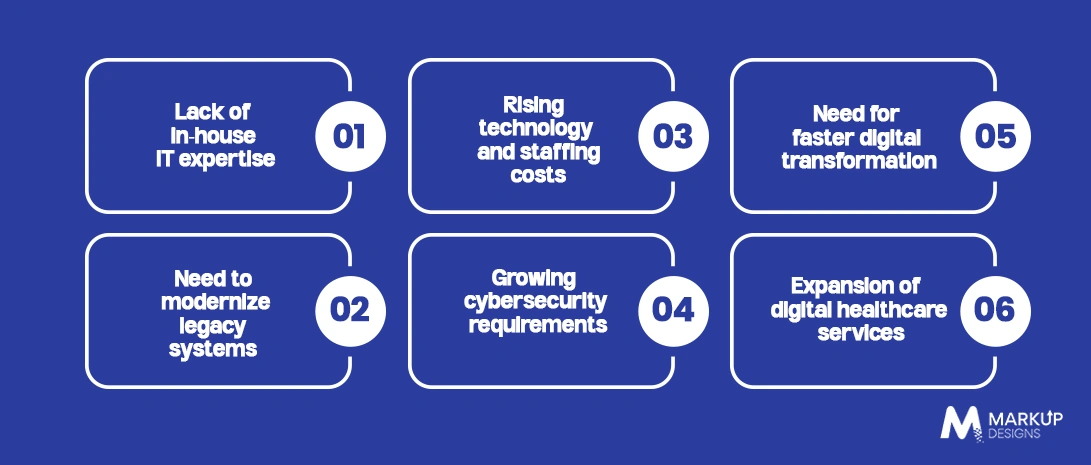
The practice of outsourcing information technology functions does not mean that all healthcare institutions need to undertake this process. IT Outsourcing services will have some benefits in some circumstances.
Outsourcing is required when:
Lack of in-house IT expertise
The internal team might lack expertise in technology such as medical applications, artificial intelligence, cloud computing, or cybersecurity.
Need to modernize legacy systems
Old technology can negatively affect efficiency and integration.
Rising technology and staffing costs
This process allows one to employ skilled professionals without having to fund the recruitment of an internal team.
Growing cybersecurity requirements
External consultants will be able to provide additional security and expertise.
Need for faster digital transformation
Outsourcing will assist in making the process of implementing new technologies faster.
Expansion of digital healthcare services
The external team will be able to provide additional resources as the company expands in terms of facilities, services, applications, and platforms for patients.
The right decision depends on the provider’s goals, internal capabilities, budget, and long-term technology strategy.
Why Choose Markup Designs for Healthcare IT Outsourcing?
It is essential to select the right technology partner when outsourcing IT services within the field of healthcare. Markup Designs helps to design and develop robust, scalable, and pragmatic digital technologies to improve business processes and customer satisfaction.
We have the capability to develop decision-making software, mobile and web applications to make patients’ interactions easier, and AI and automation tools to optimize business processes and decision-making.
At Markup Designs, we provide cloud computing and migration services that will allow building a flexible and scalable technological environment. We provide integration and interoperability services to integrate various healthcare applications, platforms, and legacy systems in order to facilitate data transfer and execution of business processes.
Our maintenance and support services will ensure that the technology backbone of the company operates in a secure manner and remains up-to-date. Thanks to our skills and technology, Markup Designs provides an additional strength to the technology backbone of organizations, giving their internal employees more time to pay attention to patients.
Modernize Your Healthcare IT Infrastructure
Build secure, scalable, and efficient healthcare technology solutions with the right outsourcing strategy. Let Markup Designs help you simplify IT operations and accelerate digital transformation.
Conclusion
Healthcare IT outsourcing has stopped being just a way of reducing technology costs for today’s healthcare organizations. Outsourcing healthcare IT can turn into a strategy for gaining technology know-how, ensuring increased security, updating existing technologies, and undergoing digital transformation.
When outsourcing healthcare IT, one can benefit from technology services including software development, cloud management, cybersecurity, AI, analytics, and integration, among many others.
However, successful outsourcing can be achieved only by choosing the right model and the right technology partner. Providers should be careful with their specialization in the sphere of healthcare, security measures, their ability to comply with regulations, communication, pricing, and other aspects.
Thus, using the right strategy, IT outsourcing in the sphere of healthcare will help achieve more efficient technological infrastructure and a patient-oriented approach.
FAQs
1. What is healthcare IT outsourcing?
Healthcare IT outsourcing refers to a process of collaborating with an external provider of technology solutions to handle certain IT tasks and create healthcare technology solutions
2. What services can healthcare providers outsource?
Healthcare providers can outsource such services as software development, cloud computing management, cybersecurity, integration, data analysis, telemedicine solutions, IT support, AI development, and more.
3. Is healthcare IT outsourcing secure?
Yes, healthcare IT outsourcing can be secure if the outsourcing partner implements proper security measures and processes, including encryption and compliance with healthcare regulations.
4. What is the cost of healthcare IT outsourcing?
It will depend on aspects like the level of complexity of the project, the number of members in the team, technical requirements, integration, security, etc.
5. How can I select a healthcare IT outsourcing vendor?
Consider their expertise in the field of healthcare technology, technical expertise, robust security practices, compliance, transparency in pricing, effective communication, scalability, and post-launch support.
Author's Perspective
Healthcare technology is evolving rapidly, and outdated systems can affect both patient care and business growth. Healthcare IT outsourcing should be viewed as a strategic partnership, not just a cost-saving solution. The right partner can provide expertise in security, compliance, AI, cloud, telehealth, and analytics while supporting long-term digital goals. With the right approach, outsourcing helps healthcare providers adopt new technologies, improve efficiency, and focus more on delivering better patient experiences.
Discuss Your Project NowJupinder Singh Arora
Founder and CEO
Related Posts
AI in UK Healthcare: Real-World Applications Driving Better...
AI-Powered Smart Hospital Systems: The Future of Healthcare...
Insights Are Valuable & Execution is Priceless
You’ve read about the digital future. Now, let’s build the infrastructure to take you there. Move your strategy from the page to the product.
Design Your Solution Now
Contact Us
Schedule The Appointment At Your Convenience Date And Time.
30 Min
Web Conference
Time Zone
Indian standard time (08:30pm)

Thanks For Getting In Touch!
You’ve Taken The First Step Toward Transforming Your Digital Presence. Our Experts Will Reach Out Shortly To Take It Forward.
Launch Your Dream Project
Provide a brief overview of your project, and our specialists will evaluate your requirements. We will connect with you to explore how the right digital solutions can help you launch faster.