
In Brief
- Low latency as a requisite: HFT programming should analyze market information and perform trades in a fast manner.
- Importance of architecture: All elements making up the software, those connected with market analysis, the decision-making process, and trade execution, should be integrated into a single mechanism.
- Technology has to be a critical decision: The characteristics of programming languages used, connectivity methods, equipment, and facilities can influence the speed of order execution.
- The role of safety controls: High-frequency trading can lead to loss just as easily as it would lead to profit without any safe guidance.
- Testing should be done constantly: Back-testing, simulations, and monitoring processes can contribute to identifying weaknesses of systems in terms of performance before it becomes cost-inefficient.
High-frequency trading software is created in order to make swift transactions on the stock exchange. This kind of technology is different from regular systems because it was created primarily for the purpose of being fast and reliable. All parts of the system should be designed with the objective of minimizing any delays while keeping them effective.
The problem is not just to improve trading application speed, but to build a platform capable of processing huge amounts of information, reacting to changing market conditions, and implementing risk management principles without disrupting its operations. This guide examines the technologies, architecture, development process, challenges, and best practices involved in HFT software development.
What is High-Frequency Trading Software?

High-frequency trading software is software developed for working with financial instruments. It processes information available on the market, recognizes opportunities to make transactions, and executes them very quickly. It works on the principle of processing information about market trends, using automated trading strategies, and managing orders.
High-frequency trading systems are different from regular trading software since it is built using the concepts of low latency and high throughput.
Unlike conventional trading platforms, HFT systems are engineered around low latency, high throughput, and predictable execution. The objective is not simply to trade faster, but to process large volumes of market activity reliably while maintaining accuracy and risk control.
A high-frequency trading platform typically integrates multiple technical components into a single execution pipeline. These can include market data feeds, strategy engines, order management systems, risk management modules, exchange connectivity, and real-time monitoring.
How High-Frequency Trading Works
HFT systems continuously receive market data, evaluate trading strategies, and automatically execute qualifying orders. A typical workflow includes:
- Receive market data: Capture price, trade, and order book updates.
- Process data: Normalise and analyse incoming market events.
- Generate signals: Evaluate conditions against predefined strategies.
- Apply risk checks: Validate orders against risk and position limits.
- Route orders: Send approved orders to the relevant trading venue.
- Track execution: Monitor fills, positions, and order status.
Strategies may include market making, arbitrage, or statistical approaches, but all depend on an efficient and reliable execution pipeline.
HFT Software vs Traditional Trading Platforms
Traditional trading platforms prioritise trader interaction, portfolio management, and usability, while HFT software focuses on automated execution, high-volume data processing, and minimal latency.
| Aspect | Traditional Trading Platform | HFT Software |
| Primary Users | Retail traders, investors, and portfolio managers | Quantitative trading firms and automated strategies |
| Execution | Manual or algorithm-assisted | Highly automated |
| Latency | Tolerates relatively higher latency | Optimised for extremely low latency |
| Market Data | Standard feeds and updates | High volume, low latency feeds |
| Architecture | Application focused | Performance and execution focused |
| Infrastructure | General purpose servers or cloud | Optimised hardware, networking, and exchange connectivity |
| Risk Controls | Account and order level | Integrated into the real-time trading workflow |
| Monitoring | Portfolio and trade metrics | Latency, execution, system health, and risk |
The key difference is performance engineering, not simply speed. HFT platforms are designed to maintain predictable performance when processing large volumes of data and executing automated strategies.
Why Latency, Throughput, and Determinism Matter
Latency measures how quickly data and orders move through the system. Throughput determines how many market events the platform can process without falling behind. Determinism ensures that the system behaves predictably under comparable conditions.
These factors are fundamental to low-latency trading systems. Optimising one while neglecting the others can create bottlenecks, inconsistent execution, or system instability.
Together, these factors determine whether an HFT platform can remain responsive and reliable during fast-moving markets. Optimising one while neglecting the others can create bottlenecks or instability.
How to Develop High-Frequency Trading Software
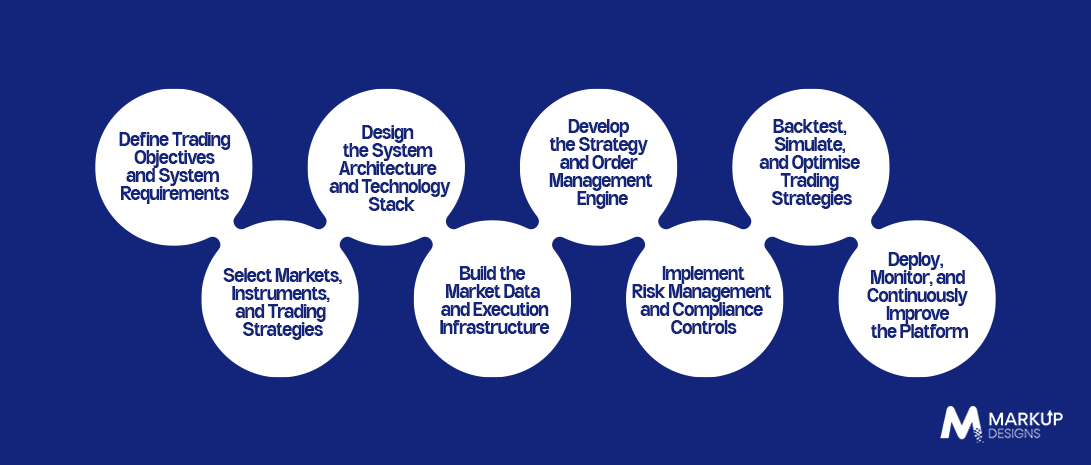
Developing HFT software requires careful planning across trading strategies, architecture, infrastructure, execution, and risk management. A structured development process helps ensure that performance requirements are defined and tested from the beginning.
Define Trading Objectives and System Requirements
Identify the target markets, instruments, trading strategies, expected order volumes, latency requirements, and operational needs. These requirements establish the technical and infrastructure priorities for the platform.
Select Markets, Instruments, and Trading Strategies
Different markets and instruments have different exchange protocols, data requirements, and execution conditions. Define the trading strategy and understand how it generates signals, places orders, and responds to changing market conditions.
Design the System Architecture and Technology Stack
Design the architecture around efficient market data processing, strategy execution, order management, and risk controls. Select programming languages, databases, networking technologies, and infrastructure based on measurable performance requirements.
A strong trading platform architecture should minimise unnecessary dependencies between latency-sensitive components while maintaining the reliability required for live trading.
Build the Market Data and Execution Infrastructure
Develop the market data pipeline and connect the platform to relevant exchanges or liquidity venues. This stage includes data normalisation, exchange integrations, order routing, and connectivity management.
Develop the Strategy and Order Management Engine
Build the strategy engine to generate trading signals and the order management system to create, track, modify, and cancel orders. Both components must handle execution events efficiently and accurately.
Implement Risk Management and Compliance Controls
Integrate position limits, order restrictions, exposure controls, and emergency mechanisms into the trading workflow. Add required audit trails, reporting, access controls, and compliance capabilities based on the target markets.
Backtest, Simulate, and Optimise Trading Strategies
Test strategies against historical data and simulated market conditions before live deployment. Evaluate execution behaviour, system performance, and risk controls under realistic workloads, then optimise based on measured results.
Deploy, Monitor, and Continuously Improve the Platform
Deploy the platform through controlled testing and pilot stages before production trading. Continuously monitor latency, system health, execution, and risk while updating the platform as strategies, infrastructure, and market conditions evolve.
High-Frequency Trading Software Architecture
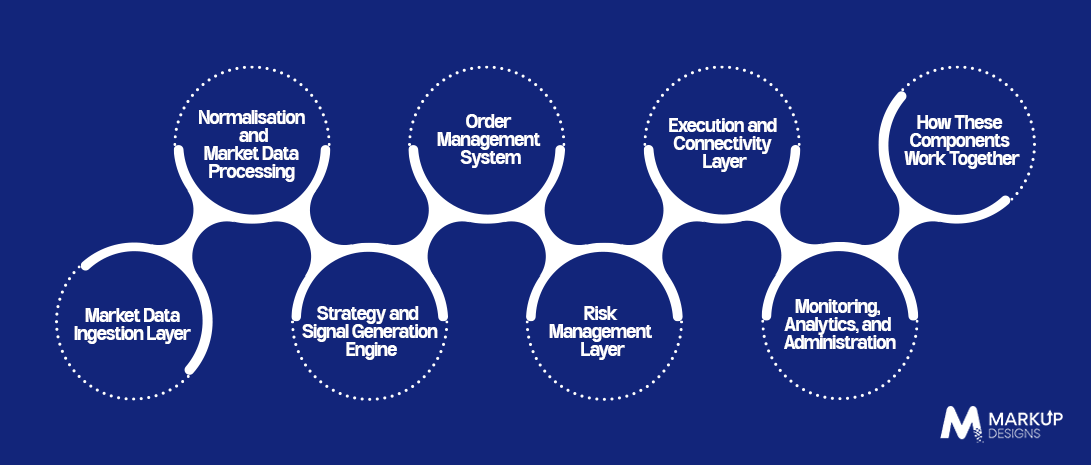
HFT architecture connects market data, trading strategies, risk controls, order management, and exchange connectivity into a low-latency execution pipeline. A well designed trading platform architecture gives every component a defined role while reducing unnecessary processing and communication delays.
Market Data Ingestion Layer
Receives real-time price, trade, and order book data from exchanges and market data providers. It must process high volumes of events without becoming a bottleneck.
Normalisation and Market Data Processing
Converts data from different venues into a consistent format for the trading engine. It can also handle validation, filtering, and order book reconstruction.
Strategy and Signal Generation Engine
Analyses processed market data and applies predefined trading strategies to generate signals. Keeping strategy logic modular makes it easier to test and update strategies without redesigning the entire platform.
Order Management System
Creates, tracks, modifies, and cancels orders while maintaining accurate execution status. It must also handle partial fills, rejections, and cancellations correctly.
Risk Management Layer
Applies real-time controls such as position, exposure, and order limits before trades are executed. It should be fast enough to support the execution path without compromising safety.
Execution and Connectivity Layer
Connects the platform to exchanges, brokers, and liquidity venues for order transmission and execution updates. Efficient protocols and reliable connectivity are critical to reducing execution delays.
Monitoring, Analytics, and Administration
Tracks latency, system health, execution activity, strategy performance, and risk conditions. Administrative tools can manage access, configurations, audit records, and operational reporting.
How These Components Work Together
The typical flow is market data → processing → strategy → risk checks → order execution → execution feedback. Designing this pipeline with minimal unnecessary dependencies helps the platform remain fast, predictable, and resilient.
Read Also: AI in Stock Trading: Enterprise Applications, Risks & Market Opportunities
Technology Stack for High-Frequency Trading Software
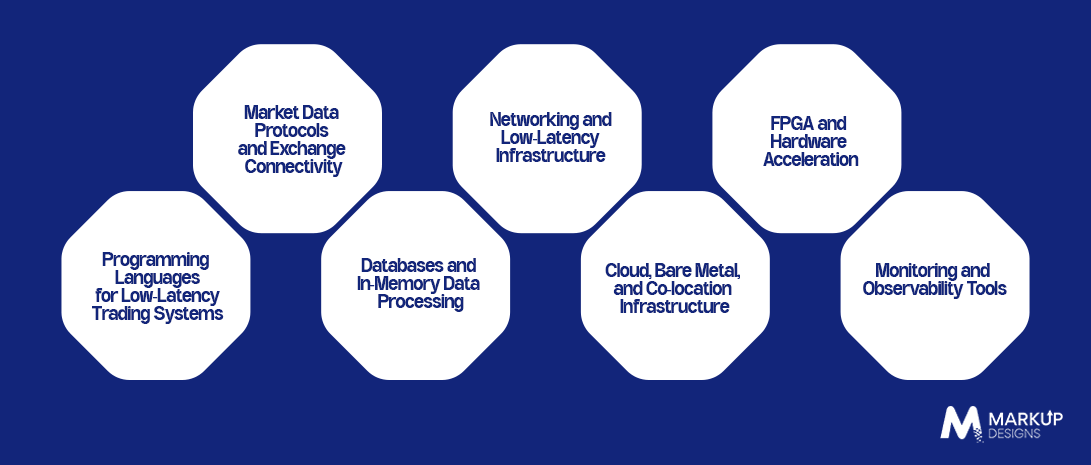
Select the HFT technology stack based on latency, throughput, trading strategy, exchange requirements, and infrastructure needs. There is no universal stack; performance requirements should determine the technology choices.
Programming Languages for Low-Latency Trading Systems
C++, Java, and Rust are common choices for performance-sensitive components. C++ provides fine-grained control over memory and execution, while Java and Rust can offer strong performance with different development and maintenance trade-offs.
Market Data Protocols and Exchange Connectivity
HFT platforms require efficient market data feeds and exchange-specific connectivity. The technology must support the required protocols while handling high volumes of updates and order responses reliably.
Databases and In-Memory Data Processing
Frequently accessed trading data can be maintained in memory for rapid processing, while databases can store historical data, trade records, configurations, and audit information. Keeping non-critical storage operations outside the execution path can help reduce unnecessary latency.
Networking and Low-Latency Infrastructure
High-performance network interfaces, optimised communication paths, and efficient network configurations can reduce delays between the trading system and exchange. Optimise network performance alongside the software, not independently.
Cloud, Bare Metal, and Co-location Infrastructure
Cloud offers flexibility and scalability, while bare metal provides greater control over hardware performance. Co-location can reduce network distance to exchanges and may be appropriate for strategies where extremely low latency is commercially important.
FPGA and Hardware Acceleration
FPGAs can accelerate specific latency-sensitive workloads through specialised hardware processing. They can deliver performance benefits but add development complexity and cost, so they should be used only where the requirements justify them.
Monitoring and Observability Tools
Monitoring tools track latency, throughput, system health, execution activity, and risk conditions. Strong observability helps teams identify performance bottlenecks and operational issues before they affect live trading.
Essential Features of High-Frequency Trading Software
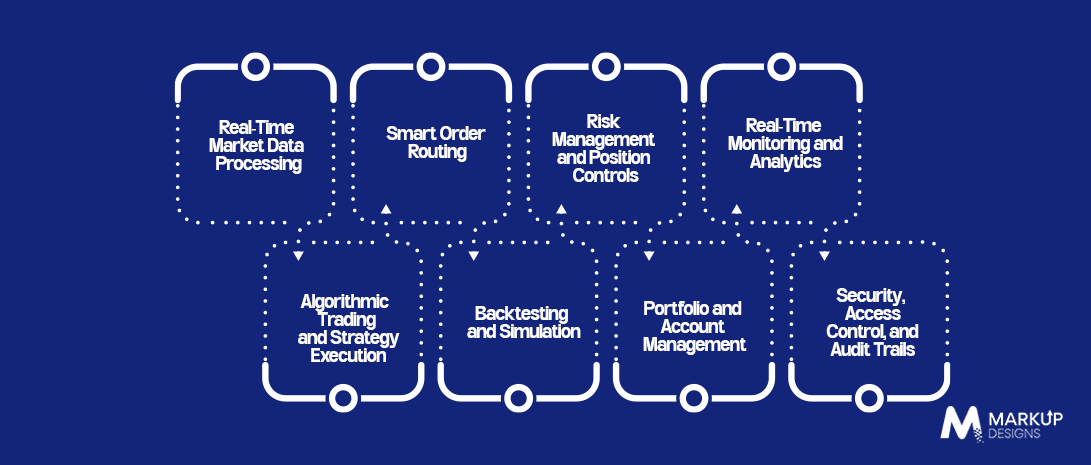
HFT software should include the core capabilities needed to process market data, execute strategies, manage risk, and monitor trading activity. Each feature should support speed, accuracy, and operational control.
Real-Time Market Data Processing
Processes price updates, trades, and order book changes as they arrive, enabling strategies to respond to current market conditions without unnecessary delays.
Algorithmic Trading and Strategy Execution
This is a core requirement in algorithmic trading software development, where automated decision logic needs to operate efficiently alongside execution and risk management components.
Smart Order Routing
Routes orders to suitable exchanges or liquidity venues based on factors such as price, liquidity, and execution conditions while keeping routing delays low.
Backtesting and Simulation
Tests strategies against historical data and simulated market conditions to evaluate performance, execution behaviour, and potential weaknesses before live deployment.
Risk Management and Position Controls
Applies limits on order sizes, positions, exposure, and trading activity. Emergency controls can also stop trading when predefined risk conditions are triggered.
Portfolio and Account Management
Tracks positions, balances, exposures, and trading activity to provide visibility into the current state of accounts and portfolios.
Real-Time Monitoring and Analytics
Monitors latency, execution, system health, market data, and risk conditions, helping teams identify issues and assess trading performance.
Security, Access Control, and Audit Trails
Protects trading systems through authentication, access controls, secure configurations, and audit records that support accountability and compliance.
Key Challenges in High-Frequency Trading Software Development
In the realm of HFT, some factors must also be taken into account. To achieve the ideal combination of fast execution, consistent and precise performance, risk control, and effective system security, a variety of obstacles can make such factors work together.
Reducing Latency Without Sacrificing Reliability
Latency must be lowered throughout the trading pipeline while still ensuring that the system is neither unstable nor difficult to operate. Real system benchmarks help assess the performance of the system.
Managing High Volumes of Market Data
An excessive number of market events causes delays and backlogs in execution. Proper data processing, memory management, and proper capacity planning can allow the system to perform effectively.
Maintaining Execution Accuracy and Determinism
The system has to ensure that orders are executed in compliance with the data provided. Proper handling of timing and concurrent execution is required.
Handling Market Volatility and Strategy Failure
Strategies may fail due to changing market conditions. Monitoring and risk limits are responsible for managing this process, and calculating the risks involved.
Preventing Overfitting and Strategy Decay
Well-performing strategies based on historical data may fail in case of a changing market environment. Out-of-sample testing and realistic simulation can help detect such instances.
Ensuring Security and Data Integrity
Unauthorised access, compromised systems, or inaccurate market data can create significant operational risks. Strong access controls, secure communications, validation, and monitoring are therefore essential.
Meeting Regulatory and Compliance Requirements
HFT platforms must account for applicable market and jurisdictional requirements, including reporting, record-keeping, audit trails, and access controls.
Managing Infrastructure Failures and Downtime
Network, hardware, software, or exchange connectivity failures can disrupt trading. Redundancy, recovery procedures, and real-time monitoring help maintain controlled operations.
Best Practices for Building a Reliable HFT Platform
A reliable HFT platform requires continuous performance optimization alongside strong engineering and risk controls. The following practices help maintain this balance.
Optimise the Entire Trading Pipeline
Measure latency from market data ingestion through to order execution and focus optimisation efforts on the actual bottlenecks.
Use Deterministic Processing and Precise Time Synchronisation
Consistent event processing and accurate time synchronisation improve execution analysis, latency measurement, and system predictability.
Separate Strategy Logic from Execution Infrastructure
Keeping trading strategies separate from exchange connectivity and execution components makes the platform easier to test, maintain, and evolve.
Build Fail-Safe Risk Controls
Use position limits, exposure controls, order restrictions, and emergency stops to prevent abnormal trading activity from escalating.
Test Under Realistic Market Conditions
Combine historical backtesting with simulations covering high event volumes, rapid price movements, rejected orders, partial fills, and connectivity failures.
Monitor Latency, Errors, and Trading Behaviour
Track technical and trading metrics in real time to identify performance issues, execution errors, abnormal behaviour, and risk conditions quickly.
Plan for Scalability and Infrastructure Resilience
Design the platform to handle increasing data and trading workloads while maintaining appropriate redundancy and recovery capabilities.
Read Also: How Much Does It Cost to Develop a Cryptocurrency Exchange App Like Coinbase
How Much Does It Cost to Develop High-Frequency Trading Software?
HFT software costs vary based on the trading strategy, number of exchanges, latency requirements, infrastructure, and compliance needs. A research platform will cost significantly less than a production system built for multi-venue, low-latency trading.
Factors That Influence HFT Development Costs
Key cost drivers include strategy complexity, exchange integrations, latency targets, risk controls, testing requirements, and the level of customisation required.
Infrastructure and Technology Costs
Costs may include servers, networking, market data feeds, exchange connectivity, hosting, monitoring, and specialised hardware. Co-location, bare metal infrastructure, and FPGA-based processing can increase costs where the strategy requires them.
Development, Testing, and Maintenance Costs
The budget should cover engineering, integrations, performance testing, deployment, optimisation, and ongoing maintenance. HFT systems also require continuous updates as strategies, exchanges, and infrastructure evolve.
Build vs Buy: Choosing the Right Approach
A custom platform offers greater control over trading logic, architecture, and performance. An existing solution may reduce initial development effort but can limit customisation and optimisation, making the choice dependent on the strategy and long-term requirements.
How Long Does It Take to Develop HFT Software?
Development time depends on the platform’s strategy, market coverage, exchange integrations, performance targets, and infrastructure. A prototype may take considerably less time than a production-ready multi-venue HFT system.
Discovery and Architecture Planning
Define the trading strategy, target markets, performance requirements, data sources, exchange connectivity, architecture, and risk controls.
Core Development and Integration
Build the market data pipeline, strategy engine, order management, risk controls, execution layer, and required exchange integrations.
Testing, Optimisation, and Pilot Deployment
Validate the system using historical data, simulation, and performance testing. Optimise measured bottlenecks before moving into a controlled pilot environment.
Production Launch and Continuous Improvement
Deploy gradually with monitoring, risk controls, and recovery processes in place. Continue optimising the platform as trading strategies, exchanges, and market conditions change.
Why Choose Markup Designs as Your HFT Software Development Partner?
HFT software requires a combination of financial technology expertise, low-latency engineering, secure architecture, and reliable infrastructure. Markup Designs brings these capabilities together to support the development of performance-focused trading platforms.
Expertise in Low-Latency Systems and Financial Technology
Develop performance-focused HFT systems for market data processing, automated trading, order management, risk controls, and exchange connectivity, based on specific latency and throughput requirements.
Secure Architecture and Regulatory-Aware Development
Build security and compliance into the platform through access controls, authentication, audit trails, data protection, and risk management aligned with the project’s requirements.
End-to-End Development and Infrastructure Support
Support the complete development journey from architecture and development to integration, testing, deployment, and ongoing optimisation, providing a single technical team for the platform.
Experienced Software Development Team
Work with experienced developers who can support performance-sensitive financial applications across software architecture, backend development, integrations, infrastructure, and testing. Businesses can also hire software developers with the technical capabilities required for specific HFT development needs.
Build an HFT Platform Engineered for Speed, Control, and Reliability
From low-latency architecture and market data processing to automated execution and risk management, build a high-frequency trading platform around your actual trading requirements.

Conclusion
High-frequency trading software development is fundamentally an engineering challenge where milliseconds, microseconds, system reliability, and execution accuracy can all influence outcomes. A successful platform needs more than algorithmic strategies. It requires efficient market data processing, carefully designed architecture, reliable exchange connectivity, integrated risk controls, and infrastructure capable of supporting the required performance.
The right development approach is therefore to design the entire trading pipeline around measurable requirements rather than chasing speed through isolated technology choices. With the right architecture, testing strategy, infrastructure, and continuous optimisation, businesses can build HFT software that is capable of supporting demanding automated trading operations while maintaining the control and reliability required for live markets.
FAQs
1. What is high-frequency trading software?
High-frequency trading software is specialised trading technology designed to process market data and execute automated trading strategies at very high speeds. It combines market data processing, strategy execution, order management, risk controls, and exchange connectivity.
2. What technology is used to develop HFT software?
HFT systems may use technologies such as C++, Java, Rust, high-performance networking, in-memory processing, specialised market data protocols, bare-metal infrastructure, co-location, and FPGA acceleration. The appropriate stack depends on the strategy and required performance rather than a single standard technology.
3. How much does it cost to develop high-frequency trading software?
There is no fixed development cost because the budget depends on factors such as strategy complexity, exchange integrations, performance requirements, infrastructure, security, testing, and ongoing maintenance. A custom production-grade HFT platform will generally require substantially more engineering and infrastructure investment than a basic trading prototype.
4. How long does it take to develop HFT software?
The timeline depends on the platform’s scope and performance requirements. Discovery and architecture planning, core development, exchange integration, testing, optimisation, pilot deployment, and production rollout should be treated as separate stages rather than assuming a single fixed development period.
5. What is the difference between algorithmic trading and HFT?
Algorithmic trading uses software to automate trading decisions and order execution, while high-frequency trading is a specialised form of algorithmic trading that places significant emphasis on extremely fast processing, high order volumes, low latency, and highly optimised execution infrastructure. Not every algorithmic trading system qualifies as HFT.
Author's Perspective
High-frequency trading is often presented as a race for speed, but speed alone does not make an HFT platform successful. The real engineering challenge is creating a system where market data, trading logic, execution, risk management, and infrastructure work together predictably under pressure. Businesses considering HFT development should therefore focus less on adopting the latest technology and more on defining measurable performance requirements, validating them through realistic testing, and building an architecture that can evolve as strategies and markets change.
Discuss Your Project NowAjit Kumar Jha
VP - Business Operations
Related Posts

How to Build an Insurance Portal with CRM,...

Custom Software Development Services in Abu Dhabi for...

Custom Software Development Cost in Bahrain: Factors, Benefits,...
Insights Are Valuable & Execution is Priceless
You’ve read about the digital future. Now, let’s build the infrastructure to take you there. Move your strategy from the page to the product.
Design Your Solution Now
Contact Us
Schedule The Appointment At Your Convenience Date And Time.
30 Min
Web Conference
Time Zone
Indian standard time (08:30pm)

Thanks For Getting In Touch!
You’ve Taken The First Step Toward Transforming Your Digital Presence. Our Experts Will Reach Out Shortly To Take It Forward.
Launch Your Dream Project
Provide a brief overview of your project, and our specialists will evaluate your requirements. We will connect with you to explore how the right digital solutions can help you launch faster.