

In Brief
- Software risk management allows companies to analyze, evaluate, prioritize, and handle potential issues that might influence the software costs, schedules, security, quality, performance, and stability in the future.
- Among the most common risks during software development are technical and architectural risks, cost overruns, scope changes, cybersecurity risks, third-party dependency risks, compliance risks, and human risks.
- Proactive software risk management is all about identifying risks, analyzing them, assigning owners to them, developing plans to mitigate and handle them, and constantly monitoring those risks throughout the entire software development process.
- Frameworks such as ISO 31000, NIST Risk Management Framework, COSO ERM, ISO/IEC 27001, OWASP, and DevSecOps can be used to develop a structured approach to managing risks that are related to technology, security, and the whole enterprise.
- However, good software risk management is going to require a considerable investment of money ($30,000 to $400,000+ for enterprise projects), but proactive planning may allow companies to save more money.
The process of developing software may seem easy when the planning phase is considered, but different complications can arise during the process of development itself. Changes in requirements, security, technical limitations, budgetary concerns, integration problems, and unforeseen delays are some of the things that could hinder the success of a project. In case these risks are not recognized earlier, they might cause the projects to be more expensive, delayed, of low quality, and result in unsatisfied users.
This is where the role of risk management in software development plays its part. Risk management enables the software development team to recognize possible risks and know how these risks can affect the project and what actions are needed before these risks become real problems.
In this blog post, we will learn about software risk management, its importance, the risks associated with it, and how companies can identify and manage those risks. We will cover the various risk management approaches, costs, plans, and checklists that could assist organizations in developing more secure software applications.
What is Software Risk Management?
Software risk management involves the identification, assessment, and management of any risk that could have an adverse impact on the software development process. Risk could emerge at any point within the development lifecycle – during the planning phase, design, development, testing, implementation, and maintenance phases.
It does not seek to mitigate all risk but aims at identifying the type of risk, its probability of occurrence, and the magnitude of its impact. With such information, the team will be able to develop proper strategies for handling the risk.
For example, the development team might consider an external API dependency as a risk. In case the API goes down unexpectedly, it will impact the functionality of critical components of the application. Thus, being aware of such a risk, the team will be able to prepare for another way out or develop a contingency plan.
Therefore, good risk management practices for software development are always ongoing activities that help organizations increase project predictability, software quality, security, and stability.
Why is Software Risk Management Important?
A software project includes various elements, such as people, technology, deadlines, budget, integration, and business needs. Even a minor issue in any of these areas can influence the whole process. Software risk management enables teams to notice potential issues and react to them in advance so that they do not become costly and uncontrollable.
An advanced approach will allow organizations to minimize delays in project implementation, save time on extra work, and keep development expenses lower. Software risk management is also helpful in improving the quality of software, as it allows to notice technical and security issues in advance. Such an aspect is even more critical when it comes to enterprise-level software.
Risk management also helps in improving the decision-making process. Teams become aware of the possible risks as well as the consequences that may occur because of them and then allocate the available resources accordingly as well as make contingency plans.
Common Types of Software Development Risks
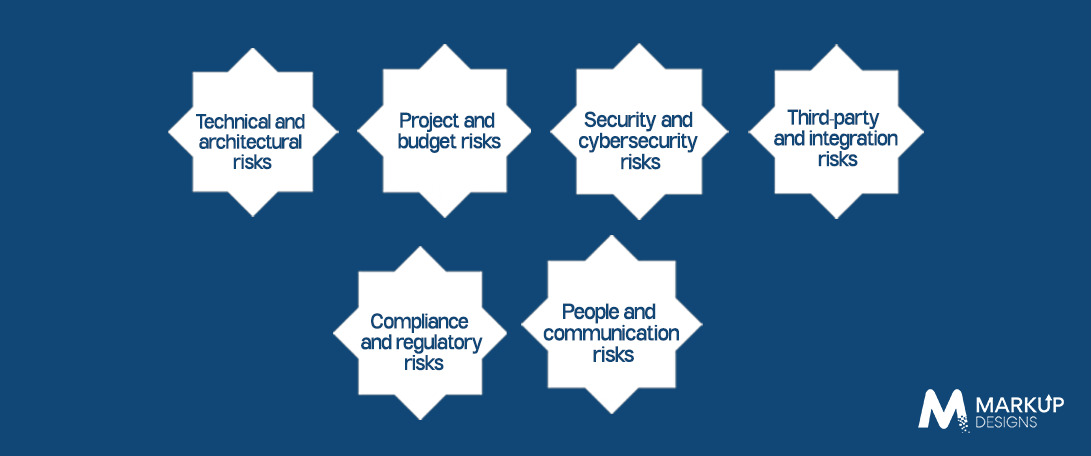
Software development risks can come from different areas of a project. Understanding these risks helps teams prepare suitable strategies to reduce their impact.
- Technical and architectural risks: Outdated architecture and technologies, technical debt, scalability, and performance problems may impact the reliability of the software.
- Project and budget risks: Unrealistic project timelines, wrong estimation, changes in requirements, scope changes, and resource limitations may lead to project delays and cost overruns.
- Security and cybersecurity risks: Weaknesses, poor authentication, API security issues, data breaches, and security vulnerabilities may harm the applications and users.
- Third-party and integration risks: Relying on external APIs, vendors, cloud services, or other systems might lead to availability and compatibility issues.
- Compliance and regulatory risks: Being unable to comply with certain standards and regulations regarding security, privacy, and other issues may bring negative consequences.
- People and communication risks: Skills shortage, employee turnover, knowledge hoarding, unclear roles, and inefficient communication may influence the outcome of development.
How to Identify Risks in Software Development
The early identification of risks gives enough time for the software team to prepare. The risk identification process needs to start from the planning and discovery phase and continue until development. Risk identification can be done by considering the project requirements, business objectives, timelines, technical architecture, and resources that are available.
It is also necessary to assess risks associated with third-party services, APIs, cloud environments, open-source libraries, and other outside dependencies. Security and compliance considerations must be evaluated alongside, particularly for applications that work with sensitive or regulated information. Risks may be discovered using project workshops, technical assessments, past project experience, checklists, and meetings with stakeholders.
After identifying risks, they must be logged in a centralized risk registry with information on their possible consequences, likelihood, owner, and mitigation plan. Periodic assessment is necessary because new risks may emerge due to changing requirements, technologies, or progress in development. In this way, risk assessment becomes an ongoing part of the software development life cycle rather than a one-off task.
Ready to Reduce Software Development Risks?
Build software with a proactive approach to security, quality, scalability, and project management. Partner with an experienced software development team to identify risks early and keep your project on track.

Software Risk Management Frameworks and Standards
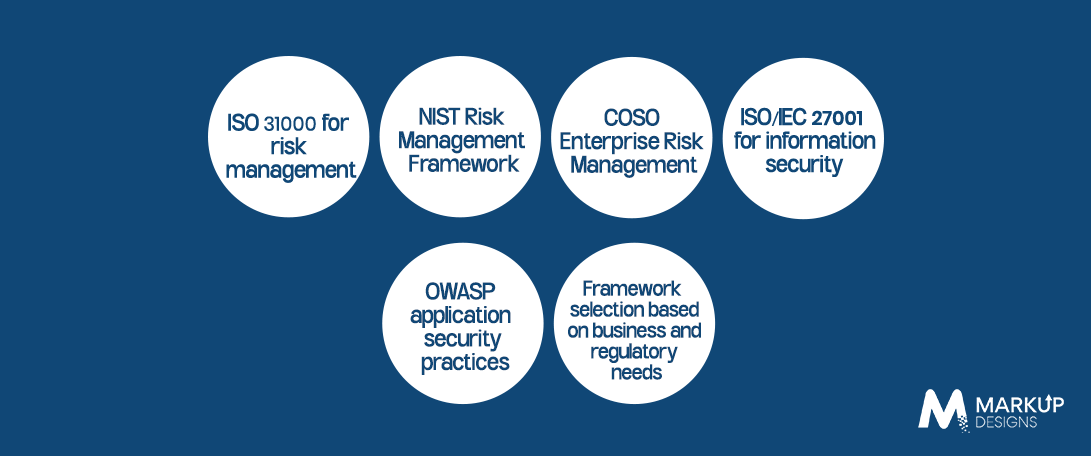
Organizations can employ proven risk management standards and frameworks to develop a systematic process for the identification, evaluation, and mitigation of software risks. A number of commonly used frameworks are:
Imanaging00 for risk management
Offers general guidelines on organizational risk management.
NIST Risk Management Framework
Assists organizations in identifying, evaluating, and manage risks.
COSO Enterprise Risk Management
Facilitates enterprise-wide risk identification, evaluation, and response.
ISO/IEC 27001 for information security
Deals with the information security management system and the security of sensitive business data.
OWASP application security practices
Offer guidelines to help identify and mitigate application security threats.
Framework selection based on business and regulatory needs
Organizations need to select frameworks based on industry, software environment, security requirements, and regulations.
How Much Does Software Risk Management Cost?
The cost involved in software risk management is highly variable and depends on the size and complexity of the particular project. It cannot be estimated in advance due to the fact that, for example, a small project with minimal integration will have a completely different set of risk management measures compared to a large enterprise solution.
In the case of enterprise software projects, the cost of software risk management can typically be between $30,000 and $400,000+. The final cost will depend on several criteriuch as risk assessment scope, security and compliance criteria, duration of the project, technology stack, etc.
The cost will also go up if there is an involvement of any legacy system, more than one vendor, cloud-based systems, or if there are strict regulatory requirements. There may also be a requirement for businesses to purchase security scanning and testing software, among others.
Even though risk management will raise the budget costs for a project, proper planning can actually help mitigate higher costs from any security incident, rework, and emergency solutions that result from this. A software be wise to think of risk management as an investment towards the sustainability of your project.
How to Build a Software Risk Management Plan
Software risk management plan provides a structured approach to dealing with possible risks during software development. This plan needs to be developed and updated regularly as the project evolves. The following steps are part of a realistic software risk management plan:
- Establish risk management objectives: Define risk tolerance, business needs, security requirements, and other criteria.
- Assess possible risks: Analyze technological, financial, security, operational, integration, and other risks.
- Evaluate probability and impact: Identify the probability and impact of each risk on the project.
- Prioritize the risks: Prioritize resources toward risks that are highly impactful and have a high probability.
- Appoint risk owners: Appoint a member for each of the risks to monitor and manage them.
- Develop response strategies: Plan your approach to each risk in terms of avoidance, mitigation, transfer, or acceptance.
- Continual monitoring: Continuously monitor the risk register and look for new risks during development.
- Communication of risks: Communicate risks to the developers, managers, stakeholders, and any other relevant teams.
Software Risk Management Checklist
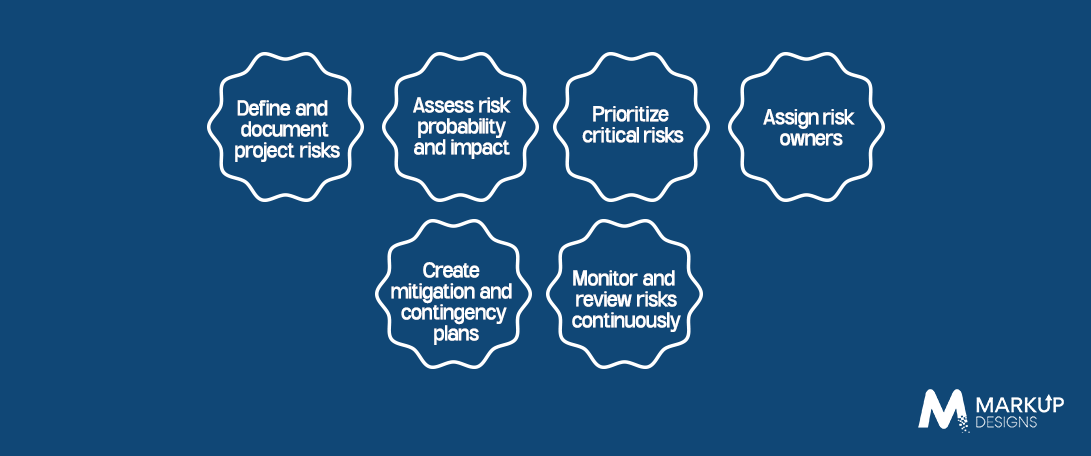
A clearly defined risk management checklist will help ensure that development teams are always ready and don’t forget any risks at any time. Companies may use the following steps in their risk management process:
1. Define and document project risks
Document risks associated with technology, security, finances, operations, compliance, and resources from the onset.
2. Assess risk probability and impact
Assess the likelihood of occurrence of each risk as well as its level of severity.
3. Prioritize critical risks
Pay more attention to those risks that have a higher level of impact on the project delivery and business operations.
4. Assign risk owners
Assign a specific risk to each team member for them to monitor and control it.
5. Create mitigation and contingency plans
Identify and document measures that need to be taken for each risk and contingency measures in case the risk occurs.
6. Monitor and review risks continuously
Keep on updating the risk register while assessing the risks that exist in the software project.
Through the use of this checklist, risk management becomes a consistent aspect of software development rather than something that is handled once issues arise.
What Happens When Software Risks Are Not Managed?
Neglecting software risks could result in difficulties that will become costlier and harder to resolve in the course of development. An IT problem that could have been handled in the initial stages of the process can take much reworking once it is deployed. Security risks that are not identified in time can leave sensitive information exposed and customers distrustful.
Other outcomes of inadequate risk management include delayed projects, overrun budgets, changed scope, and poor-quality software. When project team members lack contingency plans for potential issues, developers end up spending more time resolving emergencies rather than concentrating on their intended tasks.
Unmanaged risks could also lead to the accumulation of technical debt. Obsolete components, poor architecture, lack of documentation, and rapid development could all make updates even harder and more expensive in the future. For companies in regulated industries, not managing compliance risks could also bring more problems in terms of liability and money.
By managing risks at an early stage, organizations could mitigate such risks. By doing so, companies will be able to react to risks proactively instead of reacting to their impact.
Reduce Software Risks Before They Become Business Problems
From technical vulnerabilities to compliance and third-party risks, proactive risk management can help keep your software project secure, stable, and on track.

Conclusion
Software development risks are an integral part of the development of today’s applications. However, what is important is that companies know when to spot and control such risks. Risks related to technical and security aspects, budgets, compliance, integration, and others may influence software development projects if not managed correctly.
The application of software risk management allows developers to recognize existing risks, evaluate their importance, delegate responsibility, and plan responses. According to the current blog article, risk management must be applied throughout the entire process of software development. Through the right planning, software security measures, monitoring, and communication, businesses can minimize uncertainty, keep expenses under control, increase software quality, and develop reliable applications.
FAQs
1. What is software risk management?
Software risk management is the process of identifying, assessing, prioritizing, and managing potential risks that could affect a software project’s cost, timeline, security, quality, or performance.
2. What are the most common software development risks?
Common risks include technical and architectural issues, security vulnerabilities, budget and timeline problems, scope creep, third-party dependencies, compliance challenges, and resource or communication issues.
3. How do you identify risks in software development?
Teams can identify risks by reviewing project requirements, architecture, technology choices, dependencies, security requirements, resources, and previous project experience. Regular reviews should continue throughout development.
4. What are the main software risk response strategies?
The four common strategies are risk avoidance, risk mitigation, risk transfer, and risk acceptance. Teams choose a strategy based on the probability, impact, and nature of each risk.
5. How does DevSecOps help with software risk management?
DevSecOps integrates security into the development lifecycle. Practices such as automated security testing, dependency scanning, code analysis, and continuous monitoring can help teams identify and address risks earlier.
Author's Perspective
Software risk management is not about predicting every problem. It is about helping teams prepare for challenges before they become serious. Early risk identification supports better planning, stronger security, informed decisions, and smoother development. As businesses increasingly rely on cloud platforms, APIs, AI, and third-party services, managing risks becomes even more important. A simple, continuous, and business-focused approach can reduce costs, improve reliability, and build greater confidence in software projects.
Discuss Your Project NowJupinder Singh Arora
Founder and CEO
Related Posts

How to Build an Insurance Portal with CRM,...

Custom Software Development Services in Abu Dhabi for...

Custom Software Development Cost in Bahrain: Factors, Benefits,...
Insights Are Valuable & Execution is Priceless
You’ve read about the digital future. Now, let’s build the infrastructure to take you there. Move your strategy from the page to the product.
Design Your Solution Now
Contact Us
Schedule The Appointment At Your Convenience Date And Time.
30 Min
Web Conference
Time Zone
Indian standard time (08:30pm)

Thanks For Getting In Touch!
You’ve Taken The First Step Toward Transforming Your Digital Presence. Our Experts Will Reach Out Shortly To Take It Forward.
Launch Your Dream Project
Provide a brief overview of your project, and our specialists will evaluate your requirements. We will connect with you to explore how the right digital solutions can help you launch faster.