

In Brief
- Define your project requirements before approaching development companies
- Evaluate technical expertise, industry experience, and relevant portfolios
- Look beyond pricing and assess the actual value included in the engagement
- Verify communication, development processes, security, and post-launch support
- Choose a Dubai software development partner that can scale with your business
Choosing a software development company in Dubai is not simply about finding a team that can build an application or website. The right technology partner can influence your product’s performance, security, scalability, time to market, and long-term business value. With Dubai’s rapidly evolving digital ecosystem, businesses have access to development companies ranging from specialised technology firms to large full-service providers, making the selection process more competitive but also more complicated.
The challenge is knowing which company can actually deliver what your business needs rather than simply presenting an impressive portfolio or attractive price. From evaluating technical capabilities and development methodologies to understanding communication practices, security standards, costs, and post-launch support, several factors should influence your decision. This guide breaks down the key considerations to help you compare software development companies in Dubai and select a partner that aligns with your objectives, budget, and future growth.
Why Choosing the Right Software Development Company in Dubai Matters

The software development partner you choose can directly affect your project’s cost, timeline, and eventual performance. A company that lacks the right expertise or follows an unclear development process can lead to missed deadlines, unexpected expenses, security issues, and software that fails to meet user expectations. Fixing these problems after development has already progressed can be far more expensive than evaluating potential partners carefully at the beginning.
Technical skills alone, however, do not guarantee a successful project. Your development partner should understand what you are trying to achieve, who will use the software and how it fits into your wider business strategy. The right company combines technical capability with business understanding, structured project management, and ongoing support, helping you build software that can adapt as your users, operations, and business requirements grow
10 Factors to Consider Before Hiring a Software Development Company in Dubai
Choosing the software development company in Dubai requires more than comparing portfolios and quotations. You need to evaluate how well a potential partner understands your requirements, approaches development, manages risks, and supports the product after launch. The following factors can help you make a more informed decision.
1. Understand Your Business Requirements Before Shortlisting Companies
Start by defining the problem your software needs to solve and the users it needs to serve. Identify the essential features, expected outcomes, budget, and preferred timeline before approaching development companies. Clear requirements give potential partners a better understanding of the project and allow them to provide more accurate proposals, estimates and recommendations.
2. Evaluate Their Industry Experience and Business Understanding
Relevant industry experience can make a significant difference when developing business software. Look for a company that understands the operational challenges, customer expectations, and compliance considerations associated with your industry. A developer may have extensive experience building software, but that does not necessarily mean they understand your specific business environment. Relevant expertise can reduce unnecessary development work and help create more practical solutions.
3. Review Real Projects, Not Just Their Portfolio
A portfolio can show what a company has built, but it does not always reveal how successfully those solutions addressed business requirements. Review projects that are comparable to yours and, where possible, look for case studies, client testimonials, and measurable outcomes. Pay attention to whether their previous work demonstrates the technical capabilities, usability, and complexity your project requires.
4. Check Their Technical Expertise and Technology Stack
Evaluate whether the company has experience with the technologies your project requires, including frontend and backend development, databases, cloud infrastructure, and third-party integrations. A capable partner should also be able to recommend suitable technologies based on your requirements rather than simply using whatever is currently popular. The right technology is the one that supports your project’s performance, security, scalability, and long-term maintenance needs.
5. Understand Their Software Development Process
Ask how the company handles discovery, planning, design, development, and testing. You should also understand how requirements are documented, how approvals are managed, and how feedback or scope changes are handled. A clearly defined process creates accountability and reduces the risk of misunderstandings, delays, and unnecessary rework during development.
6. Assess the Team That Will Actually Work on Your Project
Do not evaluate only the company. Find out who will actually be working on your software. Ask about the software developers, designers, testers, and project managers assigned to the project and whether they have experience with similar solutions. It is also important to understand who will be responsible for communication and how issues can be escalated when necessary.
7. Evaluate Their Communication and Project Management
Regular and transparent communication is part of successful software delivery. Clarify how frequently you will receive progress updates, who your primary point of contact will be, and how the team communicates project risks or delays. A development partner that identifies problems early and communicates them clearly is far easier to work with than one that only raises issues when deadlines are already affected.
8. Review Their Approach to Security, Testing, and Quality Assurance
Security and testing should be incorporated throughout development rather than left until the final stage. Ask how the company tests functionality, performance, and security, and how it handles data protection and access controls. A structured quality assurance process helps identify problems earlier and reduces the risk of launching unreliable or vulnerable software.
9. Clarify Source Code Ownership and Intellectual Property Rights
Before development begins, establish who owns the source code, documentation, designs, and other project deliverables. Review the contract carefully to understand your rights and confirm whether you will receive access to repositories and relevant project assets. Resolving ownership terms at the beginning prevents disputes later and gives your business greater control over the software.
10. Compare Pricing, Support, and Long-Term Value
Do not choose a software development company solely because it provides the lowest quotation. Compare what each proposal actually includes, including development scope, testing, deployment, maintenance, and post-launch support. A lower initial price may become considerably more expensive if essential services are excluded or the software requires extensive fixes later. The better comparison is what value you receive for the total cost of building and maintaining the software.
What Questions Should You Ask Before Signing a Contract?
Before signing an agreement, make sure there is no ambiguity around cost, scope, timelines, ownership or ongoing support. Asking the right questions at this stage can prevent expensive disagreements once development begins.
What Is Included in the Project Cost?
Ask for a clear breakdown of what the quoted price covers, including design, development, testing, deployment, integrations and any third-party services. This helps you distinguish between the actual project cost and expenses that may be added later.
How Will Changes to the Scope Be Managed?
Software requirements can evolve during development. Confirm how change requests will be assessed, approved, and priced, and whether changes can affect the agreed timeline.
What Happens If the Project Is Delayed?
Understand how delays are handled and who is responsible when they occur. The contract should establish how timeline changes, dependencies and unresolved issues will be communicated and managed.
Who Owns the Source Code and Final Deliverables?
Confirm that the agreement clearly defines ownership of the source code, designs, documentation and other deliverables. Also clarify when ownership is transferred and whether you will receive access to the project’s repositories and assets.
What Support Is Available After Launch?
Find out what happens once the software goes live. Ask whether maintenance, bug fixes, security updates, performance monitoring and future enhancements are included or offered separately.
How Will Project Progress Be Reported?
Ask how frequently you will receive updates and what they will contain. Regular reporting should give you visibility into completed work, upcoming milestones, issues, risks and any decisions requiring your input.
How Much Does It Cost to Hire a Software Development Company in Dubai?
There is no meaningful single price for software development in Dubai because the cost depends heavily on what you are building. A relatively simple application with limited functionality will require considerably less development effort than an enterprise platform involving multiple user roles, complex workflows, integrations and cloud infrastructure.
Several factors influence the final cost, including project complexity, number of features, UI/UX requirements, technology stack, integrations, security requirements, development team size, testing, and ongoing maintenance. Your proposal should therefore reflect the actual scope rather than a generic market estimate.
When requesting quotations, look for a detailed breakdown of deliverables, development phases, estimated timelines, payment terms, testing, deployment, and post-launch support. Comparing proposals on the final number alone can be misleading if one provider has excluded services that another has included. A detailed proposal gives you a much more realistic basis for comparing the total cost and value of each development partner.
Local vs Offshore Software Development Companies: Which Is Better?

The choice between a local and offshore development team should depend on your project’s requirements rather than location alone. Both models can work well, but they offer different advantages in communication, expertise, cost and collaboration.
Advantages of Working With a Local Software Development Company
A local partner can make communication and collaboration easier, particularly when frequent discussions, workshops or face-to-face meetings are important. They may also have a stronger understanding of the local business environment, customer expectations and market requirements.
When an Offshore Development Partner May Be a Better Fit
Offshore companies can provide access to specialised technical talent and flexible development teams. They may also offer cost advantages depending on their location, team structure and engagement model, making them suitable for businesses looking to scale development resources efficiently.
What Matters More Than Location?
Location should not outweigh the fundamentals of a successful development partnership. Evaluate relevant experience, technical capability, communication, contractual clarity, ownership terms, delivery reliability and post-launch support before making the decision. A nearby company is not automatically better, just as an offshore company is not automatically cheaper or less capable.
Red Flags to Watch Out for When Choosing a Software Development Company
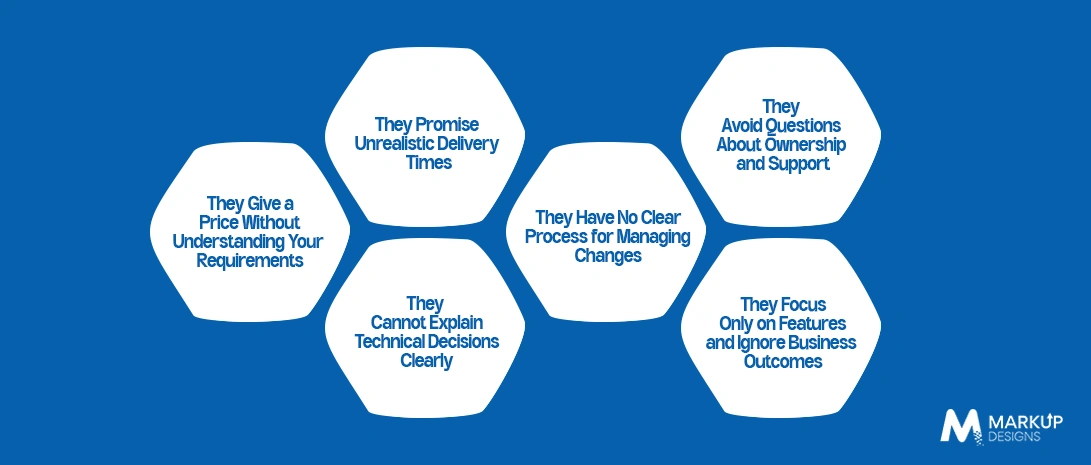
A development company’s sales presentation can look impressive, but certain warning signs should make you investigate further before signing an agreement.
They Give a Price Without Understanding Your Requirements
A company that provides a firm quotation without properly discussing your objectives, features and technical requirements may be relying on assumptions. That can lead to inaccurate estimates and additional costs later.
They Promise Unrealistic Delivery Times
Extremely short timelines may sound attractive, but software development involves planning, development, testing and revisions. If a company promises delivery without explaining how the timeline will be achieved, treat it cautiously.
They Cannot Explain Technical Decisions Clearly
You do not need to be a developer, but your development partner should be able to explain why particular technologies or architectures are appropriate for your project in clear business terms.
They Have No Clear Process for Managing Changes
If the company cannot explain how new requirements, revisions and scope changes will be handled, disagreements over cost and deadlines can become difficult to avoid.
They Avoid Questions About Ownership and Support
Unclear answers about source code ownership, documentation, maintenance or post launch support are a serious warning sign. These terms should be established before development begins.
They Focus Only on Features and Ignore Business Outcomes
A good development partner should understand why you are building the software, not just what features you want. If discussions focus entirely on functionality without considering users, business objectives or scalability, the solution may not deliver the expected value.
How to Compare Two Software Development Companies in Dubai
When two companies appear suitable, avoid making the decision based on price or presentation alone. Evaluate both against the same criteria and identify where each provider offers genuine advantages.
| Evaluation Factor | Company A | Company B |
| Relevant experience | ||
| Technical expertise | ||
| Development process | ||
| Communication | ||
| Project cost | ||
| Timeline | ||
| Support and maintenance | ||
| Source code ownership |
Compare their experience with similar projects, proposed technology and architecture, development methodology, team structure and communication process. Then assess the commercial terms, including cost, payment structure, timeline, ownership and post-launch support.
The best choice is not necessarily the company with the lowest quotation. It is the one that provides the strongest combination of technical capability, relevant experience, transparent processes, reliable delivery and long-term value for your specific requirements.
How Markup Designs Can Help With Software Development in Dubai
Choosing a development partner is ultimately about finding a team that can understand your business requirements and turn them into a reliable, scalable digital solution. At Markup Designs, our approach covers the complete development lifecycle, from defining the right technology strategy to building, testing, and supporting the final product.
Our software development capabilities include:
- Business and technology consulting
- Custom software development
- Web and mobile application development
- UI/UX design
- API and third party integrations
- Cloud and backend development
- Testing and quality assurance
- Software maintenance and scaling
Have a Software Idea in Mind?
Turn your business requirements into a secure, scalable and reliable software solution with the right technology approach from the start.

Final Thoughts
Choosing a software development company in Dubai should go beyond comparing quotations or counting the number of projects in a portfolio. The right partner is one that understands your business, communicates clearly, follows a structured development process and can deliver software that remains reliable as your requirements evolve.
Before making a decision, compare potential partners across relevant experience, technical capability, development process, communication, ownership, pricing, and post-launch support. A company that fits your business objectives and can support the product beyond its initial launch is likely to deliver far greater value than one selected purely because it offers the lowest price.
FAQ’s
1. How do I choose the best software development company in Dubai?
Start by defining your requirements and then compare companies based on relevant experience, technical expertise, development methodology, communication, pricing, ownership terms and post-launch support. The best company is the one that aligns with your specific business and technical needs.
2. What should I look for in a software development company?
Look for proven experience with similar projects, a capable technical team, transparent processes, clear communication, strong security and testing practices, well-defined ownership terms and reliable post-launch support.
3. How much does it cost to hire a software development company in Dubai?
The cost depends on factors such as project complexity, features, technology stack, integrations, design requirements, team size, testing and ongoing support. Request a detailed proposal based on your actual requirements rather than relying on a generic estimate.
4. How long does a software development project take?
Timelines vary according to the project’s scope and complexity. A simple application may take considerably less time than a feature-rich enterprise platform. The development company should provide a timeline based on clearly defined requirements and milestones.
5. Should I choose a local or offshore software development company?
Both can be suitable. Local companies may offer easier collaboration and stronger familiarity with the local business environment, while offshore teams can provide specialised expertise and flexible development models. Evaluate capability, communication, reliability and value rather than choosing based on location alone.
6. What should be included in a software development proposal?
A proposal should clearly outline the project scope, features, technology approach, deliverables, development phases, estimated timeline, cost, payment terms, testing, deployment, ownership and post-launch support.
Author's Perspective
Choosing a software development company is ultimately a business decision, not just a technical one. A developer can build exactly what you ask for and still deliver the wrong solution if they do not understand the problem behind it. Look beyond the quotation and portfolio. Evaluate how well a potential partner understands your objectives, challenges your assumptions when necessary, communicates throughout the project and takes responsibility for the product after launch. That is where the difference between a development vendor and a genuine technology partner becomes clear.
Discuss Your Project NowAjit Kumar Jha
VP - Business Operations
Related Posts

Custom Software Development Services in Abu Dhabi for...

Custom Software Development Cost in Bahrain: Factors, Benefits,...

How Much Does Healthcare Software Development Cost in...
Insights Are Valuable & Execution is Priceless
You’ve read about the digital future. Now, let’s build the infrastructure to take you there. Move your strategy from the page to the product.
Design Your Solution Now
Contact Us
Schedule The Appointment At Your Convenience Date And Time.
30 Min
Web Conference
Time Zone
Indian standard time (08:30pm)

Thanks For Getting In Touch!
You’ve Taken The First Step Toward Transforming Your Digital Presence. Our Experts Will Reach Out Shortly To Take It Forward.
Launch Your Dream Project
Provide a brief overview of your project, and our specialists will evaluate your requirements. We will connect with you to explore how the right digital solutions can help you launch faster.