
In Brief
- Compliance criteria for HealthTech applications in the UK vary by objective, risk level, and use of patient data.
- Applications in medicine may fall under MHRA guidelines on medical devices, as they may need to undergo relevant conformity assessments.
- HealthTech solutions intended to be used in the NHS may also necessitate compliance with standards regulating clinical safety, protecting data, providing technological assurance and interoperability.
- UK GDPR compliance is crucial when it comes to collecting, processing and storing sensitive health and personal data.
- Compliance should be taken into consideration from the stage of development of the HealthTech app, from its planning and architecture stage to testing, launching, and monitoring after it is on the market.
The UK HealthTech sector is bringing many opportunities to businesses related to apps for patient care, remote monitoring and healthcare management, and medical care decision-making. However, the process of creating a successful HealthTech application is not only about the user-friendly interface and integration of the latest technologies that are introduced in the field nowadays.
Depending on its functionality, the application may need to satisfy requirements related to MHRA regulations, NHS standards, clinical safety, UK GDPR, cybersecurity and medical device compliance.
For this reason, compliance must be considered from the earliest stages of HealthTech app development. Leaving regulatory requirements until the product is ready for launch can result in costly redesigns, delayed market entry and avoidable legal or safety risks. This guide explains how to build a compliant HealthTech app in the UK, covering the key NHS and MHRA requirements businesses need to address throughout the development lifecycle.
Understanding the UK HealthTech Compliance Landscape
Creating a HealthTech application in England requires complying with regulations enacted to ensure the safety of patients, physicians, and confidential health records of individuals. The specific requirements may differ based on the nature of the app, the kind of data that it works with, the target users, and whether it qualifies as a medical device based on its function. For example, while an online appointment scheduling mobile application development company will have its own obligations, an app programmed with AI technology is transforming that is capable of providing assistance for medical decisions, such as making a diagnosis, will be required to adhere to different regulations.
Therefore, businesses should not forget to gain knowledge of the governing laws before they commence working on the design of the solution. Such decisions are very important, as they determine all subsequent stages of the app creation, starting from the functionality of the application and ending with documentation and its readiness for markets.
Key Regulations and Standards HealthTech Apps Must Follow
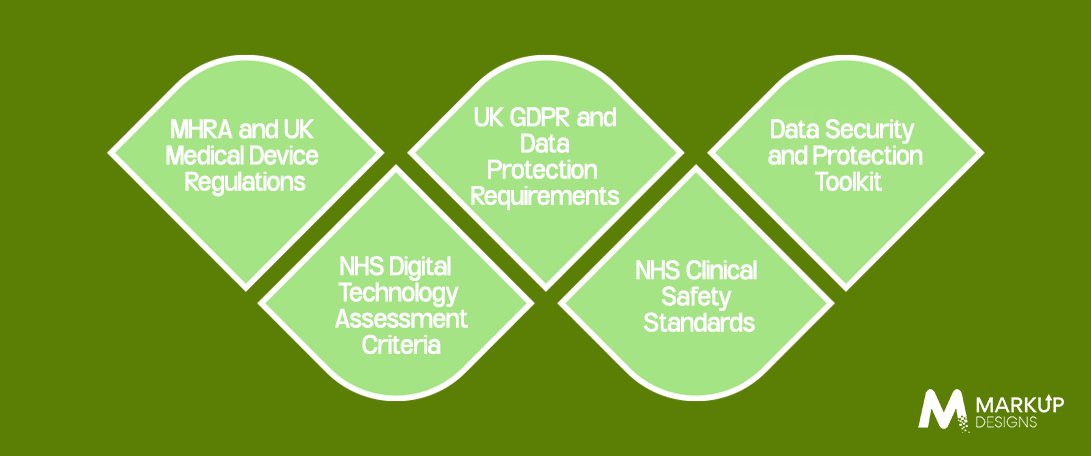
A legally acceptable HealthTech solution has to comply with multiple regulations and digital standards. The most significant laws in this sector include:
MHRA and UK Medical Device Regulations
The Medicines and Healthcare products Regulatory Agency oversees medical devices in the UK. If a HealthTech app is intended to diagnose, monitor, prevent, predict or treat a medical condition, it may qualify as Software as a Medical Device and fall within applicable medical device regulations. Developers must assess the intended purpose of the software and determine the regulatory obligations before launch.
NHS Digital Technology Assessment Criteria
The Digital Technology Evaluation Criteria may be mandatory for the use of certain HealthTech products within NHS. This criterion evaluates various parameters, including clinical safety, data security, technical assurance, interoperability, usability, and accessibility. Meeting these criteria ensures that a digital health technology is acceptable for use in the healthcare environment.
UK GDPR and Data Protection Requirements
Health information is categorized as sensitive personal information, due to which HealthTech companies should have stronger security parameters when obtaining, processing and storing it. To comply with the UK GDPR, an organization should have a valid legal basis, respect the confidentiality of its clients, and adopt adequate technical and organizational information security measures.
NHS Clinical Safety Standards
The clinical safety standards help organizations spot and manage hazards that may affect patients or medical practitioners. Every health technology application performing clinical functions should evaluate risks, keep records of safety measures, and create clear responsibility for clinical risks at all phases of the product’s lifecycle.
Data Security and Protection Toolkit
The organizations that operate with NHS data should also comply with requirements for data protection and security, including governance, access control, staff awareness, incident management, and confidentiality
This includes governance, access management, staff awareness, incident handling and controls for protecting confidential information.
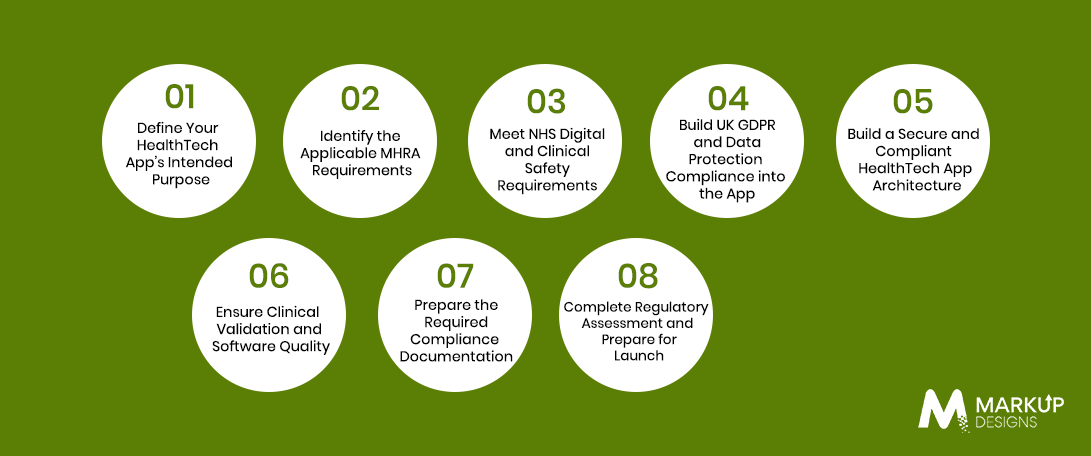
Step 1: Define Your HealthTech App’s Intended Purpose
The first thing that must be done when developing a compliant HealthTech application is to establish what exactly the application should do. The intended use determines the regulatory framework, the risk assessment process and the required evidence to support the application. Businesses are to prepare documentation of the application features, potential users, healthcare applications of the application and clinical claims before the actual development has commenced.
Determine Whether Your App Qualifies as a Medical Device
Not all HealthTech applications are classified as medical devices. Nevertheless, an application may fall under the medical device regulations when it is intended to perform such functions as diagnosis, prevention, monitoring, forecasting, prognosis, treatment and management of diseases. The classification has to be done according to the intended medical purpose rather than by the technology used for its creation.
Understand the Risk Classification of Your HealthTech App
Regulatory scrutiny can grow depending on the level of threat posed by the application. Software that is meant to provide general health information may cause less threat than an application that plays a role in making clinical decisions. Knowing the level of risk in advance may help the business regulate its evidence and documentation submission requirements.
Step 2: Identify the Applicable MHRA Requirements
Defining the target purpose and assessing the medical device status allow businesses to prioritize MHRA regulations relevant to the HealthTech application. Compliance must therefore be incorporated into the product development process as evidence supporting its regulatory and safety validity, and collected during the early stages of product creation rather than at the point of release.
Understand UK Medical Device Regulations
HealthTech applications that meet the definition of a medical device must comply with relevant UK medical device legislation that governs placement of product on the market. Developers must show that the application has been developed based on safety criteria and it has been documented consistently with official regulation requirements.
UKCA Marking Requirements
Where applicable, the UKCA marking signifies that the medical device has been subjected to conformity approvals for market access in Great Britain. The choice of the approval route will depend on different parameters like the kind of classification and applicable requirements at the time and should be defined by the business prior to app’s launch.
Clinical Evaluation and Evidence
Clinical claims should be supported by appropriate evidence. Depending on the product, this may involve clinical evaluation, performance data, usability studies, or other evidence demonstrating that the app performs as intended and that its benefits outweigh potential risks.
Risk Management Requirements
A structured risk management process should identify potential hazards associated with the app, assess their likelihood and severity, and implement controls to reduce unacceptable risks. Risk management should continue throughout development and remain active after the product is launched.
Technical Documentation
Technical documentation provides evidence of how the HealthTech app was designed, developed, and validated. It may include information about the intended purpose, software architecture, risk controls, testing activities, clinical evidence, and post-market processes. Maintaining this documentation throughout development makes compliance easier to demonstrate and manage.
Post Market Surveillance
Compliance does not end when the app goes live. Businesses should monitor real-world performance, user feedback, safety issues, and emerging risks after launch. A post-market surveillance process helps organisations identify problems early and take corrective action when required.
Step 3: Meet NHS Digital and Clinical Safety Requirements
HealthTech apps that are intended to work with NHS organisations or healthcare systems may need to satisfy additional digital and clinical assurance requirements. These standards focus on whether the product can operate safely, securely and effectively within a healthcare environment.
Align with the Digital Technology Assessment Criteria
The Digital Technology Assessment Criteria provides a structured framework for assessing digital health technologies across key assurance areas.
Clinical Safety
The app should identify potential patient safety risks and establish processes for managing them. Clinical safety considerations should influence product requirements, design decisions, testing, and ongoing monitoring.
Data Protection
The application must handle personal and health information responsibly. Developers should implement privacy controls, minimise unnecessary data collection and establish appropriate processes for consent, access and data retention.
Technical Security
Technical assurance focuses on protecting the application and its data against security threats. This can include secure development practices, vulnerability management, authentication controls and regular security testing.
Interoperability
HealthTech apps often need to exchange information with healthcare systems. Using recognised standards and well designed APIs can support accurate, secure and reliable data sharing while reducing integration challenges.
Usability and Accessibility
A healthcare application must be usable by its intended audience, including people with different levels of digital capability and accessibility needs. Accessibility should be considered throughout the design and testing process rather than added as a final adjustment.
Follow NHS Clinical Safety Standards
Clinical safety must be managed as an ongoing process when a digital product could influence patient care. This requires clear ownership, documented processes and active monitoring of potential safety issues.
Clinical Risk Management
Clinical risks should be identified, assessed and controlled throughout the development lifecycle. Any changes to functionality or clinical workflows should also be evaluated for their potential impact on patient safety.
Clinical Safety Officer Responsibilities
A designated clinical safety professional can provide oversight of clinical risks and ensure that safety considerations are properly incorporated into product development and governance processes. Their role may include reviewing hazards, validating safety controls and supporting safety documentation.
Hazard Identification and Risk Control
Potential hazards can arise from incorrect information, system failures, usability problems or inappropriate reliance on software outputs. Businesses should identify these scenarios early and implement controls that reduce the likelihood or impact of harm.
Step 4: Build UK GDPR and Data Protection Compliance into the App
HealthTech apps frequently process highly sensitive information, making data protection a core development requirement. Compliance should influence how data is collected, stored, accessed, shared and deleted throughout the product lifecycle.
Establish a Lawful Basis for Processing Health Data
Businesses must identify an appropriate legal basis for processing personal data and satisfy the additional conditions that apply to special category health data. The correct approach depends on the purpose of processing and the relationship between the organisation and the user.
Implement Privacy by Design and Default
Privacy should be embedded into the application architecture and user experience from the start. This may involve data minimisation, privacy-friendly default settings, controlled access and limiting the collection of information to what is genuinely required.
Conduct a Data Protection Impact Assessment
A Data Protection Impact Assessment can help identify and address privacy risks before high risk processing begins. The assessment should examine how personal data will be used, the risks involved and the measures implemented to reduce those risks.
Secure Data Storage and Sharing
Health information should be protected through appropriate security controls during storage and transmission. Businesses should also assess third-party providers, APIs and data-sharing arrangements to ensure that sensitive information remains protected across the wider technology ecosystem.
Read Also: Compliance Guide Launching a Mobile App in the UK
Step 5: Build a Secure and Compliant HealthTech App Architecture
A compliant HealthTech app requires a technical foundation that protects sensitive information and supports reliable healthcare operations. Security should be built into the architecture rather than added after the core product has been developed.
Implement Strong Authentication and Access Controls
Authentication mechanisms should verify user identities, while role based access controls ensure that users can access only the information and functions relevant to their responsibilities. Strong access management is particularly important when different users, such as patients, clinicians and administrators, interact with the same platform.
Encrypt Data at Rest and in Transit
Sensitive information should be protected while stored and while moving between users, applications and connected systems. Encryption reduces the risk of unauthorised exposure if data is intercepted or accessed improperly.
Maintain Audit Trails and Activity Logs
Audit trails provide visibility into important actions performed within the application. Logging access, data changes and critical system activities can support accountability, security investigations and compliance monitoring.
Use Secure Cloud Infrastructure
Cloud infrastructure should be configured to support appropriate security, resilience and access controls. Businesses should evaluate hosting environments, backup processes, disaster recovery capabilities and third party responsibilities before deploying healthcare workloads.
Conduct Regular Security Testing
HealthTech applications should be tested for vulnerabilities throughout development and after launch. Security assessments, penetration testing, dependency monitoring and timely remediation help organisations identify weaknesses before they affect users or sensitive healthcare data.
Step 6: Ensure Clinical Validation and Software Quality
Before launch, HealthTech apps should be tested beyond basic functionality. Where an app can influence patient care or clinical decisions, businesses need evidence that it performs reliably, safely and as intended.
Validate Clinical Safety and Performance
Assess whether the app delivers its intended clinical function without creating unacceptable risks. Validation should consider accuracy, reliability and potential impact on patient outcomes.
Conduct Usability and Accessibility Testing
Test the app with representative users to identify usability issues that could lead to errors. Accessibility testing should also ensure the product can be used by people with different needs and capabilities.
Perform Software Verification and Validation
Verification checks whether the software has been built according to defined requirements, while validation confirms that it meets its intended purpose. Both are essential for demonstrating product quality and reliability.
Validate AI and Algorithm Based Features
AI-driven Healthcare application features should be tested for accuracy, reliability and appropriate performance across relevant user groups. Businesses should also establish processes to monitor algorithm performance as data and real world conditions change.
Step 7: Prepare the Required Compliance Documentation
Compliance depends heavily on evidence. Businesses should maintain clear documentation throughout development rather than attempting to prepare it immediately before launch.
Develop Technical Documentation
Technical documentation should explain the app’s intended purpose, functionality, architecture, development approach and compliance measures.
Maintain a Risk Management File
Keep a structured record of identified risks, their potential impact and the controls implemented to reduce them.
Document Clinical Evidence
Maintain evidence supporting the safety, performance and clinical claims of the HealthTech app.
Maintain Data Protection Records
Document how personal and health data is collected, processed, stored, shared and protected.
Record Software Testing and Validation Activities
Maintain records of testing, identified issues and corrective actions to demonstrate that the software has been properly assessed before release.
Step 8: Complete Regulatory Assessment and Prepare for Launch
The final launch process depends on the app’s intended use, risk classification and regulatory status. Businesses should confirm that all applicable requirements have been addressed before making the product available.
Complete the Required Conformity Assessment
Medical device software may require an appropriate conformity assessment to demonstrate compliance with applicable regulatory requirements.
Register the HealthTech App Where Required
Certain medical devices must be registered with the relevant authority before being placed on the market.
Prepare for NHS Procurement and Adoption
Businesses targeting NHS organisations should be prepared to demonstrate compliance with relevant digital assurance, security, clinical safety and interoperability expectations.
Establish a Post Launch Compliance Plan
Compliance continues after launch. Monitor app performance, security issues, user feedback and potential safety concerns to identify when corrective action or product updates are required.
Read Also: How to Hire Mobile App Developers in the UK: Key Factors to Consider
Common Challenges in Building a Compliant HealthTech App in the UK
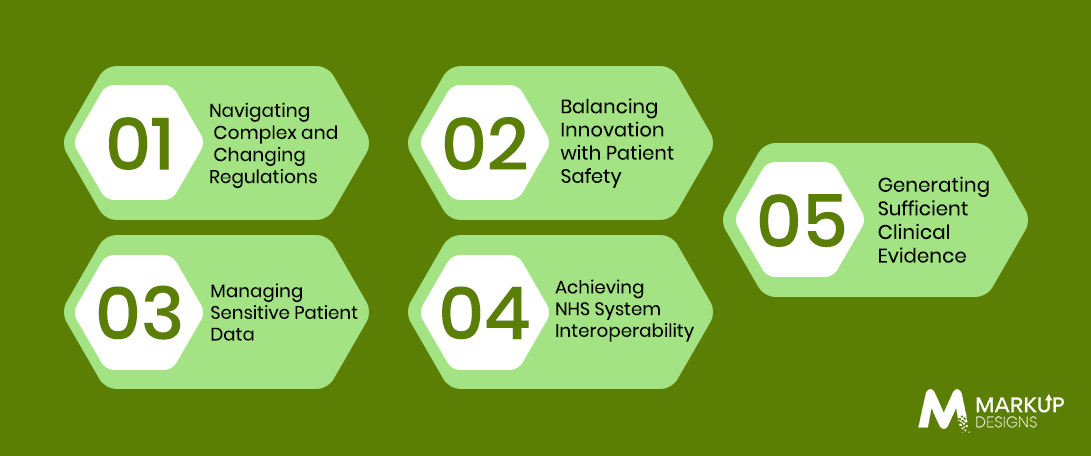
Navigating Complex and Changing Regulations
Multiple regulatory frameworks can apply to one product, making early compliance planning essential.
Balancing Innovation with Patient Safety
Advanced features should not be introduced without properly assessing their clinical and operational risks.
Managing Sensitive Patient Data
Health data requires strong privacy controls, secure architecture and careful management of third party access.
Achieving NHS System Interoperability
Integration with existing healthcare systems can be complex and requires alignment with recognised data and interoperability standards.
Generating Sufficient Clinical Evidence
Businesses often underestimate the time and resources needed to produce evidence supporting safety, performance and clinical claims.
How Markup Designs Can Help Build Compliant HealthTech Apps in the UK
Markup Designs helps businesses develop secure and scalable HealthTech applications with compliance considerations integrated throughout the development lifecycle. From product strategy and healthcare-focused UI and UX to secure architecture, AI integration, interoperability and quality assurance, our team supports the technical foundations required for modern digital health solutions. We help businesses build applications that are designed around usability, security, performance and the regulatory expectations relevant to their intended market.
Build Your HealthTech App with Compliance in Mind
Planning a HealthTech solution for the UK market? Build a secure, scalable and compliance-focused application with the right technology, clinical safety and data protection foundations from day one.

Conclusion
Building a compliant HealthTech app in the UK requires more than strong development capabilities. Businesses must consider the app’s intended purpose, MHRA requirements, NHS standards, clinical safety, UK GDPR and software quality from the earliest stages of development. By addressing compliance as part of the product lifecycle, organisations can reduce costly rework, strengthen patient trust and prepare their HealthTech solution for a safer and more efficient market launch.
FAQs
1. What are the main compliance requirements for HealthTech apps in the UK?
Requirements can include MHRA medical device regulations, NHS digital standards, UK GDPR, clinical safety processes and cybersecurity measures. The exact obligations depend on the app’s intended purpose and functionality.
2. Does every HealthTech app require MHRA approval?
No. An app may fall under MHRA medical device requirements if its intended purpose qualifies it as medical device software. General wellness or administrative apps may not be regulated in the same way.
3. When does a HealthTech app need UKCA marking?
Where applicable, medical device software may need to complete the required conformity assessment before being placed on the Great Britain market.
4. What is DTAC and why is it important for NHS HealthTech apps?
The Digital Technology Assessment Criteria provides a framework for assessing areas such as clinical safety, data protection, technical assurance, interoperability, usability and accessibility.
5. How does UK GDPR apply to HealthTech app development?
UK GDPR places strict requirements on how personal and health data is collected, processed, stored, and protected. Developers should build privacy and security controls into the app from the beginning.
6. Can a HealthTech app integrate with NHS systems?
Yes, but integration should align with relevant interoperability, security and data standards. The exact requirements depend on the NHS systems and services involved.
Author's Perspective
The biggest mistake businesses make with HealthTech app development is treating compliance as something to handle before launch. That approach is inefficient and expensive. Regulatory requirements influence the app’s architecture, data flows, clinical functionality, testing and documentation, so they need to be considered from the start. A strong HealthTech product is not simply one that offers innovative features. It is one that can demonstrate safety, reliability and responsible handling of sensitive patient information while remaining practical for real users and healthcare environments.
Discuss Your Project NowJupinder Singh Arora
Founder and CEO
Related Posts

Complete Guide to Healthcare App Development in Saudi...
Remote Patient Monitoring App Development in the UAE:...
Complete Cost Breakdown of Telemedicine App Development in...
Insights Are Valuable & Execution is Priceless
You’ve read about the digital future. Now, let’s build the infrastructure to take you there. Move your strategy from the page to the product.
Design Your Solution Now
Contact Us
Schedule The Appointment At Your Convenience Date And Time.
30 Min
Web Conference
Time Zone
Indian standard time (08:30pm)

Thanks For Getting In Touch!
You’ve Taken The First Step Toward Transforming Your Digital Presence. Our Experts Will Reach Out Shortly To Take It Forward.
Launch Your Dream Project
Provide a brief overview of your project, and our specialists will evaluate your requirements. We will connect with you to explore how the right digital solutions can help you launch faster.