
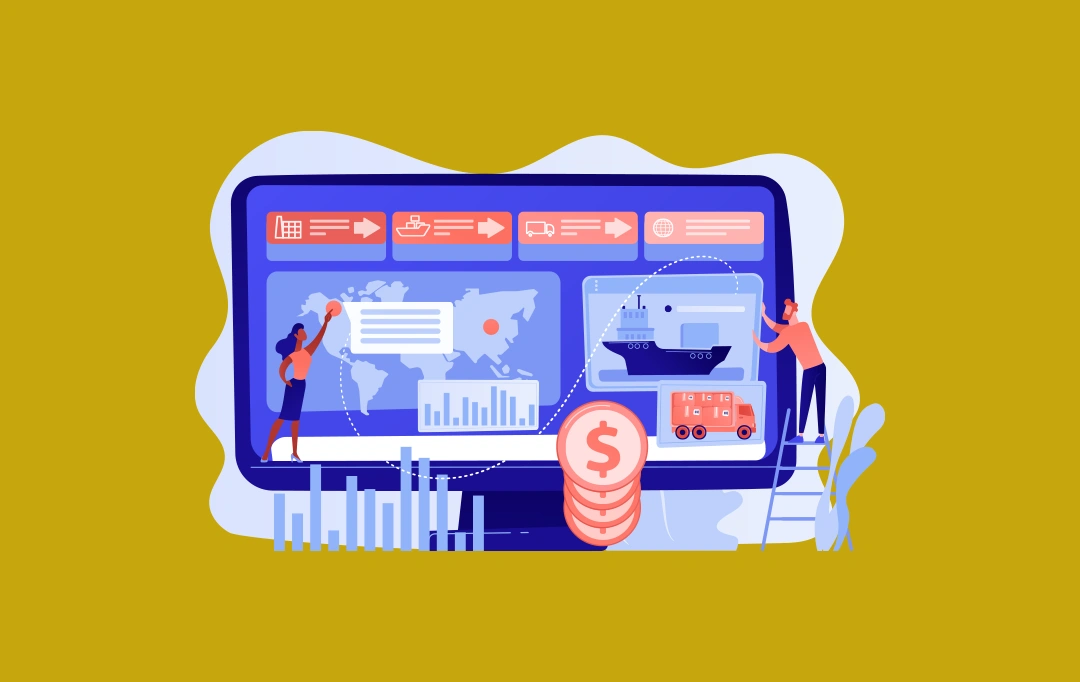
In Brief
- Due to the inefficiencies of manual claims processing, settlements take longer and are more costly to administer.
- With a centralised software platform, increased collaboration can be achieved between insurers, ports, surveyors, brokers, and shipping companies.
- Real-time tracking of claims will provide visibility throughout the claims lifecycle.
- Automation powered by AI will reduce human error in processing claims and enhance fraud detection.
- A custom-built maritime insurance platform can adapt to growing volumes of cargo being shipped and changing rules and regulations within the industry.
The United Arab Emirates is positioned as a global centre of maritime commerce with ports such as Jebel Ali and Khalifa Port facilitating international trade and logistics. As cargo volumes for these ports increase, so do the complexities associated with the claims process for cargo loss/damage, vessel incidents, delays in service, and liability exposure.
Despite improvements in the maritime infrastructure over the last several years, many insurers continue to use manual/fragmented processes, paperwork, emails, and disjointed systems to process claims. Due to these barriers, there are sufficient delays in processing claims, as well as communication barriers, resulting in increased administrative costs. Digital maritime insurance claim software can address these issues by automating workflows, providing opportunities for collaboration, and streamlining claims management.
This article provides commentary on the growing need for digital claims solutions, provides insight into their features, and outlines the steps taken to develop a compliant, secure, and scalable maritime claims solution that can be implemented in the UAE.
The Growing Need for Digital Maritime Claims Management
The maritime industry in UAE is extremely fruitful, with a $35 billion contribution to the region’s economy. Two of the world’s busiest ports, Jebel Ali and Khalifa, each handle millions of containers yearly. With the increase of cargo volume comes an increase in cargo claims from insurers for damages to cargo, shipping vessels or accidents, delays of shipments, and liability disputes.
In what can be an extremely slow process, the traditional way of processing claims takes too long due to the number of stakeholders involved in the shipping process (e.g., shipping companies, insurers, surveyors, customs agencies, freight forwarders, and port operators) having their own separate, disconnected systems and paper-based documents for each claim. This results in fragmented information, which leads to longer processing times and mistakes.
In addition to the time it takes to collect the required documentation (e.g., cargo manifests, survey reports, bills of lading, customs records, invoices, photos, and banking information) within a single claim, the time it takes to process this information using e-mail, spreadsheets, or paper creates additional burdens on completing the processing of any particular claim.
Why Maritime Insurance Claim Software Is Replacing Manual Claims Processes
As maritime transport activity continues to expand in size and complexity, penalties imposed by inefficient claims processing are going to become increasingly burdensome for the shipping industry and the various businesses that support the maritime transport process. Manual processes have become obsolete, and digital tools are crucial to enhancing workflow efficiency, workflow accuracy, and collaborative TBMs.
The unsustainability of paper-based or semi-digital logistics workflows
To deliver services to their customers, many insurance companies continue to rely on paper-based documentation, spreadsheets, e-mail correspondence, and multiple different systems that are not integrated together to complete insurance claims. Because these procedures are out of date, they create duplicate documentation, delayed approvals, decreased visibility, and increased time frames for settlement.
Establishing centralized digital platforms will enable insurers to automate their workflows, implement better document management, and provide immediate access to their claimants.
The impact of human data entry errors and multi-party communication silos
Maritime claims involve multiple participants, including insurers, surveyors, brokers, shipping companies, and port authorities; therefore, the importance of accurate communication is critical. Manual data entry errors, therefore, can cause incorrect documents to be produced, documents to be omitted, duplicate claims to be submitted, delays in the completion of inspections and thereby prolong settlement periods.
By creating a centralized claims processing platform, communication silos are eliminated because authorized users have access to up-to-date information on the claim, the associated documentation, and the communication about the workflow. Therefore, faster and more accurate decisions can be made when processing claims.
The need for rapid, automated, large-scale processing to maintain financial stability
With the number of shipments increasing and consumer expectations rising, insurance companies must process insurance claims in a timely, efficient manner to remain competitive.
Automating the complete documentation review and approval process is helping to speed up document verification, regional claim routing, claim approval, and tracking, and to put it simply, removing the manual labour involved in these processes while ultimately getting a much higher quality, consistent outcome.
The other significant impact is that by automating the claims management process, insurers are now able to settle more claims faster and at lower cost, plus mitigate fraud losses (which can be significant) while enabling them to process higher volumes of claims while still complying with regulations and providing a much better customer experience.
Key Features of Maritime Insurance Claim Software
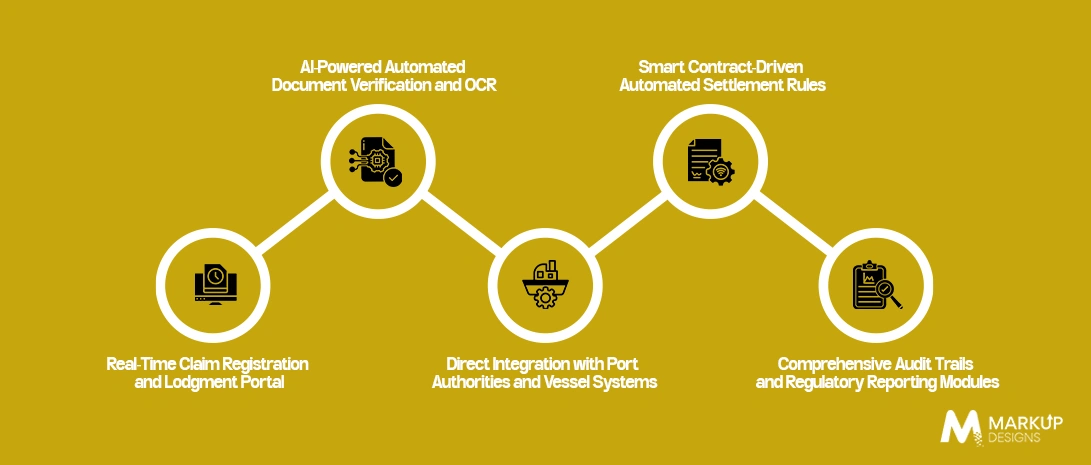
In addition to digitizing and storing, a modern maritime insurance claims platform should provide for the automation of workflows and collaboration, support for and reinforce compliance, and give users (all parties) visibility through the entire claims lifecycle.
Portal for Real-Time Claim Registration and Lodgment
A centralised claims portal will allow insurers, brokers, surveyors, marine shipping companies, and customers to register and lodge claims online from any location without the need for paper documentation to be submitted. Supporting documents will be immediately uploaded and available for processing, therefore significantly reducing the total number of pieces of paper needing to be processed.
All related parties will receive real-time status updates and can be contacted by either their telephone or smartphone devices to provide updates to the status of claims, including field surveyors who may update claims directly from a marine vessel or at a port.
AI Enhanced Automated Document Review and OCR
Maritime claims consist of many different types of documents (i.e., bill of lading, cargo manifests, invoices, and surveyor reports). AI-based OCR will facilitate the automatic extraction and validation of data from these documents with little or no human effort and significantly improve accuracy in the future.
In addition, the AI-enabled document review solution will identify duplicate claims, missing documents, and discrepancies in the documents, which will allow the insurers to process claims faster than ever before.
Direct Integration with Port Authorities and Vessel Systems (AIS Data)
Integration with port systems, AIS vessel tracking, customs databases, and logistics platforms enables insurers to access real-time operational data.
Live vessel movements, cargo information, and port records support quicker claim validation, reduce manual verification, and improve decision-making.
Smart Contract-Driven Automated Settlement Rules
Smart contracts automate claim settlements based on predefined business rules. Once claim conditions are met, the system can trigger approvals, calculate payouts, and initiate settlements automatically.
This reduces manual processing, improves consistency, and creates secure, tamper-resistant transaction records.
Comprehensive Audit Trails and Regulatory Reporting Modules
Built-in audit trails record every action performed within the platform, from document uploads to claim approvals. Automated reporting simplifies regulatory compliance and internal audits while improving governance and accountability.
How to Develop Maritime Insurance Claim Software in UAE
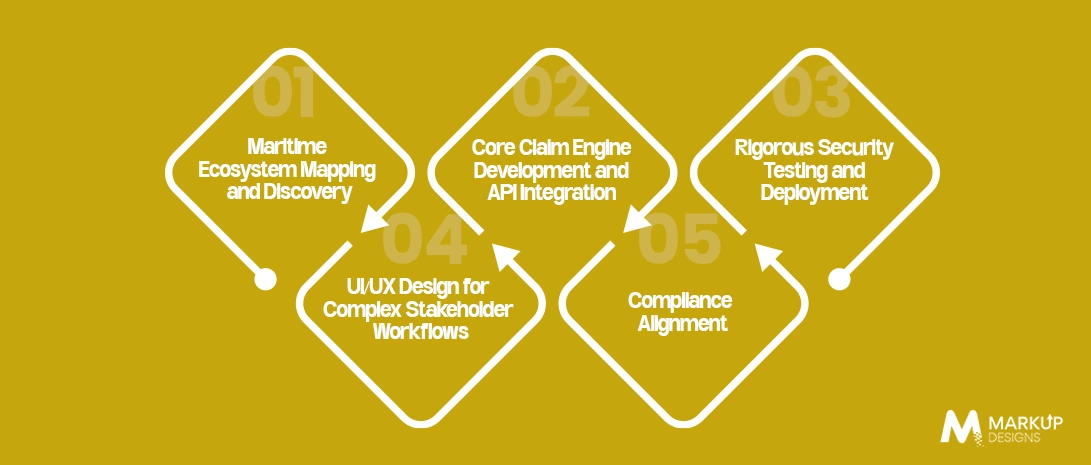
Developing maritime insurance software requires a structured approach that balances business requirements, technology, regulatory compliance, and user experience.
Phase 1: Maritime Ecosystem Mapping and Discovery
The discovery phase focuses on understanding stakeholder workflows, business objectives, regulatory requirements, and integration needs. Early planning ensures the platform reflects real-world maritime operations and supports future scalability.
Phase 2: UI/UX Design for Complex Stakeholder Workflows
Since multiple users interact with the platform, role-based dashboards and intuitive interfaces are essential. Mobile-first design enables surveyors, insurers, brokers, ports, and shipping companies to access and update claims from anywhere.
Phase 3: Core Claim Engine Development and API Integration
The claims engine manages the complete claim lifecycle, from registration to settlement. Workflow automation speeds approvals, while API integrations connect the platform with ERP systems, banking services, customs databases, vessel tracking solutions, and document management systems to ensure seamless data exchange.
Phase 4: Compliance Alignment (UAE Insurance Authority & Takaful Regulations)
The platform should comply with UAE insurance regulations while supporting Takaful frameworks where required. AML, KYC, secure data governance, and audit-ready reporting help insurers meet evolving compliance requirements.
Phase 5: Rigorous Security Testing and Deployment
Before launch, the software should undergo penetration testing, vulnerability assessments, performance testing, and disaster recovery validation. Continuous monitoring and regular maintenance ensure long-term security, reliability, and optimal platform performance.
How Maritime Insurance Claim Software Transforms Claims Management in UAE
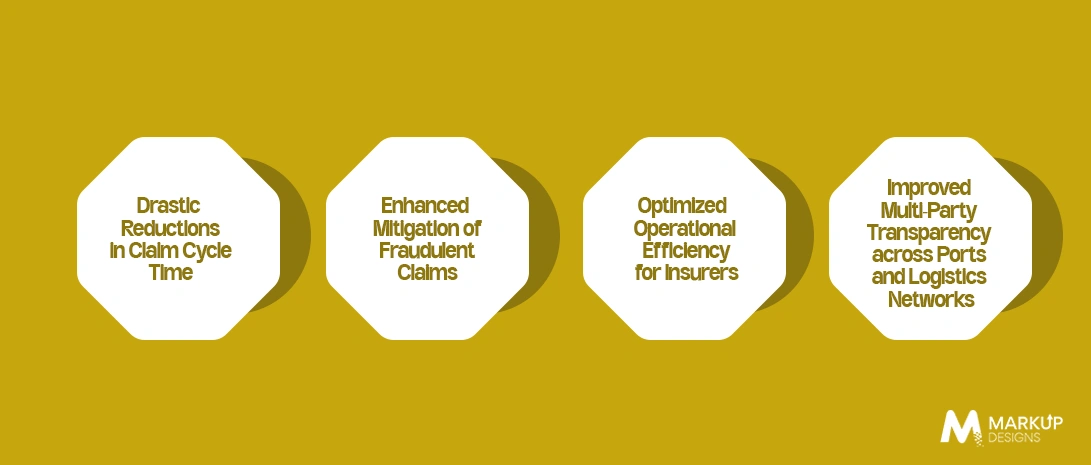
Digital claims management platforms are reshaping how maritime insurers process claims by replacing fragmented, manual workflows with automated, data-driven operations. The result is faster settlements, greater transparency, improved fraud prevention, and enhanced collaboration across the maritime ecosystem.
Drastic Reductions in Claim Cycle Times (From Weeks to Hours)
Traditional maritime insurance claims often take weeks to process due to manual document verification, multiple approval stages, and fragmented communication. Modern claims software automates workflows, verifies documentation in real time, and routes claims to the appropriate stakeholders instantly. This significantly reduces processing times, enabling insurers to resolve claims within hours rather than weeks while improving customer satisfaction.
Enhanced Mitigation of Fraudulent Claims
Fraud remains one of the biggest challenges in maritime insurance. AI-powered analytics strengthen fraud prevention by identifying unusual claim patterns, detecting duplicate submissions, validating supporting documents, and analyzing claimant behavior. Automated risk scoring allows insurers to investigate suspicious claims earlier, reducing financial losses while improving overall claim accuracy.
Optimized Operational Efficiency for Insurers and Adjusters
By digitizing the claims lifecycle, insurers can eliminate repetitive paperwork, automate routine tasks, and improve collaboration between adjusters, surveyors, brokers, and customers. Faster access to claim information reduces administrative workloads, accelerates decision-making, and lowers operational costs without compromising service quality.
Improved Multi-Party Transparency Across Ports and Logistics Networks
Maritime insurance involves multiple stakeholders working across different locations and organizations. A centralized claims platform provides real-time dashboards, shared documentation, automated notifications, and live status tracking, ensuring everyone has access to accurate and up-to-date information. This transparency minimizes communication gaps, reduces disputes, and streamlines claim resolution.
Practical Use Cases of Maritime Insurance Claim Software in UAE
Cargo Damage Claims During Transshipment at Port Operations
Cargo is particularly vulnerable to damage during loading, unloading, and transshipment activities. Traditional claim processes often involve delayed inspections and fragmented documentation, making investigations time-consuming. A digital claims platform captures inspection reports, photographs, cargo manifests, and shipping records in one centralized system, enabling faster claim validation and quicker settlements while reducing disputes between carriers, ports, and insurers.
Hull & Machinery (H&M) Physical Damage Disputes
Damage to vessels or onboard machinery requires extensive documentation, technical assessments, and coordination between ship owners, surveyors, insurers, and repair providers. Maritime insurance software centralizes maintenance records, inspection reports, repair estimates, and survey findings, allowing stakeholders to collaborate efficiently and accelerate claim approvals.
Protection and Indemnity (P&I) Club Liability Processing
Protection and Indemnity (P&I) claims often involve complex liabilities related to crew injuries, environmental incidents, cargo losses, or third-party damages. Digital platforms simplify case management by organizing legal documentation, incident reports, supporting evidence, and communication logs, enabling insurers and P&I clubs to process liability claims more efficiently while maintaining complete audit trails.
General Average Adjusting and Multi-Party Apportionment
General Average incidents require multiple cargo owners to share losses resulting from extraordinary sacrifices made to protect a vessel and its cargo. Coordinating documentation, financial calculations, and stakeholder communication manually can be highly complex. Maritime insurance software automates data collection, document sharing, cost allocation, and reporting, making General Average adjustments more transparent, accurate, and efficient.
Solving Critical Challenges in Maritime Insurance Claims with Smart Software
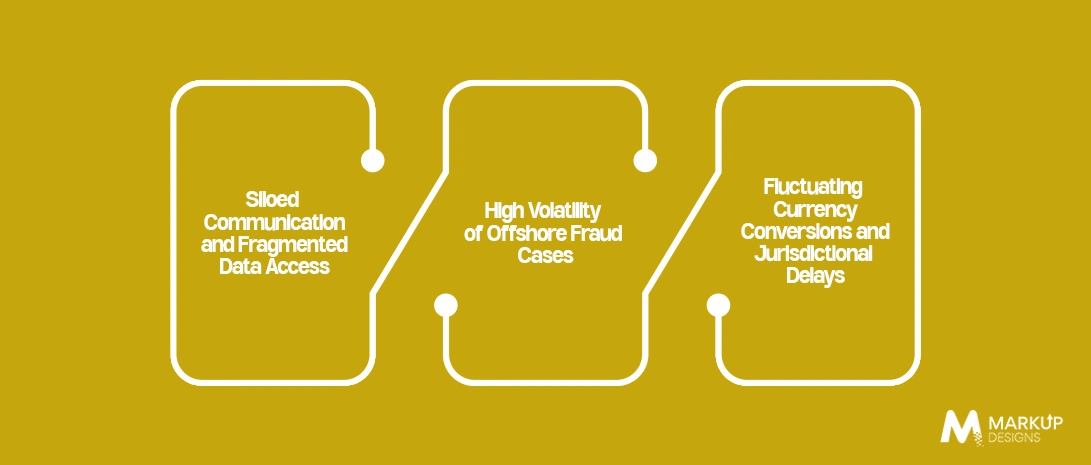
Challenge 1: Siloed Communication and Fragmented Data Access
One of the biggest obstacles in maritime insurance is the lack of centralized communication between ports, insurers, surveyors, shipping companies, and customs authorities. Information is often scattered across multiple systems, leading to delays and inconsistent decision-making.
Solution: Unified Cloud-Based Claims Platform
A cloud-based claims platform brings all stakeholders together on a single system, providing centralized document management, real-time collaboration, automated notifications, and complete visibility into every stage of the claims process.
Challenge 2: High Volatility of Offshore Fraud Cases
Maritime insurance claims can be vulnerable to fraudulent activities, including duplicate claims, manipulated documentation, and false damage reports. Detecting these issues manually is both time-consuming and resource-intensive.
Solution: AI Behavioral Modeling & Immutable Digital Audits
Artificial intelligence analyzes historical claims, behavioral patterns, and supporting documentation to identify suspicious activity before settlements are approved. Immutable digital audit trails further strengthen accountability by recording every action performed within the system.
Challenge 3: Fluctuating Currency Conversions and Jurisdictional Delays
International maritime claims frequently involve multiple currencies, cross-border regulations, and different banking systems, creating settlement delays and financial complexities.
Solution: Dynamic Multi-Currency Engines and Local Banking Integration
Integrated currency conversion engines, local banking connectivity, and automated payment processing simplify international settlements while ensuring accurate financial reporting and faster claim payouts.
Launch Your Maritime Insurance Claim Platform with Markup
Building enterprise-grade maritime insurance software requires expertise in insurance technology, logistics, cloud infrastructure, cybersecurity, and enterprise software engineering. At Markup Designs, we help insurers, logistics providers, and maritime businesses build secure, scalable, and fully customized digital claims management platforms tailored to UAE and Middle East markets.
Our capabilities include custom insurance software development, maritime workflow automation, FinTech integrations, API development, cloud-native applications architecture, enterprise security implementation, and seamless integration with third-party systems. We also help organizations navigate regional compliance requirements while delivering end-to-end implementation, from business analysis and UI/UX design to deployment, maintenance, and long-term support.
Whether you’re replacing legacy systems or launching a next-generation claims platform, our team delivers future-ready solutions that improve operational efficiency, reduce risks, and accelerate digital transformation.
Ready to Modernize Your Maritime Insurance Claims?
Transform manual, time-consuming claims processes into a secure, automated, and intelligent digital platform. Partner with Markup Designs to build a scalable maritime insurance claim solution designed for UAE’s evolving logistics and insurance landscape.

Conclusion
As UAE strengthens its position as a global maritime and logistics hub, insurance providers must embrace digital transformation to keep pace with growing trade volumes and increasingly complex claims. Modern maritime insurance claim software streamlines every stage of the claims lifecycle by automating workflows, improving collaboration, enhancing fraud detection, and ensuring regulatory compliance.
By replacing fragmented manual processes with intelligent, cloud-based platforms, insurers can significantly reduce settlement times, improve operational efficiency, and deliver better customer experiences. Investing in a secure, scalable, and future-ready claims management solution not only addresses today’s challenges but also prepares businesses for the next generation of maritime insurance in UAE.
FAQs
1. Can maritime insurance software integrate directly with existing port operating systems like DP World?
Yes. Modern maritime insurance platforms can integrate with port operating systems, logistics platforms, ERP solutions, and vessel tracking systems through secure APIs, enabling seamless data exchange and faster claim processing.
2. How long does it typically take to build a custom maritime insurance claim platform?
Development timelines depend on project complexity, required integrations, compliance requirements, and custom features. Most enterprise platforms typically take several months from discovery to deployment.
3. Does the software support compliant Takaful (Islamic insurance) claims processing structures?
Yes. Custom-built maritime insurance software can be designed to support Takaful workflows while complying with relevant UAE insurance regulations and governance requirements.
4. What security compliance standards must this software meet within UAE?
The platform should implement enterprise-grade security measures such as encryption, role-based access controls, multi-factor authentication, audit trails, secure cloud infrastructure, and regular security assessments while complying with applicable UAE data protection and insurance regulations.
5. How does AI help in detecting maritime cargo insurance fraud?
AI analyzes claim history, behavioral patterns, supporting documents, and transaction data to identify anomalies, detect duplicate claims, flag suspicious activities, and support faster, more accurate fraud investigations before settlements are approved.
Author's Perspective
The future of maritime insurance lies in intelligent, connected claims management rather than isolated manual processes. As UAE continues to strengthen its position as a global logistics and shipping hub, insurers must invest in technologies that improve speed, transparency, and regulatory compliance. AI, automation, cloud platforms, and real-time integrations are no longer optional, they are becoming essential for managing growing claim volumes and increasingly complex maritime operations. Organizations that embrace digital transformation today will be better equipped to reduce operational risks, enhance customer trust, and remain competitive in an evolving maritime insurance landscape.
Discuss Your Project NowJupinder Singh Arora
Founder and CEO
Related Posts

Software Companies in Kuwait: Smart Choices for Long-Term...
AI Software Development Cost in UAE: Complete Pricing...

How Much Does It Cost to Build CRM...
Insights Are Valuable & Execution is Priceless
You’ve read about the digital future. Now, let’s build the infrastructure to take you there. Move your strategy from the page to the product.
Design Your Solution Now
Contact Us
Schedule The Appointment At Your Convenience Date And Time.
30 Min
Web Conference
Time Zone
Indian standard time (08:30pm)

Thanks For Getting In Touch!
You’ve Taken The First Step Toward Transforming Your Digital Presence. Our Experts Will Reach Out Shortly To Take It Forward.
Launch Your Dream Project
Provide a brief overview of your project, and our specialists will evaluate your requirements. We will connect with you to explore how the right digital solutions can help you launch faster.