

In Brief
- Internet of Things (IoT) solutions are becoming the foundation of industrial operations, smart city infrastructure, utility management, and corporate sustainability across GCC economies.
- Countries such as Saudi Arabia, the United Arab Emirates, Qatar, Bahrain, and Oman are heavily investing in large-scale smart city giga-projects, national AI strategies, and cloud infrastructure.
- Businesses are moving beyond basic data logging and building connected digital ecosystems powered by edge computing, AI analytics, and automated decision-making.
- Industries such as energy and utilities, healthcare, logistics, manufacturing, and building automation are driving major IoT deployment demand across the region.
- Edge architecture, specialized low-power connectivity networks, and robust hardware ruggedization are reshaping how future IoT solutions are built and scaled.
- Arabic-first management UI/UX design, strict local data residency compliance, and hardware-level cybersecurity are becoming critical competitive advantages in GCC markets.
- Companies investing early in scalable, intelligent, secure, and highly localized IoT networks are likely to lead future connected digital markets across the Gulf region.
Modern businesses no longer treat Internet of Things (IoT) solutions as optional digital tools. Connected platforms now influence how companies communicate with machinery, manage logistics, deliver utility services, track environmental conditions, and compete in increasingly digital economies.
Across GCC countries, corporate behavior and operational workflows have shifted toward IoT-first experiences. Energy distribution, municipal infrastructure, facility management, cold-chain logistics, and even public safety services are increasingly managed through distributed sensor networks. This change is forcing businesses to rethink how digital infrastructure and hardware are designed and delivered.
The future of IoT development across the Gulf region is no longer just about deploying sensors. It is about creating intelligent, scalable, and connected digital ecosystems capable of supporting real-time telemetry, advanced automation, regional compliance, and physical durability. As governments and enterprises continue accelerating digital transformation initiatives, IoT technologies are becoming central to long-term business growth strategies across the region.
Why GCC Economies Are Adopting IoT Solutions
Let’s be realistic about what it takes to run hardware. The Gulf region isn’t just adopting tech; it is skipping entire legacy phases to build fully autonomous economies. If you look at the sheer scale of operations here, industrial and commercial enterprises expect their tech stacks to keep up without constant human monitoring.
This massive shift boils down to a few major drivers:
- High-density asset tracking across massive geographic distances
- Heavy state backing for unified digital infrastructure
- The pressure to deliver on massive giga-projects
- Rapid integration of AI into physical operational environments
- Supply chains that stretch across intense desert and maritime trade routes
- Massive, localized data center expansions
- Concrete corporate mandates for lowering water and energy waste
- Regulators who move faster than the standard global pace
If your solution treats IoT like a basic telemetry exercise, it will fail here. Businesses aren’t looking for simple readouts anymore; they want deep data analytics, predictive failure alerts, and systems that can function when things get rough.
When local operations teams evaluate an IoT platform, they look for:
- Hardware that doesn’t melt or clog in outdoor environments
- Smart processing that flags anomalies before they cause a shutdown
- Data handling that strictly respects local boundary laws
- Immediate, real-time alerts without long network lags
- Systems that integrate directly into existing ERP setups
- Multi-language dashboards that don’t look broken in Arabic
- Nodes that make localized choices when connections drop
- Long-term power setups that don’t require battery swaps every six months
If a deployment fails on any of these fronts, it becomes expensive electronic waste very quickly. That is exactly why regional operators are getting highly selective, pouring their budgets into systems engineered from day one for the Gulf’s specific reality.
Government-Led Digital Transformation Is Accelerating Innovation
You cannot talk about technology in the Middle East without talking about the public sector. Governments across the region are the ones setting the pace, using massive infrastructure budgets to shift away from oil-dependent models.
Look at the big blueprints reshaping the landscape:
- Saudi Vision 2030 (driving giga-projects like NEOM and the Red Sea Project)
- UAE Smart Government and Dubai’s paperless initiatives
- Smart Dubai frameworks and Abu Dhabi’s industrial modernization
- Qatar National Vision focuses on absolute digital sustainability
- Unified AI and data strategies across the broader GCC network
These aren’t just high-level policy papers, they translate into immediate, massive project tenders.
This state-level push has opened up huge deployment pipelines across several key areas:
- Smart municipal water grids and automated leak hunting
- Real-time energy monitoring in massive commercial high-rises
- Subterranean asset tracking for oil, gas, and mining setups
- Cold-chain visibility for food and pharmaceutical shipments
- Medical asset localization within sprawling hospital complexes
- Intelligent traffic routing and transit fleet telematics
- Factory floor automation and predictive maintenance
- Public environmental monitors for air quality and coastal safety
Because the public and private sectors are moving in lockstep, the demand for highly scalable, secure IoT platforms has skyrocketed. Companies that keep relying on legacy, disconnected hardware will find themselves locked out of the region’s largest enterprise opportunities.
AI-Powered IoT Solutions in the GCC
The era of the “dumb” sensor that simply reports a temperature value once an hour is dead. Artificial intelligence has moved directly into the physical network layer. Modern IoT infrastructure in the Gulf is expected to analyze its own data patterns and take immediate action, rather than just dumping raw logs onto a distant server dashboard.
AI-driven IoT setups are completely changing regional field operations by handling:
- Dynamic maintenance predictions based on actual machinery wear
- Automated valve shutdowns and self-healing system triggers
- Live machine-learning anomaly detection to stop cyber threats
- Automated safety compliance checks using on-site computer vision
- Pattern tracking for heavy trucks and field equipment
- Smart water and power distribution mapping based on weather shifts
- Micro-climate tracking to prevent industrial overheating
- Smart energy throttling across high-draw corporate facilities
Think about how this plays out across different sectors. A utility company can use edge analytics to pinpoint a water pipe fracture via minute pressure drops before thousands of gallons are lost in the desert. A logistics firm can analyze a combination of driver eye movements and refrigeration unit fluctuations simultaneously. In smart cities, cooling systems dynamically adapt to the actual occupancy of a stadium or district in real time.
The future belongs entirely to these self-contained, intelligent networks. By pushing automation to the point of capture, companies can radically cut down on downtime and save millions in resource waste.
IoT Systems Are Expanding Beyond Single-Purpose Platforms
One of the biggest frustrations for local operations directors is having to juggle ten different software windows for ten different device types. The market has completely turned away from single-purpose tools. Today, the goal is a unified operations center where every piece of connected hardware feeds into a singular control architecture.
No one wants to manage standalone applications for:
- Biometric gate access and field site security
- District cooling and HVAC energy consumption
- Smart internal and street lighting grids
- Fire safety sensor logs and compliance
- Water flow meters and leakage alarms
- Smart parking sensors and fleet yards
- Field personnel and asset geolocation tags
Instead, operators demand a single pane of glass. This makes perfect sense when you look at how large-scale developments are managed in the GCC, speed and centralized oversight are non-negotiable for enterprise managers.
An integrated regional IoT framework needs to weave together:
- Localized municipal utility telemetry
- Live ERP and inventory tracking logs
- Cross-border transit and fleet sensor data
- On-site worker health, safety, and environment metrics
- Urban traffic feeds and parking logistics data
- Ambient air and environmental quality indices
- Instant automated alarms are sent to emergency responses
- Long-term capital asset maintenance schedules
By tying these fields together into one platform, enterprises get real visibility. They cut through the noise, skip the costs of maintaining messy software integrations, and can actually use their data to make fast business decisions.
Industry-Specific IoT Ecosystems Are Growing Rapidly
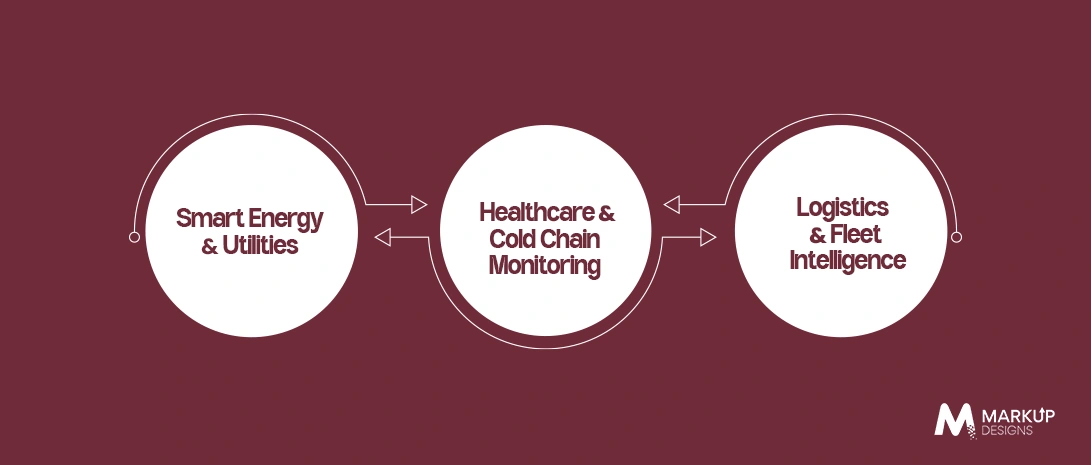
The actual application of these technologies varies widely depending on the sector, but the push for rapid digital transformation remains identical across every major industry.
Smart Energy & Utilities
Water and power scarcity aren’t abstract concepts here; they are core economic priorities. Regional utilities are deploying heavy sensor networks to automate water conservation, track solar panel performance across vast desert arrays, and use smart sub-metering in commercial developments to optimize district cooling. This hyper-focused approach gives managers accurate visibility, dramatically reduces grid losses, and ensures strict compliance with national environmental goals.
Healthcare & Cold Chain Monitoring
The healthcare supply chain across the Gulf has zero tolerance for error, particularly when dealing with temperature-sensitive pharmaceuticals and global logistics. IoT and AI-powered smart hospital systems are used to monitor vaccine shipments continuously, track high-value medical hardware across hospital wings, and manage the ambient conditions of laboratory spaces. This ensures complete transparency from manufacturer to patient delivery, protecting vital supplies in one of the fastest-growing sectors in the GCC.
Logistics & Fleet Intelligence
With massive port expansions and transit hubs running 24/7 across Saudi Arabia and the UAE, logistics, teams rely completely on continuous asset tracking. Sensor setups monitor real-time temperature drops inside refrigerated trailers, log container security status across international borders, and track vehicle telemetry to optimize fuel use. This prevents cargo spoilage over long desert transit routes and ensures smooth handoffs between sea, air, and land corridors.
Businesses Are Prioritizing Scalable IoT Development Infrastructure
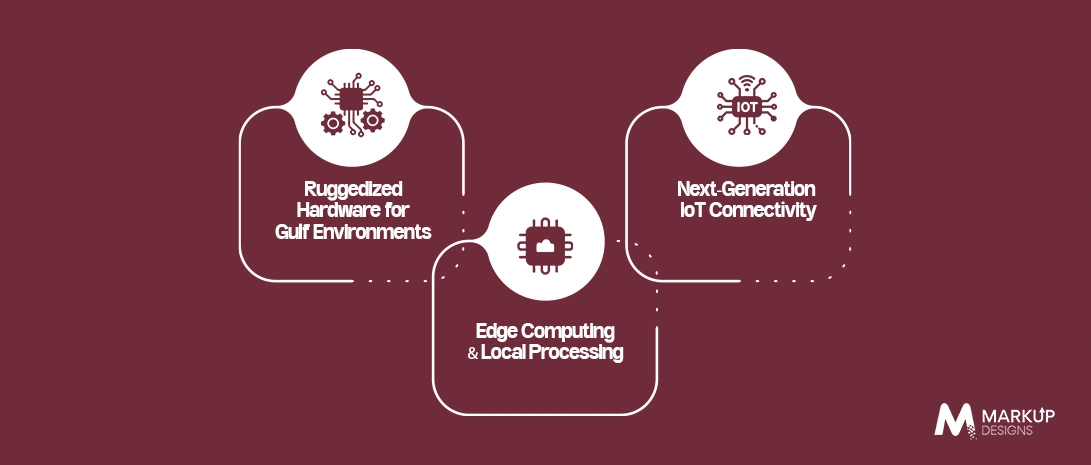
When you look underneath the hood of a successful Middle Eastern IoT Development Company, you find deep investments in underlying infrastructure. It takes serious planning to build a network that can handle the region’s physical and technical demands without crumbling.
Ruggedized Hardware for Gulf Environments
Let’s talk about the environment. You cannot take standard electronic enclosures designed for temperate climates and stick them out in the Rub’ al Khali or near the coast of Jeddah. The intense summer heat, micro-fine sand dust, and high saltwater humidity will destroy cheap buildings in weeks.
Hardware architectures meant for this market must lead with:
- Extended industrial temperature ratings that run from -40°C up to +85°C
- Certified ingress protection ratings of at least IP66 or IP67
- High-grade polycarbonates or marine stainless steel to stop salt corrosion
- Passive cooling setups that completely skip failure-prone mechanical fans
- Specialized surge protection to survive massive static charges during sandstorms
By building this level of physical durability into the hardware baseline, companies save millions on field replacement costs. Their sensors keep running without requiring constant, expensive human maintenance runs into remote areas.
Edge Computing & Local Processing
Shifting all your raw data to a distant cloud region is a massive bottleneck. It hogs network bandwidth and costs a fortune in cellular data charges. That is why edge computing has become standard across the Gulf. By running data processing directly on the field gateways, systems get significantly more efficient.
[Field Sensors] —> [Edge Gateway: Filters & Analyzes Data] —> [Cloud: Low Bandwidth Sync]
This decentralized layout delivers clear advantages:
- Machine learning algorithms evaluate data patterns right on site
- Cellular data costs drop because you only send anomalies, not raw noise
- Alarms go off instantly without waiting for a cloud round-trip
- Critical automation stays fully functional even if the main network drops out
- Field systems run clean deduplication routines before archiving records
Edge frameworks give your field setups the independence they need. They keep working, processing, and protecting assets regardless of flickering external network availability.
Next-Generation IoT Connectivity
The GCC boasts some of the most advanced telecom networks on Earth. The widespread availability of 5G, paired with dedicated IoT bands like NB-IoT and LTE-M, means teams can deploy vast device counts without choking the available airwaves.
This advanced connectivity tier opens up massive possibilities:
- Ultra-high frequency telemetry streams for heavy industrial machinery
- Dense city-wide grids featuring tens of thousands of smart parking nodes
- High-definition video streams are analyzed live for public safety
- Vehicle-to-everything communication networks for smart transit fleets
- High-speed automation loops inside modern port facilities
- Real-time tracking for complex drone-based inspection squads
With these dedicated networks, sensors can maintain reliable, crystal-clear connections to corporate backends, even from deep inside thick concrete buildings or remote underground utility installations.
IoT Security & Arabic-First UX in GCC Markets
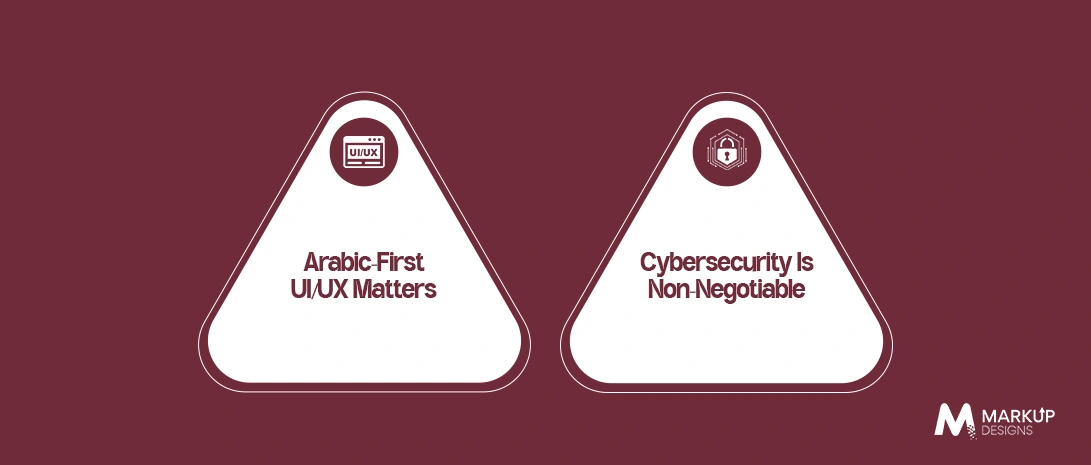
As connected platforms assume control of critical corporate assets, developers face immense pressure to deliver custom software that matches this technical capability with deep cultural localization and uncompromised cybersecurity.
Arabic-First UI/UX Matters
It is a massive oversight to treat translation as an afterthought by simply running an English interface through a basic translation tool. The software platforms managing control rooms and field operations need to respect how local operators actually read and interact with data.
A truly localized dashboard requires:
- Complete native Arabic text alignment built from scratch
- Proper Right-to-Left (RTL) chart, menu, and layout flow mirroring
- Industry-specific alert terms tailored to regional engineering teams
- Emergency response protocols that align with local civil defense structures
- Perfect dual support for both Gregorian and Hijri calendar schedules
When an industrial alert goes off, operators shouldn’t have to struggle with broken UI text or misaligned charts. Clear, intuitive localization speeds up human response times when seconds count.
Cybersecurity Is Non-Negotiable
Because every connected sensor represents a potential doorway into a broader corporate network, cybersecurity has become a top priority for CIOs across the Gulf. No enterprise can afford an unsecured device compromising their main systems.
Modern deployments secure their networks by using:
- Cryptographic chips like TPM or HSM modules are built directly into the boards
- Zero-trust onboarding rules that reject unverified device connection attempts
- Unique, rotating security certificates for every single field node
- Secure, encrypted over-the-air (OTA) patches for immediate firmware fixes
- Automated machine learning monitors to isolate rogue or compromised nodes
- Full alignment with national cloud security and data localization mandates
Treating security like a checkbox item at the end of a project is a recipe for disaster. True security must be baked directly into the architectural blueprints before the first piece of hardware ever leaves the warehouse.
Planning for Long-Term IoT Evolution
Managing an IoT solution over a ten-year lifecycle means planning for continuous change. Enterprise teams constantly face real operational hurdles: cellular standards shift, batteries naturally degrade, field inventories grow difficult to track, firmware needs constant patching, and connecting twenty-year-old factory machinery to modern web interfaces is always a headache.
Technology doesn’t stand still. An IoT platform needs regular diagnostic checks, ongoing hardware revisions, and clean cloud API updates to stay useful over the long haul. Companies that look at IoT as a simple, one-time hardware purchase almost always run into scaling issues within the first couple of years.
To keep a system viable over its lifespan, planning must center on:
- Modular hardware designs that allow you to swap radio chips easily
- Flexible, plugin-based software architectures for fast upgrades
- Aggressive power-saving sleep profiles to maximize battery life
- Commitment to open, vendor-neutral data standards
- Flexible cloud backends that aren’t locked into a single software suite
- Staying ahead of changing data privacy laws across the region
Why Strategic IoT Partnerships Matter
Assembling a reliable, long-term IoT setup takes far more than just buying cheap sensors and hoping for the best. Enterprises need engineering partners who deeply understand local field realities, complex enterprise software integrations, regional data residency laws, strict digital security protocols, and scalable cloud infrastructure.
When deployments miss the mark, it is usually because of weak hardware choices, crushing maintenance costs, clunky software interfaces, or sudden regulatory compliance issues. Working with an experienced development team helps businesses build resilient, future-ready networks that deliver rock-solid reliability, fast local processing, and the flexibility to scale as the business grows.
The Future of IoT in the GCC
The Gulf region is consistently proving to be a global launchpad for advanced infrastructure. As regional networks grow more automated, deeply interconnected, and operationally self-sufficient, the future of field deployments will turn completely on:
- Predictive edge analytics that stop failures before they start
- Fully automated, hands-off industrial workflows
- Secure, local cloud hosting infrastructures
- Unified management dashboards that cut through operational noise
- Deep, high-density sensor grids monitor entire districts
- Latency-free 5G telemetry for moving machinery assets
- Environmentally hardened hardware built for deep desert survival
- Strict, chip-level root-of-trust security protocols
- Native, culturally aligned data interfaces built for regional teams
Connected sensor platforms have transitioned from minor asset-tracking accessories into the absolute baseline of modern enterprise operations. Businesses that move early to build rugged, intelligent, and completely compliant networks lock in massive wins in efficiency, resource conservation, and long-term market agility. On the flip side, operations that cling to fragmented, unconnected legacy systems will find it increasingly difficult to compete in the region’s rapidly accelerating smart economies.
Transform Industrial Operations with Smarter IoT Infrastructure
Develop intelligent, ruggedized, and compliance-focused IoT ecosystems engineered for long-term digital growth in the Middle East.

Conclusion
IoT infrastructure in the GCC has officially evolved past basic connectivity. Success in this market demands a deep combination of tough, climate-ready hardware, local cloud storage, ultra-fast network speeds, and strict alignment with regional data privacy laws. Enterprises are no longer installing devices just to look at graphs; they are building complex, automated environments designed to optimize resources, protect infrastructure, and scale effortlessly.
From deep desert oil fields and smart municipal grids to high-security hospital wings and massive shipping lanes, connected ecosystems are fundamentally changing how assets are run across the Gulf. At this stage, things like native Arabic layouts, chip-level encryption, and smart edge processing aren’t premium features—they are basic requirements for any enterprise-grade roll-out. The companies that lead the market over the coming years will be the ones that treat their IoT networks not as isolated IT experiments, but as permanent, core corporate infrastructure engineered specifically for the Middle East.
FAQs
1. Why is environmental ruggedization so critical for Middle East IoT devices?
Outdoor devices face extreme heat over 50°C, highly abrasive fine sand dust, and corrosive salt-heavy humidity in coastal commercial zones. Standard hardware quickly suffers from component degradation and network failures without explicit industrial-grade protections.
2. How do local data regulations impact IoT system architectures in the GCC?
Governments in countries like Saudi Arabia (via NDMO/PDPL regulations) and the UAE have strict data governance frameworks requiring sensitive enterprise, citizen, and public infrastructure data to be processed and stored in clouds physically located within national borders.
3. What networks are most commonly used for IoT deployments in the Gulf?
The region features world-class 5G network coverage alongside specialized cellular IoT network protocols like NB-IoT and LTE-M, which are engineered specifically for low-power, wide-coverage device communications.
4. Why is an Arabic-first interface necessary for enterprise IoT platforms?
Localizing tracking systems and control rooms into native Arabic layouts ensures that regional field teams, safety controllers, and municipal operators can respond to alerts instantly without translation lag or interface friction.
5. What is the value of edge computing in industrial Gulf settings?
Edge computing allows field devices to process complex data streams locally, reducing expensive mobile data transmission fees and ensuring that automation tasks continue uninterrupted if a remote connection drops.
6. How does AI change basic IoT functionality into intelligent infrastructure?
Instead of just logging historical data, AI analyzes current sensor signals to anticipate equipment breakdowns, instantly isolate network threats, and dynamically balance utility energy consumption without human intervention.
Author's Perspective
Let’s look at the reality of the situation: a lot of companies in the region are still treating IoT deployments like minor technical side-projects or simple asset-tracking experiments. In our view, that approach misses the point entirely. Distributed sensor networks have rapidly matured into the core backbone of modern industrial and public infrastructure across the GCC.
With smart city giga-projects scaling up and national sustainability laws getting significantly tighter, you can no longer get away with deploying generic, non-localized hardware or disconnected software platforms. The real winners in this market are the ones building tough, edge-intelligent, and fully compliant ecosystems that can take a beating in harsh field conditions while keeping sensitive operational data securely inside national borders. Putting money into those foundational technical layers today is what determines who sets the operational standard for the region’s connected future.
Discuss Your Project NowAjit Kumar Jha
VP - Business Operations
Related Posts

Digital Transformation for Government Services in Kuwait: Key...

Why Businesses in Oman Need Digital Transformation Services

Digital Transformation in Financial Services: Trends, Benefits &...
Insights Are Valuable & Execution is Priceless
You’ve read about the digital future. Now, let’s build the infrastructure to take you there. Move your strategy from the page to the product.
Design Your Solution Now
Contact Us
Schedule The Appointment At Your Convenience Date And Time.
30 Min
Web Conference
Time Zone
Indian standard time (08:30pm)

Thanks For Getting In Touch!
You’ve Taken The First Step Toward Transforming Your Digital Presence. Our Experts Will Reach Out Shortly To Take It Forward.
Launch Your Dream Project
Provide a brief overview of your project, and our specialists will evaluate your requirements. We will connect with you to explore how the right digital solutions can help you launch faster.