

In Brief
- Businesses are shifting from traditional systems to AI-powered infrastructures built for intelligence and scalability.
- Companies are replacing rule-based chatbots with AI agents that can reason, execute tasks, and connect with real-time systems.
- Finance, retail, healthcare, energy, and government sectors are using AI to improve efficiency and customer experience.
- AI adoption is helping reduce operational costs, improve accuracy, and increase conversion and engagement rates.
- Language diversity, regulatory compliance, and legacy system integration shape how AI solutions are deployed in Kuwait.
- Businesses that adopt context-aware, integrated AI solutions will lead the next wave of digital innovation.
The digital ecosystem of Kuwait is evolving, not because of any policy or regional competition but out of necessity. The organizations do not simply replace the obsolete technology with the current one, but build the intelligent infrastructure from scratch. The key element of this evolution process is the development of applications with the use of AI technologies in Kuwait, which has widely been adopted among organizations in order to introduce more intelligent solutions.
As opposed to simple workflow management and interface with only data, apps are expected to perform more functions, such as help, anticipate actions, and make decisions. The transition from chatbots to AI agents indicates a fundamental change in service delivery.
The Changing Role of AI: From Chatbots to Intelligent Agents
AI systems nowadays are not only support layers but are functional elements of business architectures. This is having an impact on various aspects of enterprise architectures: from user experience to back-end automation and the decision-making process.
The Shift to Agentic Workflows
For Kuwaiti CTOs, the distinction isn’t just about “smarter” chat; it’s about the shift from the retrieval limitations of traditional chatbots to execution.
Traditional chatbots rely on fixed decision trees (If/Then logic), whereas AI agents use reasoning and planning approaches such as ReAct. Chatbots typically depend on a static knowledge base, while AI agents can integrate with real-time APIs and databases. In terms of capability, chatbots mainly answer questions, whereas AI agents can execute tasks through function calling.
Chatbots: Limited and Predictable
The vast majority of the initial implementations of chatbots within Kuwait have been based on the use of decision tree models. Chatbots were only as effective as their flow diagrams, which made companies unable to handle scenarios in which users did not use predefined keywords. Banks used them for FAQs, retailers for shop hours and returns.
It should be mentioned that one of the things that are usually ignored about chatbots is the cost of maintenance. The initial implementations of chatbots in the telecom sector have shown scalability problems, with studies reporting 70-89% of support tickets being escalated by humans at first.
AI Agents: Capable, Context-Aware, and Proactive
In contrast to the above-mentioned approaches, LLM-based AI agents utilize live data, customer information, and processes’ histories to address the following limitations:
- Ability to initiate actions (e.g., reporting service interruption or pre-populating a complaint form)
- Capability to understand the tone and urgency of Arabic-English dialogues
- Possession of context for multi-session interactions
A relevant real-world example is the private bank operating in Kuwait City that utilized the AI agent in its mobile application and significantly accelerated loan by automating document validation, risk assessment, and checking eligibility criteria inside the user’s experience flow.
What’s Driving AI App Development in Kuwait?
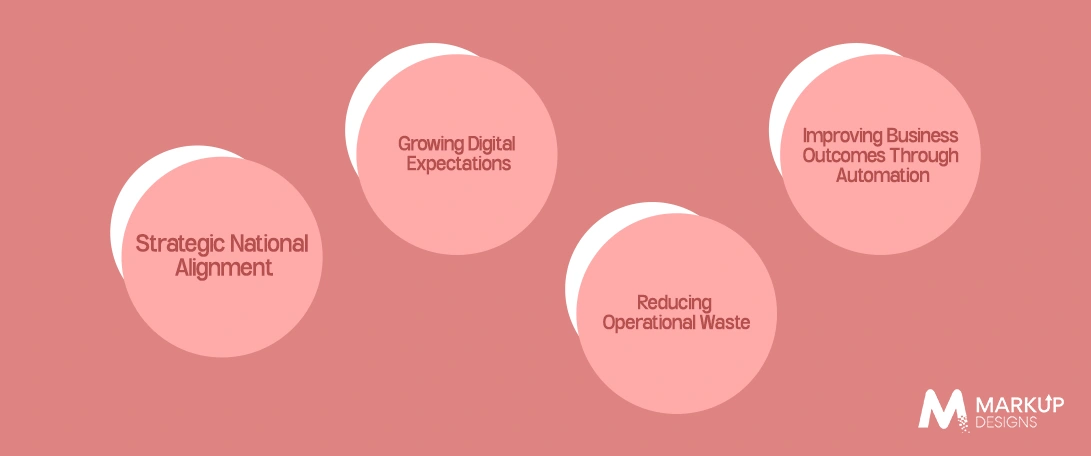
AI integration in Kuwait is not being followed through by Silicon Valley practices. Rather, the implementation process is being adjusted to fit the ground realities of the country, such as regulations, regional cultural values, linguistic challenges, and complexities associated with individual sectors.
Strategic National Alignment
Vision 2035 is an absolutely crucial framework. The pillar of the digital economy describes the shift that must be made: government services must adopt smart service delivery systems. The important thing to notice here is that several ministries are already working towards designing their processes with the help of AI co-pilots in productivity suites.
Growing Digital Expectations
While today’s users of apps in Kuwait not only demand quick response but also relevance, this is no longer set by government entities or locally-based startups but by their interactions on international platforms.
An insurance startup operating in the Sharq district reported a 3.4x increase in app engagement after switching from an FAQ bot to an AI agent that guides users through policy comparison and helps them book appointments with human advisors.
Reducing Operational Waste
When used for such internal purposes as inventory verification and delivery coordination, AI agents reduce the number of handovers between various departments. In logistics companies, 20 to 30% of all delays result from improper warehouse support coordination, but the use of AI agents has reduced these delays by 60 to 80%.
However, the point was not only that handovers were automated, what was really important was that they were intelligently automated through the use of AI agents.
Improving Business Outcomes Through Automation
The performance of the AI agents is not limited to improvements in metrics but also extends to better business results. For example, one regional bank has reported a 42% decrease in false positives for fraudulent activity detected through transaction monitoring using AI.
As companies move towards automation efforts, AI-driven digital tools in Kuwait are being used by companies to lower operational costs, make decisions based on data analysis, and provide digital services at scale while keeping staffing costs constant.
This is not because human beings could not do it. It is because of the sheer volume of tasks and the speed and memory necessary.
AI Adoption Across Industries in Kuwait
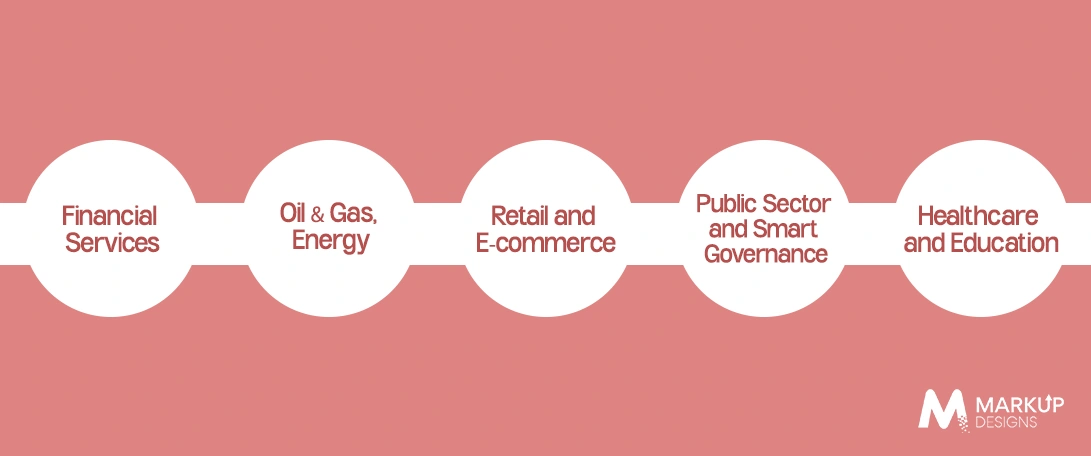
Now, let us pay attention to industry-specific developments. Each industry in Kuwait uniquely applies AI, driven by its problems and prospects.
Financial Services
AI is being tested by both fintechs and traditional banks. The retail-oriented bank in Salmiya leverages AI agents to offer cards to users based on their spending habits on different categories of merchants. On the other hand, wealth portfolio managers are leveraging AI to analyze the regional market and suggest risk profiles.
Oil & Gas, Energy
Kuwait’s energy sector is already putting AI to serious use, and not in a small or experimental way. One of the country’s largest downstream energy companies has deployed predictive maintenance AI to monitor pipeline integrity in real time. Camera footage from across the pipeline network is analyzed using edge AI, allowing the system to detect early signs of strain or wear long before they turn into costly failures or safety risks.
This kind of application shows how far AI adoption has come in an industry many still assume is slow to change.
Retail and E-commerce
An AI-based recommendation system was implemented in a Kuwaiti chain of department stores within their mobile application based on seasonality factors, user location, and number of visitors to the store. The chain recorded a growth of 19% in cross-category buying within 8 weeks.
Public Sector and Smart Governance
Kuwait’s Ministry of Interior is building an AI agent to simplify the process of renewing certain driver’s licenses. Right now, this process requires people to go through three separate touchpoints across two different government portals, which makes a fairly routine task feel more complicated than it needs to be. The AI agent is designed to bring this down to a single, guided interaction.
An initial trial of the system showed strong results, with submission errors dropping by 58%. It’s an early but clear sign of how AI is starting to simplify everyday interactions between citizens and government services in Kuwait.
Healthcare and Education
A group of hospitals in Kuwait is currently piloting an AI application that listens in on conversations between patients and doctors and automatically converts them into electronic medical records, in both Arabic and English. Instead of doctors spending extra time typing up notes after every consultation, the system handles much of that documentation in real time.
Beyond saving time, the application is also built to meet CITRA’s data accuracy standards for healthcare systems, which means the technology isn’t just convenient, it’s also held to the same compliance bar as traditional medical record keeping.
Why Businesses Are Replacing Chatbots With AI Agents
This shift isn’t happening because AI agents are the latest trend. There’s real business logic driving it.
Most organizations in Kuwait adopted chatbots in the first place simply because they were easy to set up and far cheaper than other solutions, while still being able to answer basic customer questions or route inquiries to the right department. But as customer expectations have grown, plain chatbots have started to fall short.
AI agents are filling that gap. Unlike traditional chatbots, they don’t just process natural language, they understand workflows, connect with APIs, and can even recommend the next best action to take. This becomes especially valuable for companies operating across multiple channels, where a customer’s context needs to carry over smoothly from one conversation to the next, regardless of where it started.
AI agents are also helping organizations move faster without having to scale up their headcount at the same rate. This matters most in industries like fintech and healthcare, where hiring specialized talent takes time and comes at a real cost. In these fields, an AI agent capable of resolving 60 to 70 percent of tier one queries on its own can make a meaningful difference to how efficiently a team operates.
Evolving Use Cases for AI Agents
In addition to customer service, companies are increasingly using AI bots to perform functions such as:
- Procurement: Evaluating quotations from vendors and providing recommendations to management.
- Compliance Reporting: Generating standard compliance reports to CITRA or internal audit teams.
- Knowledge Management: Providing institutional knowledge from documents or messaging platforms.
Chatbot vs AI Agent for Enterprise Apps
Here’s a simple way to see the difference. Imagine a customer asks, “What are your working hours?” A regular chatbot would just answer with the hours and stop there. An AI agent receiving that same question would go further, sharing the working hours, the nearest branch location, available appointment slots, and it could even go ahead and book the appointment for the customer right then and there.
It’s differences like this that build real customer loyalty. One simply reacts to what’s asked. The other anticipates what the customer actually needs next.
This shift isn’t just a surface level upgrade. It’s structural, and it’s quickly becoming one of the things that separates competitive businesses from the ones falling behind.
Why Kuwaiti Businesses Are Investing in AI-Powered Digital Solutions
Businesses in Kuwait are adopting AI to streamline operations, improve customer experience, and stay competitive in a digital-first economy.

Beyond Customer-Facing Interactions: AI Agents in Internal Operations
Most conversations about AI agents focus on customer support or sales, but some of the most impactful work happening in Kuwait is actually behind the scenes. One major firm based in Al Ahmadi, for instance, recently deployed an AI agent to monitor its IT infrastructure logs and catch early signs of server deterioration. By flagging issues before they turned into outages, the system helped the company avoid more than 16 hours of downtime in just the first quarter of the year.
HR departments are seeing similar gains. AI assistants that handle onboarding, walk new hires through company benefits, and guide them around internal systems have cut the time spent on manual onboarding tasks by up to 60%.
A consulting firm operating across Kuwait and UAE is taking this even further, piloting an AI agent that helps draft client proposals. The agent scans the firm’s internal case studies and existing knowledge base, then generates a first draft based on what it finds. Early results have been striking, with proposal turnaround time dropping from three full days to under 12 hours.
Metrics That Matter: Measuring ROI of AI-Powered Applications
The business world has just one straightforward question: how do we gauge our impact? Metrics can be measured by companies once they introduce AI agents to their systems:
- Time-to-resolution (TTR): Lowered hours per ticket or request
- Utilization rate: Number of tasks per day based on their purpose
- Hand-off reduction across systems: Percentage of times workflows complete without escalation
- Customer Satisfaction (CSAT): Gained during sessions after AI
- Human escalation rate: A lower number means better-performing agents
For instance, the use of the AI mortgage agent by a bank helped increase the application completion rate by 31% in 45 days. This is definitely an indicator of lead conversion.
These metrics are not vanity metrics but metrics whose results relate to the objectives of the board: cost reduction, experience enhancement, and speed.
With the compounding nature of such insights, AI agents transition from just being tools to becoming an integral part of an infrastructure.
Considerations for AI App Development in Kuwait
AI is not just about the code, but the context around it. And that’s particularly true in Kuwait compared to other places. Developers have to be aware of what makes AI work in the region.
AI Compliance and Regulations in Kuwait
One regulatory detail that often gets overlooked is CITRA’s data classification framework. Under this framework, any personal data being processed by analytics or AI software must first be classified according to its level of risk sensitivity, depending on how sensitive that data is and what could go wrong if it’s mishandled. In practice, this means AI developers can’t just plug data into a model and start building. Data classification has to be built into the development process from the start, not treated as an afterthought once the system is already up and running.
This includes:
- Ensuring that all high-risk data is not processed outside Kuwait without permission
- Strong encryption and access control measures for the classification of data
- Keeping logs of decisions made by the AI algorithms using personal data
It should be noted that the compliance regulations of Kuwait are changing, and programmers must keep themselves abreast of all the CITRA advisories regarding transparency in AI models and data belonging to users.
Bilingual and Cultural Context
One area of tension that often gets overlooked is tone. Some apps use formal Arabic phrasing that ends up sounding too official, almost like government correspondence, when it’s meant for everyday users. Building a good AI agent isn’t just about language proficiency, it also requires getting the tone right. For instance, a phrase like “Greetings, how can I help you today?” might come across as overly formal if used by an AI bank app addressing a customer in Arabic. Something like “Ahlan! Shlonik?” would feel far more natural for a Kuwaiti retail app speaking to its everyday users.
On top of that, many business apps in Kuwait run on dual language interfaces, which means every prompt, instruction, and conversation the AI agent handles needs to be translated into both languages while staying culturally accurate, not just linguistically correct. A few examples of what that actually involves:
- Dates and weekends need to follow Gulf regional standards, not Western defaults
- Responses need to account for adjusted business hours during Ramadan
- Product recommendations should reflect local preferences, such as leaning toward family oriented language when suggesting products
Building an AI agent capable of switching between languages naturally takes more than plugging in a translation API. It requires prompting that’s built around the region itself, not just the language.
Integration with Legacy Systems
Kuwait’s banking and utilities sector hasn’t fully modernized yet. Many of these systems still rely on infrastructure that’s closely tied to old mainframe technology, and APIs aren’t always available to connect newer tools into them. To work around this, we’ve used RPA as a middle layer between the AI agent and the legacy system for our clients, while full modernization is still underway.
This approach is fairly common in industries where rebuilding core systems from scratch would be too expensive or take too long. A few examples of how this plays out in practice:
- utilities company used an AI agent to let customers update their billing preferences directly through the app, even though the backend was still running on a terminal based process behind the scenes
- The AI agent communicated with the legacy system using RPA scripts that mimic human keystrokes, without requiring any changes to the original IT infrastructure
- While this approach isn’t perfect when it comes to scalability, it does allow AI solutions to be successfully implemented even in environments that haven’t been modernized. Forward thinking CIOs across Kuwait are already using this method to experiment with AI, all without putting their mission critical systems at risk
Given these local realities, AI powered apps in Kuwait need to be designed with this kind of legacy infrastructure in mind from day one, not as an afterthought.
Cost of AI-Powered App Development in Kuwait
The cost of AI-powered app development in Kuwait depends on complexity, AI features, tech stack, integrations, and ongoing maintenance. Simple apps like chatbots are more affordable, while advanced solutions using ML, NLP, or computer vision require higher investment. UI/UX design, APIs, and cloud infrastructure also impact pricing. Overall, costs align with global mid-to-high market rates due to demand for skilled AI development.
| App Type | Estimated Cost (KWD) |
| Basic AI App (Chatbot / Simple Automation) | 1,500 – 5,000 KWD |
| Mid-Level AI App (Recommendation Systems / Predictive Features) | 5,000 – 15,000 KWD |
| Advanced AI App (NLP, ML Models, Real-time Analytics) | 15,000 – 40,000+ KWD |
| Enterprise AI Platform (Custom AI Ecosystem) | 40,000 – 100,000+ KWD |
Role of Generative AI in Shaping Kuwait’s AI Ecosystem
AI is not just redefining consumer behavior. It’s also redefining the internal IT priorities of Kuwait-based businesses as well as product requirements within them.
CIOs are demanding LLM-related capabilities be embedded in their internal dashboards which includes:
- Intelligent searching through internal documents
- AI-driven summary of updates in projects
- Voice-to-text translation capability for bilingual meetings
The compliance teams have started writing SOPs around generative AI content filtering within those industries where CITRA is applicable. The SOPs typically mandate traceability of the AI-generated content, explainability of models, and protection against misinformation.
Product development teams in fintech and healthtech are incorporating the use of summarization and AI assistants in apps that did not have any AI components before. Examples include:
- A loan app from Kuwait bank is employing a generative AI assistant for summarizing financial documents of borrowers and filling up loan application form accordingly.
- In a teleconsultation app for doctors, there is an AI assistant powered by GPT for drafting EMR notes while patients interact with doctors.
The HR department is now leveraging the power of generative AI to draft initial copies of policies, create job descriptions depending on the requirements of the teams, and answer employee questions via AI-driven assistants built into communication software such as Slack and Microsoft Teams.
This has made organizations in Kuwait focus increasingly on digital solutions with AI capabilities integrated within enterprise applications and dashboards.
Best Practices for Enterprise-Grade AI App Development
Enterprise-grade AI app development requires a strong focus on scalability, security, and real-world usability. Organizations should prioritize clean data pipelines, robust model governance, and seamless integration with existing systems. Continuous monitoring, user feedback loops, and compliance with industry standards ensure long-term reliability and performance.
- Identify tangible business challenges
Begin by finding existing issues and avoid focusing on AI to provide the solution that will have a quantifiable benefit. It will help align technologies with value-added results.
- Provide linguistic and contextual validation
AI tools in GCC should work with Arabic languages (including all dialects) and English, preserving tone, clarity, and context. Validation of language abilities will increase trust and usage by users.
- Design prompt engineering and UX solutions
Right prompts can enhance the performance of any AI tool considerably, making prompt design an integral element of user experience. Prompt engineering often allows increasing the precision of AI without retraining or increasing model costs.
- Implement safety measures, fallbacks, and phased rollouts
Use human escalations, perform phased testing, and comply with regulations for particular industries. It will reduce risks associated with AI usage for enterprises.
- Monitor the performance constantly
Track the drift of the model, user interaction, and output, train your team, and optimize for a mobile-first approach. Continuous optimization ensures high quality of the AI solution.
Choose Markup Designs for AI-Powered Mobile App Development in Kuwait
At Markup Designs, we specialize in building AI powered mobile apps that are both scalable and high performing, tailored specifically for businesses operating in Kuwait. Our developers bring together strong AI capabilities with intuitive, easy to use design, creating apps that not only improve the user experience but also support smarter, faster decision making. Every application we build is designed to be future proof and scalable, so your business stays ready to compete as the market keeps evolving.
How is AI Transforming Businesses in Kuwait?
AI-powered solutions are helping businesses in Kuwait achieve faster growth, improved efficiency, and smarter decision-making across industries.

Conclusion
AI is not a novel technology experiment anymore in Kuwait, but it is now a key element in digital transformation initiatives for many firms in the country. The use of artificial intelligence ranges from replacing static chatbots with intelligent AI assistants to increasing efficiency and decision-making process. However, with the increase in the application of AI solutions in firms, success can be achieved through proper planning and adoption of the technology.
FAQs
1. Why are Kuwaiti businesses investing in AI-powered solutions?
They are adopting AI to improve efficiency, reduce operational costs, and deliver smarter, more personalized customer experiences.
2. What is the difference between chatbots and AI agents?
Chatbots rely on fixed rules and limited responses, while AI agents use reasoning and real-time data, and can execute complex tasks.
3. Which industries in Kuwait are using AI the most?
Finance, retail, oil & gas, healthcare, education, and government sectors are actively adopting AI solutions.
4. Is AI expensive to implement in Kuwait?
Costs vary based on complexity, but generally range from basic chatbot solutions to enterprise-level AI platforms with higher investment requirements.
5. What challenges do companies face when implementing AI in Kuwait?
Key challenges include language adaptation (Arabic-English), regulatory compliance, integration with legacy systems, and ensuring data security.
Author's Perspective
From our viewpoint, AI implementation in Kuwait is more than an improvement in technology; it is a change in the very structure of how companies conduct their business. Those that go beyond mere automation to embrace fully integrated and contextually intelligent AI systems will be the ones to drive future digital success in the region. In the end, market leaders will be those who best leverage their intelligence within their business practices.
Discuss Your Project NowGaurav Goyal
Global Sales- VP
Related Posts
Enterprise AI Agents: Practical Use Cases Driving Business...
LLM-as-a-Judge Explained: Improving Enterprise AI Governance and Evaluation

IoT in Banking: Transforming Financial Services Through Connected...
Insights Are Valuable & Execution is Priceless
You’ve read about the digital future. Now, let’s build the infrastructure to take you there. Move your strategy from the page to the product.
Design Your Solution Now
Contact Us
Schedule The Appointment At Your Convenience Date And Time.
30 Min
Web Conference
Time Zone
Indian standard time (08:30pm)

Thanks For Getting In Touch!
You’ve Taken The First Step Toward Transforming Your Digital Presence. Our Experts Will Reach Out Shortly To Take It Forward.
Launch Your Dream Project
Provide a brief overview of your project, and our specialists will evaluate your requirements. We will connect with you to explore how the right digital solutions can help you launch faster.