

In Brief
- UAE offers a high-growth, mobile-first market with strong government support and a tech-savvy user base.
- Successful apps focus on real user problems, seamless experience, and strong localization.
- Key trends in 2026 include AI-driven apps, fintech growth, 5G experiences, and on-demand services.
- Post-launch success depends on continuous updates, performance optimization, and user-driven improvements.
- Start lean, validate early, and build strategically to create an app that scales and retains users.
As per the Dubai Chamber of Digital Economy, UAE’s digital economy is set to reach approximately US$140 billion by 2031, driven by rapid technological advancements and a growing base of entrepreneurial ventures in Dubai.
Whether you’re introducing an innovative new product or scaling your current offerings, investing in custom app development can play a pivotal role in your startup’s journey. A well-built application not only improves internal efficiency but also strengthens how you connect and engage with your customers.
However, successful app development goes far beyond coding. It requires a strategic approach and selecting the right architecture, gaining a deep understanding of user behavior, and collaborating with a development partner who can deliver solutions aligned with your business goals.
There are more than 5.4 billion smartphone users worldwide, and nearly 90% of their mobile screen time is spent on native applications rather than web browsers. This shift highlights how mobile apps have become the primary way people interact, shop, communicate, and manage daily activities online.
This blog is for those who want to build a mobile app in UAE. Whether this is your first startup idea or you already run a business and want to go digital, this guide will walk you through everything step by step.
Why is UAE One of the Best Places to Launch a Mobile Application?
UAE is not just a dot on the map; it is a digital nation on the planet. It is a country that is actively pushing its population and businesses toward digital tools. The government and the people want this. The money is here to support it.
Dubai launched its Smart Dubai initiative years ago, and it has been pushing every sector to go digital. UAE’s National AI Strategy wants the country to become a global technology leader by 2031.
There is a ready market of millions of tech-savvy users. There is government support through free zones with low taxes. Investors are looking for the next big idea. And there is a world-class digital infrastructure backed by high-speed internet, advanced logistics networks, and a young, innovation-driven population eager to adopt new apps and technologies.
Mobile App Market Trends in UAE
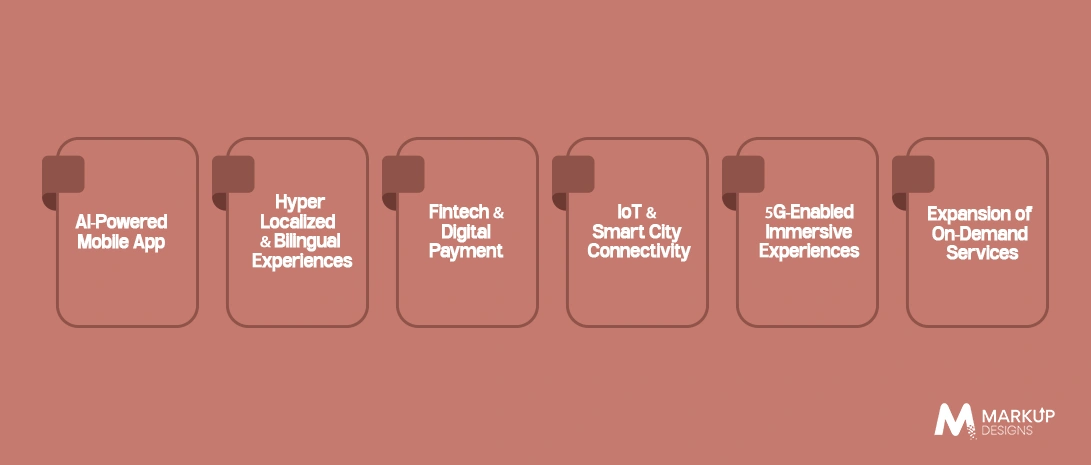
Before you start building, you need to know what is working right now. UAE app market moves fast, and the startups that win are the ones that spot trends early.
- AI-Powered Mobile App
In 2026, AI is no longer an optional feature; it’s a foundational element of modern mobile apps. From generative AI enabling hyper-personalized content to intelligent chatbots enhancing customer support and predictive analytics transforming decision-making in sectors like finance and retail, AI is at the core of next-generation app experiences. - Hyper-Localized & Bilingual Experiences
With UAE’s diverse and multicultural population, apps that offer seamless Arabic and English interfaces are gaining a competitive edge. Voice-enabled features and culturally tailored user experiences are enhancing accessibility and engagement across different user segments. - Fintech & Digital Payment
As UAE accelerates toward a cashless economy, digital payments are reaching new levels of maturity. Contactless transactions, mobile wallets like Apple Pay and Samsung Pay, along with the rise of Sharia-compliant fintech solutions, are reshaping how users manage and transact money. - IoT & Smart City Connectivity
Aligned with Dubai’s smart city vision, mobile apps are increasingly integrating with IoT ecosystems. From smart home automation to connected transportation and public infrastructure services, apps are becoming central hubs for managing urban lifestyles. - 5G-Enabled Immersive Experiences
The widespread rollout of 5G networks is unlocking new possibilities for mobile apps. High-speed connectivity supports advanced AR and VR applications, real-time streaming, and immersive digital experiences, particularly in industries like real estate, gaming, and entertainment. - Expansion of On-Demand Services
The on-demand economy continues to evolve beyond traditional food delivery. In 2026, users expect instant access to a wide range of services, including healthcare consultations, beauty services, and professional assistance, all delivered through intuitive, real-time mobile platforms.
Best Startup App Ideas for UAE Market
Different markets have different gaps. Here are the categories where UAE startups are finding success in 2026.
E-commerce and marketplace apps still have room to grow, especially in niche categories. General shopping is crowded with Noon and Amazon. But vertical marketplaces like apps for buying local crafts, used luxury goods, or specialty food items have real opportunities.
On-demand service apps remain one of the most proven models in UAE. The key is picking an underserved service. Home maintenance, beauty services, pet care, and tutoring are all areas where existing apps are not fully meeting demand.
Fintech apps need more regulatory work, but the rewards are big. Digital wallets, expense trackers for SMEs, international remittance tools for the large expat population, and buy-now-pay-later platforms are all growing.
Healthtech and telemedicine apps have got a major boost from the pandemic and are still growing. Startups building tools for chronic disease management, mental health support, or connecting patients with specialists are finding strong demand.
EdTech platforms are in high demand because UAE has a large population of students and professionals who want to upskill. Arabic-language learning apps, professional certification prep, and coding education platforms are especially popular.
Real estate apps work extremely well because the UAE property market is massive and constantly active. Tools that help people search, rent, or manage property with less friction are welcomed by both landlords and tenants.
Common Roadblocks in Mobile App Development
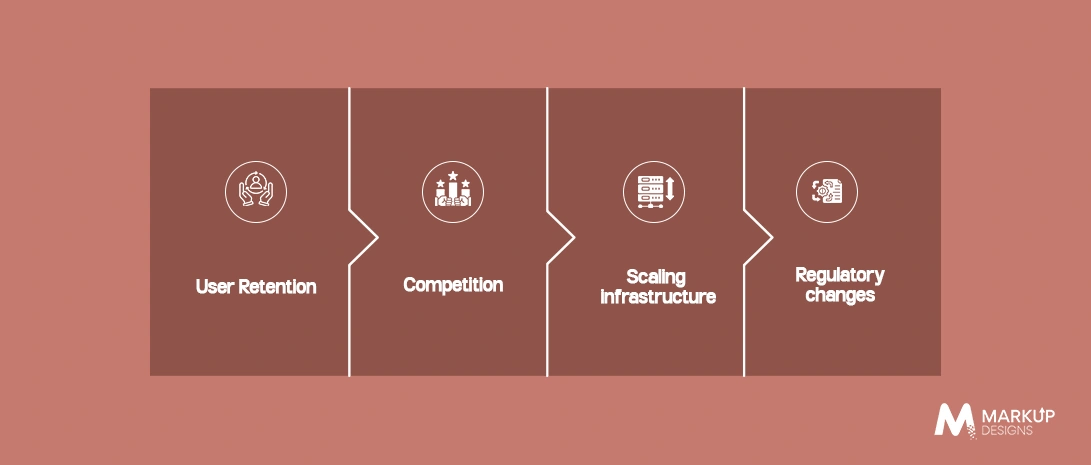
- User Retention is expensive. Getting people in UAE to download and regularly use a new app can cost much more than in many other countries. Businesses should prioritize user retention just as much as they prioritize user acquisition. Build an app experience that keeps users engaged, loyal, and returning regularly instead of constantly spending on acquiring replacements for churned users.
- Competition is high in popular app categories like food delivery, ride-hailing, and online shopping. If you want to succeed, your app must offer faster service, unique features, or a more personalized user experience.
- Scaling infrastructure surprises founders. An app that works perfectly with 500 users can crash under 50,000. Plan for scaling from the beginning. Use auto-scaling cloud infrastructure so that your app can handle traffic spikes without you manually adding servers.
- Regulatory changes happen. UAE updates its digital regulations regularly. What is compliant today may need updates next year, particularly around data protection and fintech rules. Build a relationship with a local legal advisor who tracks these changes.
How to Choose the Right App Development Approach?
One of the first technical decisions you will make is how your app gets built. There are three main options, and each one fits different situations.
Native apps are built separately for iOS and Android. An iOS app is written in Swift. An Android app is written in Kotlin. Cloud-Native apps give you the best performance and a smooth user experience. They are the right choice if your app needs to use a phone’s hardware deeply, like the camera, GPS, or fingerprint scanner.
Cross-platform apps use a single codebase that works on both iOS and Android. Flutter and React Native are the two most popular options. Flutter has become the standard choice for UAE startups in 2026 because it delivers near-native performance and supports Arabic right-to-left layouts natively. Cross-platform development costs 30- 40% less than native and takes significantly less time. For the vast majority of startup apps, this is the smart starting point.
Progressive Web Apps are websites that behave like apps. They do not need to be downloaded from an app store. They work directly in the browser but can be added to a home screen. PWAs are the right choice if your budget is limited or if your app does not need advanced functions.
Smart Features That Help Startup Apps Stand Out in the Market
Some of the key features of mobile applications in UAE are as follows:
Arabic and English support: The text should flow right to left in Arabic and left to right in English without any layout breaking. Dates, numbers, and currency should also adapt to each language.
Local payment options: Integrating only credit cards is not enough. UAE users expect Apple Pay, Google Pay, and local gateways like Telr, PayTabs, or Network International. Many prefer paying through their banking apps. If your payment process feels complicated, users will drop off at checkout.
UAE Pass integration: This is the government-backed digital ID. Apps that let users sign in or verify their identity with UAE Pass are seen as more trustworthy. It also reduces friction because users do not have to fill out long forms.
Strong data security” UAE has its own data protection law called PDPL, and enforcement is getting stricter in 2026. Your app must tell users what data you collect, give them control over it, and store sensitive data securely. For fintech and healthtech apps, there are additional regulatory requirements.
Fast loading speed: Even with 5G, users do not wait. Research shows 77% of users will delete an app if it crashes or loads slowly more than twice. Performance is not a nice-to-have. It is a survival requirement.
Scalable backend infrastructure: Many startups build an app that works fine with 100 users but crashes when 10,000 show up. Using cloud providers like AWS or Microsoft Azure with UAE regional deployment ensures your app can handle sudden spikes and keep data secured in compliance with local laws.
Mobile App Development Approach
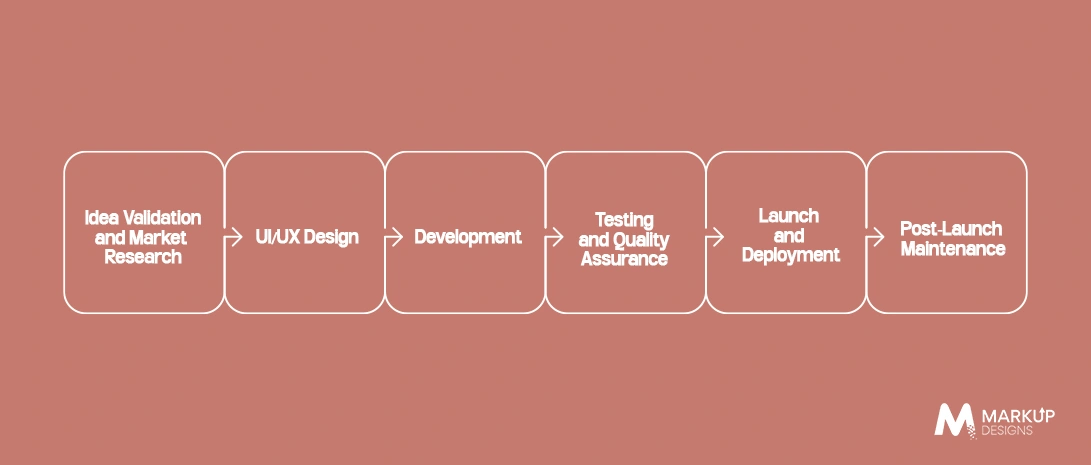
Building a mobile app is not just about writing code. It is a process with clear stages, and skipping any stage creates problems later.
Stage 1: Idea Validation and Market Research
Before spending money on development, make sure people actually want what you are building. Talk to at least 30 to 50 potential users. Do not ask them if they would use your app. Show them a rough sketch and ask them to walk you through how they would use it. Watch where they get confused. Run a simple landing page with a sign-up form to measure real interest.
Stage 2: UI/UX Design
Users expect apps to look modern, premium, and easy to use. A simple or outdated design can quickly push users away, which is why creating a smooth and visually appealing app experience is important.
Stage 3: Development
A professional development team works in two-week sprints called agile cycles. Every two weeks, you see a working piece of the app. This keeps the project on track, and lets you make small changes before they become expensive problems. Your development stack will typically include Flutter or React Native on the frontend, Node.js or Python on the backend, and AWS or Azure for cloud hosting with a UAE data center.
Stage 4: Testing and Quality Assurance
Quality assurance should be an independent and structured process, and not an extension of development. Relying on developers to test their own code often leads to overlooked issues. Instead, startups should implement a dedicated QA function to ensure objective and comprehensive testing.
Stage 5: Launch and Deployment
Getting on the App Store and Google Play takes longer than most founders expect. Apple’s review process alone can take one to two weeks. Both app stores have strict guidelines about the types of apps they approve for publishing. Work with a development partner who has recently launched apps on both stores and knows the latest guidelines. Before going fully public, always start with a soft launch, put your app in front of a small group of real users, gather their feedback, iron out the issues, and then open the doors with confidence.
Stage 6: Post-Launch Maintenance
App launch is not the finish line; it’s the starting point for continuous improvement. Startups should plan ongoing maintenance from day one, typically allocating 15–20% of the initial development cost annually. This budget covers essential updates such as OS compatibility, security patches, bug fixes, and performance optimization. It also enables the addition of new features based on real user behavior and analytics.
Cost of Mobile App Development in UAE
This is the question every founder asks first, and the honest answer is, it depends. But here are the numbers.
| App Type | Estimated Cost (AED) | Key Features Included |
| Basic App | AED 40,000 – 80,000 | Simple UI, basic features, minimal backend |
| Mid-Level App | AED 80,000 – 200,000 | User authentication, APIs, payment integration |
| Advanced App | AED 200,000 – 500,000+ | AI features, real-time sync, and an advanced backend |
| Enterprise App | AED 500,000 – 1,000,000+ | Custom architecture, scalability, and integrations |
Why Partner with Markup Designs for Mobile App Development in UAE?
Choosing the right development partner is just as important as having a great app idea. We at Markup Designs have been helping UAE startups and businesses build mobile apps that actually work in the real market.
From Arabic right-to-left layouts to local payment gateways and UAE Pass integration, everything is designed with the local user in mind.
Our process is simple and transparent. You know what we are building, when you will see it, and what it costs before a single line of code is written. Our milestones are clear, and our communication is consistent throughout the project.
We also do not disappear after launch. Post-launch support, maintenance, and feature updates are part of how we work, not an afterthought. If you have an app idea and want a team that treats your project with the attention it deserves, we are the partner to call.
The Future of Mobile App Development in UAE
The next three to five years will bring even more change. These are the areas worth watching.
Smart city integrations are coming. Dubai and Abu Dhabi are building city-level data platforms. Apps that can connect to these platforms and offer services tied to city data, including traffic, public transport, and utilities, will have enormous advantages.
Voice interfaces are growing, especially in Arabic. As voice recognition in Arabic continues to improve, hands-free apps are becoming a powerful advantage. A significant segment of UAE population naturally prefers speaking over typing, and building for that behavior puts your app ahead of the curve.
IoT integration means your app could connect to smart home devices, vehicles, or medical equipment. With 5G enabling faster device-to-device communication, these use cases are becoming practical for startups, not just large enterprises.
Blockchain-based identity and payment systems are being explored by UAE government. Startups that build with modern infrastructure now will be ready when these systems become mainstream in the region.
FAQ
1. How much does it cost to build an app in UAE?
A basic MVP starts at around $8,000. A mid-level app with full features costs $20,000 to $50,000. Complex platforms with marketplace features, video, or deep integrations cost $60,000 and above. Cross-platform development using Flutter saves 30 to 40% compared to building separate native apps.
2. How long does it take to develop a mobile app?
A simple MVP takes 8 to 12 weeks. A standard full-featured app takes 3 to 6 months. A complex enterprise platform can take 9 to 14 months. The timeline depends heavily on how clearly the requirements are defined at the start.
3. Which platform should a startup choose, iOS or Android?
In UAE, Android has about 68% market share, and iOS has about 31%. For mass-market reach, Android should be your priority. For premium or business users, iOS matters more. Most startups use Flutter to build both at once and cut costs significantly.
4. Do I need a local partner to launch in UAE?
Not necessarily. Free zones like Dubai Internet City, DIFC, and Hub71 allow 100% foreign ownership. If you set up on the mainland in certain regulated sectors, local requirements may apply. A local business setup consultant can guide you to the right structure for your situation.
5. What are the legal requirements for app development in UAE?
You need a valid business license. Apps collecting user data must comply with the PDPL data protection law. Fintech apps need Central Bank approval. Healthtech apps need Ministry of Health compliance. Payment gateways must be licensed locally. Trademark registration for your brand name and logo is strongly recommended from day one.
Final Thoughts
UAE is one of the best markets in the world to launch a mobile app right now as a startup owner. The users are there, the infrastructure is there, the government support is there, and investors are actively looking for the next big digital product coming out of this region.
But none of that means success is guaranteed. The startups that win here are the ones that do their research, validate their ideas before spending big, choose the right technology and development partner, and stay focused on solving a real problem for a specific group of people.
The right app, built the right way, in the right market, at the right time, can grow into something that reaches millions of people across the Middle East and beyond.
Transform Your Idea Into an App That People Trust
Build a powerful real estate app designed to deliver seamless property discovery, secure transactions, and exceptional user experiences. From AI-powered search features to scalable cloud infrastructure, create a platform that attracts users, builds credibility, and drives long-term business growth.

Author's Perspective
Building a mobile app in UAE means entering a fast-paced, highly competitive digital market. Startups succeed not by spending more, but by understanding users, moving quickly, and making smart tech decisions. The market rewards speed, clarity, and seamless user experience, while poor performance or weak localization can drive users away. Start lean, validate early, and build with scalability in mind to succeed in this high-growth ecosystem.
Discuss Your Project NowGaurav Goyal
Global Sales- VP
Related Posts

How Much Does It Cost to Build an...

How to Build a Car Wash App: Development...

Benefits of Mobile App Development for Businesses in...
Insights Are Valuable & Execution is Priceless
You’ve read about the digital future. Now, let’s build the infrastructure to take you there. Move your strategy from the page to the product.
Design Your Solution Now
Contact Us
Schedule The Appointment At Your Convenience Date And Time.
30 Min
Web Conference
Time Zone
Indian standard time (08:30pm)

Thanks For Getting In Touch!
You’ve Taken The First Step Toward Transforming Your Digital Presence. Our Experts Will Reach Out Shortly To Take It Forward.
Launch Your Dream Project
Provide a brief overview of your project, and our specialists will evaluate your requirements. We will connect with you to explore how the right digital solutions can help you launch faster.