

In Brief
- The importance of mobile application security to today’s enterprises.
- The crucial Australian regulations and the associated mobile application security compliance requirements.
- The steps to develop a secure mobile application.
- The key security framework for all applications and best practices for mobile application security.
- The significance of working with DevSecOps and mobile application security testing.
- The various factors that influence the secure application development costs for Australian businesses.
The booming nature of Australia’s digital economy means that the importance of creating secure mobile apps is now a business issue as much as it is a technical one. With huge volumes of personal data in the fintech, healthcare, retail, and government sectors, end-to-end security throughout an application’s development will be required.
The cyber threat landscape is becoming even more difficult to navigate. The Australian Signals Directorate (ASD) Annual Cyber Threat Report 2023-24 has detailed that Australia received more than 87,400 reports of cybercrime during 2023, with 69% of businesses experiencing ransomware attacks in 2024, rising from 56% in 2023. Along with the number of incidents occurring, cybercrime is also highly expensive to small businesses, with an estimated cost of $300 million per year to Australian small businesses from these incidents, with the average cybercrime incident costing $46,000 for small, $97,200 for medium, and $71,600 for large organisations. Due to these rising threats, the Australian Government is reviewing its Cyber Security Strategy 2023-2030 and is advising businesses to move towards adopting secure-by-design app development processes. (Annual Cyber Threat Report 2023-2024 | Cyber.gov.au)
Regardless of whether you are developing a secure app as a startup or an enterprise organisation in Australia, security is an integral part of the entire development lifecycle, from initial planning, through coding, deployment, and compliance, and into ongoing monitoring.
This blog will help you securely develop applications while providing a comprehensive overview of the app development life cycle, security requirements, compliance standards, and the app’s secure development costs.
Why App Security Matters More Than Ever in Australia

There are increasing numbers of cyber-attacks, growing sophistication of attackers, and the increased number of applications storing customer information (i.e., name, date of birth, address), payment information, health records, and critical business information (i.e., customer databases, software tools, etc.), all being targeted in cyber attacks. Furthermore, the complexity of applications, driven by the growth of cloud-based services, multiple APIs, and third-party application integrations, underscores the need for proactive and multi-layered security measures for all components of an application.
Without implementing adequate security measures, organizations are exposing themselves to reputational harm, fines from regulatory authorities, financial losses, lost business, operational downtime, and creating distrust among their customers. Organizations can mitigate their risks by implementing mobile application security’s best practices, enacting DevSecOps, and undertaking continuous mobile application security testing, as well as providing their mobile application security to customers, ultimately increasing the number of scalable, secure, and compliant mobile applications.
Australia’s Regulatory Framework
Developing secure applications may also relate to building applications that adhere to Australia’s regulations of cybersecurity and privacy.
Privacy Act 1988 & Australian Privacy Principles (APPs)
The Australian Privacy Principles (APPs) and the Privacy Act 1988 provide regulations for organisations on how they will use, collect, store, and protect personal information. Secure applications must be designed with privacy by design, user consent management, secure storage, and access control to data.
Detailed information- Australian Privacy Principles | OAIC
Cyber Security Bill 2024 (Cth)
The Cyber Security Bill, which was introduced in 2024 (Cth), provides stronger governance of cyber security, continuous monitoring, secured software development, incident reporting, and the protection of critical infrastructure, thereby providing a holistic security by design approach when developing applications.
Consumer Data Right (CDR)
The CDR facilitates the secure sharing of data between two or more sectors, for example, banking, energy, and telecommunications. The CDR business must use secure API’s, encrypted data, authenticated users, and establish strong access control processes.
Australian Cyber Security Centre (ACSC) Essential Eight
The ACSC recommends the Essential Eight mitigation strategies to help achieve secure applications. The strategies are:
– Application Whitelisting
– Patch Management
– Multi-Factor Authentication (MFA)
– Restricting Administrative Privileges
Why Compliance Matters
Implementing compliance as part of the application security framework in Australia at the initial development phase will reduce ongoing security risks, simplify adherence to regulations, create consumer confidence, and secure long-term business viability.
How to Build a Secure App in Australia: Step-by-Step Process
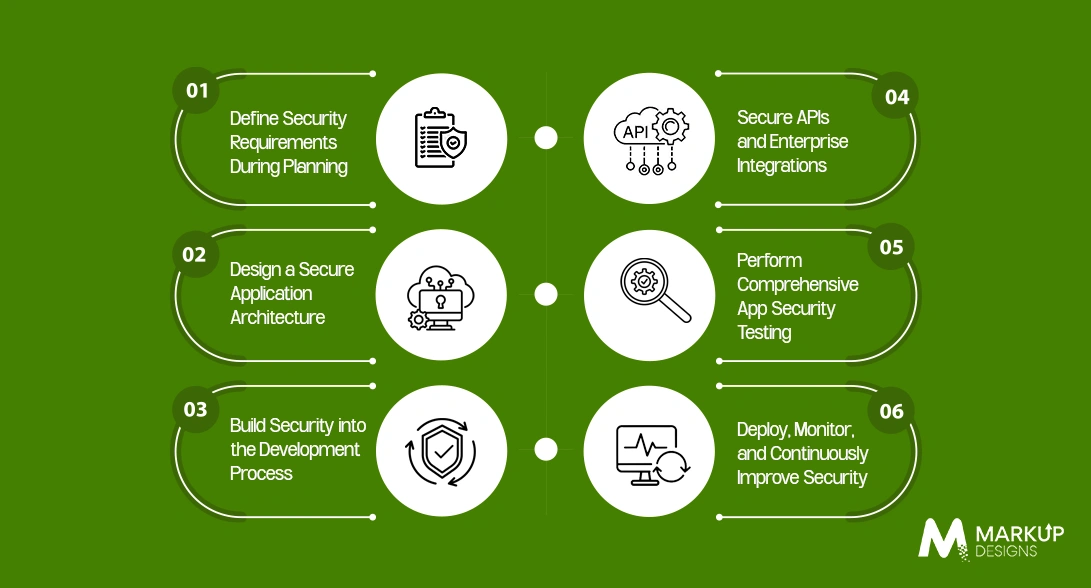
To develop a secure application, an Australian business must do much more than just simply add a few security features to the application prior to going live. Security must be built into every stage of the application development life cycle so that any vulnerabilities in the application are identified as early as possible, instead of detecting them after the application has gone live. This approach to application security helps to protect users’ sensitive data, as well as assist organisations in meeting their obligations under Australian legislation and reducing the costs of remediating security issues, and establishing trust with customers.
Step 1: Define Security Requirements During Planning
Every secure application starts with a clearly defined strategy for ensuring the security of the application. During the planning phase, it is essential for businesses to establish what type of information will be collected, processed, stored, and/or transmitted by the application, and what level of risk will exist based on that information. A critical component of the planning phase is to perform threat modelling to allow the development team to identify ways in which the application could be attacked before they begin developing the application.
As part of their plans for developing the application, organisations must also ensure that they adhere to their regulatory obligations outlined within the Privacy Act 1988, as well as the Australian Privacy Principles (APPs), the Consumer Data Right (CDR) (if applicable), and the proposed Cyber Security Bill 2024 (Cth). Addressing these requirements during the project planning will save an organisation from having to redesign the application later, and support in assisting an organisation in establishing a robust application security framework that will comply with regulations and evolve into a sustainable security model.
Step 2: Design a Secure Application Architecture
A secure architecture is key to developing a secure mobile application. Security controls should not be added after the development of an application; they should be part of the application’s design from the beginning. All components shall be designed with security in mind, including the mobile interface, backend services, APIs, cloud structure, and databases.
This stage of development will implement end-to-end encryption for sensitive data, encrypting the data both in transit and at rest, securing API communications using either HTTPS or OAuth 2.0, enforcing Role-Based Access Controls (RBAC), and implementing Multi-Factor Authentication (MFA) using biometrics or other methods when appropriate. Many organizations are adopting a Zero Trust Security Model where every user, device, or application request for access must be verified each time before approval, reducing the potential for unauthorized access.
Step 3: Build Security into the Development Process
Securely writing code is one of the most essential parts of maintaining a secure mobile application in Australia. In order to decrease vulnerabilities such as SQL injection, Cross-Site Scripting (XSS), weak authentication, broken access control, and incorrectly implementing APIs, developers are strongly encouraged to adhere to secure coding standards. Input validation, best practice session management, dependency management, and proper error handling need to be used as standard development practices and not as optional enhancements.
Companies in Australia are increasingly adopting DevSecOps Australia, a method of integrating security into the CI/CD pipeline rather than treating it as a separate process. Automated code scanning, vulnerability detection, secret management and dependency analysis allow teams to detect security problems much earlier in the development process. This results in higher quality software while also saving substantial amounts of time and money through reduced costs for repairing identified vulnerabilities.
Step 4: Secure APIs and Enterprise Integrations
Modern applications typically do not operate alone. They communicate with multiple external sources, such as payment gateways, Customer Relationship Management (CRM) applications, Enterprise Resource Planning (ERP) systems, cloud computing applications, healthcare-related platforms, and many third-party APIs. Each integration represents an additional potential entry point for attackers and, therefore, will be very important in establishing best practices for securing applications through the implementation of security for APIs.
To secure APIs, organisations must establish token authentication, apply OAuth 2.0 for authorisation, communicate securely over HTTPS, use an API Gateway, employ rate limiting, and perform continual monitoring to identify suspected activity. Similarly, and as further protection of organisations’ software supply chains, development teams should constantly monitor third-party libraries and maintain a Software Bill of Materials (SBOM) to allow them to quickly identify vulnerable dependencies before they can be exploited.
Step 5: Perform Comprehensive App Security Testing
Before any secure application can be deployed into production, a thorough testing of the system’s security features must occur. It would be a mistake to only run security tests at the end of development when the product is ready for launch. Developers should be continuously reviewing and testing their development efforts for potential vulnerabilities before they become risks once deployed into the production environment.
Successful test plans will contain several types of testing: Static Application Security Testing (SAST); Dynamic Application Security Testing (DAST); penetration tests; security testing of APIs; authentication testing; security testing of cloud-based applications; and full vulnerability assessments. Continuous testing increases the security of developed applications, allows organizations to demonstrate compliance against Australia’s regulatory security requirements, and aligns with the expectations of the Australian Cyber Security Centre (ACSC) and the goals of the Australian Government’s Cyber Security Strategy 2023-2030.
Step 6: Deploy, Monitor, and Continuously Improve Security
Developers’ responsibility to protect the security of their applications does not stop when launching into production. Cybersecurity threats continue to develop, and organizations must take proactive measures to strengthen their applications and infrastructure after going live through effective monitoring and maintenance of application security. Regular monitoring of systems through patch management, vulnerability remediation, credential rotation, log analysis, and infrastructure monitoring will alert organizations to new vulnerabilities before they
can cause business loss.
Ongoing monitoring will help organizations meet their obligations to continue developing towards Australia’s ever-changing cybersecurity landscape, including providing guidance to organizations via the ACSC and supporting the overall direction and goals of the Australian Government’s Cyber Security Strategy 2023-2030. By combining continuous monitoring with mature DevSecOps Australia practices, organizations can rapidly respond to new threats, maintain regulatory compliance, and ensure their applications remain secure throughout their lifecycle.
Emerging Security Trends in Australia
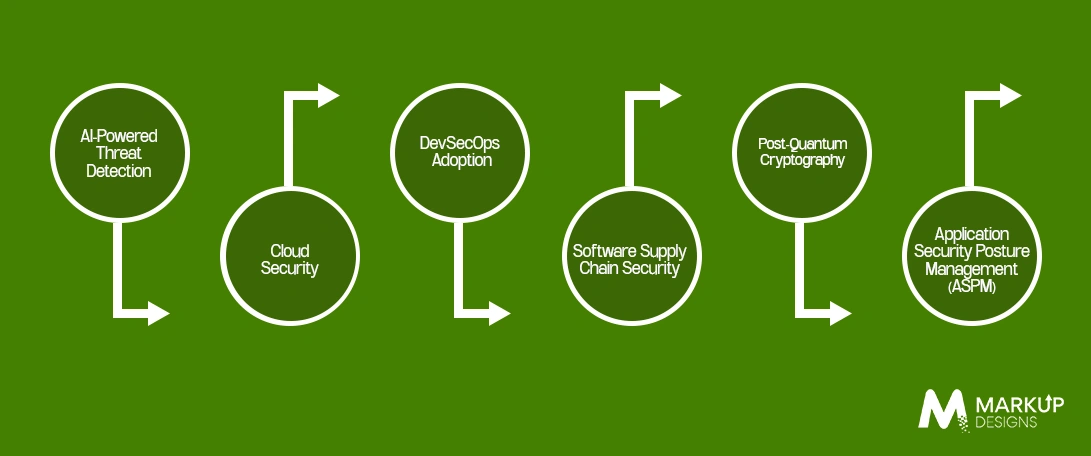
Companies face an increasing number of cyber threats. In order to stay secure from these threats, companies must use modern technology solutions to keep mobile applications secure, stay compliant, and build long-term resiliency.
AI Powered Threats Detection
AI is changing the way cybersecurity is working by providing real-time threat detection, behaviour analysis, and automated incident response capabilities. Attackers are utilising AI for more sophisticated attack methods than ever before, while companies use machine learning for detecting abnormal behaviour and accelerating their response time to provide better overall application security.
Cloud Security
Since the majority of mobile applications are reliant on cloud infrastructure for their operation, securing these cloud environments is now business-critical. Companies are now deploying Cloud Security Posture Management (CSPM) products to identify misconfiguration, secure API’s, strengthen identity management, and continuously monitor resources in the cloud to ensure that sensitive customer data is being managed securely.
DevSecOps Adoption
Companies view security as no longer being an activity performed at the end of an event. Through their use of DevSecOps, companies are now implementing automated security checks, vulnerability assessments, compliance checks, and other security feature functions directly into their CI/CD pipelines. As a result, these companies can identify issues earlier in the process, reduce remediation costs, and quickly bring their secure applications to market.
Software Supply Chain Security
Modern applications depend heavily on open-source libraries and other third-party components. By maintaining an SBOM, companies can proactively manage their software supply chain risk by tracking software dependencies, locating any vulnerable packages, and reducing risks before deploying production systems.
Post Quantum Cryptography
With the rise of quantum computers, many industries are looking into Post Quantum Cryptography (PQC) to protect confidential data from future threats posed by next-generation computers. Industries including financial services, health care, and defence are preparing for these new cryptographic challenges.
Application Security Posture Management
As more companies adopt Application Security Posture Management (ASPM) platforms to consolidate vulnerability data, manage compliance, prioritize risks, and get central visibility across their applications, they will be able to effectively manage application security.
Secure App Development Costs in Australia
Secure app development costs in Australia vary based on a number of factors, including application complexity, security requirements, compliance requirements, integrations and ongoing maintenance. On average, secure app development prices will be in the range of USD $5,000 – $100,000 (approximately AUD $7800 – $154,000).
Generally, if an application has baseline security, it includes secure coding, SSL/TLS encryption, authentication, vulnerability scanning, and the minimum level of compliance. If an enterprise is developing applications that will handle financial, health or government data, they should incorporate the highest levels of security into their applications, such as end-to-end encryption, threat modelling, penetration testing, multi-factor authentication (MFA), cloud security, continuous monitoring, and DevSecOps, which will significantly increase development costs.
While developing a secure application may incur additional costs, it will be less expensive to remediate vulnerabilities found during development compared to the price of paying regulatory fines, covering the costs of a data breach, or repairing or replacing damaged reputations after an application is deployed.
Common Challenges in Secure App Development
One of the primary obstacles to secure application development in Australia is keeping up with the ever-changing threat environment. To mitigate potential cyber threats, companies need to continually adjust their approach to securing their applications.
Additionally, organisations have difficulty balancing usability and security when designing applications. High levels of authentication can result in increased protection; however, excessive authentication creates a barrier between users and their ability to access the system. By taking a Minimum Viable Security (MVS) approach to implementing security within your apps, organisations can achieve the right balance between security and usability.
In addition, when operating across multiple regions, organisations have to deal with increasingly complex compliance requirements. As well as adhering to the range of Australian Laws, including the Privacy Act 1988, the Australian Privacy Principles (APPs), and the Consumer Data Right (CDR), organisations may also need to comply with various international standards, including the General Data Protection Regulation (GDPR) and the Health Insurance Portability and Accountability Act (HIPAA).
Finally, with Australia’s growing cybersecurity skills shortage, organisations are often challenged to locate suitably qualified security professionals. To resolve this issue, many organisations partner with third-party development companies that possess the necessary security expertise and have demonstrated an ability to develop secure architectures, understand and comply with regulations, develop and manage cloud security solutions, and be able to perform ongoing monitoring of developed applications for potential breaches in security.
Best Practices for Developing a Secure Application in Australia

Building a secure application requires more than just meeting regulatory compliance; it requires organisations and their development teams to adopt a proactive security-first mindset throughout the entire development process.
Businesses should adopt a security-by-design approach, integrate continuous app security testing, implement Multi-Factor Authentication (MFA), encrypt sensitive data both at rest and in transit, and secure APIs using protocols such as OAuth 2.0 and HTTPS. Following the Australian Cyber Security Centre (ACSC) Essential Eight, embedding DevSecOps Australia practices into CI/CD pipelines, and conducting regular vulnerability assessments help organizations strengthen security while maintaining compliance and reducing long-term risks.
Why Choose Markup Designs for Secure App Development?
Markup Designs specializes in the design and development of secure, scalable software solutions and has extensive expertise in developing mobile applications that are in compliance with Australian Cyber Security requirements.
We start by creating secure applications at the design stage and consider security, from design to deployment and ongoing maintenance, as we develop your mobile application, ensuring that sensitive business and customer information is protected, in addition to ensuring Australian regulatory and compliance requirements are being met while the application is being developed.
Our team of developers follows the app security best practices outlined by our industry, utilises secure coding standards, performs complete application security testing, and utilises the DevSecOps development process methodology to identify and address application security weaknesses earlier than the traditional development process could.
Our developers create secure applications following Australian Cyber Security regulatory and compliance standards; including end-to-end encryption, secure APIs, Role-Based Access Control (RBAC), Multi-Factor Authentication (MFA), and a secure cloud environment, while design and development activities are being completed in compliance with the requirements of the Privacy Act 1988, Australian Privacy Principles (APPs), Consumer Data Right (CDR) and ACSC Essential Eight.
Build Secure Mobile Applications That Clients Can Trust
Protect your clients from cyber threats and meet Australian regulatory compliance by creating secure applications that meet the security needs of your clients from the design stage through to the application’s release and ongoing maintenance.

Conclusion
Security must be prioritized at all stages of development for secure application development in Australia. Organizations must recognize that the development of secure applications goes well beyond functional aspects and take into consideration all aspects related to security, such as regulatory compliance, secure architecture, continuous monitoring, and emerging technologies, including Artificial Intelligence (AI)-driven threat detection, Cloud Security Posture Management (CSPM), Software Bill of Materials (SBOM), and Application Security Posture Management (ASPM). The model of modern application security is based on the premise of ongoing improvement by creating and maintaining an application, rather than relying on a single event to deliver secure applications.
The cost to develop a secure app in Australia is influenced by project complexity and compliance requirements. However, by making a commitment to invest in security at the outset of a project, an organization’s risk of incurring significant financial losses from cyberattacks, regulatory fines, and damage to its reputation can be substantially reduced. Securing mobile application development, following an effective application security framework in Australia and integrating DevSecOps in Australia, will enable organizations to create applications that are resilient, protect user data, meet compliance obligations, and enable sustainable digital growth.
FAQs
1. What are the steps to developing a secure app in Australia?
The overall steps to developing a secure app include putting appropriate security measures into place throughout the development lifecycle, such as threat modelling, secure architecture, encryption, Multi-Factor Authentication (MFA), secure Application Programming Interfaces (APIs), continuous app security testing, and compliance with Australian government standards, such as the Privacy Act 1988, APPs, CDR, and the ACSC Essential Eight.
2. What is the approximate cost for a Secure app development in Australia
The cost can range from USD$5,000.00 to USD$100,000.00 (Approx. AUD$7,800-AUD$154,000) depending on complexity, the types of security features needed, whether or not government and regulatory compliance is required, and how much integration and/or testing is needed before going live.
3. How is DevSecOps critical for secure mobile applications development?
It puts security throughout all phases of software development, so you can automate vulnerability scans, provide continuous compliance checks, and quickly remediate security violations before the application is deployed.
4. What are the top risks to mobile app security in Australia?
Poorly designed or unprotected APIs, weak authentication methods, unprotected data, poorly configured clouds, insecure software supply chain vulnerabilities, and inadequate security testing. By implementing good security controls and ongoing monitoring, you can greatly reduce your risk.
Author's Perspective
Developing a secure application is no longer simply an IT responsibility; it’s now a business requirement. As Australia’s cybersecurity regulations continue to evolve and cyber threats become more sophisticated, organizations that integrate security from day one will be better positioned to protect customer trust, ensure compliance, and support long-term digital growth. Rather than viewing security as an additional expense, I suggest that businesses should see it as a strategic investment that safeguards their applications, reputation, and future success.
Discuss Your Project NowJupinder Singh Arora
Founder and CEO
Related Posts

How to Build a Car Wash App: Development...

Benefits of Mobile App Development for Businesses in...

Complete Guide to Hiring Mobile App Developers in...
Insights Are Valuable & Execution is Priceless
You’ve read about the digital future. Now, let’s build the infrastructure to take you there. Move your strategy from the page to the product.
Design Your Solution Now
Contact Us
Schedule The Appointment At Your Convenience Date And Time.
30 Min
Web Conference
Time Zone
Indian standard time (08:30pm)

Thanks For Getting In Touch!
You’ve Taken The First Step Toward Transforming Your Digital Presence. Our Experts Will Reach Out Shortly To Take It Forward.
Launch Your Dream Project
Provide a brief overview of your project, and our specialists will evaluate your requirements. We will connect with you to explore how the right digital solutions can help you launch faster.