

In Brief
- UAE is rapidly transforming into an AI-driven economy through smart infrastructure, automation, and digital innovation initiatives.
- Artificial intelligence is helping industries improve efficiency, reduce manual work, and deliver smarter customer experiences.
- Real statistics show strong AI momentum, including billions in projected economic contribution and rising AI tool adoption among organizations and consumers.
- AI-powered smart cities, predictive healthcare, intelligent banking systems, and automated services are becoming more common across UAE.
- Challenges like cybersecurity concerns, lack of AI talent, legacy systems, and high implementation costs still impact AI growth.
- By 2030, UAE is expected to witness stronger AI integration across education, government services, mobility, and enterprise operations.
A few years ago, many organizations across UAE were still dependent on manual operations, traditional customer support systems, disconnected data, and slow decision-making processes. Industries were struggling to manage rising customer expectations, increasing operational costs, and the growing pressure to deliver faster digital experiences.
At the same time, consumers were expecting smarter services, personalized recommendations, and seamless online interactions. This growing gap between traditional systems and modern digital demands created an urgent need for intelligent technologies.
This is where UAE started accelerating its adoption of artificial intelligence across industries. From smart healthcare systems and AI-powered banking to automated retail experiences and intelligent government services, AI is helping organizations improve efficiency, minimize repetitive tasks, and make faster, data-driven decisions.
The rapid growth of UAE AI economy is also encouraging innovation, attracting global technology investments, and accelerating AI adoption across multiple sectors.
Today, the future of AI looks more promising than ever as the country continues investing in digital infrastructure, smart cities, and emerging technologies.
In this blog, we will explore the growing role of AI in UAE’s economy, major industry trends, real statistics, future opportunities, implementation costs, and the challenges shaping the country’s AI-driven future.
Understanding Artificial Intelligence
Artificial Intelligence refers to technology that enables machines and software systems to perform tasks that normally require human intelligence. These tasks include learning from data, understanding language, recognizing patterns, solving problems, and making decisions.
Over the last few years, AI adoption in UAE has grown rapidly across different industries, helping improve efficiency, innovation, and digital experiences.
Hospitals are using AI for faster diagnostics, banks are implementing intelligent fraud detection systems, and retail platforms are offering personalized shopping experiences based on customer behavior. Even government services are becoming smarter through automation and predictive technologies.
One of the biggest reasons behind this rapid transformation is UAE’s long-term vision for a technology-driven economy. Strong digital infrastructure, cloud computing investments, and smart city initiatives are creating the ideal environment for AI growth.
Instead of viewing AI as a future concept, UAE is already integrating intelligent technologies into real-world operations to improve productivity, customer experiences, and decision-making across industries.
Why UAE is Becoming a Global AI Leader
UAE is not just adopting artificial intelligence technologies – it is actively building an ecosystem designed to support long-term innovation and digital growth. Over the years, the country has introduced multiple government-led initiatives focused on advanced technologies, smart infrastructure, and future-ready economic development. This strong vision is one of the biggest reasons behind the rapid growth of AI development in UAE.
One of the most significant steps was the launch of UAE Artificial Intelligence Strategy 2031, which aims to position the nation among the world’s leading AI-powered economies. The government has also invested heavily in smart city projects, research centers, digital infrastructure, and cloud technologies to create an environment where innovation can scale faster.
Cities like Dubai and Abu Dhabi are already using AI in transportation systems, public safety, healthcare services, and urban planning. At the same time, international technology companies and startups are increasingly choosing UAE as their regional innovation hub because of its supportive regulations, modern infrastructure, and growing investment opportunities.
Another major advantage is the country’s ability to quickly adapt to emerging technologies. Instead of slowly experimenting with AI, UAE is actively integrating intelligent systems into real-world operations, making it one of the fastest-growing digital economies in the Middle East.
Read Also: Why Dubai is Becoming the AI Capital of the Middle East
Real Statistics Showing AI Growth in UAE
UAE’s AI transformation is no longer just a future vision. Real market data already shows how rapidly the country is investing in intelligent technologies, cloud infrastructure, and automation. The steady rise of UAE AI Innovation market growth reflects how seriously the nation is building a technology-driven economy.
Here are some real statistics highlighting this momentum:
- According to Public First’s Google UAE report, generative AI could contribute nearly AED 298 billion to UAE economy, equivalent to around 19% of the country’s Gross Value Added (GVA).
- The same report revealed that 91% of organizations in UAE already use at least one AI tool in their workflows, while 87% believe AI is a major economic opportunity.
- Research by P&S Intelligence estimates that UAE artificial intelligence market will reach USD 7.1 billion by 2032, growing at a CAGR of 7.4%.
- Reports also show that UAE government aims for AI to contribute around AED 335 billion to the national economy by 2031 through large-scale digital transformation initiatives.
- Public First research further highlights that 78% of adults in UAE already use AI tools, with nearly 30% using them regularly in daily activities.
These numbers clearly show that AI adoption in UAE is moving beyond experimentation. From healthcare and banking to logistics and smart cities, artificial intelligence is becoming a major driver of productivity, innovation, and long-term economic growth.
How AI is Reshaping Major Industries in UAE
Artificial intelligence is transforming almost every major industry in UAE. As organizations across UAE continue investing in automation, predictive analytics, and intelligent systems, the demand for advanced AI solutions is growing rapidly across both public and private sectors.
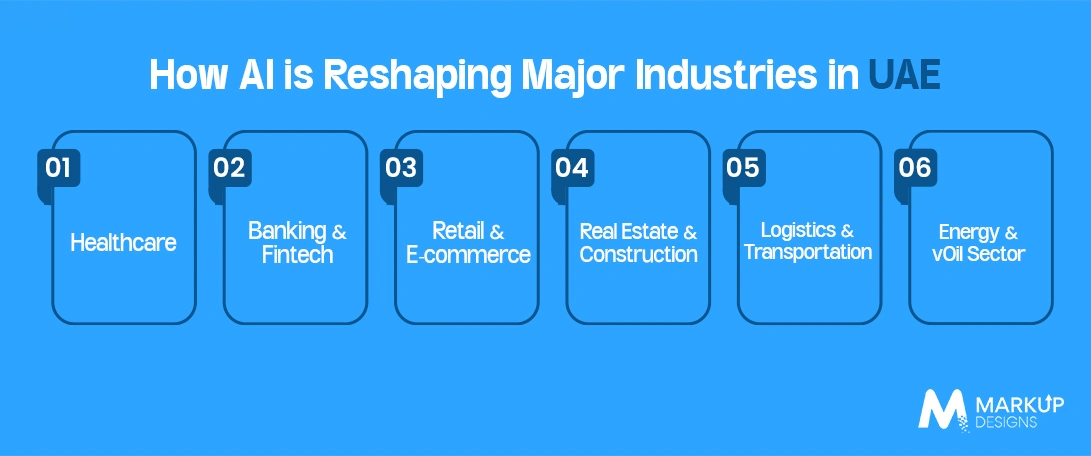
- Healthcare
AI is helping healthcare providers improve diagnostics, patient monitoring, and treatment planning. Hospitals are using intelligent systems to analyze medical data faster, reduce manual workloads, and improve patient experiences. Virtual health assistants and AI-powered diagnostic tools are also becoming more common across UAE healthcare sector.
- Banking & Fintech
Financial institutions are using AI to strengthen fraud detection, automate customer support, and deliver more personalized banking experiences. Intelligent systems are helping banks process data faster while improving security and operational efficiency.
- Retail & E-commerce
Retail brands are using AI-powered recommendation engines, customer behavior analysis, and smart inventory systems to improve shopping experiences. Personalized product suggestions and automated support systems are becoming standard across online platforms.
- Real Estate & Construction
AI is supporting smarter property management, predictive maintenance, and data-driven real estate analysis. Developers are also using intelligent technologies in smart building projects and urban planning initiatives.
- Logistics & Transportation
Transportation and logistics companies are implementing AI for route optimization, fleet management, and smart traffic systems. These technologies help reduce delays, improve fuel efficiency, and support smarter mobility solutions across UAE cities.
- Energy & Oil Sector
UAE’s energy sector is increasingly using AI for predictive monitoring, operational automation, and sustainability optimization. Intelligent systems help reduce downtime, improve equipment performance, and support more efficient resource management.
Read Also: How AI Is Transforming UAE Businesses
The Cost of AI Development and Adoption
The growing demand for intelligent technologies is encouraging organizations across UAE to invest more in automation, analytics, and smart digital systems. As AI technology trends in UAE continue evolving, the cost of AI implementation can vary depending on project complexity, infrastructure requirements, integrations, and long-term scalability goals.
Simple AI solutions like chatbots or workflow automation tools are generally more affordable because they require limited customization.
On the other hand, enterprise AI platforms involving predictive analytics, machine learning, and real-time data processing require larger investments and stronger cloud infrastructure.
Estimated AI Development Costs in UAE
| AI Solution Type | Estimated Cost | Best For |
| Basic AI Chatbots & Automation | AED 20,000 – AED 80,000 | Customer support, workflow automation, basic virtual assistants |
| Mid-Level Predictive AI Systems | AED 80,000 – AED 250,000 | Analytics, forecasting, recommendation systems, operational insights |
| Enterprise AI Platforms & Custom Models | AED 250,000 – AED 1M+ | Large-scale automation, advanced AI integration, enterprise operations |
Factors That Affect AI Development Costs
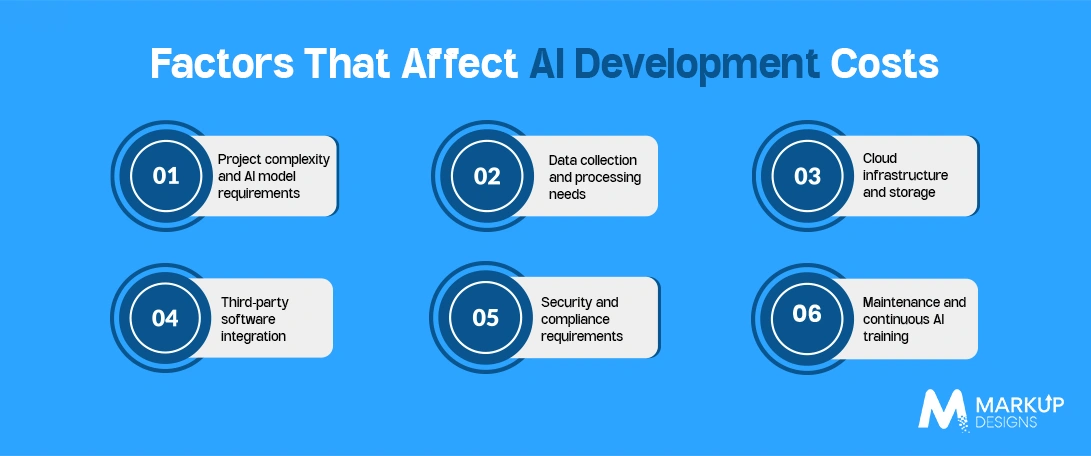
- Project complexity and AI model requirements
- Data collection and processing needs
- Cloud infrastructure and storage
- Third-party software integrations
- Security and compliance requirements
- Maintenance and continuous AI training
Despite the upfront investment, AI helps improve efficiency, reduce repetitive work, and support faster decision-making, making it a long-term technology investment for many organizations.
Challenges Slowing AI Growth in UAE
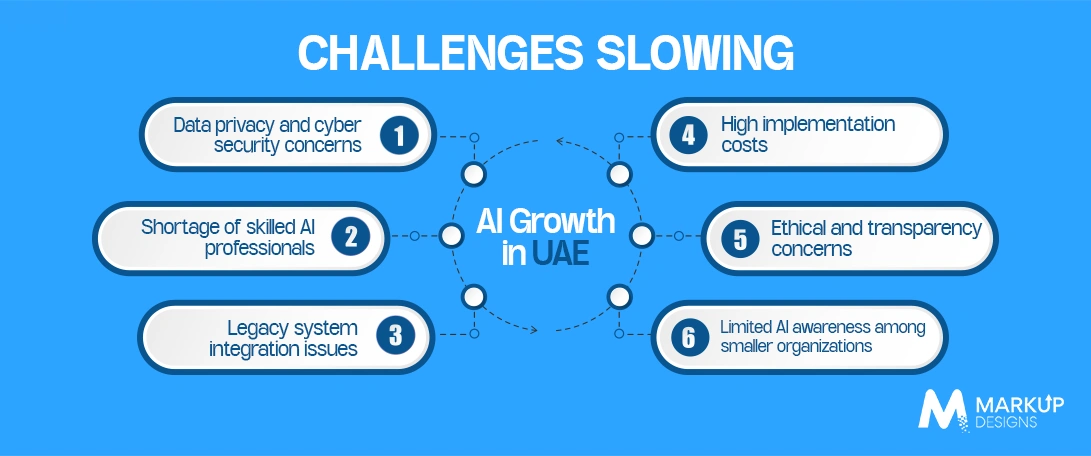
While AI adoption is expanding rapidly, several challenges still impact the pace of AI digital transformation across industries. Major challenges include:
- Data privacy and cybersecurity concerns
AI systems rely heavily on data, making security and compliance a major priority.
- Shortage of skilled AI professionals
The demand for AI engineers, machine learning experts, and data scientists continues to grow faster than available talent.
- Legacy system integration issues
Many organizations still operate on outdated systems that are difficult to integrate with modern AI technologies.
- High implementation costs
Advanced AI solutions often require strong infrastructure, cloud systems, and continuous maintenance.
- Ethical and transparency concerns
Organizations are becoming more cautious about how AI systems make decisions and use customer data.
- Limited AI awareness among smaller organizations
Some companies still lack a clear understanding of how AI can improve operations and customer experiences.
To address these challenges, the UAE government is investing heavily in AI education, innovation hubs, smart regulations, and digital infrastructure to support long-term technology growth.
What an AI-Powered UAE Could Look Like by 2030
UAE is moving steadily toward a future where artificial intelligence becomes part of everyday life, industry operations, and national development strategies. The growing focus on the future of AI-Powered technology in UAE is not limited to automation alone – it is about building a smarter, faster, and more connected economy driven by intelligent technologies.
By 2030, AI is expected to play a major role in smart city infrastructure, autonomous transportation, personalized healthcare, digital education, and advanced government services.
Cities like Dubai and Abu Dhabi are already investing in intelligent traffic systems, smart energy management, and AI-powered public services designed to improve efficiency and citizen experiences.
Healthcare systems may become more predictive and personalized through AI-driven diagnostics and patient monitoring tools. Similarly, education platforms could use AI to create adaptive learning experiences based on individual student performance and behavior.
UAE is also expected to see rapid growth in AI startups, research centers, cloud innovation, and intelligent automation across industries.
As investments continue increasing, artificial intelligence will likely become one of the strongest contributors to the country’s long-term economic and technological growth.
Conclusion
Artificial intelligence is rapidly becoming one of the strongest forces shaping UAE’s digital future. From healthcare and banking to logistics, retail, and smart city infrastructure, AI is helping industries improve efficiency, automate operations, and deliver faster and more personalized experiences. The country’s strong focus on innovation, cloud infrastructure, and emerging technologies is also accelerating AI solutions in UAE across both public and private sectors.
Government initiatives like UAE AI Strategy 2031, rising technology investments, and increasing digital adoption clearly show that UAE is preparing for a long-term AI-driven economy. While challenges such as implementation costs, cybersecurity, and talent shortages still exist, the country continues making significant progress toward building a smarter and more connected digital ecosystem.
As AI adoption grows further, organizations that embrace intelligent technologies early may gain stronger operational advantages and better long-term scalability. The future of AI in UAE is no longer just a vision – it is already becoming a reality.
FAQs
1. What is the future of Artificial Intelligence in UAE?
UAE is expected to become one of the leading AI-driven economies in the Middle East through smart city initiatives, automation, digital infrastructure, and government-backed innovation strategies.
2. How is UAE government supporting AI growth?
UAE government is supporting AI growth through initiatives like UAE AI Strategy 2031, smart city investments, AI-focused regulations, digital transformation programs, and technology innovation hubs.
3. Which industries are using AI the most in UAE?
Healthcare, banking, retail, logistics, transportation, real estate, and energy are among the leading industries adopting AI technologies in UAE.
4. How much does AI development cost in UAE?
AI development costs depend on project complexity and infrastructure requirements. Basic AI solutions may start from AED 20,000, while enterprise-level AI platforms can exceed AED 1 million.
5. Why is UAE considered a growing AI hub in the Middle East?
UAE is considered a growing AI hub because of its strong government support, advanced digital infrastructure, high technology adoption rate, and long-term focus on innovation and smart economy development.

Author's Perspective
UAE is rapidly building a future shaped by innovation, intelligent technologies, and connected digital experiences. What makes this transformation unique is the country’s willingness to adopt emerging technologies at scale while continuously investing in infrastructure, education, and innovation. As industries evolve and customer expectations continue changing, organizations that adapt early will be better positioned for long-term growth. The coming years will not just be about automation, but about creating smarter, faster, and more efficient experiences across every sector.
Discuss Your Project NowJupinder Singh Arora
Founder and CEO
Related Posts

Why Businesses in Oman Need Digital Transformation Services

Digital Transformation in Financial Services: Trends, Benefits &...
How to Build Production-Ready Applications with AI Coding...
Insights Are Valuable & Execution is Priceless
You’ve read about the digital future. Now, let’s build the infrastructure to take you there. Move your strategy from the page to the product.
Design Your Solution Now
Contact Us
Schedule The Appointment At Your Convenience Date And Time.
30 Min
Web Conference
Time Zone
Indian standard time (08:30pm)

Thanks For Getting In Touch!
You’ve Taken The First Step Toward Transforming Your Digital Presence. Our Experts Will Reach Out Shortly To Take It Forward.
Launch Your Dream Project
Provide a brief overview of your project, and our specialists will evaluate your requirements. We will connect with you to explore how the right digital solutions can help you launch faster.