
Cost of Mobile App Development in Dubai: The Ultimate Guide, Pricing & ROI (2026 )
When businesses consider building a mobile app, the first question isn’t about features, design, or technology, it’s about cost.
Before anything else, decision-makers want clarity on one thing: “Can we afford it, and is it worth the investment?” Because ultimately, the cost of development determines whether the idea moves forward or stays on hold.
In a fast-growing digital market like Dubai, this question becomes even more critical. With rising competition and increasing customer expectations, businesses know they need a mobile app, but uncertainty around pricing often creates hesitation.
This guide breaks down everything you need to know about mobile app development in the UAE market, from detailed cost structures to ROI insights, helping you make informed and confident decisions in 2026.
Why Dubai is Becoming a Global Hub for Mobile App Development?
In 2026, Dubai is expected to emerge as one of the world’s leading mobile app development hubs. With advanced digital infrastructure, business-friendly policies, and a highly tech-savvy population, the city has rapidly transformed into a mobile-first economy where digital experiences drive everyday life.
The demand for mobile applications in Dubai is growing rapidly due to strong digital adoption, government support, and changing consumer behavior, making it one of the fastest-growing mobile-first markets globally.
Key drivers of growth:
- High digital penetration: 91-99% internet penetration and more than 11.1 million active internet users in the UAE (source), making digital access nearly universal.
- Strong market growth outlook: UAE smartphone market expected to grow at a 6.8% CAGR growth rate through 2031, showing consistent long-term demand.
- Government digital initiatives: The D33 Economic Agenda aims to generate AED 100 billion annually through digital transformation (source).
- Smart city programs: Initiatives like Smart Dubai and UAE Vision 2031 are driving AI adoption and smart technology integration across sectors.
- Changing consumer behavior: Users increasingly rely on mobile apps for banking, shopping, healthcare, food delivery, and transport services.
- Business adoption of mobile-first strategy: Companies are investing in apps to improve customer experience, engagement, and operational efficiency.
Dubai’s startup ecosystem is also contributing to rapid market expansion. From fintech and eCommerce to HIPAA-compliant healthcare apps , logistics, and real estate, businesses across industries are launching mobile-first platforms to stay competitive.
The availability of funding opportunities, innovation-focused policies, and free economic zones makes Dubai an attractive destination for both startups and enterprises.
At the same time, companies are increasingly integrating advanced technologies such as AI, Blockchain, IoT, and cloud computing into mobile applications. This is helping businesses build smarter, scalable, and future-ready digital products for both local and global markets.
App development in Dubai is no longer viewed as just a technical investment. It has become a long-term business strategy for growth, customer engagement, and digital transformation. Dubai is not just following global mobile app trends – it is actively shaping them.
Emerging Mobile App Market Trends in Dubai’s Tech Ecosystem
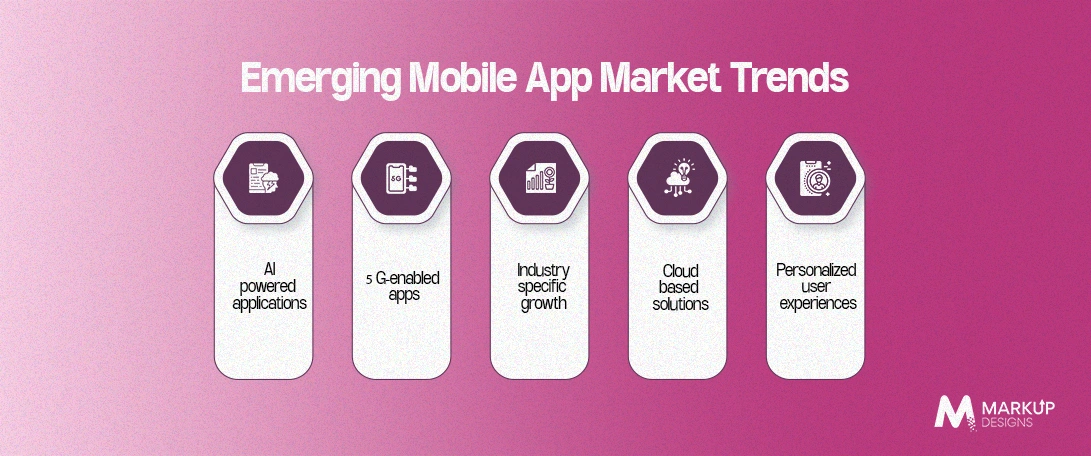
Dubai’s mobile app ecosystem is rapidly evolving, driven by emerging technologies and rising user expectations. Businesses are no longer focusing only on online presence; instead, they are building faster, smarter, and more personalized digital experiences.
Key market trends:
- AI-powered applications: Growing adoption of AI for chatbots, predictive recommendations, and automated customer interactions to improve engagement and efficiency.
- 5G-enabled apps: Faster internet and low latency are enabling real-time features like live streaming, AR/VR experiences, smart tracking, and instant transactions.
- Industry-specific growth: Strong rise in fintech, healthtech, edtech, and on-demand apps as users prefer mobile-first convenience across sectors.
- Cloud-based solutions: Increasing shift toward cloud applications for better scalability, security, and performance.
- Personalized user experiences: Businesses are using data-driven insights to deliver customized content, recommendations, and services.
Estimated Cost to Build a Mobile App in Dubai
Estimating the cost associated with developing a mobile application usually marks the first step when considering any enterprise that wants to go digital. Due to the competitive nature of Dubai’s market and the innovation that takes place, the cost of developing applications could be quite different.
It must be noted that while estimating the cost of mobile app development, there isn’t going to be a one-size-fits-all solution. Instead, costs will depend upon the type of application.
Here’s a simplified breakdown:
Basic Apps (Approx. $10,000 – $30,000)
These include simple applications with limited features such as static content, basic UI, and minimal backend functionality. Ideal for small businesses or early-stage validation.
Mid-Level Apps (Approx. $30,000 – $80,000)
These apps include more advanced features like user authentication, API integrations, real-time data, and improved UI/UX. Suitable for growing businesses looking to enhance customer engagement.
Complex / Enterprise Apps (Approx. $80,000 – $200,000+)
Designed for scalability, these apps include advanced functionalities such as AI integration, real-time syncing, payment systems, high-level security, and multi-user roles. Common in industries like fintech, healthcare, and large-scale e-commerce.
To make this easier to scan:
| App Type | Estimated Cost Range |
| Basic App | $10,000 – $30,000 |
| Mid-Level App | $30,000 – $80,000 |
| Complex / Enterprise App | $80,000 – $200,000+ |
It is important to emphasize that these are average figures. The cost will depend on various factors like design specifications, selection of platforms (iOS, Android or both), development strategy and additional tools and components.
Key Factors Affecting Mobile App Development Cost in Dubai
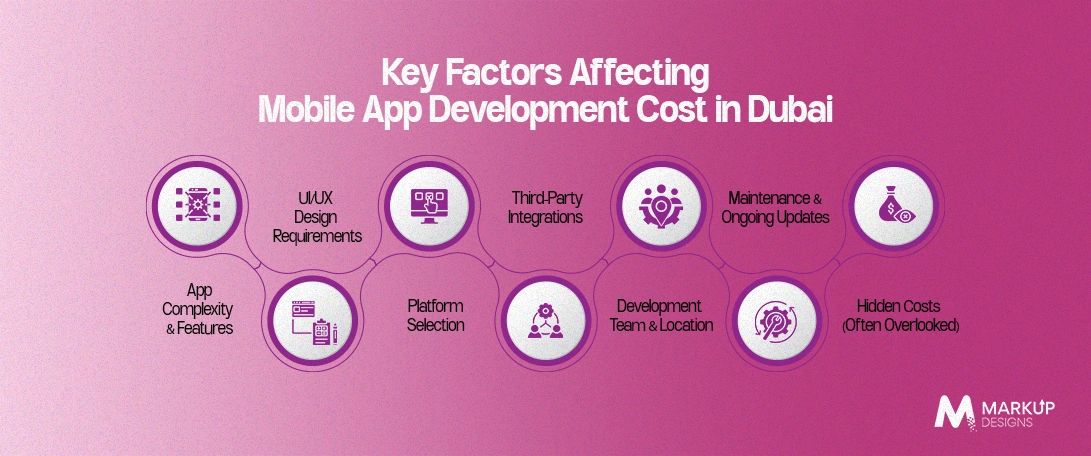
The app development price in UAE is not fixed, it varies based on several interconnected factors. Understanding these elements helps businesses estimate budgets more accurately and avoid unexpected expenses during development.
1. App Complexity & Features
App complexity is the most critical factor influencing cost. The more advanced the features, the higher the development effort required.
- Basic apps with limited functionality cost less
- Advanced apps with features like:
- Real-time tracking
- Payment integrations
- AI-based recommendations
- Multi-user systems require significantly higher investment
2. UI/UX Design Requirements
An effective user interface design significantly affects user interaction and user retention, more so in an upscale market such as Dubai.
Cost depends on:
- Visual design elements
- Branding and customization
- Typography and color strategy
- User journey and navigation flow
3. Platform Selection (iOS, Android, or Cross-Platform)
The choice of platform significantly affects development cost.
- Single platform (iOS or Android): Lower initial cost
- Both platforms (native): Higher cost due to separate development
- Cross-platform: Cost-efficient but may have limitations
Each platform has different development time, testing requirements, and publishing costs.
4. Third-Party Integrations
Integrating external services adds both functionality and cost.
Common integrations include:
- Payment gateways
- Geolocation services
- Push notifications
- Analytics tools
- Maps and tracking systems
5. Development Team & Location
The cost also depends on who you hire:
- Local Dubai agencies: Higher cost, better regional expertise
- Offshore teams: Lower cost, but potential communication and quality challenges
6. Maintenance & Ongoing Updates
An App development doesn’t just end at launch. Post-launch costs are a significant part of the total investment.
These include:
- Bug fixes
- OS updates
- Performance optimization
- Feature upgrades
7. Hidden Costs (Often Overlooked)
Beyond development, there are additional costs businesses must consider:
- App marketing and promotion
- App Store Optimization (ASO)
- Paid ads and user acquisition
- Ongoing analytics and monitoring
For strategic decision-making, a business must know the costs involved. An app development cost breakdown in Dubai will reveal the details of the cost and shed light on the reasons behind different costs among projects.
Mobile App Development Process in Dubai
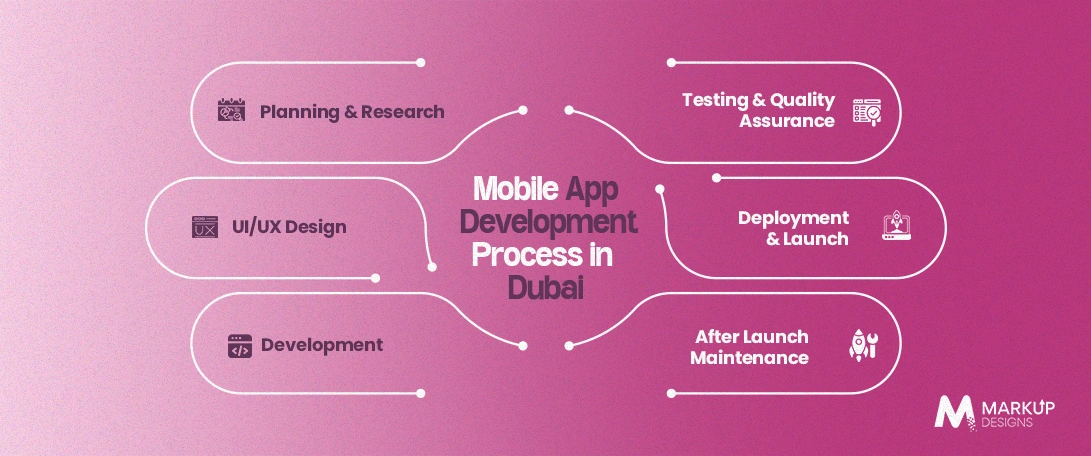
Mobile app development in Dubai follows a structured, step-by-step approach to ensure efficient planning, development, and delivery of high-quality applications.
4.1 Planning & Research
Planning and research forms the backbone of your application. Ignoring this step or doing it hastily usually means preparing for costly mistakes in the future.
Involves the definition of purpose, audience, and positioning. In Dubai, especially in competitive industries, a data-driven approach is essential to mitigate any risks which involves:
- Market research: Identifying the need and demand for your application
- Competitor analysis: Looking for weak sides among competing applications
- Product Strategy: Creating the product concept and development road map
4.2 UI/UX Design
UI/UX design is not only an aesthetic choice but it directly impacts how engaged and loyal users will be. In a markets like Dubai, users demand top-notch digital products, and therefore, UI/UX is a significant factor in the success of apps.
The design phase takes ideas and creates the visuals and interactions that define them.
Main components involves:
- Wireframing: Laying out the structure of the application
- Prototyping: Creating interactive mockups for testing purposes
- User experience improvements: Making sure the app is intuitive to use
4.3 Development
This stage is by far the most costly and usually consumes the majority of the budget. It involves implementing the design into an actual application.
Development consists of several stages including:
- Front-end development: The side of the application users see and interact with
- Back-end development: The server-side of the application
- API integration: Integrating third-party APIs such as payment gateways or CRM platforms
- Database design: Planning and organizing the database structure effectively
4.4 Testing & Quality Assurance
The working application is not sufficient; rather, it should have robustness in performance. In this phase, the functionality of the application is made stable, secure, and bug-free.
Areas covered in testing include:
- Functional testing: Checking for proper functioning of all features
- Performance testing: Ensuring high speed
- Security testing: Ensuring no vulnerability
4.5 Deployment & Launch
When the application development reaches its final stage, it must be launched by deploying it. Technical deployment along with some legal compliance is important if operating in the UAE.
Deployment involves:
- Submitting the application in App Store/Play Store
- Meeting compliance in the UAE (e.g., data privacy laws, etc.)
4.6 After Launch Maintenance
This cost is often underestimated by companies. Nevertheless, maintenance is crucial for any app if you want it to work properly for years.
Activities involved after launch:
- Frequent app updates
- Bug fixing
- Adding new features
A clear understanding of the above App development process in Dubai ensures that businesses can allocate budgets effectively, avoid hidden surprises, and plan for both short-term execution and long-term scalability.
Cross-Platform vs Native App Development
When it comes to deciding between the two, the conversation around Cross-platform vs native app usually starts with budget but it shouldn’t end there. The real decision is about what your app needs to achieve in the long run.
Let’s start with native apps. These are built separately for iOS or Android, so everything is designed for one platform at a time. Because of this, they usually cost more-if you want your app on both iOS and Android, it has to be developed separately for each platform.
Now, cross-platform apps take a different approach. Instead of building everything from scratch twice, developers use a single codebase that works across both platforms. This cuts down development time and cost significantly.
But in return, you get top-tier performance, smoother user experience, and better access to device features like camera, GPS, and sensors. If your app is complex, handles a lot of data, or needs to be extremely fast and reliable, native is often the safer bet.
So, what should you choose?
Go for native if:
- Performance and speed really matter
- Your app has complex features
- You’re building for long-term scalability
Go for cross-platform if:
- You want to save on cost
- Speed to market is important
- You’re building an MVP or a standard business app
At the end, it’s not just about saving money, it’s about making the right investment for where you want your app to go.
MVP Cost in Dubai: Start Smart, Scale Faster
For startups and businesses working with limited budgets, building a full-scale app right from the start isn’t always the smartest move. That’s where an MVP-Minimum Viable Product-comes in.
An MVP is a simplified version of your app that includes only the core features which solves the main problem for users. Instead of building everything at once, you focus on what truly matters, launch quickly, and improve based on real user feedback.
This approach is especially relevant in a competitive market like Dubai, where speed and adaptability can make a big difference.
Why do businesses choose the MVP approach?
- Lower initial investment: You avoid spending heavily on features that users may not even need
- Faster time to market: Launch your app in weeks instead of months
- Real user validation: Test your idea with actual users before scaling
- Flexibility to improve: Make data-driven decisions for future updates
When it comes to pricing, the Minimum Viable Product (MVP) cost Dubai typically ranges between $15,000 to $50,000, depending on the app’s complexity, design, and basic integrations. This is significantly lower than building a full-featured application from day one.
Most importantly, an MVP helps reduce risk. Instead of investing a large budget upfront, start small, validate your concept, and scale gradually.
Industry-Wise App Development Costs in UAE
The cost of building a mobile app in Dubai varies significantly depending on the industry your business operates in. Different markets require different features, compliance levels, and integrations, which directly impact development effort and pricing. Understanding these variations helps businesses plan budgets more realistically.
Key industry-wise cost insights
- E-commerce apps: The ecommerce app development cost is generally moderate to high, depending on platform scale. Basic apps include product listings, cart, and payment gateways, while advanced versions with AI recommendations, inventory systems, and multi-vendor features significantly increase cost.
- Fintech applications: The Fintech app development pricing in Dubai is usually on the higher side due to strict security requirements, encryption standards, regulatory compliance, and real-time transaction processing. Features like digital wallets, fraud detection, and payment integrations add complexity and cost.
- AI-powered applications: The AI app development cost in UAE is typically the highest because of advanced technologies like machine learning models, predictive analytics, and automation systems. These solutions require specialized expertise and higher development investment.
Overall, industry-specific requirements play a major role in shaping app development costs. Businesses need to align features with industry standards while maintaining a balance between functionality, scalability, and budget.
Mobile App Maintenance Costs in Dubai
One of the most overlooked aspects of app development is what happens after launch. Many businesses assume that once the app is live, the major investment is complete. But in reality, ongoing maintenance is essential for long-term success.
The Mobile app maintenance costs Dubai typically range between 15% to 25% of the initial development cost annually. This includes keeping the app updated, secure, and aligned with evolving user expectations.
Here’s where the cost comes from:
- Regular updates: Ensuring compatibility with new OS versions and devices
- Bug fixes: Addressing issues reported by users post-launch
- Performance optimization: Improving speed and responsiveness
- Security updates: Protecting against vulnerabilities and cyber threats
- Feature enhancements: Adding new functionalities based on user feedback
Ignoring maintenance can lead to performance issues, poor user experience, and even security risks-all of which can damage your brand reputation.
App Development ROI for Startups & Enterprises
Cost is only one side of the equation, the real question is what you get in return. Understanding the App development ROI for Startups helps businesses evaluate whether their investment will deliver measurable value or not.
A well-built mobile app can drive growth in multiple ways. For startups, it opens new revenue streams and provides direct access to customers. For enterprises, it improves operational efficiency and strengthens customer relationships.
Here’s how ROI typically shows up:
- Increased revenue: Through in-app purchases, subscriptions, or transactions
- Better customer engagement: Personalized experiences and direct communication
- Operational efficiency: Automation reduces manual effort and costs
- Brand visibility: Strong digital presence improves market positioning
- Customer retention: Apps encourage repeat usage and loyalty
The timeline for ROI can vary. Some businesses start seeing returns within months, while others may take longer depending on their strategy and market conditions.
Ultimately, the focus should not be on minimizing cost, but on maximizing value. A strategically developed app often pays for itself over time.
How to Optimize Your App Development Cost in Dubai
While app development can be a significant investment, there are smart ways to control costs without compromising quality. The key is to focus on efficiency, prioritization, and the right development approach.
Businesses investing in Mobile App Development in Dubai can optimize costs by making informed decisions initially in the process.
Here are some practical ways to reduce expenses:
- Start with an MVP: Build only core features first and scale gradually
- Prioritize essential features: Avoid unnecessary functionalities in the initial phase
- Choose the right platform: Decide between native and cross-platform based on your requirement
- Use ready-made solutions: Leverage existing tools and APIs instead of building everything from scratch
- Plan scalability early: Avoid expensive rework later
Cost optimization is not about cutting corners, it’s about making smarter choices that align with your long-term business goals.
Choosing the Right Mobile App Development Partner in Dubai
Selecting the right development partner can make or break your project. With so many options available, businesses must go beyond pricing and evaluate overall capability, experience, and reliability.
When considering a for Mobile App Development Company in Dubai, here’s what you should look for:
- Proven portfolio: Check previous projects and industry experience
- Technical expertise: Ensure they are skilled in relevant technologies
- Transparent pricing: Clear cost structure with no hidden charges
- Communication & collaboration: Smooth coordination throughout the project
- Post-launch support: Ongoing maintenance and updates
At the same time, watch out for red flags:
- Unrealistically low pricing
- Lack of clear timelines
- Poor communication
- No structured development process
A reliable partner doesn’t just build your app, they guide you through strategy, execution, and scaling. Investing in the right team ensures better outcomes and long-term success.
Why Partner with Markup Designs for Mobile App Development in Dubai
Choosing the right development partner is just as important as defining your app idea. In a competitive and fast-evolving market like Dubai, businesses need more than just developers, they need a team that understands strategy, scalability, and long-term impact. That’s where Markup Designs stands out.
With a strong focus on delivering value-driven solutions, Markup Designs approaches every project with a combination of technical expertise and business insight, ensuring that your investment in Mobile App Development in Dubai translates into measurable results.
Rather than offering one-size-fits-all solutions, Markup Designs works closely with clients to understand their industry, goals, and challenges. This allows them to build applications that are not only functional but also aligned with real business outcomes, whether it’s increasing user engagement, improving operational efficiency, or driving revenue growth.
What sets us apart
- Strategic, business-first approach: Every app is built with a clear focus on ROI and long-term scalability
- Customized solutions: Tailored development based on your specific industry and requirements
- End-to-end expertise: From ideation and design to development, launch, and post-launch support
- Transparent pricing: Clear cost structure with no hidden surprises
- User-centric design: Focus on intuitive UI/UX to enhance user experience and retention
- Strong technical capabilities: Expertise in modern technologies including AI, cross-platform, and scalable architectures
- Ongoing support & optimization: Continuous improvements to keep your app competitive
By partnering with Markup Designs, businesses gain more than a development service-they gain a reliable technology partner committed to delivering high-quality, future-ready mobile applications.
Conclusion
By now, it’s clear that the Mobile App Development Cost in Dubai is not a one-size-fits-all number. It varies based on complexity, features, industry, and long-term goals. But more importantly, it should be viewed in the context of value, not just expense.
Businesses that hesitate due to cost often end up falling behind in a digital-first market. On the other hand, those who invest strategically in mobile applications gain a competitive edge, improve customer engagement, and unlock new growth opportunities.
The key takeaway is simple: focus on building the right app, not just the cheapest one.
When planned and executed correctly, a mobile app becomes more than just a digital product-it becomes a powerful business asset that drives long-term success in Dubai’s evolving digital landscape.
FAQ
1. How much does mobile app development cost in Dubai in 2026?
The mobile app development cost in Dubai typically ranges from $10,000 to $200,000+, depending on the app’s complexity, features, platform, and development approach. Basic apps cost less, while enterprise-level applications with advanced functionalities require a higher investment.
2. How long does it take to develop a mobile app in Dubai?
The development timeline usually ranges from 2 to 9 months. A basic app may take 6–10 weeks, while complex apps with advanced features like AI, real-time data, and integrations can take several months to complete.
3. What factors affect mobile app development cost in Dubai?
Several factors influence the cost, including app complexity, UI/UX design, platform selection (iOS, Android, or both), third-party integrations, development team expertise, and post-launch maintenance requirements.
4. Is it better to choose native or cross-platform app development in Dubai?
Native apps offer better performance and scalability but are more expensive. Cross-platform apps are more cost-effective and faster to develop, making them ideal for startups or MVPs. The right choice depends on your business goals, budget, and long-term vision.
5. What is the cost of building an MVP in Dubai?
The MVP (Minimum Viable Product) cost in Dubai typically ranges between $15,000 and $50,000. It includes only the core features needed to validate your app idea, helping businesses reduce risk and launch faster.

Author's Perspective
Many businesses in Dubai initially focus only on app development costs, but successful mobile applications are built around long-term business value. A well-planned app should support scalability, user experience, operational efficiency, and future growth. In a highly competitive digital market like Dubai, investing in the right technology strategy and development partner often delivers far greater returns than simply choosing the lowest-cost option. Businesses that approach app development strategically are more likely to build stronger customer engagement and sustainable digital growth.
Discuss Your Project Now
Gaurav Goyal
Global Sales- VP
Related Posts

Complete Guide to Hiring Mobile App Developers in...

How to Build an App Like Yuka: Features,...

10 Key Factors to Choose the Right Mobile...
Insights Are Valuable & Execution is Priceless
You’ve read about the digital future. Now, let’s build the infrastructure to take you there. Move your strategy from the page to the product.
Design Your Solution Now
Contact Us
Schedule The Appointment At Your Convenience Date And Time.
30 Min
Web Conference
Time Zone
Indian standard time (08:30pm)

Thanks For Getting In Touch!
You’ve Taken The First Step Toward Transforming Your Digital Presence. Our Experts Will Reach Out Shortly To Take It Forward.
Launch Your Dream Project
Provide a brief overview of your project, and our specialists will evaluate your requirements. We will connect with you to explore how the right digital solutions can help you launch faster.