
How to Validate Your Mobile App Idea Before You Write a Single Line of Code
You’ve had the idea for months. A real problem, a clear solution, a product you can already picture. So you build it – the way every founder does.
Six months in, the dashboard shows eleven downloads. Eight were yours.
This isn’t a story about a bad idea or poor execution. It’s about the gap between believing something is worth building and actually knowing it. That gap costs $40,000 in dev fees, investor credibility, a co-founder relationship, and something harder to put a number on – the confidence that takes far longer to come back than your bank balance does.
The founders who dodge this don’t move slower. They just don’t confuse excitement for evidence. Before Figma, before the first hire, before the name – they go find out if the problem is actually real. They talk to strangers. Test a landing page. Charge someone to do by hand what the app would eventually automate. By launch, they’re not hoping for a market. They’ve already found one.
Validation isn’t the step before the real work. It is the real work.
The Brutal Math of Unvalidated Apps
Before moving on, consider what the data actually shows.
- Over 90% of mobile apps are abandoned within the first year of launch.
- 72% of startups fail because they build something the market doesn’t want – not because of bad execution.
- The average cost of building a mid-complexity mobile app with a freelance team runs between $30,000–$80,000. That’s before marketing, maintenance, or iteration.
- Less than 1% of consumer apps generate meaningful revenue in year one.
- Most founders spend 6–18 months building before they find out if anyone cares.
These statistics aren’t meant to scare you into leaving the premises. They’re here to make you ask a harder question: what if the risk isn’t in the launch – it’s in the assumption that the idea itself is enough?
The problem was never the idea. It was the assumption that the idea was enough.
Most failed apps weren’t bad ideas. They were good ideas that no one ever stress-tested. The founder was too close to the concept to see its blind spots. They confused personal enthusiasm with market demand. And by the time they figured out the difference, the clock had already run out.
Understanding the risk is one thing. Reducing it is another. A structured approach, like a mobile app discovery workshop, helps you validate assumptions, define scope, and avoid building the wrong product.
What Validation Actually Means (And What It Doesn’t)
Let’s kill the most dangerous myth in early-stage product development right now: validation is not asking your friends and family if they think your idea is cool.
Your mom will tell you it’s brilliant. Your college roommate will say he’d definitely use it. Your LinkedIn connections will hit the heart emoji on your announcement post. None of that is a signal. All of it is noise.
The keyword is evidence. Not enthusiasm. Not encouragement. Not supportive retweets. Evidence. Behavior. Action. Skin in the game.
Validation is when a stranger clicks on your signup button after spending $50 advertising on a landing page. Validation is when a stranger agrees to an interview lasting half an hour and tells you, in vivid detail, exactly how they handle the pain point right now. Validation is when a stranger pays for your product because he believes that it has value.
Everything else is a polite guess wearing the costume of market research.
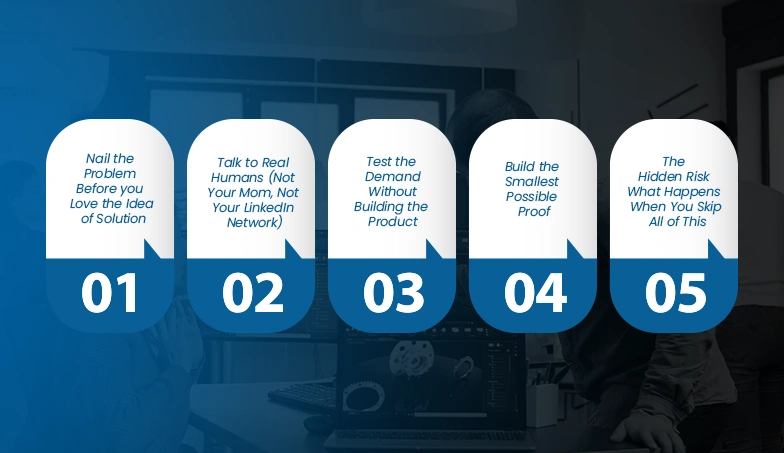
Step 1 – Nail the Problem Before You Love the Idea of Solution
Here’s one that always seems to happen every year at accelerators and incubators. A founder who’s intelligent, driven, and technologically savvy spends three months creating an application for gyms that has beautiful 3D body mapping and AI-based counting of repetitions. The UI looks incredible. The animations are perfect. All the features they came up with are implemented.
They take it to the gyms to see what people think of it. And they find that the real problem isn’t counting reps; it’s getting the gym-goer into the gym. What’s really difficult isn’t keeping track of sets; it’s the accountability and motivation to go to the gym. The founder created the wrong product beautifully.
This is due to the fact that founders are in love with solutions before understanding what problems are. To fix this, simply make sure to write a problem statement before writing anything else.
The problem statement formula
Before you design a single screen, firstly think about these factors:
Who struggles with [What] because [Why], and right now they deal with it by [Current Alternative].
Who – Who are you building this app for? Define your target audience clearly. Age, profession, lifestyle, the more specific, the better. A busy college student, a working parent, a small restaurant owner. This tells you exactly whose problem you’re solving.
What – What is the core purpose of your app? What job does it do for that person? Ex-: A food delivery app delivers meals from nearby restaurants to your doorstep. Keep it simple and outcome-focused.
Why – Why does this audience actually need your app? Is there a real gap in their life that isn’t being met well enough? Ex: Maybe they’re in a Tier-2 city where Swiggy and Zomato have poor restaurant coverage. Maybe they want homemade food but no platform connects them to local home cooks. That’s your “why.”
Current Alternative – What are they using right now instead of your app? For instance, for food delivery, the obvious answer is Swiggy and Zomato. So the real question becomes – what do you offer that they don’t? Faster delivery? Lower prices? A specific cuisine? Home-cooked meals? If your app doesn’t answer that clearly, there’s no reason for someone to switch.
If someone is already happy with Swiggy, you’re not just competing with an app. You’re competing with a habit. Your “why” needs to be strong enough to break it.
Founders skip this because it slows them down. The problem statement feels like homework when you’re buzzing with product ideas. But spending two hours on it can save you six months of building the wrong thing with total confidence.
Step 2 – Talk to Real Humans (Not Your Mom, Not Your LinkedIn Network)
It involves interacting with strangers – people who have no social obligation to be nice to you. People who will offer you an intimate perspective on whether or not your problem is pertinent to them.
Contrary to popular opinion, finding such people isn’t as complicated as it might seem. Reddit threads or subreddits based on the specific interests or issues of your target audience, as well as Facebook groups. Finding mentions of your problem on Twitter or X. Slack communities built around your niche.
Approach those people with cold outreach messages about participating in interviews about your problem. Invite them for a conversation lasting 20 minutes, where they can freely rant while having your full attention – and maybe even a $15 gift card.
What to ask – and what to never ask
Ask: “Walk me through the last time you dealt with this.” Tell me what you actually do now. What’s the most frustrating part? Have you tried anything to fix it? What happened?
Never ask: “Would you use an app that did X?” or “How much would you pay for something like this?” These questions produce worthless hypothetical answers. People are optimists about their future behavior. They’ll say yes. They almost never mean it.
You’re looking for patterns. Consistent language. Emotional spikes. The moment someone says “oh god, yes, that drives me crazy” – that’s a signal. Fifteen to twenty conversations with the right people is usually enough to see those patterns emerge.
Confirmation bias will consume your validation process like a virus if you don’t control it. You must go into each discussion with an honest effort to figure out what makes your idea unworkable. Even if you can’t find one reason in 20 attempts, it’s still important. But if you reject all the “no’s,” then something very important is wrong.
Step 3 – Test the Demand Without Building the Product
This is where the magic happens. You can measure real demand without writing a single line of app code. Here’s how.
The landing page test: Build a simple one-page website that describes your app as if it exists. Clear headline. Three benefit bullets. A sign-up button that says “Join the waitlist” or “Get early access.” Run $100 of targeted ads to your ideal user profile. Measure how many people click and convert. Anything above 5–10% conversion on cold traffic is meaningful interest. This takes a weekend and about $150 total.
The fake door test: Put a “premium features” button inside an existing product, tool, or context. When someone clicks it, instead of unlocking a feature, they see a message like “This feature is coming soon – want to be first to know?” Track the click-through rate. You’ve just measured demand for something that doesn’t exist yet.
The concierge MVP: Do what your application does manually. For example, if you are creating an app for personal finance, you can provide an analysis of someone’s expenses manually through email. If you are creating a scheduling app, you can use Google Calendar to schedule tasks manually. Ask for a payment. Since users will be willing to pay for manual work, they will definitely pay for the automated task. Some successful applications have used this approach to verify demand for automation.
Tools you can use right now: Carrd or Webflow for landing pages, Typeform for intent-capture forms, Stripe for payment testing, and basic ad platforms for traffic. Your timeline for this entire phase: two weeks. What to measure: click-through rate, sign-up rate, and whether people voluntarily share the page with others.
Step 4 – Build the Smallest Possible Proof
Let’s talk about what an MVP actually is, because the word has been mangled beyond recognition.
An MVP is not a version-one app with some features removed. It’s not a prototype with real data. It’s not a beta you launch on Product Hunt. An MVP is the smallest possible thing that tests your most important assumption.
Most founders think in features: “My MVP needs login, profile creation, search, and the core function.” That’s not an MVP – that’s a product. Your MVP needs exactly one thing: to answer one critical question.
What’s the one question? It’s different for every product, but it usually sounds like one of these: Will people pay for this? Will people change their behavior to use this? Does solving the problem this way actually solve the problem? Everything your MVP does should serve to answer that question. Everything else is scope creep dressed up as diligence.
The difference between a prototype and an MVP is purpose. A prototype tests whether something works. An MVP tests whether something is wanted. You can have a flawless prototype for a product nobody wants.
Read Also: Mobile App Development: Complete 2026 Guide for Businesses
The Hidden Risk – What Happens When You Skip All of This
Let’s go back to that founder staring at eleven downloads.
He didn’t skip validation because he was careless. He skipped it because he was genuinely excited – because the idea felt real, the momentum felt good, and every day spent not building felt like a day wasted. Validation felt like a speed bump. Turns out, skipping it was the wall.
The cost would be the four-figure price tag. However, the real cost would actually be six months of time. The real cost is also the co-founder who was able to stand by during the uncertain times but could not survive the pressure that came with a product that was not succeeding. The real cost is also the investment meetings that required credibility that he had already invested before having any kind of success.
But let’s not forget about another important component that we do not talk about. The emotional aspect. There is always the feeling of personal disappointment whenever you have invested your energy and resources into something that does not get the market response it deserves. It’s the kind of disappointment that makes you think “the product failed,” when what you really mean to say is “I failed.”
Here’s what stings most – none of it was inevitable. Two weeks of real conversations with strangers, people with no reason to be nice to him, would have surfaced the truth early. That the problem existed, yes – but not urgently enough. Not frequently enough. And not without already-good-enough alternatives sitting right next to it. That information was never hidden. He just never went looking for it.
You Have Two Choices Right Now
| Choice A | Close this tab, open your laptop, start building. Hire a developer. Set up your repository. Name your app. Design the logo. Move fast. And find out six months and $40,000 from now whether any of it was worth it. |
| Choice B | Spend the next two weeks validating. Write your problem statement. Talk to twenty strangers. Run a landing page test. Do the thing manually and charge someone for it. And when you finally do build – every line of code, every design decision, and every dollar spent will be pointed at a target you know is real. |
Choice B doesn’t require courage. It requires discipline. The discipline to slow down when everything inside you wants to go fast. The discipline to treat your own excitement as a hypothesis, not a conclusion.
Conclusion
Most founders don’t run out of talent. They don’t run out of drive. They ran out of runway because they trusted their excitement more than they tested their assumptions.
The idea was never the problem. The belief that the idea was enough – that’s what gets you.
Validation doesn’t slow you down. It’s the thing that makes sure you’re running in the right direction before you sprint. Two weeks of honest conversations with strangers, a rough landing page, one person who pays you before the product even exists – that’s worth more than six months of building in the dark.
The market has never cared who got there first. It only cares who got it right.
So before the first line of code, before the Figma file, before the name – go find out if the problem you’re excited about is a problem someone else actually loses sleep over. If the answer is yes, you’ll build with a confidence that no amount of momentum can fake. And if the answer is no, you just saved yourself everything.
Author's Perspective
From my perspective, custom blockchain development is not just about adopting a modern technology trend; it’s about making strategic decisions that create real business impact. Many organizations rush into blockchain adoption without clearly defining their objectives, which often leads to underutilized solutions.
The key lies in understanding where blockchain truly adds value. Not every system needs decentralization, but for processes involving multiple stakeholders, trust gaps, or data integrity concerns, blockchain can be transformative.
Ultimately, the success of any blockchain initiative depends on balancing innovation with practicality. With the right strategy, technology, and development partner, businesses can unlock the full potential of blockchain and drive long-term growth.
Discuss Your Project NowAjit Kumar Jha
VP - Business Operations
Related Posts

How to Build a Chat App Like Arattai:...
How to Hire Mobile App Developers in the...

How Much Does It Cost to Build a...
Insights Are Valuable & Execution is Priceless
You’ve read about the digital future. Now, let’s build the infrastructure to take you there. Move your strategy from the page to the product.
Design Your Solution Now
Contact Us
Schedule The Appointment At Your Convenience Date And Time.
30 Min
Web Conference
Time Zone
Indian standard time (08:30pm)

Thanks For Getting In Touch!
You’ve Taken The First Step Toward Transforming Your Digital Presence. Our Experts Will Reach Out Shortly To Take It Forward.
Launch Your Dream Project
Provide a brief overview of your project, and our specialists will evaluate your requirements. We will connect with you to explore how the right digital solutions can help you launch faster.