
Mobile App Discovery Workshops: Agenda, Outcomes, and Deliverables
What separates the apps that ship and scale from the ones that stall, pivot, and burn through budget – before a single line of code is written.
Two fintech startups launched within six months of each other in 2022. Same category – personal expense management. Similar seed funding. Similar founding teams. One shipped a polished MVP in five months, hit 40,000 users in its first quarter, and closed a Series A by month nine. The other spent eleven months building, launched to lukewarm reviews, struggled with an architecture that couldn’t handle notifications reliably, and ultimately pivoted – burning nearly $400,000 in the process.
The difference wasn’t talent. It wasn’t timing. It wasn’t even product vision. The first team spent three days in a structured discovery workshop before writing a single line of code. The second team had a Figma file and a sprint board by week two.
This isn’t a cautionary tale about moving too fast. It’s about moving in the wrong direction at full speed – and what it costs.
The Market Reality
The question every product leader must answer before kick off isn’t “what do we build?” – it’s “what problem are we actually solving, and for whom?” The market data makes the cost of getting this wrong brutally clear.
- 71% of apps are abandoned within 90 days of first use – most because they failed to solve the problem users actually had, not the one developers imagined.
- $240K+ is the average cost to rebuild a mobile app after a failed first launch. Discovery typically costs under $20,000. The math is not subtle.
- 3X more likely – projects with formalized discovery phases are three times more likely to be delivered on time and within budget, per the Standish Group’s CHAOS reports.
- $7.7T is the projected global mobile app market by 2032. Competing in it without a clear, validated differentiator is not bold – it’s reckless.
- 42% of product failures trace back to “no market need” – the single most common cause of startup death, according to CB Insights. Discovery is how you validate that a need exists before you pay to build the solution.
These aren’t abstract statistics. They represent teams that had great ideas, real budgets, and genuine conviction – but skipped the one process that could have reoriented their efforts before momentum became a liability.
Read Here: The Future of AI in Digital Transformation: Trends That Will Define the Next Decade
What a Discovery Workshop Actually Is
Let’s clear something up immediately: a discovery workshop is not a brainstorming session. It’s not a requirement to have a meeting dressed up with sticky notes. And it is absolutely not a delay tactic dressed up in consulting language.
A discovery workshop is a structured, time-box intensive – typically one to three days – where your product, business, and technical stakeholders align on the problem space, user needs, technical constraints, and strategic priorities before any design or development begins. Done well, it collapses weeks of misaligned back-and-forth into a single focused sprint of intentional decision-making.
The myth is that workshops are for teams that don’t have clarity yet. The reality is that they’re for teams smart enough to know that the clarity they think they have is probably incomplete. Every founding team thinks they understand their user. Every product manager believes they’ve thought through the edge cases. Discovery is how you stress-test those assumptions in a low-cost, high-honesty environment – before your engineering team builds the wrong thing at full capacity.
Think of it as the difference between reactive building – responding to whatever surfaces in the backlog – and agentic planning: making deliberate, informed choices about what to build, why, and in what order. Reactive builders ship fast and rework often. Agentic planners move with purpose and ship things that stick.
The Agenda: What Actually Happens Across Three Days
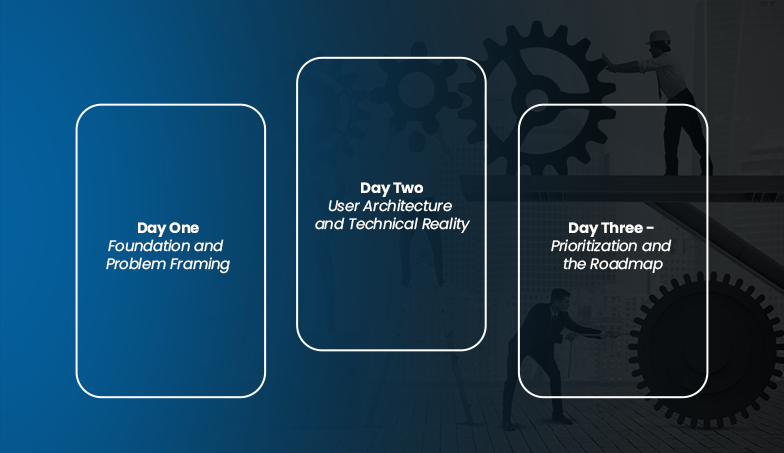
Day One – Foundation and Problem Framing
Aligning on the Problem Before Falling in Love with the Solution
Day one is about excavation. Most teams arrive with a product design idea or a solution they’re excited to build. The first job is to set that solution aside temporarily and go deeper into the problem it’s meant to solve. Who experiences this problem? How frequently? What are they doing today as a workaround? What does good look like to them?
The morning opens with stakeholder alignment: everyone on the team – product, engineering, design, business – maps their individual understanding of the user, the goal, and the constraints. Differences surface almost immediately, and that’s exactly the point. Surfacing disagreement on day one costs nothing. Discovering it at sprint review costs weeks.
The afternoon moves into competitive landscape and market positioning. Where does this product live in the ecosystem? What do competitors do well, and where do they fall short? What’s the single wedge – the one thing this product does better than anything else available – that will drive initial adoption? By the end of day one, the team has a shared understanding of the problem space and a preliminary product hypothesis that everyone can interrogate.
Day Two – User Architecture and Technical Reality
Designing for Real People and Real Constraints
Day two is where abstractions get replaced with specifics. The morning centers on user research synthesis and personal development. Who are the one, two, or three distinct user types this product must serve? What are their goals, anxieties, technical comfort levels, and behavioral patterns? This isn’t demographic window dressing – it’s the foundation that every future design decision will reference.
User journey mapping follows: tracing the end-to-end experience a user has with the product, from discovery through activation, retention, and eventually advocacy or churn. This exercise reliably surfaces the moments of friction that no one had thought to address – the onboarding drop-off point, the notification timing problem, the edge case that turns a five-star experience into a one-star review.
The afternoon shifts to technical architecture. Engineers and architects weigh in on platform decisions (native iOS, native Android, cross-platform), integration complexity (third-party APIs, authentication, payment systems), data structure, and security requirements. Crucially, this conversation happens while it’s still cheap – before any infrastructure has been provisioned or any architectural decisions have been locked in by early code.
Day Three – Prioritization and the Roadmap
Turning Clarity into a Plan the Whole Team Can Execute
The final day is about synthesis and commitment. Every insight from days one and two gets translated into a prioritized product backlog, an MVP scope definition, and a phased release roadmap. This is the hardest conversation of the workshop – not because the team lacks direction, but because building clarity means making explicit trade-offs. Feature X goes into V1. Feature Y moves to V2. Feature Z gets cut entirely because it serves the wrong user or solves a problem the user doesn’t actually have.
The afternoon closes with documentation review and sign-off. Every deliverable – personas, journey maps, technical scope, roadmap, wireframes – gets reviewed, refined, and formally agreed upon by all stakeholders. The workshop ends not with energy and excitement, but with something rarer and more valuable: genuine alignment. Everyone knows what’s being built, why, for whom, and in what sequence.
Outcomes: What Shifts After Three Days
The most common objection to discovery workshops is one you’ve probably already thought of: “This slows us down.” It’s worth addressing directly, because it’s based on a fundamental misunderstanding of what “speed” means in product development.
Speed isn’t measured by how fast you start coding. It’s measured by how fast you ship something that works. A team that spends three days in discovery and then builds for four months is faster than a team that starts coding on day one and spends three months rebuilding. Every time.
What actually shifts after a well-run discovery workshop?
First: clarity. Every person on the team can articulate what the product is, who it’s for, and what success looks like. That clarity eliminates the most common source of slow-downs in development – ambiguous requirements that turn into interpretation differences that turn into rework.
Second: alignment. Stakeholder disagreements that would have surfaced as crisis moments mid-sprint get resolved in a structured environment on day one. The engineering lead and the product manager no longer have different understandings of the MVP. The business founder and the UX designer agree on which user segment to prioritize first.
Third, and perhaps most importantly: risk reduction. Technical risks, market risks, user assumption risks – all of these get identified, named, and addressed before they become expensive problems. Discovery doesn’t eliminate uncertainty. It maps it, which is an entirely different thing.
Discovery doesn’t slow you down. It stops you from building fast in the wrong direction – which is the only thing slower than not building at all.
Deliverables: What You Walk Away With
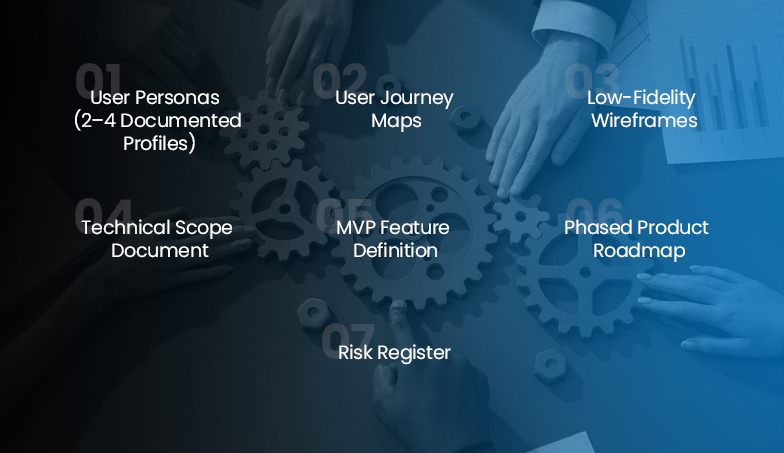
A discovery workshop without tangible outputs is a conversation, not a process. Here’s what a professional engagement produces – and why each one matters.
User Personas (2–4 Documented Profiles)
Composite representations of your core user segments, built from research synthesis and stakeholder input. They give every design and development decision a human reference point – preventing the slow drift toward building for a hypothetical “average user” who doesn’t exist.
User Journey Maps
End-to-end visualizations of how each persona discovers, uses, and either adopts or abandons the product. Journey maps expose friction points that no one thought to design for – and they do it before a single screen has been built.
Low-Fidelity Wireframes
Screen-level sketches of the core user flows – not polished UI, but structural blueprints that communicate information hierarchy and interaction logic. Wireframes allow rapid iteration at near-zero cost. Changing a wireframe takes minutes; changing a coded screen takes days.
Technical Scope Document
A written definition of the technical architecture, platform decisions, third-party integrations, and non-functional requirements (performance benchmarks, security standards, scalability thresholds). This document is the contract between product vision and engineering reality.
MVP Feature Definition
A clearly bounded definition of what constitutes the Minimum Viable Product – not the minimum feature list everyone can agree on, but the minimum set of capabilities that delivers genuine value to the primary user persona. This document answers the question: “What must be true for this product to be worth launching?”
Phased Product Roadmap
A three-to-four phase release plan mapping features to milestones. Not a Gantt chart of false precision – a strategic sequencing of priorities that accounts for user needs, technical dependencies, and business objectives. Teams with roadmaps make better day-to-day decisions because every micro-decision has a macro context.
Risk Register
A documented inventory of the top technical, market, and execution risks identified during the workshop, along with mitigation strategies for each. The teams that fail are rarely surprised by the thing that killed them – they just hadn’t written it down or assigned anyone to watch it.
The Hidden Risk: What Skipping This Actually Costs
There’s a cost that never shows up in any budget line, but it destroys more products than bad engineering ever will: the cost of building the right features in the wrong order, for the wrong user, with the wrong assumptions baked into the foundation.
When you skip discovery, you don’t save three days. You spend those three days distributed invisibly across the next twelve months – in the form of scope creep that was actually scope confusion, in sprint planning arguments that were actually alignment failures, in user feedback that reveals you built the wrong onboarding for the user you thought you had.
The startups that fail expensively rarely build bad software. Most of them built good software for a problem they misunderstood. The technical execution was fine. The strategic foundation was wrong, and everything built on top of it eventually reflected that.
Consider the actual sequence of events that typically follows a skipped discovery phase: two months of development produces a working prototype. Stakeholder review reveals that the core flow doesn’t match how users actually think about the problem.
Read Also: How Much Does it Cost to Develop a Mobile App?
Rework begins. Three months in, an integration dependency surfaces that the team didn’t know existed. Architecture changes are required. Six months of development deliver a launch candidate that the sales team struggles to explain because the value proposition was never formally defined. The product launches. Retention is poor. A post-mortem traces the failures back to assumptions that were never validated.
This is not a hypothetical. This is the modal outcome for teams that treat discovery as optional.
Conclusion
You are, at this moment, either the team that ships a focused, validated product in five to six months and spends the following six months growing it – or you are the team that ships something in eight to ten months, discovers its structural problems in the market, and spends another year and another budget cycle rebuilding.
Discovery workshops don’t cost three days. They save three to six months. The teams that skip them don’t move faster – they pay later, with compounded interest, in the form of rework, churn, and the particular exhaustion of rebuilding something that should have been right the first time.
The question isn’t whether you can afford to run a discovery workshop. The question is whether you can afford what happens when you don’t.
Author's Perspective
Many businesses look to outsource their IT services as a cost savings opportunity, but the most successful companies use outsourcing as a strategic lever for growth instead. The real difference comes from moving from the question “How can I save money by outsourcing?” to the question “How can I use my outsourced provider to create new capabilities?” It is when you change your focus from cost savings to capability creation that your outsourced IT provider will deliver the value you want to achieve.
In my experience, the biggest difference between successful companies that outsource and those that do not is the degree to which they are clear about the goals they wish to achieve through outsourcing, whether that’s accelerating product development, enhancing their cybersecurity capabilities, or enabling scalable infrastructures. Successful companies tend to create effective outsourcing partnerships, while companies that outsource without a strategic plan are more likely to encounter issues with alignment and a lack of results.
Discuss Your Project NowGaurav Goyal
Global Sales- VP
Related Posts

How Much Does It Cost to Build a...

How to Build a Secure Payment Gateway Integration...

Cost to Build a Mobile App in Qatar...
Insights Are Valuable & Execution is Priceless
You’ve read about the digital future. Now, let’s build the infrastructure to take you there. Move your strategy from the page to the product.
Design Your Solution Now
Contact Us
Schedule The Appointment At Your Convenience Date And Time.
30 Min
Web Conference
Time Zone
Indian standard time (08:30pm)

Thanks For Getting In Touch!
You’ve Taken The First Step Toward Transforming Your Digital Presence. Our Experts Will Reach Out Shortly To Take It Forward.
Launch Your Dream Project
Provide a brief overview of your project, and our specialists will evaluate your requirements. We will connect with you to explore how the right digital solutions can help you launch faster.