
In Brief
- Predictive analytics uses historical and real-time healthcare data to forecast patient risks, outcomes, and operational needs.
- Healthcare providers use predictive models for early disease detection, readmission prevention, personalised treatment, and resource planning.
- AI, machine learning, EHR data, medical records, wearable data, and healthcare APIs form the foundation of predictive analytics solutions.
- Developing a predictive analytics solution involves data preparation, model development, validation, healthcare system integration, and continuous monitoring.
- The cost of predictive analytics development depends on data complexity, AI model requirements, integrations, compliance, infrastructure, and ongoing maintenance.
Healthcare organisations generate massive volumes of clinical, operational, and patient data every day. The real challenge is not simply collecting this information but using it to identify patterns and anticipate what may happen next. Predictive analytics in healthcare addresses this challenge by analysing historical and real-time data to forecast potential health risks, patient outcomes, resource requirements, and operational trends. When implemented effectively, it can help healthcare providers move from reactive decision-making toward more proactive and data-driven care.
From predicting patient deterioration and hospital readmissions to forecasting demand and supporting personalised treatment, predictive analytics has applications across both clinical and administrative functions. However, building a reliable healthcare predictive analytics solution requires more than selecting an AI model. Data quality, system integration, model accuracy, security, regulatory compliance, development complexity, and ongoing monitoring all influence its effectiveness and cost. This guide explores the benefits, use cases, development process, technologies, compliance considerations, and cost of predictive analytics in healthcare.
What Is Predictive Analytics in Healthcare?
Predictive analytics in healthcare uses historical and real-time data to identify patterns and estimate what is likely to happen in the future. It combines statistical analysis, machine learning, and healthcare data to help providers anticipate patient risks, treatment outcomes, resource requirements, and operational challenges.
Unlike conventional analytics that primarily explains what has already happened, predictive analytics focuses on what may happen next. This allows healthcare organisations to identify high-risk patients, support earlier interventions, improve planning, and make more informed clinical and operational decisions.
How Predictive Analytics Works in Healthcare
Predictive analytics analyses large datasets to identify relationships and patterns that may indicate future outcomes. Machine learning models can process information such as patient history, diagnoses, laboratory results, medications, demographics, and monitoring data to generate predictions or risk scores.
For example, a model can analyse a patient’s medical history and current clinical indicators to estimate the likelihood of readmission or disease progression. Healthcare professionals can then use these insights alongside clinical judgement to determine appropriate next steps.
Types of Healthcare Data Used for Prediction
Predictive analytics can use multiple sources of healthcare data, including electronic health records, medical imaging, laboratory results, patient demographics, medication history, claims data, and wearable device information. Combining relevant datasets can provide a more comprehensive view of patient conditions and healthcare operations.
The type and quality of data directly affect model performance. Structured, accurate, and properly integrated data helps predictive models identify meaningful patterns and produce more reliable results.
Predictive Analytics vs Traditional Healthcare Analytics
Traditional healthcare analytics generally focuses on historical and current information to understand performance, trends, and outcomes. Predictive analytics goes a step further by using that information to estimate potential future events.
| Traditional Analytics | Predictive Analytics |
| Explains what happened | Estimates what may happen |
| Uses historical data | Uses historical and real-time data |
| Identifies trends | Identifies potential risks and outcomes |
| Supports reporting | Supports proactive decision-making |
How Does Predictive Analytics Work in Healthcare?
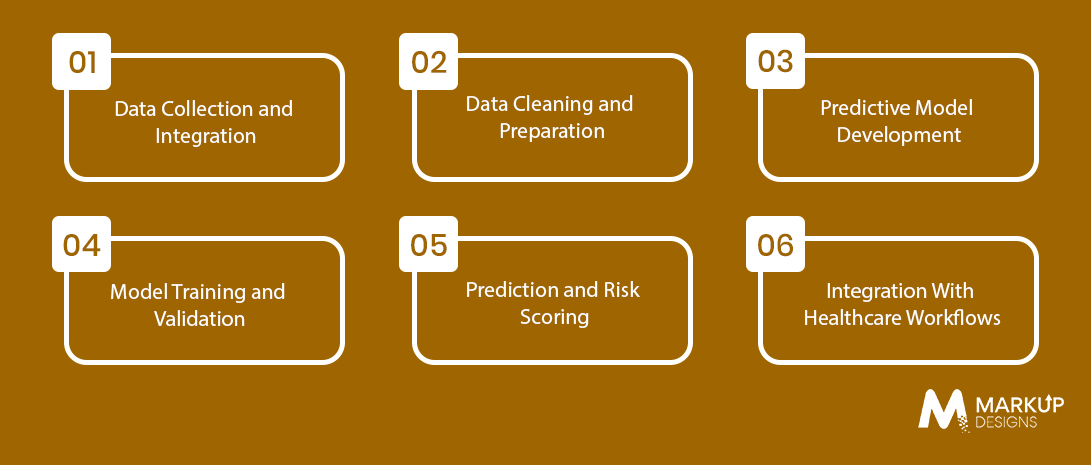
A healthcare predictive analytics solution typically follows a structured pipeline that transforms raw healthcare data into actionable predictions. The process involves collecting relevant data, preparing it for analysis, developing and validating models, and integrating the resulting insights into existing healthcare workflows.
Data Collection and Integration
The first step is collecting relevant data from sources such as EHR systems, laboratory systems, medical devices, claims platforms, and wearable technologies. Data integration brings information from these different systems into a format that can be analysed together.
Data Cleaning and Preparation
Healthcare data can contain missing values, duplicate records, inconsistent formats, and other quality issues. Data cleaning and preparation help remove these problems and structure the information for model development.
Predictive Model Development
Developers and data scientists select an appropriate machine learning or statistical approach based on the prediction objective. The model is designed to identify relationships between historical data and the outcome being predicted.
Model Training and Validation
The model is trained using historical datasets and then tested against separate data to evaluate how accurately it performs. Validation helps identify overfitting and determines whether the model can produce reliable predictions on new data.
Prediction and Risk Scoring
Once validated, the model can process new patient or operational data to generate predictions. Depending on the application, this may result in risk scores, probability estimates, alerts, or predicted outcomes.
Integration With Healthcare Workflows
Predictions become useful when they are available where healthcare professionals already work. Integration with EHRs, clinical dashboards, patient monitoring systems, or other healthcare platforms allows teams to access insights without relying on a separate system.
What Are the Benefits of Predictive Analytics in Healthcare?
Predictive analytics can improve both clinical decision-making and healthcare operations by helping organisations identify potential problems earlier and allocate resources more effectively.
Early Disease Detection and Risk Prediction
Predictive models can analyse patient data to identify patterns associated with potential diseases or health complications. This can help healthcare professionals identify high-risk patients and consider earlier assessment or intervention.
Improved Patient Outcomes
Earlier identification of risks can support timely intervention and closer monitoring. Predictive insights can complement clinical expertise and help providers make more informed decisions throughout the patient journey.
Personalised Treatment Planning
Predictive analytics can identify patterns across patient characteristics, medical histories, and treatment outcomes. These insights can support more personalised care planning based on individual patient needs.
Reduced Hospital Readmissions
Models can identify patients who may have a higher probability of readmission based on clinical and historical factors. Healthcare teams can use these insights to strengthen discharge planning, follow-up, and post-treatment monitoring.
Better Resource Planning
Hospitals can use predictive models to estimate patient volumes, bed requirements, staffing needs, and demand for medical resources. This supports better allocation of resources and operational planning.
Improved Clinical Decision-Making
Predictive analytics provides healthcare professionals with data-driven insights that can support clinical assessment. It does not replace professional judgement but can provide additional information when evaluating potential risks and outcomes.
Reduced Healthcare Costs
By improving resource utilisation, supporting preventive care, and identifying potential complications earlier, predictive analytics can help reduce avoidable costs associated with inefficient operations and unnecessary interventions.
Improved Operational Efficiency
Predictive models can help healthcare organisations anticipate demand, optimise workflows, and identify operational bottlenecks. This allows teams to plan ahead instead of responding only after problems occur.
What Are the Use Cases of Predictive Analytics in Healthcare?
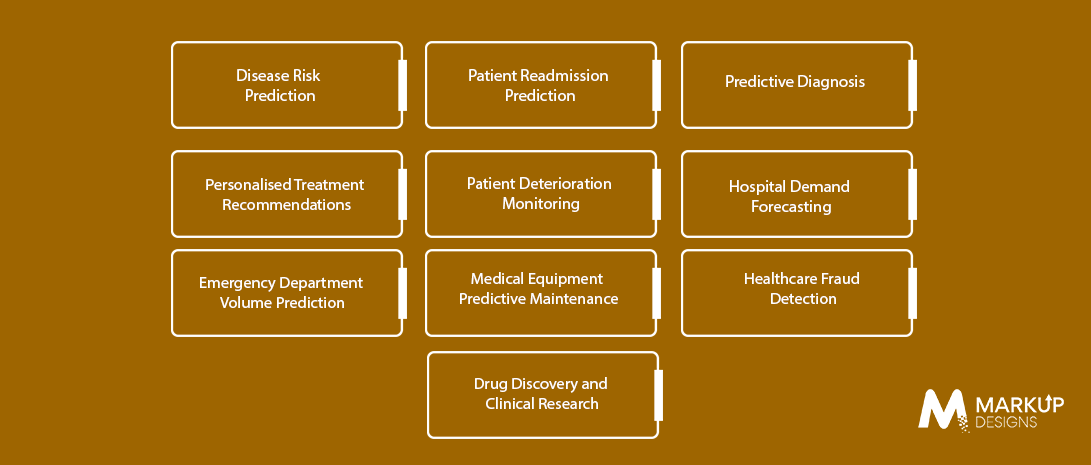
Predictive analytics has applications across patient care, hospital operations, research, and healthcare administration.
Disease Risk Prediction
Predictive models can assess patient information and identify individuals who may have a higher risk of developing specific diseases or complications. These insights can support preventive monitoring and early intervention.
Patient Readmission Prediction
Healthcare organisations can use historical patient and clinical data to estimate the likelihood of readmission. High-risk patients can then receive additional follow-up or post-discharge support.
Predictive Diagnosis
Predictive models can analyse symptoms, medical history, test results, and other clinical information to identify patterns associated with potential conditions. These insights can support, rather than replace, professional diagnosis.
Personalised Treatment Recommendations
By analysing patient characteristics and historical treatment outcomes, predictive analytics can help identify patterns that may inform treatment planning and patient-specific care strategies.
Patient Deterioration Monitoring
Predictive systems can monitor clinical indicators and identify patterns that may signal patient deterioration. Alerts can help healthcare teams prioritise patients who may require closer observation.
Hospital Demand Forecasting
Hospitals can analyse historical admission patterns and other operational data to forecast future demand. This can support planning for beds, staff, equipment, and other resources.
Emergency Department Volume Prediction
Predictive models can estimate emergency department volumes based on historical patterns and relevant operational factors. Hospitals can use these forecasts to plan staffing and resource allocation.
Medical Equipment Predictive Maintenance
Healthcare organisations can analyse equipment performance and usage data to identify potential failures before they occur. Predictive maintenance can reduce unexpected downtime and support equipment availability.
Healthcare Fraud Detection
Predictive analytics can identify unusual patterns across claims, transactions, and healthcare activities. Potentially suspicious activity can then be flagged for further investigation.
Drug Discovery and Clinical Research
Researchers can use predictive models to analyse biological, clinical, and experimental datasets, helping identify patterns that may support drug discovery, clinical trial planning, and research analysis.
What Technologies Power Predictive Analytics in Healthcare?
A healthcare predictive analytics solution typically combines AI, machine learning, data infrastructure, healthcare software development systems, and integration technologies.
Machine Learning
Machine learning algorithms analyse historical data to identify patterns and generate predictions. Different algorithms can be selected depending on the healthcare problem, dataset, and required output.
Artificial Intelligence
AI enables predictive systems to process complex datasets and support automated analysis. It can combined with machine learning to develop more intelligent healthcare applications.
Natural Language Processing
NLP can extract useful information from unstructured clinical text such as medical notes, reports, and documentation. This makes textual healthcare data more accessible for predictive analysis.
Big Data Analytics
Big data technologies help healthcare organisations process large and diverse datasets generated across clinical and operational systems.
Cloud Computing
Cloud infrastructure provides scalable computing and storage resources for healthcare analytics workloads. It can also support model training, data processing, deployment, and monitoring.
Electronic Health Record Integration
EHR integration allows predictive analytics systems to access relevant patient information and deliver predictions within existing clinical environments.
Healthcare APIs and Interoperability
APIs and interoperability standards help predictive analytics solutions exchange data with healthcare applications, systems, and platforms while supporting more connected workflows.
What Data Is Required for Predictive Analytics in Healthcare?
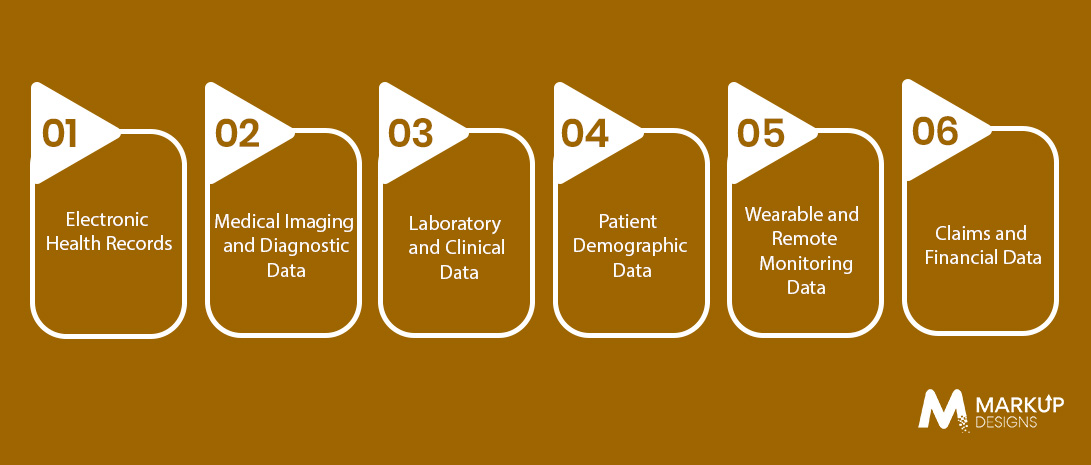
The data requirements depend on the specific prediction being developed. A patient risk model, for example, may require clinical history and laboratory results, while a hospital demand model may rely more heavily on operational and historical admission data.
Electronic Health Records
EHRs can provide information such as diagnoses, medications, procedures, medical history, and clinical observations for patient-focused predictive models.
Medical Imaging and Diagnostic Data
Medical images and diagnostic information can provide valuable inputs for models designed to identify disease patterns or predict clinical outcomes.
Laboratory and Clinical Data
Laboratory results, vital signs, clinical measurements, and other observations can help models identify changes associated with patient risks or treatment outcomes.
Patient Demographic Data
Information such as age and other relevant demographic characteristics can help models identify patterns across different patient populations.
Wearable and Remote Monitoring Data
Wearables and remote monitoring devices can provide continuous or frequent information such as activity, heart rate, and other health indicators, depending on the device and use case.
Claims and Financial Data
Claims and financial datasets can support applications such as cost forecasting, utilisation analysis, fraud detection, and healthcare resource planning.
How to Develop a Predictive Analytics Solution for Healthcare?
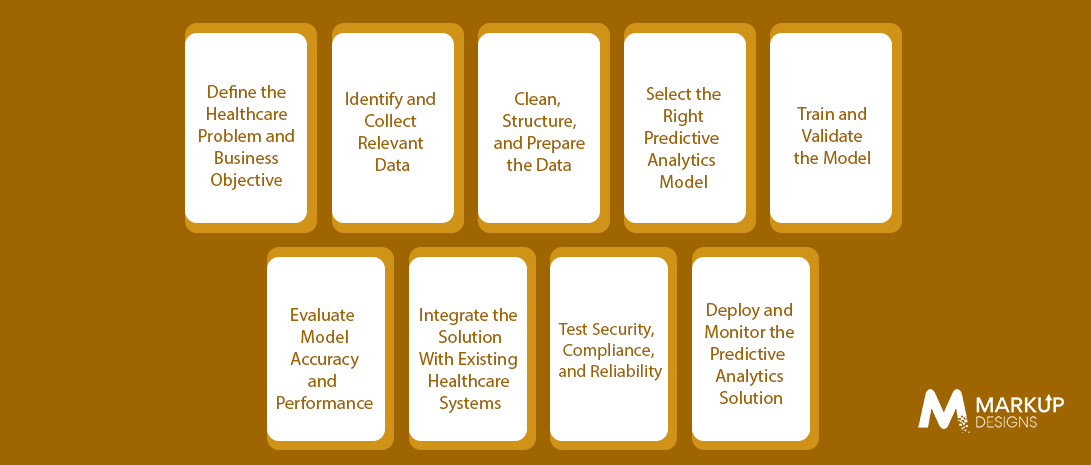
Developing predictive analytics for healthcare requires a combination of data engineering, AI development services, healthcare integration, security, and continuous model management. The process should begin with a clearly defined business or clinical objective rather than simply selecting an AI technology.
Step 1: Define the Healthcare Problem and Business Objective
Start by identifying the specific problem the solution needs to address. Define the expected prediction, target users, desired outcome, and KPIs that will determine whether the solution is successful.
Step 2: Identify and Collect Relevant Data
Determine which datasets are required to train and operate the predictive model. Relevant data may come from EHRs, laboratory systems, medical devices, claims platforms, or other healthcare sources.
Step 3: Clean and Prepare the Data
Remove duplicate and inconsistent records, address missing information, standardise formats, and prepare the dataset for analysis. Strong data preparation is essential for developing reliable predictive models.
Step 4: Select the Right Predictive Analytics Model
Choose an appropriate statistical or machine learning model based on the prediction objective, available data, required accuracy, and level of explainability.
Step 5: Train and Validate the Model
Train the model using historical data and validate its performance using appropriate testing datasets. The process should evaluate whether the model performs consistently across relevant patient or operational groups.
Step 6: Evaluate Model Accuracy and Performance
Measure metrics such as accuracy, precision, recall, specificity, and other application-specific indicators. Healthcare models should also be evaluated for reliability, bias, and clinical relevance.
Step 7: Integrate With Existing Healthcare Systems
Connect the predictive solution with relevant EHRs, clinical applications, dashboards, or other healthcare software development systems. The objective is to make predictions available within existing workflows.
Step 8: Test Security, Compliance, and Reliability
Healthcare solutions must protect sensitive data and meet applicable privacy, security, and regulatory requirements. Security testing, access controls, encryption, audit mechanisms, and system reliability should be assessed before deployment.
Step 9: Deploy and Monitor the Predictive Analytics Solution
After deployment, continuously monitor model performance and data quality. Models may become less accurate as patient populations, clinical practices, or data patterns change, making ongoing evaluation and retraining necessary.
How Much Does It Cost to Develop Predictive Analytics in Healthcare?
The cost to develop a predictive analytics solution in healthcare can vary significantly depending on its purpose, data requirements, AI complexity, integrations, security needs, and deployment environment. A basic proof of concept may require a relatively limited investment, while an enterprise-grade platform connected to multiple healthcare systems can require substantially more development effort.
Rather than estimating cost based on the AI component alone, businesses should consider the complete development lifecycle, including data preparation, model development, infrastructure, healthcare integrations, compliance, testing, deployment, and ongoing maintenance.
Factors Affecting Predictive Analytics Development Cost
The main factors influencing development cost include the complexity of the prediction, volume and quality of available data, number of integrations, AI model requirements, security standards, development team expertise, and post-launch support.
Data Collection and Preparation Costs
Healthcare data often comes from multiple sources and may require cleaning, standardisation, labelling, and integration before it can be used for predictive modelling. If high-quality datasets are not readily available, data preparation can become a significant part of the development budget.
AI and Machine Learning Model Complexity
A straightforward prediction model generally requires less development effort than a sophisticated model involving multiple datasets, advanced machine learning techniques, real-time predictions, or highly specialised clinical requirements. The level of model training, validation, and optimisation also affects the overall cost.
Integration and Infrastructure Costs
Connecting the solution with EHRs, laboratory systems, medical devices, healthcare APIs, or other existing platforms adds development and testing requirements. Cloud infrastructure, data storage, computing resources, and deployment architecture also contribute to the total cost.
Security and Compliance Requirements
Healthcare applications handle sensitive information and therefore require strong security controls. Encryption, authentication, access management, audit trails, privacy controls, and regulatory compliance can increase development and testing requirements.
Development Team and Technology Stack
The development team may include AI/ML engineers, data scientists, backend and frontend developers, healthcare integration specialists, QA professionals, and security experts. The technologies, infrastructure, and expertise required for the project can significantly influence development costs.
Maintenance and Model Retraining Costs
Development does not end at deployment. Predictive models need ongoing monitoring to identify performance issues, data changes, and model drift. Regular maintenance, infrastructure management, security updates, and model retraining should therefore be included in the long-term budget.
Read Also: Healthcare App Development Cost in 2026
How Long Does It Take to Develop a Predictive Analytics Solution?
Development time depends on the complexity of the solution, data readiness, integrations, compliance requirements, and testing scope. A simple proof of concept can be developed much faster than an enterprise platform requiring multiple healthcare integrations and extensive validation.
Proof of Concept
A proof of concept typically focuses on validating whether a specific predictive model can solve the identified problem using a limited dataset and controlled environment.
MVP Development
An MVP adds essential user functionality, data pipelines, model deployment, basic integrations, security controls, and monitoring needed for initial real-world use.
Enterprise-Grade Solution
An enterprise solution requires more extensive development, including multiple integrations, scalable infrastructure, advanced security, compliance, testing, monitoring, user management, and ongoing model management.
What Healthcare Compliance Standards Should Predictive Analytics Follow?
Compliance requirements depend on the target market, type of healthcare data, users, and intended application. Businesses should identify applicable regulations and standards early rather than treating compliance as a final development step.
HIPAA
Healthcare solutions handling protected health information in the United States may need to comply with HIPAA requirements for privacy, security, and appropriate handling of patient data.
GDPR and Healthcare Data Privacy
Solutions processing personal health data in the European Union or applicable jurisdictions need to consider GDPR requirements, including lawful data processing, privacy, security, and data subject rights.
HL7 and FHIR
HL7 and FHIR standards support healthcare data exchange and interoperability. Using appropriate standards can make it easier for predictive analytics systems to communicate with existing healthcare applications.
Data Encryption and Access Controls
Sensitive healthcare information should be protected through encryption, secure authentication, role-based access controls, and appropriate data security measures.
Patient Consent and Data Governance
Organisations need clear policies for how patient data is collected, processed, stored, shared, and retained. Consent and data governance requirements should align with the applicable regulatory framework and use case.
AI Model Transparency and Explainability
Healthcare professionals may need to understand why a predictive model generated a particular risk score or prediction. Explainable AI techniques can help improve transparency, validation, and user trust.
What Challenges Should Businesses Consider When Implementing Predictive Analytics in Healthcare?
Predictive analytics can deliver valuable insights, but implementation involves challenges that extend beyond model development.
Data Quality and Availability
Incomplete, inconsistent, outdated, or poorly structured data can reduce model performance. Reliable predictions require relevant and sufficiently representative datasets.
Patient Data Privacy
Healthcare data requires strict protection throughout collection, processing, storage, and transmission. Weak privacy controls can create both security risks and regulatory exposure.
Model Bias and Accuracy
A model trained on limited or unrepresentative data may produce biased or unreliable predictions. Models should therefore be evaluated across relevant patient populations and monitored after deployment.
Integration With Legacy Systems
Many healthcare organisations operate with older systems that may have limited interoperability. Connecting predictive analytics with these environments can increase development complexity.
Lack of Explainability
Highly complex models can make it difficult for users to understand how predictions were generated. This can become a problem when healthcare professionals need to evaluate or act on model outputs.
Regulatory and Compliance Challenges
Healthcare AI must operate within applicable privacy, security, and regulatory frameworks. Requirements can vary based on geography, data type, and intended use.
Model Drift and Continuous Monitoring
Patient populations, clinical practices, and data patterns can change over time. A model that performs well initially may lose accuracy, making continuous monitoring and periodic retraining necessary.
What Is the Future of Predictive Analytics in Healthcare?
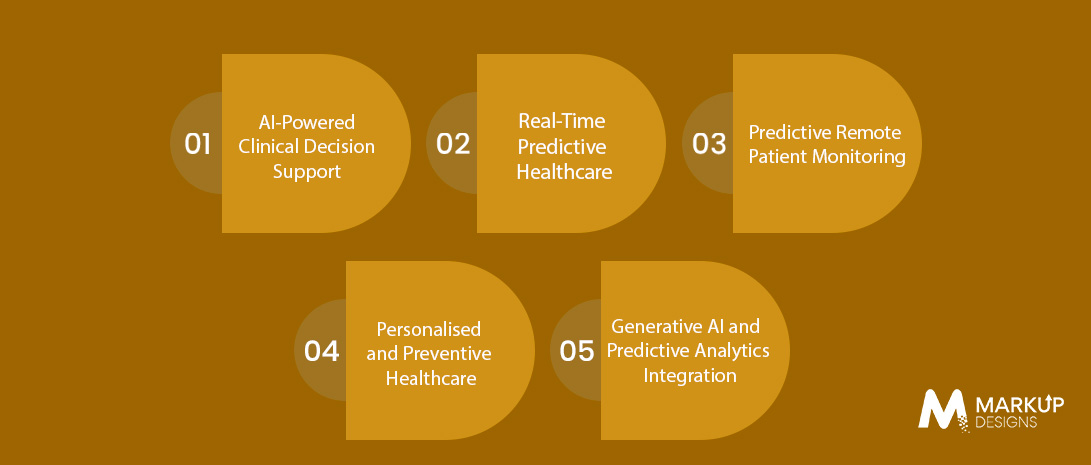
Predictive analytics is moving toward more connected, real-time, and personalised healthcare applications. As healthcare organisations improve their data infrastructure and AI capabilities, predictive models can become more closely integrated into clinical and operational workflows.
AI-Powered Clinical Decision Support
Predictive analytics can increasingly support clinical teams by identifying potential risks, highlighting relevant patterns, and providing data-driven insights during decision-making.
Real-Time Predictive Healthcare
Real-time data from EHRs, medical devices, and monitoring systems can enable healthcare organisations to identify potential changes in patient conditions and operational demand more quickly.
Predictive Remote Patient Monitoring
Combining predictive models with remote monitoring can help identify patients who may require additional attention based on changes in their health data.
Personalised and Preventive Healthcare
Predictive analytics can support earlier risk identification and more individualised care strategies, helping healthcare providers focus more on prevention and proactive management.
Generative AI and Predictive Analytics Integration
Generative AI can complement predictive analytics by helping users interpret model outputs, summarise relevant patient information, and interact with complex healthcare data through natural-language interfaces.
Why Choose Markup Designs for Predictive Analytics Development in Healthcare?
Markup Designs can help healthcare organisations build predictive analytics solutions tailored to their specific clinical, operational, and business requirements. Our approach can cover the complete development lifecycle, from data and AI model development to healthcare integrations, security, testing, deployment, and ongoing support.
The focus should be on building a solution that is not only technically capable of generating predictions but also practical for healthcare professionals to use within their existing workflows. A scalable architecture, appropriate technology selection, secure data handling, and continuous model monitoring can help create a predictive analytics platform designed for long-term use.
Build a Predictive Analytics Solution for Healthcare
Turn healthcare data into actionable predictions with a secure, scalable, and purpose-built analytics solution.

Conclusion
Predictive analytics is helping healthcare organisations move from reactive decision-making toward earlier risk identification, better resource planning, and more personalised care. By combining healthcare data with AI and machine learning, organisations can identify patterns that support clinical and operational decisions.
However, successful implementation depends on more than predictive models. Data quality, healthcare system integration, security, compliance, model accuracy, and continuous monitoring all play an important role. A well-planned development approach can help organisations build predictive analytics solutions that deliver practical value while supporting long-term scalability.
FAQ
1. What is predictive analytics in healthcare?
Predictive analytics in healthcare uses historical and real-time healthcare data, statistical methods, and AI or machine learning models to forecast potential patient outcomes, risks, and operational requirements.
2. How is predictive analytics used in healthcare?
It is used for applications such as disease risk prediction, patient readmission prediction, patient deterioration monitoring, hospital demand forecasting, personalised treatment planning, fraud detection, and medical equipment maintenance.
3. What are the benefits of predictive analytics in healthcare?
Key benefits include earlier risk identification, improved patient outcomes, better clinical decision-making, personalised care, more efficient resource planning, reduced operational costs, and improved healthcare workflows.
4. How much does it cost to develop predictive analytics in healthcare?
The cost depends on factors such as data requirements, AI model complexity, healthcare integrations, infrastructure, security, compliance, development team, and ongoing maintenance. A simple proof of concept will typically require far less investment than a fully integrated enterprise solution.
5. How long does it take to develop a predictive analytics solution?
Development time depends on the scope and complexity of the solution. A proof of concept can be completed faster, while an MVP or enterprise-grade platform requires additional time for integrations, security, testing, compliance, and deployment.
Author's Perspective
Predictive analytics has the potential to become an important part of modern healthcare infrastructure, but its value depends on how effectively predictions are integrated into real-world workflows. Healthcare organisations should focus on building solutions around clear use cases, reliable data, explainable models, and measurable outcomes rather than adopting AI simply for the sake of innovation.
The right technology and development partner can help turn predictive capabilities into a practical healthcare solution that supports better decisions, improves efficiency, and creates a foundation for future AI-driven healthcare applications.
Discuss Your Project NowJupinder Singh Arora
Founder and CEO
Insights Are Valuable & Execution is Priceless
You’ve read about the digital future. Now, let’s build the infrastructure to take you there. Move your strategy from the page to the product.
Design Your Solution Now
Contact Us
Schedule The Appointment At Your Convenience Date And Time.
30 Min
Web Conference
Time Zone
Indian standard time (08:30pm)

Thanks For Getting In Touch!
You’ve Taken The First Step Toward Transforming Your Digital Presence. Our Experts Will Reach Out Shortly To Take It Forward.
Launch Your Dream Project
Provide a brief overview of your project, and our specialists will evaluate your requirements. We will connect with you to explore how the right digital solutions can help you launch faster.