

In Brief
- AI is transforming the Middle East aviation industry by improving airport efficiency, safety, and passenger experience through technologies like biometrics, IoT, and machine learning.
- Airports in countries such as UAE, Saudi Arabia, Qatar, and Oman are using AI for facial recognition, security screening, baggage tracking, and crowd management.
- Predictive analytics and AI models help optimize operations like flight scheduling, gate allocation, maintenance planning, and passenger flow management.
- AI also enhances weather forecasting and turbulence prediction, helping reduce delays caused by sandstorms and improving flight safety.
- Smart systems like AI-powered queuing, real-time translation, and automated check-ins make passenger journeys smoother and more efficient.
- Overall, AI is driving major digital transformation in Middle East aviation, leading to smarter airports, reduced operational costs, and better travel experiences.
In recent years, countries in the Middle East, especially Saudi Arabia and UAE, have increasingly adopted artificial intelligence in their aviation sector. Airports in these regions are now using technologies like facial recognition, IoT systems, and biometric scanning on a large scale. AI is also helping streamline airport operations by improving security checks and making passenger management faster and more efficient.
According to MDPI, there are four main applications of AI technologies in aviation. First, airports, such as Dubai International Airport, employ AI facial recognition technology to confirm the identity of passengers. This increases accuracy and decreases time and human errors.
Building on this, another major application of AI is predictive analytics, which plays a crucial role in optimizing airport operations. By analyzing real-time and historical data, AI systems help in gate assignment optimization, forecasting passenger crowd movements, and improving maintenance scheduling. Together, these applications demonstrate how AI is transforming airports into smarter, more efficient, and highly responsive environments.
Thirdly, artificial intelligence has been utilized to improve the baggage handling system. It has assisted in increasing the efficiency of tracking the movement of the bags to avoid losses and ensure that passengers’ luggage is delivered promptly and securely.
Lastly, the integration of IoT devices and artificial intelligence helps in monitoring airport activities such as congestion and cleanliness. The system is able to identify congestion in real time and trigger alarms for appropriate measures to be taken.
AI Solutions: Market Forecast Overview

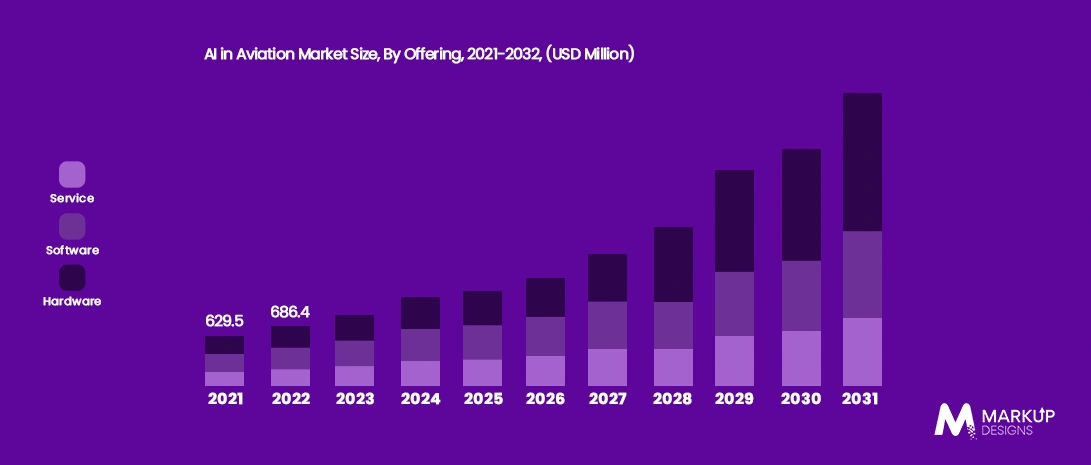
The AI in aviation market size was valued at USD 686.4 million in 2022 and is projected to register a CAGR of over 20% between 2023 and 2032. AI can analyze vast amounts of data to identify potential safety risks, predict equipment failures, and assist in proactive maintenance, thereby enhancing overall safety in aviation operations.
The implementation of artificial intelligence into the aviation industry will lead to changes regarding its increased efficiency, safety, and passenger experience. In fact, artificial intelligence is currently applied in the main aspects of the industry, which include passenger check-in and security clearance. The application of machine learning technologies enables the prediction of maintenance needs, the reduction of fuel usage, and better personalization using chatbots and recommendation systems.
Middle East Aviation Industry: Key Highlights
The Middle East aviation market is projected to increase from USD 28.64 billion in 2025 to USD 30.07 billion in 2026, eventually reaching USD 37.93 billion by 2031, growing at a CAGR of 4.75% during the 2026–2031 period. This relatively moderate growth rate, especially when compared to the 9.4% surge in passenger traffic seen in 2024, indicates a strategic shift in the industry. Instead of relying solely on rising passenger volumes, the focus is moving toward higher-value operations, including premium fleet utilization, stronger cargo revenue, and expanded ancillary income sources.
How AI is Transforming Aviation in the Middle East
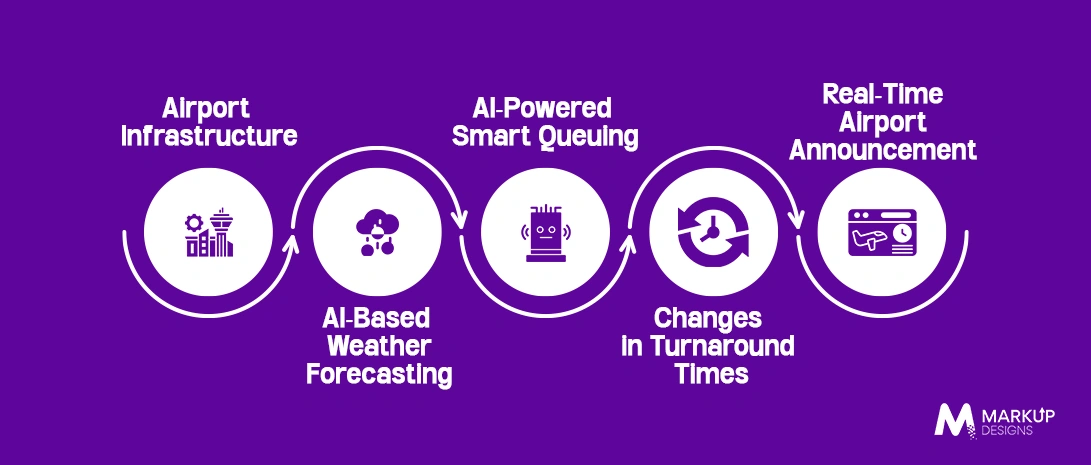
The Dubai International Airport is currently under construction to become the biggest airport terminal in the world, with 400 gates and five runways. This proves that the implementation of AI technology in aviation is not only about the application of new tech but also about changing approaches to designing and building airports altogether, eliminating all previous limitations in airport infrastructure construction.
Evolving Airport Infrastructure and Operational Redesign
In the last two decades, airports have seen massive changes in terms of their structure and operations owing to better design, security checks, and passenger parking.
AI does not change the layout of airports but plays a supporting role in making connections within the system and ensuring effective planning and operations. In the Middle East, the application of AI in flight operations is gaining popularity as airports undergo several operational and structural changes.
Airport security and passenger screening are changing significantly with the introduction of AI in airport operations. Machine learning systems use data from past security incidents to learn how to identify suspicious behavior and detect unusual objects during screening. At security checkpoints, technologies like biometrics and CT scanners are used together, making the screening process faster, more accurate, and easier to manage.
AI-Based Weather Forecasting and Turbulence Management in Aviation
The aviation sector in the Middle East has been struggling with sandstorms and dust storms over the years. These weather conditions often make it difficult to see clearly, which can delay or cancel flights. Sandstorms can also harm airplane engines, resulting in more frequent maintenance and repairs. Dust storms can reduce air quality and increase the risk of operational disruptions at airports, affecting both flight schedules and ground operations.
In recent times, AI has been useful in predicting weather conditions such as sand and dust storms and taking appropriate action. AI-powered systems rely on data from various sources, including wind speed, soil moisture content, and satellite images, to accurately predict when storms will occur. With this information, airlines and airports can adjust their flight schedule or change routes in anticipation of sandstorms and dust storms.
With regards to turbulence management, machine learning algorithms can be used to predict better and more accurately by combining various measures used in measuring turbulence.
AI-Powered Smart Queuing for Security and Immigration
The process of organizing passengers’ movement in airports is one of the biggest challenges faced by air transport service providers. Therefore, to enhance the efficiency of the process, AI-based smart queuing systems have been applied at security checks and immigration checkpoints to regulate passenger flows.
This is achieved through using various tools and methods, such as computer vision and analytics, that help control queue processes and manage crowd flows effectively. Furthermore, reinforcement learning technology helps AI-powered systems make smarter decisions by learning from past queue experiences.
By collecting and processing real-time data, an AI system can forecast the peak rush hours using certain algorithms of travel demand. It will be possible for airports to distribute their staff and manage waiting times and expenses more efficiently.
All in all, the implementation of intelligent technologies has made the whole journey of the customer from check-in to the flight smoother.
Currently, several aviation enterprises are implementing AI solutions in major cities, such as Dubai, to create self-managing smart systems.
Changes in Turnaround Times through Incremental Steps
There are more than just commercial purposes when discussing aviation, since this mode of transportation acts as a lifeline on which the entire region heavily relies as far as overseas business dealings go. As such, it makes perfect sense that the revenue potential is lost at every single minute an airplane remains grounded.
The aviation industry, especially in the Middle East, is growing quickly and handling a large number of passengers. Because of this, improving and optimizing airport processes is very important. New aviation technologies in the region play a key role in ensuring smoother and more efficient operations.
For instance, AI algorithms can utilize up-to-date information and historical data in order to come up with accurate forecasts concerning delay times, constellation changes, and even baggage handling times. Furthermore, a combination of a unified platform and AI technology can minimize miscommunication issues or even eliminate them.
Real-Time Airport Announcement Translation
While thought of as a premium service, real-time translation of airport announcements has become a prevalent phenomenon intended for serving more than one passenger at once. Multilingual airports serve millions of tourists yearly, especially in the Middle East region.
AI-based translation systems first translate the live public announcement and then use models such as:
- Natural Language Processing
- Neural Machine Translation
- Speech Recognition
- Text-to-Speech Synthesis
Overall, the advantage lies in the fact that it eliminates confusion and improves operations by relieving the workload from employees.
AI-Powered Aviation Transformation
Transform your aviation business with advanced AI-driven digital transformations that improve efficiency, enhance passenger experience, and optimize operations across every stage of the journey.

AI Integration Costs in Middle East Aviation: Overview of Key Expenses
The integration of AI within the aviation sector in the Middle East includes number of cost elements, depending on the magnitude of the implementation and the technological processes employed. These cost elements range from developing infrastructure, software, information management, hiring of talent, and maintenance.
Companies that are integrating AI tend to set aside large amounts of money for the creation of an infrastructure that will facilitate the use of information technology systems, including machine learning algorithms and computer vision. Integrating AI into existing airport systems can also be costly. This includes updating or connecting it with current security systems, baggage handling systems, and passenger services.
Other costs incurred during the implementation process relate to the recruitment and training of experts in AI systems, system updates, and cybersecurity, among other aspects.
Estimated Cost Breakdown for AI Integration in Aviation
| Cost Component | Description | Estimated Share of Total Cost |
| Infrastructure Development | Servers, cloud systems, data centers, and hardware setup | 25% – 30% |
| AI Software Development | Machine learning models, AI platforms, and system integration | 20% – 25% |
| Data Management Systems | Data storage, processing, and analytics tools | 10% – 15% |
| Workforce & Training | Hiring AI specialists and training airport staff | 15% – 20% |
| System Integration | Linking AI with existing airport operations systems | 10% – 15% |
| Maintenance & Cybersecurity | Ongoing updates, monitoring, and security protection | 10% – 15% |
How Markup Designs Helps Grow Your Aviation Business
With constant evolution in the aviation industry, digitalization and AI-based solutions have become increasingly relevant and essential for increasing productivity, enhancing customer satisfaction, and making companies more scalable. Markup Designs could deliver great value and help organizations create an innovative and robust technology-driven digital environment.
By providing its services and support, Markup Designs offers a range of advanced solutions that allow companies to implement AI technology and aviation software development and create data-focused systems that enhance operations and improve decision-making processes. From passenger management systems to smart dashboards powered by analytics, the company offers a variety of options customized to different customers.
Moreover, Markup Designs develops various products to increase customers’ online experience, including responsive web portals and automated booking systems. These tools help increase customer satisfaction by streamlining operations and reducing workload.
Finally, Markup Designs provides its clients with an opportunity to implement innovations in the areas of artificial intelligence, machine learning, and cloud computing into their environment.
Future-Ready AI Aviation Solutions
Enhance the transformation of your aviation with the use of intelligent AI solutions that are made to be future-proof and ensure improved efficiency and better operational processes while creating a seamless passenger experience.

Conclusion
AI is changing the face of the Middle Eastern aviation industry through its impact on efficiencies, improvements in safety, and better passenger experience. Examples of some of the areas in which AI is already being applied within airports include smart security scanning, intelligent queuing systems, AI-powered weather predictions, and translation services.
Some of the leading nations adopting such innovations include Saudi Arabia, UAE, Qatar, and Oman, as they invest in technologies that include biometric identification, IoT applications, machine learning, and computer vision.
Overall, AI has been at the forefront of revolutionizing airport infrastructure, enhancing efficiency levels, minimizing delays, and creating a smoother travel experience for passengers.
FAQs
1. How is AI used in the aviation industry in the Middle East?
AI is used in several areas such as passenger check-ins, security screening, baggage handling, flight scheduling, predictive maintenance, and crowd management at airports.
2. Which Middle Eastern countries are leading in AI aviation adoption?
Countries like UAE, Saudi Arabia, Qatar, and Oman are leading in adopting AI technologies in aviation to improve airport efficiency and passenger experience.
3. How does AI improve airport security?
AI improves security through facial recognition, biometric verification, computer vision, and machine learning systems that detect suspicious behavior or items more accurately.
4. Can AI help reduce flight delays?
Yes, AI can predict weather conditions, optimize flight routes, and improve airport operations, which helps reduce delays and improve scheduling efficiency.
5. What role does AI play in passenger experience?
AI enhances passenger experience through smart queuing systems, automated check-ins, personalized recommendations, real-time updates, and multilingual support systems.
6. Is AI used in airport infrastructure planning?
Yes, AI helps in planning airport layouts, gate allocation, passenger flow management, and resource optimization using historical and real-time data.
7. What are the main challenges AI solves in aviation?
AI helps solve challenges like congestion, delays, security risks, baggage mismanagement, operational inefficiency, and high maintenance costs.
8. What is the future of AI in Middle East aviation?
The future of AI in Middle East aviation includes fully automated airports, smarter passenger processing, predictive operations, and highly optimized airport infrastructure.
Author's Perspective
From my perspective, the implementation of AI in aviation in the Middle East is not just an advancement in technology but a strategic move for the long term. Slowly, the region is becoming a leading player in the sphere of smart aviation by making advances in automation and data-driven solutions as well as passenger-focused technologies. Although innovations such as the use of biometrics and predictive analytics have made a huge difference, the real future of airport ecosystems will be that of a truly intelligent environment.
Discuss Your Project NowGaurav Goyal
Global Sales- VP
Related Posts
How AI is Revolutionising Industrial Automation in Australia

How UK Enterprises Can Build an Effective AI...

AI Voice Agent for Real Estate: Features, Benefits,...
Insights Are Valuable & Execution is Priceless
You’ve read about the digital future. Now, let’s build the infrastructure to take you there. Move your strategy from the page to the product.
Design Your Solution Now
Contact Us
Schedule The Appointment At Your Convenience Date And Time.
30 Min
Web Conference
Time Zone
Indian standard time (08:30pm)

Thanks For Getting In Touch!
You’ve Taken The First Step Toward Transforming Your Digital Presence. Our Experts Will Reach Out Shortly To Take It Forward.
Launch Your Dream Project
Provide a brief overview of your project, and our specialists will evaluate your requirements. We will connect with you to explore how the right digital solutions can help you launch faster.