
In Brief
- AI software development cost in the UAE can be defined as a cost determined by the complexity of software, abilities of AI, features, integrations, data needs, and security requirements.
- Basic AI solutions are cheaper than advanced AI solutions such as those with generative AI or those that use predictive analytics along with automation and corporate integrations.
- Development costs include planning, UI/UX design, software development, AI integration, testing, and deployment.
- Businesspeople have to take into account ongoing expenditures, such as cloud computing infrastructure, AI model usage, working with APIs, data management, and so on.
- Creating an MVP and a scalable development process can help businesspeople minimize the initial costs and create their AI software for further development.
AI plays an essential role in the automation of processes, data analysis, personalization, and making of decisions in companies based in the UAE. Thanks to AI chatbots, predictive analytical systems, and generative AI systems, numerous companies possess software able to process huge data piles and make them actionable. However, the cost of developing AI software can vary significantly depending on what the solution needs to achieve.
AI software development costs in the UAE depend on several factors, including software complexity, AI models, features, data requirements, integrations, security, technology stack, and development expertise. Businesses also need to account for ongoing expenses such as cloud infrastructure, AI API usage, model monitoring, maintenance, and updates. This guide explores the AI software development cost in the UAE in 2026, along with the key cost factors, development process, technology stack, hidden expenses, timeline, and ways businesses can manage their investment.
How Much Does AI Software Development Cost in the UAE in 2026?
The AI software development cost in the UAE can range from $30,000 to $200,000+, depending on the software’s complexity, AI capabilities, features, integrations, data requirements, and security needs. The final cost can vary considerably between a basic AI solution and an enterprise-grade platform with advanced models and automation.
AI Software Development Cost by Complexity
- Basic AI Software: 30,000–60,000 for core AI functionality, limited features, and essential integrations.
- Mid-Level AI Software: 60,000–120,000 for advanced AI capabilities, multiple integrations, analytics, and more complex workflows.
- Advanced AI Software: 120,000–200,000+ for enterprise-grade AI, generative AI, predictive analytics, extensive integrations, and scalable infrastructure.
AI Software Development Cost by Development Stage
The overall investment is distributed across different development stages, with the scope of each stage depending on the software’s complexity.
- Discovery and Planning: Business requirements, AI use cases, technical architecture, and project planning.
- UI/UX Design: User journeys, interfaces, dashboards, and AI-driven interaction design.
- AI and Software Development: Frontend, backend, databases, AI models, and core software functionality.
- Integration and Testing: Third-party integrations, AI performance testing, security testing, and quality assurance.
- Deployment: Cloud configuration, production deployment, monitoring, and launch support.
What Factors Affect AI Software Development Cost in the UAE?
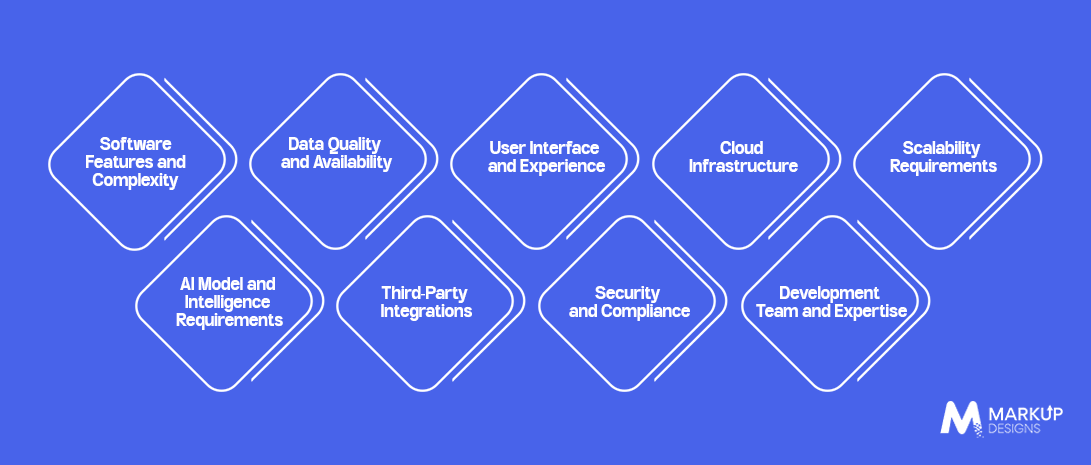
Software Features and Complexity
The number and complexity of features, workflows, user roles, and business processes directly influence development effort and cost.
AI Model and Intelligence Requirements
Using pre-trained models and APIs generally requires less development effort than building, training, fine-tuning, or deploying custom AI models.
Data Quality and Availability
AI software may require significant data preparation, cleaning, labelling, and processing before models can deliver reliable results.
Third-Party Integrations
Integrating payment gateways, CRMs, ERPs, cloud services, AI APIs, or external data sources can increase both development time and cost.
User Interface and Experience
Custom dashboards, personalised experiences, conversational interfaces, and complex workflows require additional UI/UX design and development.
Security and Compliance
Data encryption, authentication, access controls, audit logs, and applicable compliance requirements add to the overall development scope.
Cloud Infrastructure
AI workloads can require substantial computing, storage, and processing resources, particularly when handling large datasets or running AI models at scale.
Development Team and Expertise
The expertise and location of developers, AI engineers, designers, and other specialists can significantly influence development costs.
Scalability Requirements
Software designed to support large user volumes, high data loads, and future AI capabilities requires a more robust and scalable architecture.
What Types of AI Software Can Businesses Build in the UAE?
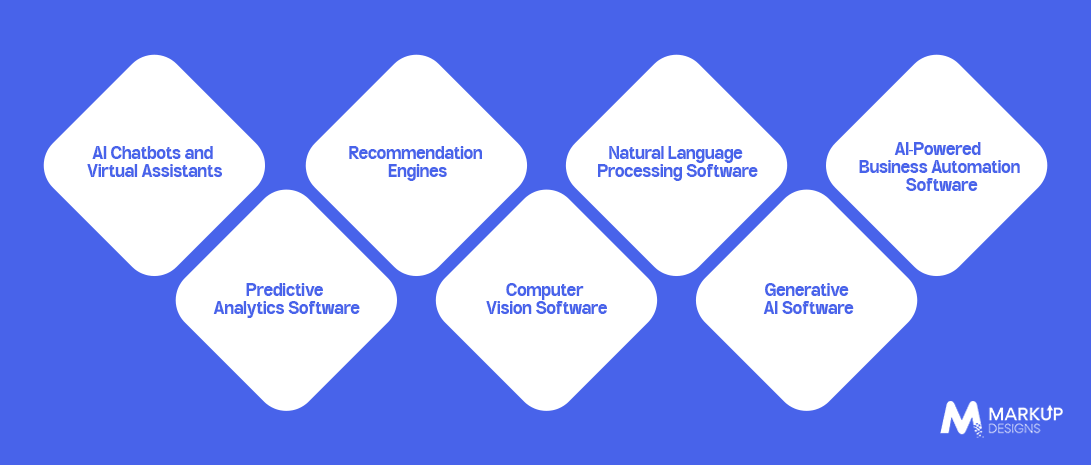
AI Chatbots and Virtual Assistants
AI-powered conversational software can automate customer support, answer queries, assist employees, and handle routine interactions.
Predictive Analytics Software
Predictive AI can analyse historical and real-time data to identify patterns, forecast outcomes, and support business decisions.
Recommendation Engines
Recommendation systems can analyse user behaviour and preferences to deliver personalised products, content, services, or offers.
Computer Vision Software
Computer vision solutions can process images and video for applications such as object detection, quality inspection, security, and automation.
Natural Language Processing Software
NLP-based software can analyse, classify, summarise, and generate human language for applications such as document processing and text analytics.
Generative AI Software
Generative AI applications can create text, images, code, documents, and other content based on user prompts and business requirements.
AI-Powered Business Automation Software
AI can automate repetitive business processes, extract information from documents, route tasks, and support operational decision-making.
What Are the Key Features of AI Software?
AI-Powered Automation
Automate repetitive tasks and workflows using AI model development, rules, and intelligent process automation.
Data Analytics and Reporting
Process business data and present actionable insights through reports, metrics, and visual analytics.
Intelligent Dashboards
Provide users with centralised dashboards to monitor AI outputs, business performance, alerts, and key activities.
Personalisation and Recommendations
Use customer and behavioural data to deliver personalised experiences, recommendations, and relevant content.
AI Chatbots and Assistants
Enable users to interact with the software through conversational interfaces for support, search, information retrieval, or task execution.
Predictive Insights
Use historical and real-time data to identify patterns, forecast trends, and support proactive decision-making.
API and System Integrations
Connect AI software development with existing business systems, third-party services, databases, and AI models through APIs.
User and Access Management
Control user roles, permissions, authentication, and access to sensitive data and AI-powered functionality.
How to Build AI Software in the UAE?
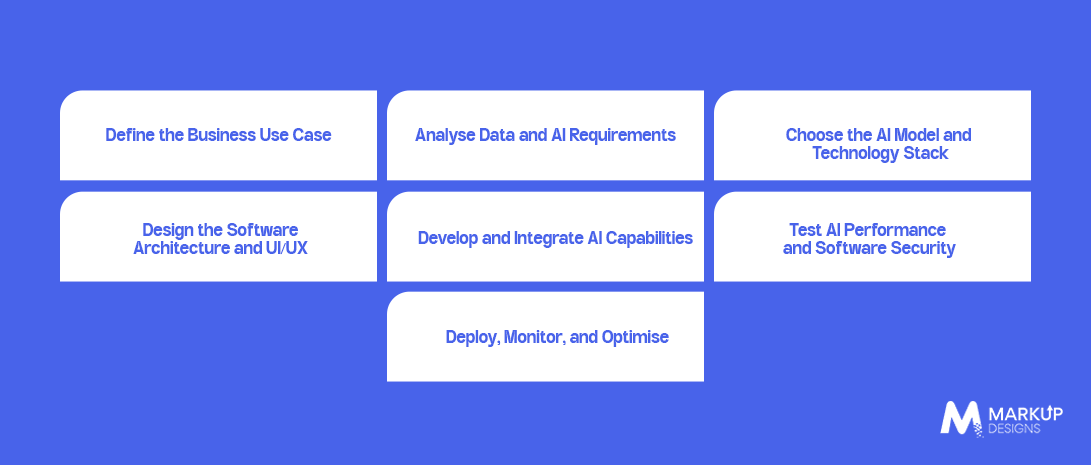
Step 1: Define the Business Use Case
Identify the business problem, target users, expected outcomes, and specific processes where AI can deliver value.
Step 2: Analyse Data and AI Requirements
Assess available data, data quality, processing requirements, AI capabilities, and whether a pre-trained or custom model is appropriate.
Step 3: Choose the AI Model and Technology Stack
Select suitable AI models, frameworks, programming languages, databases, APIs, and cloud infrastructure based on the software requirements.
Step 4: Design the Software Architecture and UI/UX
Plan the technical architecture and create user experiences that make AI-powered features clear, accessible, and practical.
Step 5: Develop and Integrate AI Capabilities
Build the core software and integrate AI models, APIs, databases, automation workflows, and required third-party systems.
Step 6: Test AI Performance and Software Security
Test functionality, AI accuracy, performance, integrations, security, and reliability before moving the software into production.
Step 7: Deploy, Monitor, and Optimise
Deploy the software, monitor AI and system performance, identify issues, and continuously optimise models, infrastructure, and features.
What Technology Stack Is Used for AI Software Development?
Frontend and Backend Technologies
Technologies such as React, Angular, Node.js, Python, and Java can be used to build responsive interfaces, backend services, APIs, and AI-powered business workflows.
AI and Machine Learning Frameworks
Frameworks and libraries such as TensorFlow, PyTorch, Scikit-learn, and Hugging Face support model development, training, fine-tuning, and deployment.
Databases and Data Processing
Databases and data-processing tools help store, organise, process, and analyse the structured and unstructured data required by AI applications.
APIs and AI Model Integration
AI software can integrate third-party AI models, business systems, data sources, payment services, and other applications through secure APIs.
Cloud and DevOps Infrastructure
Cloud and DevOps technologies provide the computing power, storage, deployment automation, monitoring, and scalability required to operate AI software.
What Are the Hidden Costs of AI Software Development?
AI Model and API Usage
AI APIs and model inference can create recurring costs based on usage, request volume, model type, and processing requirements.
Cloud Computing and Storage
AI workloads may require substantial computing power, storage, and data transfer, particularly as usage and data volumes increase.
Data Preparation and Management
Cleaning, labelling, organising, and maintaining high-quality training data can require significant time and resources.
Model Training and Retraining
Custom AI models may require ongoing training, fine-tuning, evaluation, and retraining as data and business requirements change.
Security and Compliance
Security monitoring, access controls, audits, encryption, and compliance requirements can add ongoing operational expenses.
Maintenance and Updates
AI software requires regular software updates, bug fixes, performance optimisation, model monitoring, and infrastructure maintenance.
How Long Does It Take to Develop AI Software in the UAE?
The development timeline depends on the software’s complexity, AI requirements, integrations, data readiness, and testing scope.
Planning and UI/UX Design
Requirements gathering, AI use-case analysis, architecture planning, and interface design establish the foundation for development.
AI and Software Development
The core software, databases, AI models, automation workflows, and required functionality are developed during this stage.
Integration and Testing
Developers integrate third-party systems and test functionality, AI performance, security, scalability, and reliability.
Deployment and Optimisation
The software is deployed to the production environment and continuously monitored and optimised based on performance and user requirements.
How Can Businesses Reduce AI Software Development Costs?
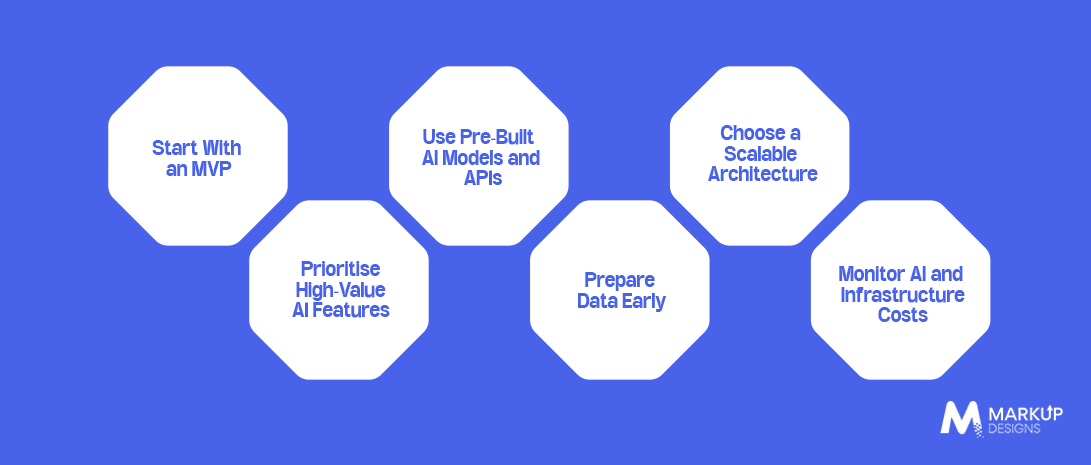
Start With an MVP
Launch with essential features and a focused AI use case before expanding the platform with advanced capabilities.
Prioritise High-Value AI Features
Invest first in AI functionality that directly addresses important business problems rather than adding AI features without a clear purpose.
Use Pre-Built AI Models and APIs
Pre-trained models and reliable APIs can reduce the time and resources required to build certain AI capabilities from scratch.
Prepare Data Early
Organising and validating data before development can reduce delays and avoid costly rework during AI implementation.
Choose a Scalable Architecture
A flexible architecture allows businesses to expand users, data volumes, and AI capabilities without rebuilding the entire software.
Monitor AI and Infrastructure Costs
Tracking model usage, cloud resources, API consumption, and infrastructure performance helps identify unnecessary recurring expenses.
Read Also: Why UAE Startups Prefer Flutter for MVP App Development in 2026
How to Choose an AI Software Development Company in the UAE?
AI and Machine Learning Expertise
Look for a development partner with practical experience in AI models, machine learning, automation, and AI-powered software development.
Industry Experience
Relevant industry experience can help the development team understand business workflows, data requirements, and domain-specific challenges.
Software Development Capabilities
The company should have expertise across frontend, backend, databases, APIs, cloud infrastructure, and software architecture.
Security and Compliance Expertise
Ensure the development partner can implement appropriate authentication, encryption, access controls, data protection, and security practices.
Integration and Scalability
The team should be capable of integrating existing business systems and building software that can scale with future requirements.
Post-Launch Support
Ongoing maintenance, AI monitoring, infrastructure management, updates, and technical support are important for long-term software performance.
Why Choose Markup Designs for AI Software Development?
Markup Designs helps businesses develop custom AI software aligned with their business processes, data requirements, and growth objectives. Our team combines AI/ML, software engineering, automation, cloud technologies, and secure architecture to build scalable AI solutions, from initial strategy and MVP development to integration, deployment, and ongoing support.
Build AI Software That Delivers Business Value
Build secure, scalable, and intelligent AI software tailored to your business needs with Markup Designs. From AI strategy and development to integration and optimisation, we help businesses turn AI opportunities into practical software solutions.

Conclusion
AI software can be a valuable resource for firms in the UAE because it allows them to automate processes, perform analyses, and make quicker decisions. Nevertheless, successful implementation of the technology requires more than just choosing an enterprise AI model. Businesses must consider data readiness, architecture of the software, integration issues, security, scalability, and the running expenses of the operations of AI.
A well-defined use case, focused MVP, technology stack appropriate for the project, and scalable architecture can assist companies in managing their financial investments.
FAQ
1. What is the cost of AI software development in UAE in 2026?
AI software development in UAE costs from $30k to $200k+ depending on the complexity of the software, its AI functionalities, features, integrations, security requirements, and scope of development.
2. How long does AI software development take in the UAE?
Development of AI software in the UAE takes from 4 to 12 months depending on the complexity of the solution, data expenses, types of possible integrations, and AI technologies used.
3. What affects AI development costs?
The main factors that influence the cost are the complexity of the software, requirements for the AI model, quality of data, possible integrations, security issues, cloud infrastructure, experience and competency of the development company, and scalability.
4. What types of AI applications may be developed by businesses?
AI applications that can be created by businesses include chatbots, virtual assistants, predictive analytics software, recommendation systems, computer vision applications, NLP applications, generative AI, and automation platforms.
5. What technologies are used to create the different kinds of AI software?
Technologies such as Python, Java, React, Node.js, TensorFlow, Pytorch, Scikit-learn, and other well-known platforms and libraries and tools that are needed for the completion of the project can be used for writing AI applications.
6. What are the ongoing costs associated with AI software development?
Ongoing costs can include expenses associated with the usage of the model and API, cloud computing, data storage, model monitoring and training, security, maintenance and updates, and scaling.
Author's Perspective
In my opinion, businesses shouldn’t start their AI software project with the question “Which AI technology should be used?” but rather ask the questions “What business problem do we want to solve and where exactly can AI bring value?” By starting with technology choice, companies risk making the whole process overly complicated and costly.
Choosing technology before defining the use case often leads to unnecessary complexity and higher costs. A practical AI solution should begin with a focused problem, reliable data, and clearly defined outcomes, then expand as the software proves its value.
Discuss Your Project NowGaurav Goyal
Global Sales- VP
Related Posts

Software Companies in Kuwait: Smart Choices for Long-Term...

How Much Does It Cost to Build CRM...
How to Build Production-Ready Applications with AI Coding...
Insights Are Valuable & Execution is Priceless
You’ve read about the digital future. Now, let’s build the infrastructure to take you there. Move your strategy from the page to the product.
Design Your Solution Now
Contact Us
Schedule The Appointment At Your Convenience Date And Time.
30 Min
Web Conference
Time Zone
Indian standard time (08:30pm)

Thanks For Getting In Touch!
You’ve Taken The First Step Toward Transforming Your Digital Presence. Our Experts Will Reach Out Shortly To Take It Forward.
Launch Your Dream Project
Provide a brief overview of your project, and our specialists will evaluate your requirements. We will connect with you to explore how the right digital solutions can help you launch faster.