
In Brief
- Kotlin and Scala are JVM-based programming languages that enable interoperability with Java and allow developers to create applications of the modern era.
- In terms of design philosophy and development approach, Kotlin is distinguished by simplicity and developer productivity, and Scala stands out due to powerful functional programming capabilities and a type system.
- Both Kotlin and Scala can be used for backend development, enterprise-level applications, and software architecture that can scale well.
- The former tends to have a slightly easier learning curve, while the latter can provide more flexibility in complex functional and data-related applications.
- In any case, selection of the appropriate programming language should depend on a number of factors such as application requirements, developer skill set, expected performance of an application, and future maintenance of software.
Selection of a programming language is one of the essential aspects of application performance, development, and future scalability. Kotlin and Scala are two popular JVM-based languages that can serve as alternatives to Java. Although both languages are similar in many ways, such as concise syntax, object-oriented programming, functional programming, and interoperability with Java, they still differ.
The knowledge of their distinctions in terms of performance, learning curve, ecosystem, and development expenses will allow companies and developers to choose the best option depending on the requirements of their project. The following guide offers a comparison of Kotlin and Scala on the basis of several parameters in order to help you make the choice.
What Are Kotlin and Scala, and How Do They Differ?
Kotlin and Scala are modern programming languages that work on the JVM and are statically typed. These two languages have Java interoperability and help developers to create scalable applications using fewer lines of code. However, there are some distinctions between them in terms of programming paradigms, complexity, ecosystem, and usage.
What Is Kotlin?
Kotlin is a statically typed programming language created by JetBrains. It was developed to facilitate the process of application creation through the use of concise syntax, null safety, and Java interoperability. Kotlin is used for Android app development, backend applications, and cross-platform apps with the help of Kotlin Multiplatform.
What Is Scala?
Scala is a programming language that allows working in both object-oriented and functional programming paradigms and is statically typed. It runs on the JVM and provides advanced features such as pattern matching, type inference, and higher-order functions. Scala is commonly used for backend systems, distributed applications, and data engineering.
Key Differences Between Kotlin and Scala
Kotlin prioritises simplicity, readability, and developer productivity, making it suitable for teams seeking a modern alternative to Java. Scala offers greater flexibility in functional programming and complex type systems, making it useful for sophisticated software architectures. While both support JVM development, their learning curves and ecosystem strengths differ.
Kotlin vs Scala: A Detailed Comparison of Key Features
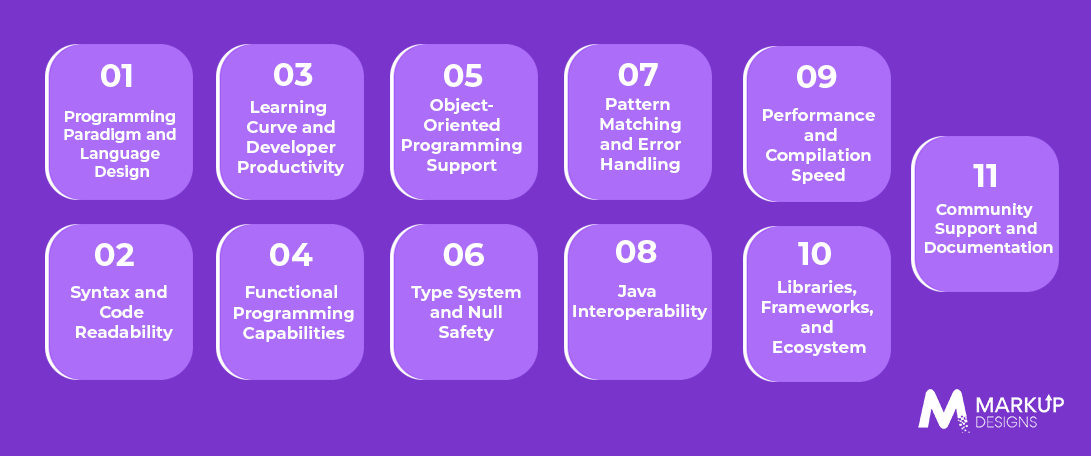
It is vital to know the technical details about the two languages in order to pick one for business and development purposes.
Programming Paradigm and Language Design
Kotlin is a language that supports OOP and functional programming. Scala is known for incorporating OOP and FP with many advanced abstractions and features of the latter.
Syntax and Code Readability
Kotlin has a compact syntax that makes writing programs easy. Scala has a good syntax and language features, but advanced programming may lead to difficult-to-read code.
Learning Curve and Developer Productivity
Kotlin has a relatively easy learning curve for programmers who know Java. Scala is more challenging as it requires to understand more about FP and type system.
Functional Programming Capabilities
Kotlin and Scala have functional programming capabilities, including lambdas, higher-order functions, immutable data, and others. Scala has more functional programming features than Kotlin.
Object-Oriented Programming Support
Kotlin has classes, inheritance, interfaces, and other OOP elements along with the rest. Scala combines object-oriented programming with functional concepts through traits, classes, and case classes, offering greater flexibility in application architecture.
Type Systems and Null-Safety
The Kotlin programming language has an advanced static type system and null safety mechanisms built into it that allow developers to avoid the most common mistakes related to null references. Scala, on the other hand, has an expressive type system that includes algebraic data types and union types in Scala 3.
Pattern Matching and Error Handling
There is a possibility of using a very advanced mechanism of pattern matching with match expressions in Scala. In Kotlin, there are conditional expressions, smart casting, and sealed classes; however, the language does not offer such rich pattern-matching opportunities.
Compatibility with Java
Both languages are compatible with Java and its ecosystem. Kotlin has excellent compatibility with Java, and developers can use any libraries or frameworks developed for Java. Similarly, Scala is also compatible with Java even though some issues may occur due to differences in language and type systems.
Performance and Compile Time
As both programming languages have the JVM under the hood, there are no direct differences in terms of performance because they depend on the application logic, memory usage, and many other factors. However, Scala has longer compile time due to its complex language features.
Libraries, Frameworks, and Ecosystem
Kotlin enjoys good integration with Android and compatibility with frameworks such as Spring Boot and Ktor. Scala has a proven ecosystem of libraries useful in functional backend development and big data operations with Akka, Play Framework, and Apache Spark.
Community Support and Documentation
Kotlin enjoys excellent community support thanks to Android developers, JetBrains, and the backend Kotlin ecosystem. Scala has a well-established developer community in functional programming and data engineering, and documentation for its ecosystem.
Kotlin vs Scala: Advantages and Limitations
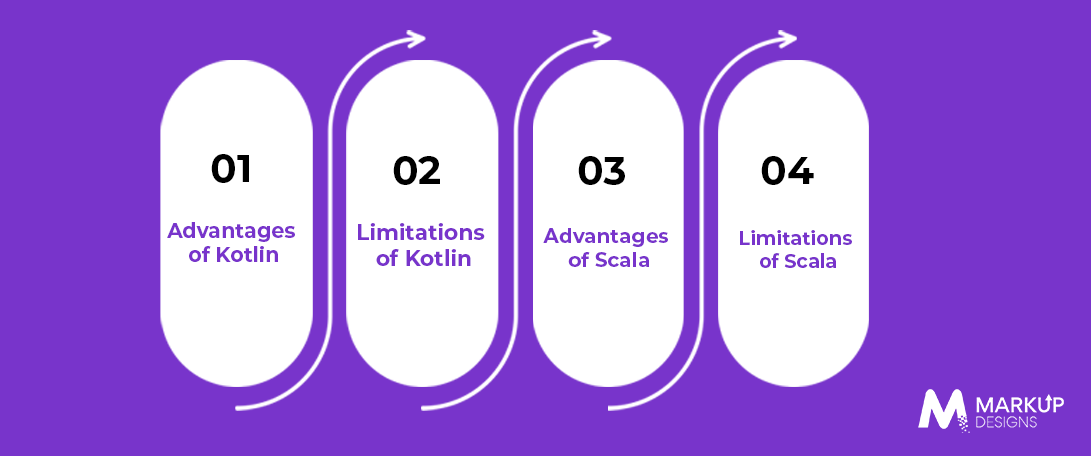
Kotlin and Scala languages offer great features, yet their applicability to particular cases differs by complexity of application development process, amount of developer resources and other factors.
Advantages of Kotlin
Kotlin provides concise syntax, built-in null safety and seamless Java interoperability. Its Android support, user-friendly development features, Java project compatibility make it a sensible choice for developing contemporary applications.
Limitations of Kotlin
Kotlin can cause increased compile time in complex projects and interoperability with Java can occasionally be tricky in matters of nullability and language differences. Kotlin’s ecosystem is not specialized to the same extent as Scala.
Advantages of Scala
Scala provides functional programming abilities, flexible type systems, and good concurrent and data-heavy applications. Scala is also a JVM-compatible language with a good data engineering environment.
Limitations of Scala
Scala has a high learning curve for people who lack knowledge about functional programming. Scala’s complexity may lead to higher compilation time, code maintenance work, and recruitment difficulties.
What Are the Best Use Cases for Kotlin and Scala?
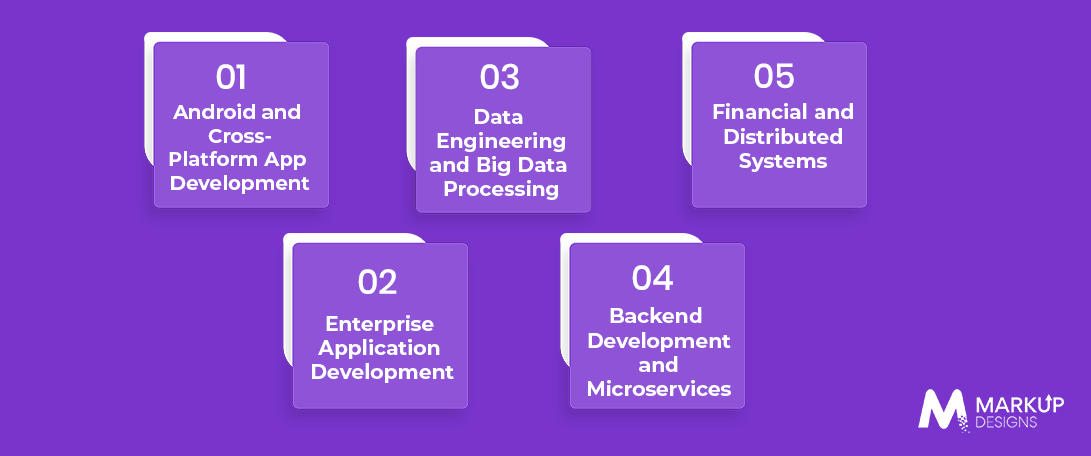
Despite the similar applicability to application and backend programming, their benefits make these languages good options for various business needs.
Android and Cross-Platform App Development
Kotlin is one of the best options for developing Android mobile applications due to Android’s official support of the language, its clear syntax, and Android-related tooling. Kotlin Multiplatform lets companies use the same code in Android, iOS, and other apps.
Enterprise Application Development
Kotlin is a good fit for enterprise applications that need Java interoperability, maintainability, and fast development. Scala is perfect for complicated enterprise applications that would take advantage of functional programming, data processing, and sophisticated architecture.
Data Engineering and Big Data Processing
Scala is a strong player in data engineering due to its compatibility with Apache Spark and its capability to process data distributedly. Kotlin is capable of handling data-intensive tasks but has a smaller ecosystem for data engineering at scale.
Backend Development and Microservices
Scala and Kotlin can be used for backend development and microservices-based architecture. While Kotlin is well-suited for Spring Boot and Ktor, Scala is compatible with frameworks such as Play and Akka.
Financial and Distributed Systems
Kotlin can be used to create financial apps that require security, transaction processing, and integration with Java-based infrastructure. Scala is especially good for distributed systems and processing vast amounts of data.
Kotlin vs Scala: Which Language Is More Cost-Effective for App Development?
The price of development depends on project complexity, available developers, required infrastructure, and maintenance costs. Both languages cannot be said to be cheap in general; the choice depends on available resources.
Development Time and Developer Availability
Kotlin tends to provide quick onboarding and recruit more developers due to its readable syntax and popularity among Android and Java developers.
Scala developers often require more specialised expertise, which can increase hiring and training costs for complex projects.
Infrastructure and Maintenance Costs
Both languages run on the JVM and can use similar hosting and infrastructure environments. Kotlin’s simpler syntax may reduce maintenance efforts for conventional applications, while Scala’s advanced features can provide long-term value for systems requiring complex data processing.
Scalability and Long-Term Development Expenses
Both languages can support scalable applications when designed and optimised appropriately. Kotlin is often practical for mobile and enterprise application growth, whereas Scala can be valuable for data-intensive and distributed systems. Architecture, development expertise, and maintenance planning ultimately influence long-term costs.
Kotlin vs Scala: How Should Businesses Choose the Right Language?
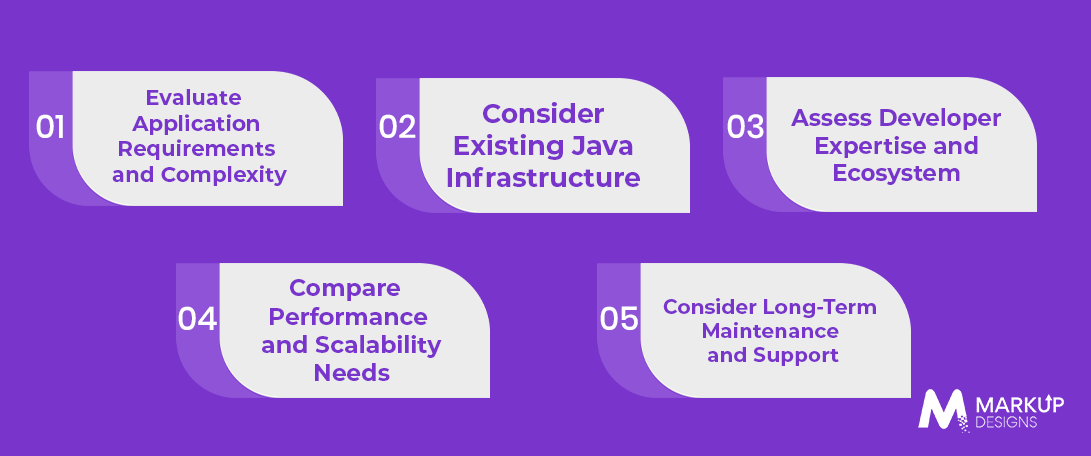
A choice between the two programming languages depends on application requirements, business infrastructure, and development capabilities. Below are several key considerations a company has to think about.
Evaluate Application Requirements and Complexity
The Kotlin language is appropriate for the development of mobile apps, enterprise software, and typical backend services. The Scala language is good to use if an application contains complex functional programming, heavy data processing, or requires special distributed architecture.
Consider Existing Java Infrastructure
Companies with legacy Java software can use both languages without rewriting the whole software stack. In most cases, Kotlin will be easier to integrate than Scala due to its simpler language features.
Assess Developer Expertise and Ecosystem
It is important to estimate the experience of the current team using one or another language, the availability of experienced developers, and possible libraries and frameworks. Choosing a programming language according to developers’ knowledge will help save time and effort.
Compare Performance and Scalability Needs
Both languages have similar performance based on the JVM, but companies need to conduct a practical analysis of workload, concurrency, memory usage, and architecture to find out which language is better for particular needs.
Consider Long-Term Maintenance and Support
Evaluate documentation, community support, framework maturity, and the availability of developers for future upgrades. Kotlin is generally easier to maintain for mainstream application development, while Scala can be a strong long-term choice for specialised systems with experienced development teams.
How Do Markup Designs Assist Companies In Selecting and Developing the Correct Application?
Selecting either Kotlin or Scala is based on the analysis of application requirements, complexity of development, scalability needs, and future-oriented plans. Markup Designs assists companies in finding out the proper technology stack for the application as well as developing it according to their operational needs. We provide our services in the sphere of mobile, web, and enterprise applications; thus, we assist our customers in choosing the proper programming languages, frameworks, and architecture.
From Android, cross-platform applications to backend and enterprise software development we are always working on developing secure, scalable, and maintainable products. Depending on whether your project requires development simplicity or advanced programming features you will get the needed technology stack from Markup Designs.
Build the Right Application with Kotlin or Scala
Choose the right programming language for your application’s performance, scalability, and long-term goals. Markup Designs helps businesses evaluate technology requirements and develop secure, scalable mobile, web, and enterprise applications using the right technology stack.

Conclusion
Both Kotlin and Scala are great technologies that have a lot to offer for the modern application development, but each of them suits different technical requirements. If your application is simple and is meant to be scalable then it makes sense to use Kotlin as it will provide you with simplicity and Java interoperability. If your project is complex and involves functional programming then Scala is the best choice.
FAQ
1. Should Kotlin be preferred over Scala for application development?
Kotlin is preferable in case of mobile and cross-platform application development due to developer-friendly syntax and platform support. Scala is preferable in cases where advanced functional programming and complex backend capabilities are needed.
2. Which language is easier to learn: Kotlin or Scala?
Kotlin is easier to learn especially for those who know Java. Scala has a difficult learning curve due to its type system, functional programming, and expressiveness of language.
3. Is Kotlin faster than Scala?
Neither language can claim universality of being faster than another one. These languages are both executed on JVM and their performance depends on many factors like application architecture, implementation, workload, and JVM optimization. Real performance must be checked via project-specific benchmarking.
4. Can Kotlin and Scala interact with Java?
Sure, both languages allow interaction with Java and can use its libraries, frameworks and JVM functionality. Thus businesses can implement these languages into their existing Java projects.
5. Which language is better for backend development?
Kotlin is appropriate for conventional backend applications and microservices built on Spring Boot and Ktor. Scala is a good choice for complex backend systems, functional architectures, and distributed applications.
Author's Perspective
Kotlin and Scala should not be evaluated simply on the basis of features or popularity. The right choice depends on what the application needs to achieve and whether the development team can maintain it effectively. Kotlin offers a more accessible development experience for most mainstream applications, while Scala provides specialised capabilities for complex systems. Businesses should prioritise technical requirements, developer expertise, and long-term maintenance rather than choosing a language based on trends.
Discuss Your Project NowGaurav Goyal
Global Sales- VP
Related Posts
Green Software Development: A Complete Guide to Sustainable...

AI Scheduling Assistant for Healthcare: Development Process, Architecture,...

Government Software Development in Australia: How to Choose...
Insights Are Valuable & Execution is Priceless
You’ve read about the digital future. Now, let’s build the infrastructure to take you there. Move your strategy from the page to the product.
Design Your Solution Now
Contact Us
Schedule The Appointment At Your Convenience Date And Time.
30 Min
Web Conference
Time Zone
Indian standard time (08:30pm)

Thanks For Getting In Touch!
You’ve Taken The First Step Toward Transforming Your Digital Presence. Our Experts Will Reach Out Shortly To Take It Forward.
Launch Your Dream Project
Provide a brief overview of your project, and our specialists will evaluate your requirements. We will connect with you to explore how the right digital solutions can help you launch faster.