

In Brief
- Healthcare ERP software creates a platform for connecting multiple hospital departments, such as procurement, finance, human resources, and inventory.
- With automated workflows, hospitals can eliminate repetitive tasks, reduce mistakes, and increase operational effectiveness.
- Hospitals can better manage their supplies, control their expenditures, and allocate their workers and equipment thanks to real-time data.
- Integrating hospital management systems (HMS) and electronic health records (EHR) allows hospitals to improve their information sharing and exchange.
- ERP implementation involves secure data management, seamless system integration, training of personnel, and the implementation of the system in a proper manner.
Operating a hospital requires the management of various functions related to different departments involving different areas such as patient administration, finance, inventory, procurement, and the management of the staff. When things like this are done through disconnected systems or performed manually, administrative processing will suffer delays and include inconsistent records, waste of resources, and no clear picture of the operation. Today, with more and more organizations using digital technologies, ERP systems are essential for effective management of hospitals.
It enables automated workflows, provides real-time operational insights, and supports better coordination between departments. When integrated with hospital management systems (HMS) and electronic health records (EHR), healthcare ERP can strengthen information flow while helping hospitals make informed decisions, manage resources efficiently, and support sustainable growth.
What Is Healthcare ERP Software?

ERP software for healthcare is a centralized system that aids hospital administration and operational functions such as finance, procurement, human resource management, hospital inventory software, and facility management. It connects these departments, clearing the way for better workflows and improved resource management.
Hospital Management System does not intend to work with the business side, as it handles patient registration, patient scheduling, admission, and billing, while EHR systems take care of handling patients’ medical data. Integrating both systems allows hospitals to improve their handling of administrative and clinical processes.
How Healthcare ERP Software Is Transforming Hospital Management
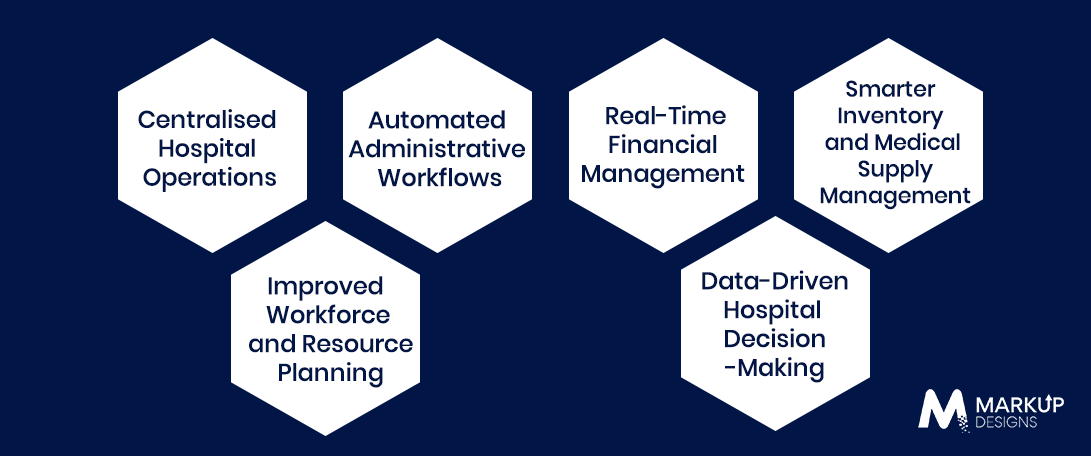
With the help of ERP healthcare software, hospitals can move from non-integrated systems to more efficient ones, minimizing the use of manual processes and enhancing operations by connecting key departments, such as finance, procurement, inventory, human resources, etc. Thus, hospital administrators have better insight into their daily operations and get support for their decision-making.
Centralised Hospital Operations
Hospitals are forced to operate different departments through separate systems, which is usually problematic in terms of obtaining the same information. Healthcare ERP brings these functions together on a centralised platform, allowing authorised teams to share operational data and coordinate activities more effectively.
For example, procurement teams can use inventory data to plan purchases, while finance teams can monitor related expenses. This reduces information silos, limits duplicate data entry, and improves visibility across hospital operations.
Automated Administrative Workflows
Manual tasks like invoice processing, purchase approvals, report preparation, and employee scheduling can be exhausting for employees in administration. However, healthcare ERPs’ automated processes can help simplify those operations through predefined rules while keeping track of approvals and notifications.
By automating processes, the amount of paperwork diminishes, as well as the number of mistakes, allowing departments to fulfill their routine tasks more quickly. As a result, workers will have more time to deal with operations instead of wasting it on unnecessary administrative tasks.
Real-Time Financial Administration
In hospital finance management, one of the biggest issues is achieving visibility of budgets, operational costs, procurement costs, and revenue-generating processes. The use of ERP dashboards allows obtaining consolidated data on finances, which makes it easier for administrators to monitor their expenses and detect discrepancies in the budget.
This helps make more informed financial decisions and allocate resources efficiently. ERP also allows hospitals to achieve accuracy in the record-keeping processes through integration with accounting and billing systems.
Smarter Inventory and Medical Supply Management
Hospitals must have sufficient inventories of medications, medical tools, and necessary supplies without incurring excessive inventory expenses. Famous for its extensive supply monitoring features, a healthcare ERP system enables institutions to keep track of stock levels, monitor usage of products, maintain vendor relations, and employ a reorder system.
Automated notifications alert staff members about stocks falling below various thresholds, while inventory reports may be employed for identifying underhanded and expiring goods. With the above capabilities, shortages, overstocking, and wastage of goods can be eliminated.
Improved Workforce and Resource Planning
Managing employees’ payroll, schedules, vacations, and records becomes increasingly more complex as hospitals grow. Thanks to its ability to centralize such administrative functions as employee management, healthcare ERP allows administrators to develop staffing plans based on appropriate workforce management information.
The system allows obtaining various information on the equipment, its maintenance, and usage, thus enabling administrators to prevent scheduling problems and downtime.
Data-Driven Hospital Decision-Making
Healthcare ERP facilitates the transformation of operational data into dashboards, reports, and performance measures, allowing the managers of hospitals to assess their resource utilization. Historical trends can also support demand forecasting and budget planning. With accurate data and regular performance reviews, hospital leaders can make better-informed decisions and adjust operations as requirements change.
Read Also: How Digital Transformation Is Revolutionizing Healthcare with Smarter, Connected Care Systems
Key Benefits of Healthcare ERP Software for Hospitals
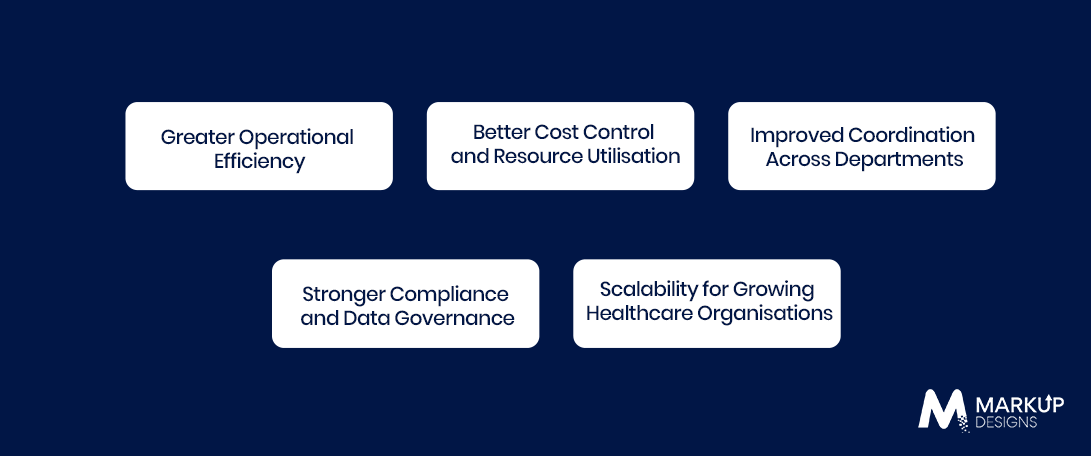
A healthcare ERP system has more to it than just process automation. The system, when executed properly, will allow hospitals to keep costs in check, attain improvement in departmental coordination, gain improved oversight capabilities, and lay down a strong base for the extended development of operations.
Greater Operational Efficiency
Information consolidation and automation help the hospital staff minimize the monotony of administrative activities, reducing duplicate information and delays due to system disconnections. Therefore, staff members get access to the information they need, with ease of managing routine actions performed by different departments.
Furthermore, this contributes to an increase in administrative productivity that allows for performing more tasks.
Better Cost Control and Resource Utilisation
ERP systems give an opportunity to view the company’s costs, its stock, and usage of resources more clearly. Hospitals can benefit from this information by reducing vacancies, preventing overstocking, and monitoring their costs in the budget context.
Visibility into the use of equipment and manpower helps hospitals with the planning process, but savings will depend on the conditions under which this software has been used.
Improved Coordination Across Departments
The successful operation of hospitals depends on the teamwork of the finance, purchasing and procurement, human resources, materials management, and administration departments. When these departments operate on disconnected data, day-to-day decision-making becomes more time-consuming and less accurate.
By using a single integrated ERP platform, various user groups have access to the same operational data; for instance, consumption requirements from the materials management department affect the purchases made by the purchasing and procurement department, making interdepartmental collaboration more effective.
Stronger Compliance and Data Governance
Hospitals have to keep all records accurate, protect confidential data, and ensure transparency in their administration processes. Healthcare ERP can meet the above-mentioned needs due to tools such as role-based access control, audit trails, history of approvals, and proper documentation.
Still, software does not guarantee compliance. The hospital has to create good data governance policies, perform security audits, and comply with various legal acts applicable to its business.
Scalability for Growing Healthcare Organisations
As a healthcare company grows and improves its sites, departments, and geographic coverage, its operational tasks become more complicated.
Modular ERP systems allow organisations to introduce additional capabilities as needed rather than implementing every function at once.
Cloud-based deployments can also provide flexible infrastructure and centralised access across locations. Hospitals should evaluate integration needs, data protection, system reliability, and ongoing costs to ensure the solution can support future growth.
Essential Features of Healthcare ERP Software
An effective healthcare ERP system should include the capabilities needed to manage hospital administration, monitor resources, and connect existing technology systems. The specific modules depend on the hospital’s size, workflows, and operational priorities.
- Financial Management: Supports budgeting, accounting, expense tracking, financial reporting, and integration with billing workflows.
- Inventory and Procurement Management: Tracks stock levels, manages suppliers and purchase orders, and supports replenishment planning.
- Human Resource Management: Maintains employee records and supports payroll, staff scheduling, leave management, and workforce planning.
- Reporting and Analytics: Provides operational dashboards and performance reports to help administrators monitor costs, resource usage, and departmental performance.
- Integration Capabilities: Connects with hospital management systems (HMS), electronic health records (EHR), laboratory systems, pharmacy platforms, and other relevant applications.
- Security and Access Management: Uses role-based permissions, audit logs, and appropriate data protection controls to safeguard sensitive information.
The most suitable ERP solution is one that aligns with a hospital’s operational needs, integrates reliably with its existing systems, and can be maintained securely as requirements evolve.
How Healthcare ERP Integrates With Hospital Management Systems
Healthcare ERP is compatible with Hospital Management Systems (HMS). While HMS is used in everyday operations in hospitals, the ERP system manages administrative functions of the organization. Integration of these two systems with other systems like EHRs, laboratory devices, pharmacy systems, and financial systems allows avoiding system fragmentation.
For instance, the data on inventory aids pharmacies in replenishing their stock, while the billing information caters to reporting. Secure APIs and standardized communication protocols make it possible to avoid duplicate entries and errors.
Challenges of Implementing Healthcare ERP Software
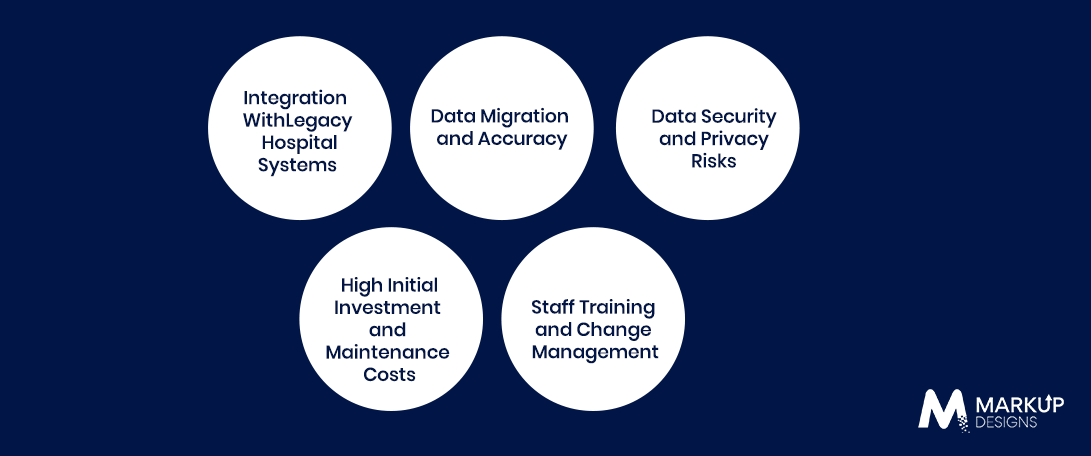
Implementation of healthcare ERP solutions requires careful planning, as hospitals need to integrate different systems, keep information secure, manage the budget, and prepare employees.
Integration With Legacy Hospital Systems
Most hospitals still rely on obsolete software that would not allow smooth integration with modern ERP solutions. Compatibility issues can complicate data exchange and disrupt existing workflows. Assessing current infrastructure and defining integration requirements before deployment can help minimise these problems.
Data Migration and Accuracy
Data migration is vulnerable to issues such as duplicates and inconsistencies in the databases being migrated. Hence, it is advisable to clean the databases, check the integrity of information, and conduct tests before going live.
Data Security and Privacy Risks
Healthcare ERP systems may deal with sensitive data regarding employees, finances, and operations, and weak access controls or security loopholes can cause this data to be accessed without authorization. However, encryption, assignment of roles, security monitoring, and constant evaluation can mitigate these risks.
High Initial Investment and Maintenance Costs
Implementing ERP means more than just purchasing software. The costs of customization, integration, infrastructure deployment, and employee training must also be factored in. Hospitals must think about the total cost of ownership in the long term and focus on selecting modules that meet the significant business needs.
Staff Training and Change Management
Adopting new systems and taking up different practices may be hard for employees. Without the required training, employees may be slow in adopting the system and prone to operational mistakes. Good quality training, communication, and staged implementation can assist employees in bridging the gap.
Read Also: How Much Does It Cost to Develop Hospital Inventory Management Software?
How to Implement Healthcare ERP Software Successfully
A structured implementation strategy helps hospitals select the right solution, minimise disruption, and achieve measurable operational improvements.
- Assess Existing Workflows: Identify inefficiencies, system limitations, and departmental requirements before selecting a solution.
- Define Clear Objectives: Establish measurable goals for operational efficiency, cost management, and resource utilisation.
- Choose the Right ERP Solution: Select a platform that suits the hospital’s size, budget, integration needs, and future growth plans.
- Plan Integration and Data Migration: Map existing systems, clean datasets, and validate transferred information before deployment.
- Establish Security Controls: Configure access permissions, audit trails, data protection measures, and applicable compliance requirements.
- Train Employees and Test Workflows: Provide practical training and test essential processes before rolling out the system across departments.
- Monitor and Optimise Performance: Track system reliability, employee adoption, processing times, and operational costs to identify areas for improvement.
A phased rollout can be particularly useful for larger hospitals, allowing teams to resolve issues in individual departments before expanding implementation across the organisation.
How Much Does Healthcare ERP Software Development Cost?
The healthcare ERP software cost is determined by the complexity of the system, the required modules, integration requirements, the chosen deployment model, and security requirements. Generally, the basic solution for financial and inventory accounting will require other investments than a customized system linking various hospitals and clinical systems.
The ongoing costs like hosting, support, maintenance, upgrades, and staff training have also to be taken into account. The detailed investigation of the requirements provides the most realistic cost evaluation due to the detailed understanding of the requirements.
How Markup Designs Can Help Develop Healthcare ERP Software
Markup Designs helps healthcare organizations design and integrate ERP solutions that can fit their operational needs in the most efficient way. The company employs custom software development, cloud solutions, workflow automation, integration of the system, and analytics to provide better-connected hospital operations. The architecture, focusing on security and scalable design, helps organizations manage their data efficiently and adapt their systems as the organization moves on.
Transform Hospital Operations With Custom Healthcare ERP Solutions
Would you like to help hospitals improve their operations and resource utilization? Markup Designs can assist healthcare organizations in the development of their unique solutions.

Conclusion
Healthcare ERP software development connects administrative operations in hospitals, enabling administration of resources, regulation of costs of operations, and increase of efficiency of decision-making. The success of such software implementation significantly depends on the selection of the right modules, integration of the already functioning systems, protection of sensitive information, and preparation of staff for new operations. Well-planned implementation will allow hospitals to create a more coordinated and effective working environment.
FAQ
What is the distinction of healthcare ERP from hospital management software?
Healthcare ERP specifies management of administrative operations, for example, finance, procurement, inventory, and human resources management, while hospital software aims at daily operations in hospitals like patient registration, making appointments, admissions, and billing. It is also possible to integrate both systems in order to enhance the efficiency of operations.
What modules should be contained in the hospital ERP system?
A hospital ERP system should generally incorporate modules such as financial management, purchase and inventory management, human resource management, reporting and analytics, system integration, and security management. However, the exact number of modules virtually depends on the size and requirements of the hospital.
In what way does healthcare ERP software affect the operation of hospitals?
Healthcare ERP enhances effectiveness by automating repetitive administrative activities, consolidating operational data, modernising procurement processes, and optimising resource allocation. It also allows hospitals to decrease the amount of manual work and support their administration in making informed choices.
Is it possible to implement healthcare ERP together with electronic health records (EHR)?
Yes, healthcare ERP can be integrated with EHR for secure data-sharing purposes. As a result, clinical workflows can merge with administrative work, while access to the data is controlled by appropriate measures.
How long does it take to implement healthcare ERP software?
The implementation of healthcare ERP software can take months or more, depending on the number of modules, complexity of the program, data migration, customisation, and integration requirements. One solution is to use a phased rollout approach, which can help hospitals minimise risks of disruptions.
Is it advisable to use cloud-based ERP for hospitals?
Cloud-based ERP provides scalability, remote access, and centralised system management; however, hospitals should be careful when choosing the deployment model based on the requirements for data protection, access rights, reliability of service, and hosting solutions.
Author's Perspective
The greatest advantage of the healthcare ERP software is realized when it helps in dealing with the actual problems instead of just automating them. Hence, before using advanced features, hospitals have to give priority to aspects like integration, reliable information, and staff acceptance.
By applying the right ERP solution, hospitals can enhance administrative efficiency and productivity effectively as well as allow healthcare workers to devote more time to their patients.
Discuss Your Project NowAjit Kumar Jha
VP - Business Operations
Related Posts

How to Build a Hospital Management System in...
Insights Are Valuable & Execution is Priceless
You’ve read about the digital future. Now, let’s build the infrastructure to take you there. Move your strategy from the page to the product.
Design Your Solution Now
Contact Us
Schedule The Appointment At Your Convenience Date And Time.
30 Min
Web Conference
Time Zone
Indian standard time (08:30pm)

Thanks For Getting In Touch!
You’ve Taken The First Step Toward Transforming Your Digital Presence. Our Experts Will Reach Out Shortly To Take It Forward.
Launch Your Dream Project
Provide a brief overview of your project, and our specialists will evaluate your requirements. We will connect with you to explore how the right digital solutions can help you launch faster.