
In Brief
- When selecting an AI development firm in the UK, keep in mind what to look for: technical know-how and industry background.
- Be informed about what kinds of AI development services, technologies, and expertise suitable IT partners can provide.
- Get tips on how to evaluate AI development companies, including what to look for in their portfolios, in their development process, in terms of security measures undertaken, scalability, and post-launch maintenance.
- Know the major questions to ask before you choose an AI partner, as well as the red flags that can show that it is not a trustworthy company.
- Learn why working with the right AI technology partner helps you create AI solutions that are secure, scalable, and offer a good return on investment.
The choice of an AI development company in the UK does not only revolve around whether a firm provides services for building an AI model or developing a generative AI API. A knowledgeable partner should know your business goals, data environment, IT infrastructure, industry specifics, and strategies for growth. Their experience should translate into the final product, which is truly able to meet the requirements of your enterprise, not merely implement AI technology because it is technically sound.
This blog explains the key factors businesses should evaluate when choosing an AI development company in the UK and how to identify a technology partner capable of delivering measurable, scalable, and business-focused AI solutions.
Why Choosing the Right AI Development Company in the UK Matters
Making a decision regarding the selection of an AI development partner is among the most critical strategic initiatives, as the success of the technology partner can significantly affect the performance, safety, expandability, and potential returns of the solutions. The right partner is supposed to not only come with AI development expertise but should also be knowledgeable enough to identify where AI can create tangible business value and suggest an efficient architecture for your technology base.
Business Alignment and AI Strategy
The partner that perfectly matches your requirements will start from your business goals before actually beginning to develop an AI solution. Such an entity should define relevant use cases, outline potential outcomes, rank various AI initiatives in terms of cost-benefit ratio, and develop an AI strategy consistent with your broader business objectives.
Technical Expertise and Development Capabilities
AI technology might involve various technologies including but not limited to machine learning systems, LLMs, application programming interfaces (APIs), cloud services, data processing, and automation services. One of the possible tasks that you need to accomplish here is to determine whether the AI software firm has the necessary technical expertise for the design, building, testing, and launching of your AI solution.
Data Security, Governance, and Compliance
Many businesses process sensitive information related to their operations or customers. Thus, select a technology provider that pays serious attention to data protection, governance policies, and relevant UK regulations, including UK GDPR and the Data Protection Act 2018, as well as relevant security standards and access management practices.
Scalability and Long-Term Support
An AI tool has to grow along with the business. Evaluate the ability of your technology vendor to handle higher volumes of data, users, connections to third-party systems, and models, while ensuring constant monitoring, optimisation, and support.
ROI and Total Cost of Ownership
Lowest development price might not mean the lowest cost in total. Thus, one should also take into account not only the prices of development but also the costs of infrastructure, AI model usage, connection to third parties, maintenance costs, security, and updates.
What Services Should You Expect From an AI Development Company in the UK?
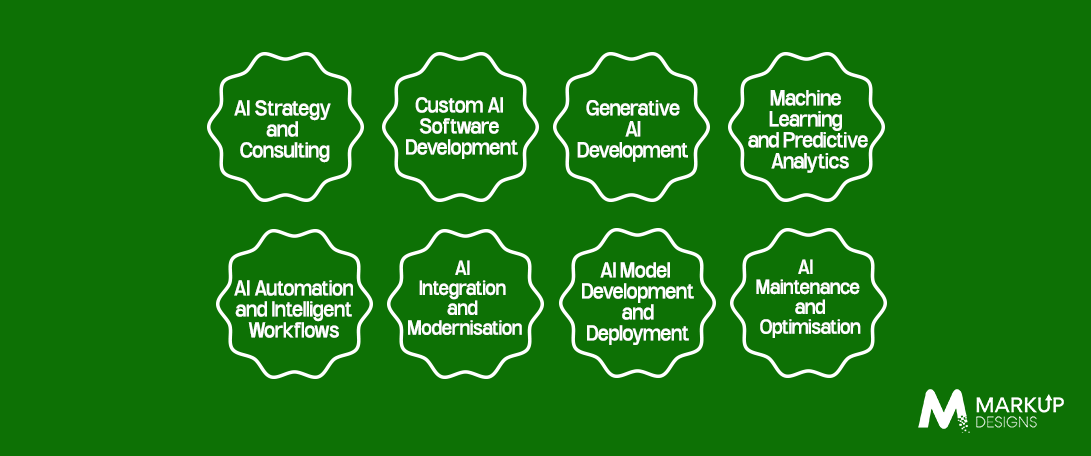
An effective company in AI development should bring to the table more than just model development work. Based on the particular needs of a client, the offering may comprise, among other things, strategy, custom software development, generative AI, automation, integrations, deployment, and continuous optimization services. Having a good understanding of the service range can help estimate a prospective company’s capability of supporting a project after the initial build.
AI Strategy and Consulting
AI consulting is a service that provides businesses with information about where AI technology can be applied successfully, including defining promising use cases. The list of offered services may include AI readiness analysis, determining potential cases, technology selection, and creating roadmaps and feasibility studies related to AI technology deployment.
Custom AI Software Development
Custom AI software constitutes an application that meets the specific needs of a business in terms of workflows, data, users, and goals. The solutions offered may vary from AI-based applications and recommendation systems to intelligent search and decision support systems.
Generative AI Development
A technology vendor is expected to build generative AI solutions using language models and other base models for such applications as AI assistants, content generation systems, document processing technology, knowledge management, and conversational interfaces.
Machine Learning and Predictive Analytics
The implementation of machine learning can mean the attainment of identifying patterns and trends in old as well as real-time information and data that can be used for forecasting, classification, recommendation, detecting anomalies, and making predictive decisions. The development partner must offer building, training, testing, and deployment of models that are based on a particular business task.
AI Automation and Intelligent Workflows
By using artificial intelligence, it is possible to automate monotonous tasks while adding smartness to processes that required human intervention in the past. This includes operations such as document processing, customer support, data extraction, lead qualification, routing of workflows, and others.
AI Integration and Modernization
In many cases, there is a need for integration of artificial intelligence solutions with existing technology such as ERPs, CRMs, cloud technologies, systems, APIs, and enterprise software. Such a partner must offer AI services and solutions while keeping the process of technology integration smooth and easy.
AI Model Development and Deployment
A partner must be able to take all steps necessary for developing AI solutions, starting from the choice of model and its creation, testing, and production launch. This also includes testing of the model and evaluation of its performance after it has been
This includes model evaluation, performance monitoring, deployment infrastructure, and processes for updating models as requirements or data change.
AI Maintenance and Optimisation
AI systems require ongoing attention after launch. Maintenance may include model monitoring, performance optimisation, retraining, security updates, infrastructure management, troubleshooting, and improvements based on changing business requirements and user feedback.
How to Evaluate an AI Development Company in the UK?
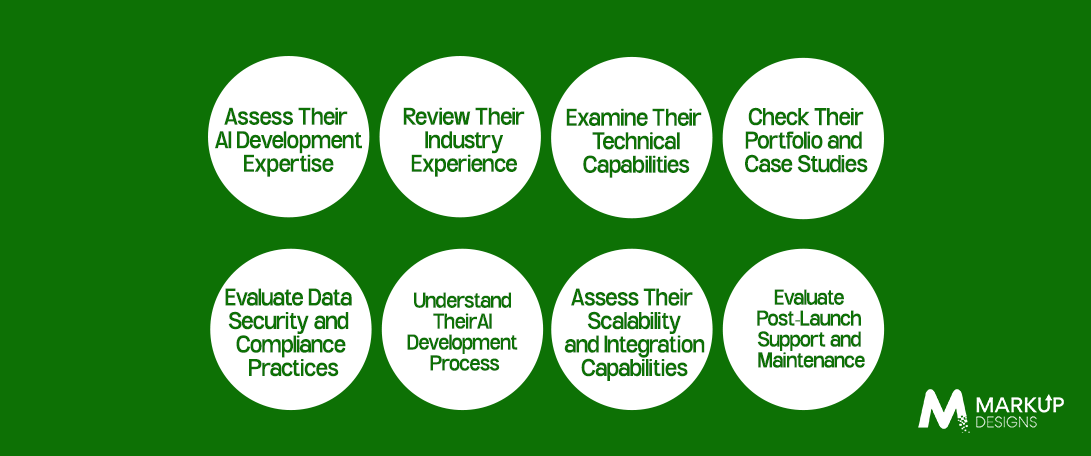
Once the types of services needed are determined, the next step is to evaluate potential technology partners against applicable criteria for their selection. Do not depend on mere claims made on the internet or a list of technologies used. Look for proof that the company can utilize its expertise to resolve real business challenges and keep supporting the AI system throughout its lifecycle.
Assess Their AI Development Expertise
Look rather at their level of expertise concerning AI technologies than on irrelevant claims made on their web pages. Evaluate the company’s expertise in models, frameworks, architectures, and deployment environments and see if its previous work proved its ability to cope with tasks like yours, especially in cases when such systems must work efficiently in production conditions.
Review Their Industry Experience
Industry experience will shorten the learning curve and enable the development team to grasp your processes, regulations, customers, and difficulties in work. Look for partners who have already cooperated with companies having goals similar to yours, but do not focus only on the number of projects realized.
Examine Their Technical Capabilities
Review whether the company’s technical expertise matches your planned solution. Depending on the project, relevant capabilities may include:
- AI and machine learning frameworks
- Generative AI and LLM technologies
- Cloud platforms and infrastructure
- APIs and third-party integrations
- Data engineering and databases
- MLOps and DevOps
- AI agents and intelligent automation
The goal is not to find a company that uses every technology available. It is to find one that can select and combine the right technologies for your specific requirements.
Check Their Portfolio and Case Studies
A portfolio can reveal more than a list of services. Examine the complexity of previous projects, the problems they solved, technologies used, deployment environments, and measurable outcomes. Prioritise case studies that demonstrate production-ready solutions and tangible business results rather than experimental prototypes.
Evaluate Data Security and Compliance Practices
Security should be assessed before development begins, particularly when the AI system will process confidential, personal, financial, healthcare, or commercially sensitive information. Ask potential partners how they approach:
- UK GDPR
- Data Protection Act 2018
- ISO 27001
- SOC 2
- Data governance
- Encryption
- Access controls
- AI-specific risk management
Also clarify how data is stored, processed, accessed, retained, and protected throughout the AI system’s lifecycle.
Understand Their AI Development Process
A structured development process reduces technical and commercial uncertainty. Ideally, the partner should cover discovery, data assessment, solution architecture, prototyping, development, testing, deployment, monitoring, and optimisation. Ask how requirements are validated at each stage and how changes are handled once development begins.
Assess Their Scalability and Integration Capabilities
Your AI solution may eventually need to support more users, larger datasets, additional features, or new business systems. Evaluate whether the proposed architecture can scale accordingly and whether the development company has experience integrating AI with your existing applications, databases, APIs, and cloud infrastructure.
Evaluate Post-Launch Support and Maintenance
AI development services does not end when the application goes live. Models can require monitoring and retraining, integrations can change, security requirements can evolve, and business requirements can shift. Before signing a contract, clarify what the partner provides for model monitoring, performance optimisation, security updates, retraining, troubleshooting, infrastructure management, and ongoing improvements.
What Technology Stack Should an AI Development Company in the UK Have?
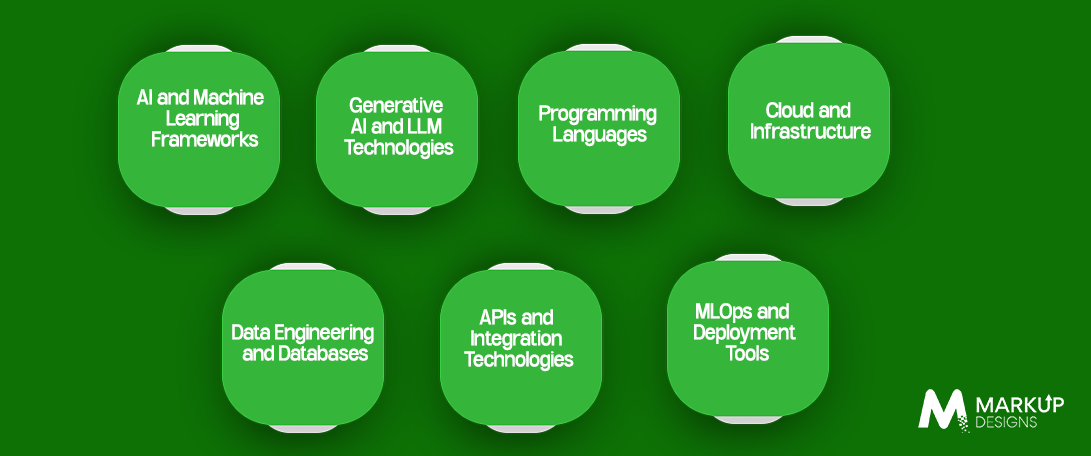
The technology stack employed by the AI solution has an impact on the solution’s ability to perform well, scale easily, integrate without difficulties, and be maintained without spending too much on maintenance. Instead of looking for the firm that uses all technologies available in artificial intelligence, businesses need to find out whether the technological expertise of the chosen firm meets requirements such as the use case, data, security, and deployment.
AI and Machine Learning Frameworks
The trustworthy AI development firm should be familiar with such frameworks as TensorFlow, PyTorch, Scikit-learn, Keras, and other frameworks relevant to machine learning. The choice of a particular framework depends on many factors, including the complexity of the model, training specifications, deployment environment, and the type of AI application created.
Generative AI and LLM technologies
If you want to create a generative AI application, you have to check the experience in building such technologies as large language models (such as foundation models), embeddings, vector databases, retrieval-augmented generation, fine-tuning, prompt engineering, and AI agents. An experienced partner can choose the proper architecture and model and not use the same approach for every case by applying the same LLM.
Programming Languages
Python is widely used for AI and machine learning development because of its extensive ecosystem of AI libraries and frameworks. A partner for development should have proper knowledge of JavaScript or TypeScript, Java, C++, or other programming languages needed for application development, backend services, and performance-driven solutions depending on the domain of use.
Cloud and Infrastructure
Cloud infrastructure is responsible for the computing resources required for the training, deploying, and scaling of AI applications. Look for expertise in platforms like AWS, Microsoft Azure, and Google Cloud, along with containerisation, serverless architecture, GPU computing, networking, and cloud security.
Data Engineering and Databases
AI systems rely on properly structured and reliable data. Therefore, the technology partner must be familiar with data pipelines, ETL, and ELT processes, data warehouses, data lakes, relational databases, NoSQL databases, and, when necessary for AI and LLM applications, vector databases.
APIs and Integration Technologies
AI applications often require seamless integration with various business processes, SaaS development systems, payments, CRM, ERP software systems, and other third-party services. Thus, ensure the potential partner has the necessary exposure to REST and GraphQL APIs, webhooks, SDKs, microservices development services, and integration security solutions.
MLOps and Deployment Tools
MLOps helps organisations manage the development, deployment, monitoring, and continuous improvement of AI and machine learning models. Relevant capabilities may include CI/CD pipelines, model versioning, experiment tracking, automated testing, model monitoring, containerisation, and infrastructure management.
How Much Does It Cost to Hire an AI Development Company in the UK?
The cost of working with an AI development company in the UK varies considerably because an AI chatbot, predictive analytics platform, and enterprise AI system can have completely different technical requirements. Project scope, data complexity, model selection, integrations, security requirements, development time, and ongoing infrastructure costs all influence the final investment.
Factors Affecting AI Development Costs
Key cost factors include:
- Complexity and number of AI features
- Type of AI or machine learning model
- Custom model development versus third-party models
- Data collection, preparation, and processing
- UI and backend development
- Third-party integrations
- Cloud infrastructure and computing requirements
- Security and compliance requirements
- Testing and quality assurance
- Post-launch maintenance and model optimisation
AI Development Cost by Project Complexity
AI undertakings can essentially be divided into basic, medium, or enterprise-level projects. For instance, a basic AI solution requires less development as compared to deploying solutions that entail various AI applications, extensive data collection, and sophisticated integrations.
Therefore, it is advisable that the company asks for price estimation based on the project scope instead of going with the standard hourly rates.
In-house AI Team vs. AI Development Firm
While having an in-house AI team gives a company more direct control, it would mean an investment in people, such as AI engineers, data engineers, machine learning experts, Cloud DevOps, and others dealing with infrastructure & tools, as well as their continuous training. A company offering AI development services has the advantage of hiring a well-trained multidisciplinary team and not investing extensively in the hiring process.
Choosing one option over the other depends on several aspects, including the project complexity and the cost involved, as well as your company’s long-term staffing requirements.
How to Evaluate AI Development ROI
When it comes to AI ROI, it’s important to look beyond just the revenue it brings in. Consider other measurable outcomes like lower operational costs, enhanced employee productivity, quicker processing times, better customer retention, higher conversion rates, fewer errors, and faster decision-making cycles. A trustworthy development partner should assist in setting up key performance indicators (KPIs) before the development kicks off. This way, businesses can effectively evaluate their AI investment against tangible operational and financial results once everything is up and running.
What Are the Red Flags When Choosing an AI Development Partner?
Not every company advertising AI development has the expertise required to deliver a reliable production system. Identifying warning signs early can prevent technical debt, unexpected costs, security problems, and failed AI initiatives.
Promising AI Solutions Without Understanding the Business Problem
If a company immediately recommends chatbot development services, LLM, or AI agent without first understanding your business objective, data, users, and existing systems, it may be selling technology rather than solving a business problem.
No Evidence of Production-Ready AI Projects
A collection of prototypes or generic AI demos is not enough. Look for evidence of deployed solutions, measurable outcomes, technical complexity, and experience maintaining AI systems in real-world environments.
Lack of Transparency Around Costs and Timelines
Be cautious when a partner provides an unusually low estimate without clearly defining the project scope, assumptions, deliverables, infrastructure costs, integrations, and ongoing support requirements.
Weak Data Security and Compliance Practices
If the company cannot clearly explain how your data will be stored, processed, accessed, encrypted, and protected, that is a serious concern—particularly for solutions handling personal or commercially sensitive information.
Overdependence on Third-Party AI APIs
Third-party models can accelerate development, but relying on a single external provider without considering model costs, data handling, vendor dependency, performance, and fallback options can create long-term risks.
No Clear Post-Launch Support Strategy
AI systems require monitoring and optimisation after deployment. A partner that focuses exclusively on delivery but cannot explain how it will handle model performance, retraining, updates, security, and technical issues may not be suitable for a long-term AI initiative.
How to Choose the Right AI Development Company in the UK: A Step-by-Step Process
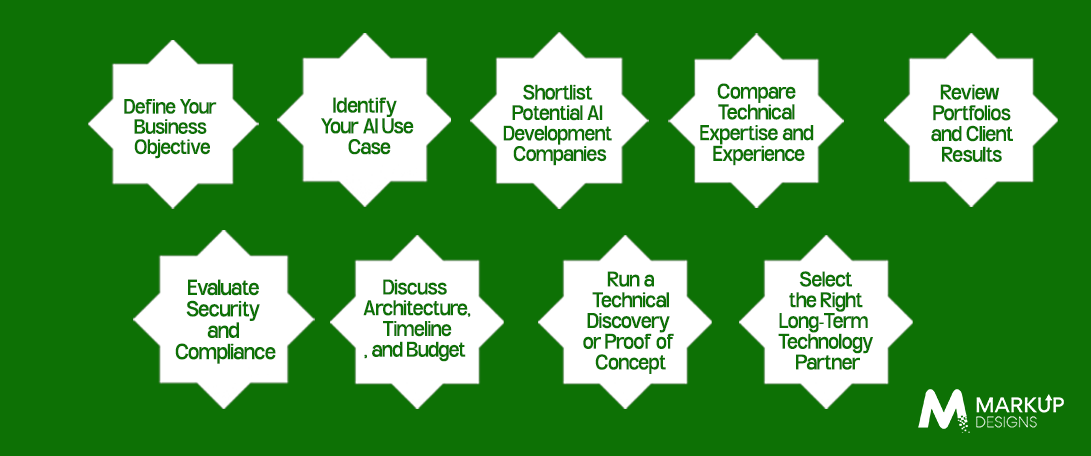
Choosing a technology partner gets simpler when the evaluation feels like a structured process, not just a comparison of websites and quotes.
Define Your Business Objective
Start by pinpointing the specific business issue you want AI to tackle. Define your expected outcome, identify target users, understand the operational impact, and set measurable success criteria before diving into technology discussions.
Identify Your AI Use Case
Figure out if you need predictive analytics, generative AI, intelligent automation, computer vision, natural language processing, recommendation systems, AI agent development services, or something else entirely.
Shortlist Potential AI Development Companies
Create a shortlist focusing on key technical abilities, UK market experience, industry insights, portfolio quality, security practices, and their capacity to handle your project scope.
Compare Technical Expertise and Experience
Examine each company’s experience with models, frameworks, cloud environments, data architectures, integrations, and deployment methods relevant to your project.
Review Portfolios and Client Results
Look past basic project descriptions. Dig into the problems solved, technical challenges tackled, measurable outcomes achieved, deployment experiences, and how closely they align with your needs.
Evaluate Security and Compliance
Check how each potential partner manages data protection, access control, encryption, secure development, compliance needs, AI governance consulting services, and risk management.
Discuss Architecture, Timeline, and Budget
Request that shortlisted partners outline their proposed architecture, development phases, technology choices, estimated timelines, costs, dependencies, and ongoing infrastructure needs.
Run a Technical Discovery or Proof of Concept
For more complex or high-stakes projects, a discovery phase or proof of concept is crucial to confirm technical feasibility before diving into full-scale development. This can also reveal data, integration, performance, or model limitations early on.
Select the Right Long-Term Technology Partner
Make the final decision based on more than just the first quote. Pick the partner that showcases a solid mix of technical skill, business insight, security, scalability, transparency, and long-term support.
Why Choose Markup Designs as Your AI Development Partner in the UK?
Markup Designs is ready to step in as a technology partner for businesses eager to transform AI possibilities into real, scalable software solutions. The key to our approach is to first grasp the unique business needs before diving into the right AI architecture, models, integrations, and development strategies.
With expertise in custom AI development, generative AI, machine learning, AI-driven automation, seamless integrations, scalable architecture, security-focused development, and ongoing support, Markup Designs is equipped to guide businesses through every stage of the AI development journey, from the initial discovery and planning phases all the way to development, deployment, and optimization.
Build a Scalable AI Solution for Your Business in the UK
Partner with Markup Designs to turn your AI requirements into secure, scalable, and business-focused software solutions.

Conclusion
Choosing the right AI development company in the UK requires more than comparing service lists or development quotes. Businesses should evaluate technical expertise, industry experience, security practices, development methodology, scalability, portfolio quality, and post-launch support before making a decision.
The right partner should also be willing to understand the underlying business problem before recommending a technology or model. Whether you are planning a generative AI application, predictive analytics platform, intelligent automation solution, or a custom AI system, selecting a technology partner with the right capabilities can reduce implementation risks and create a stronger foundation for long-term growth.
FAQ
1. How do I hire the best AI development company in the UK?
Look for relevant experience in AI, proven project delivery, process transparency, secure practices, industry experience, scalable architectural setup, and support systems post-launch.
2. What is the price of hiring an AI development company in the UK?
Development costs mainly depend on project complexity, AI model requirements, data preparation for training models, integrations with the current stack, security considerations, development time, infrastructure, ongoing maintenance, and so on. Generally, a simple AI application will include a different type of investment than a complex and piece-built enterprise AI platform.
3. What should I consider when choosing an AI development partner?
Evaluate the technical expertise of the company along with projects they have completed in the past, the methodology used, security and compliance practices, scalability, communication and pricing transparency, IP ownership, and post-launch support.
4. How long does it take to develop an AI solution?
The period it takes varies based on solution complexity, data readiness, integrations of any kind, model requirements, testing, and deployment environment. A basic AI feature may take considerably less time than a custom enterprise AI platform requiring extensive data engineering and system integration.
5. What AI disciplines should a software creation firm operating in the UK master?
The required specialization depends on the goal of the project, but a good partner should possess certain skills and knowledge in such domains as machine learning, generative AI, large language models, AI agents, natural language processing, predictive analytics, cloud solutions, data engineering, APIs, MLOps, and AI cybersecurity.
6. Should I work with an AI development company or create my own team?
The AI software creation company ensures rapid access to required specialists and provides an already formed team. The development of one’s own team means that the company retains more power over specialists and the whole development process. The final decision depends on financial resources, the company’s own knowledge needs and the skills of specialists, project requirements, and objectives of using AI solutions.
Author's Perspective
AI software development is no longer about simply implementing another intelligent feature into an existing product. It is a matter of choosing the right technologies, architecture, data strategies, and partners to ensure business impact. For UK companies, issues of security, compliance, and management of the solution over time make the choice of a partner even more crucial task. The reliable AI development partner is
For UK businesses, factors such as security, regulatory requirements, scalability, and long-term model management make partner selection particularly important. A strong AI development company should therefore act as a technology and strategic partner—not just a team that writes code.
Discuss Your Project NowGaurav Goyal
Global Sales- VP
Related Posts
Hiring an AI Development Partner in the UK:...
10 AI Innovations Transforming the UK Healthcare Industry...
AI Chatbots in Banking: Enhancing Customer Experience Through...
Insights Are Valuable & Execution is Priceless
You’ve read about the digital future. Now, let’s build the infrastructure to take you there. Move your strategy from the page to the product.
Design Your Solution Now
Contact Us
Schedule The Appointment At Your Convenience Date And Time.
30 Min
Web Conference
Time Zone
Indian standard time (08:30pm)

Thanks For Getting In Touch!
You’ve Taken The First Step Toward Transforming Your Digital Presence. Our Experts Will Reach Out Shortly To Take It Forward.
Launch Your Dream Project
Provide a brief overview of your project, and our specialists will evaluate your requirements. We will connect with you to explore how the right digital solutions can help you launch faster.