

In Brief
- An Open Finance solution allows clients to seamlessly link and access their data on banking, borrowing, insurance, investing, pensions, and other financial services based on consented data sharing and API functionality.
- The cost of implementing the Open Finance solution in the UK may range between £80,000 and £350,000+ depending on the complexity, functionality, integrations, security, compliance requirements, AI functionality, technology stack, and developers’ expertise.
- Features may comprise account aggregation, consent management, financial dashboards, payment initiation, personalized insights, fraud detection, API management, analytics, authentication, and reporting.
- The implementation process may involve requirement discovery, compliance and architecture planning, UI/UX design, platform development, financial API integration, security testing, deployment, and ongoing maintenance.
- Companies could leverage Open Finance to deliver personalized financial solutions, improve lending and financial processes, build new fintech products, and facilitate embedded finance solutions. Using the MVP approach and building a scalable and secure architecture is key to managing expenses and preparing for growth in the future.
Open Finance is a new way of accessing, sharing, and processing financial data. In contrast to conventional banking systems, it lets users connect their financial information between providers safely and effectively, thus getting a more personal and integrated experience. And for any fintech company, bank, lender, or other financial business operating in the UK, there is a chance to create better financial products/services by implementing Open Finance solutions.
However, the process of creating an Open Finance platform is not just about connecting several API interfaces. Issues related to security, compliance, integration, user interface design, infrastructure, and additional features can influence the total investment significantly.
So, how much does it cost to build an Open Finance platform in the UK? As with many other questions in software development, the main determinant of your expenses will be what you need from your platform and how complicated your financial ecosystem is.
Let’s talk about Open Finance platform development costs, features, AI technologies, development phases, factors of investment, and its possible benefits in this blog post.
What is an Open Finance Platform?
An Open Finance platform is an online environment that enables consumers to exchange and manage their financial information across various financial products and service providers. In contrast to Open Banking, which provides a more limited concept, Open Finance expands upon it by including all other types of financial products like banking, loans, insurance, investment, pensions, and mortgage services.
Using the customer’s authorization, the Open Finance platform connects various financial accounts and services using APIs. In this way, consumers get access to more comprehensive information about their financial situation, and companies are helped in developing personalized products and services.
For instance, users can integrate their bank accounts, investments, loans, and even insurance into one single place. The lender can then leverage the permissible financial data to determine affordability, whereas the fintech firm can offer insights based on the same.
The Open Finance Platform usually consists of APIs, data aggregation, consent management, security, analytics, and integration of financial services. For businesses, it helps build an integrated ecosystem, wherein financial data is leveraged efficiently while maintaining customer privacy and data security.
Open Banking vs Open Finance
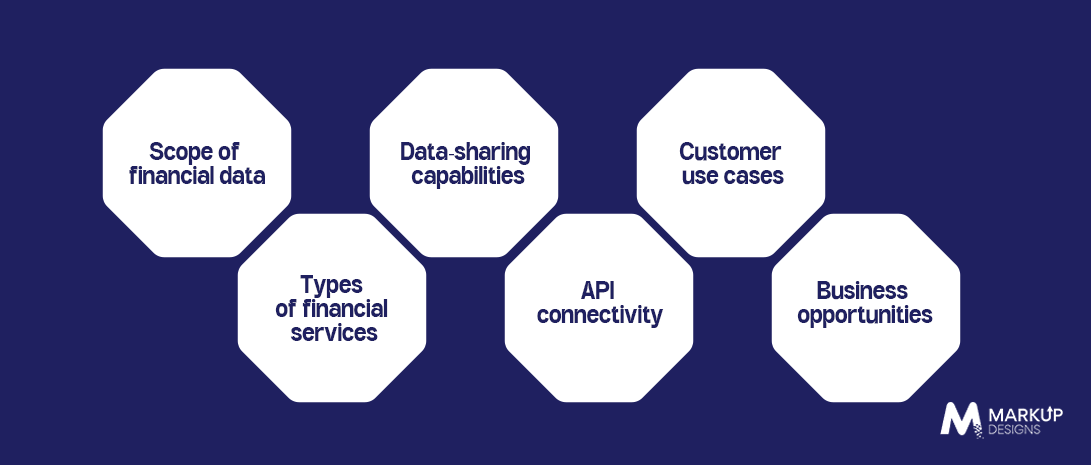
Open Banking and Open Finance are very similar concepts; however, the main distinction lies in the sphere of their application and the kinds of financial information they link. It is crucial to understand this difference if one plans to create an appropriate platform.
| Key Differentiators | Open Banking | Open Finance |
| Scope of financial data | Banking data and payments data only | Broader financial data across multiple products |
| Types of financial services | Banking services and payment services | Banking, loans, investments, insurance, pensions, and much more |
| Data-sharing capabilities | Allows users to share their selected banking data with their permission | Facilitates sharing of expanded financial data among various providers |
| API connectivity | Connects banks and authorized third parties | Connects banks, fintechs, lenders, insurers, investors, and other providers |
| Customer use cases | Banking data aggregation, payments initiation, budgeting, financial insights | Financial planning, personalized products, loans, investment management, and more general financial management |
| Business opportunities | Businesses can develop their own banking and payment solutions | Provides more connected and personalized financial products |
In simple terms, Open Banking focuses mainly on banking data, while Open Finance expands data connectivity across the wider financial ecosystem.
Role of AI in Open Finance Platforms
Artificial intelligence is becoming an important part of modern financial platforms. When integrated into an Open Finance platform, AI can help businesses turn large amounts of financial data into useful insights while reducing manual work.
Here are some ways AI can support an Open Finance platform:
- Personalised financial insights: AI can analyse transactions and financial behaviour to provide relevant recommendations.
- Automated transaction categorisation: Transactions can be automatically categorised as bills, shopping, travel, or savings.
- Fraud detection: AI models can identify unusual transaction patterns and flag potentially suspicious activity.
- Risk assessment: With appropriate customer consent and compliant data use, AI can support credit and affordability assessments.
- Predictive analytics: Companies can leverage their past financial trends to find out what’s trending and any possible customer needs.
- Intelligent assistance: Artificial intelligence could answer typical questions about finances and guide users around platform functionalities.
It will be up to the specific use case of the platform to determine what capabilities the AI would have. In addition, the implementation of more sophisticated AI could add to development costs.
Factors Affecting Open Finance Platform Development Cost
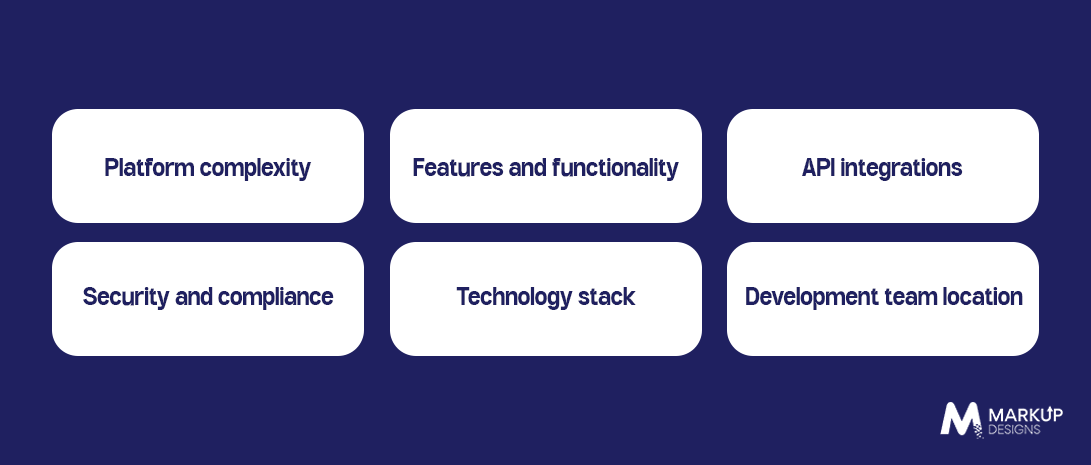
The price of building an Open Finance platform in the UK may vary greatly depending on various parameters, including the scope of the product and its technical and regulatory requirements. Before establishing your budget, it makes sense to take into account the major cost drivers that may affect the development cost of your Open Banking platform.
- Platform complexity: A simple data aggregation platform may demand less effort than a full-scale ecosystem of financial services.
- Features and functionality: Features like dashboards, consent management, payments, analytics, artificial intelligence, and recommendations will make the process more expensive and more labor-intensive.
- API integrations: Integration of banks, lenders, investment platforms, insurers, and other providers of financial services may also cost you money.
- Security and compliance: Various issues of encryption, authentication, consent management, audits, and data protection should be considered from the very beginning.
- Technology stack: Cloud infrastructure, databases, API architecture, artificial intelligence software development, and many other technologies may affect the development cost.
- Development team location: Skills and experience of developers, their hourly rate, and the size of the team may have some impact on the cost of Open Banking platform development.
Considering the mentioned aspects, you may estimate the price of the project more realistically.
How Much Does It Cost to Develop an Open Finance Platform in the UK?
The cost of building an Open Finance solution for the UK market usually ranges from £80,000 to £350,000 and above, depending on the level of customization, complexity, and other factors.
Here’s a general estimate:
| Platform Type | Estimated Cost | Development Timeline |
| Basic Open Finance Platform | £80,000–£120,000 | 4–6 months |
| Mid-Level Platform | £120,000–£200,000 | 6–9 months |
| Advanced Enterprise Platform | £200,000–£350,000+ | 9–15+ months |
The most basic platform could be built based on account aggregation, financial dashboarding, consent management, and basic API integrations. The intermediate platform could involve payment services, analytics, various financial integrations, and automation.
An enterprise-level platform would normally consist of a more comprehensive financial ecosystem, advanced API integrations, artificial intelligence (AI), security, compliance, and scalability.
Key Features of an Open Finance Platform
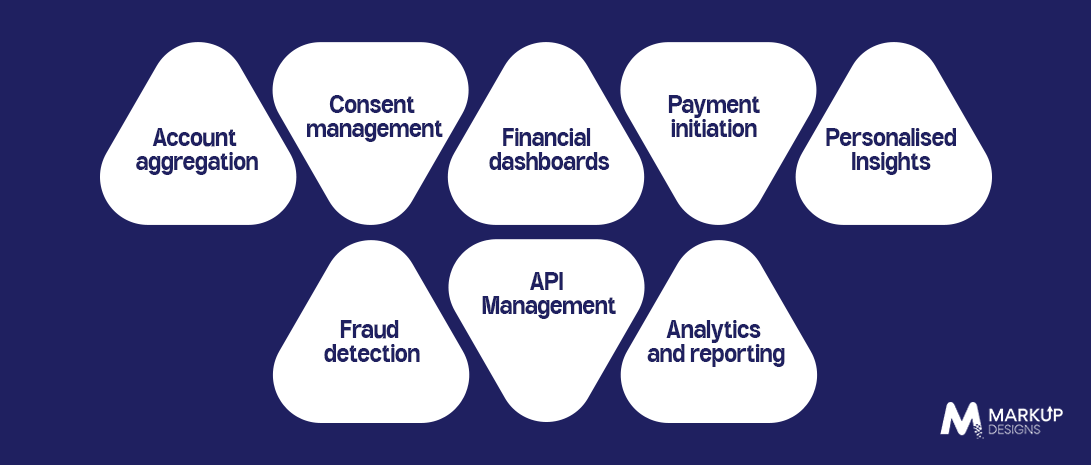
In terms of functionality, the features that you include will have an influence on the functionality of your platform as well as its cost of development. Good Open Finance solutions allow to easily get access to financial data and at the same time to give users the opportunity to control how this information will be used.
Some of the important features that should be included are the following:
- Account Aggregation: Connect multiple financial accounts and display relevant information in one place.
- Consent Management: Allow users to provide, review, and withdraw permission for financial data sharing.
- Financial Dashboard: Show information about accounts, transactions, balances, and activity on financial accounts.
- Payment Initiation: Enable secure payments through connected financial accounts where supported.
- Personalized Insights: Provision of spending, saving, and other useful insights based on financial data and analysis.
- Fraud Detection: Detection of suspicious activity on accounts and transactions.
- API Management: Management of connections with different types of entities (banks, fintechs, lenders, etc.).
- Analytics & reporting: Deliver meaningful reports to the businesses about their customers’ behavior, transactions, and the performance of the platform.
The precise list of features will depend on your target audience, business model, regulations, and future plans for the platform.
Open Finance Platform Development Process
Open Finance platform creation is a rather elaborate process since the system needs to incorporate financial data, APIs, security, compliance, and UI components. Typically, the development process involves the following steps:
- Requirement Discovery
Identify your target audience, business model, financial services, integrations, and general requirements for the platform.
- Compliance & Architecture Planning
Determine the UK requirements that apply to you and build a scalable architecture to handle financial data and APIs.
- UI/UX Design
Design easy-to-use dashboards, consent journey, account linking, and financial processes for users.
- Platform Development
Create frontend, backend, databases, APIs, authentication systems, dashboards, and general finance functionalities.
- API & Financial Integration
Integrate the platform with the respective banks, fintech companies, payment platforms, lenders, or any other source of financial information.
- Security & Testing
Perform functional, integration, security, performance, and compliance testing before launch.
- Deployment & Maintenance
Deploy your platform on the right cloud infrastructure, monitor its performance, fix bugs, and regularly update features and integrations.
Following a well-designed development process allows you to save money while creating scalable software.
Why Invest in an Open Finance Platform in the UK?
Open Banking in the UK and increasing focus on financial data sharing have opened up possibilities for businesses to build more connected financial experiences. The Open Finance platform can assist businesses in integrating different financial services and data sources, along with increased visibility and control for the customer.
Below are some of the possible benefits for the business:
- Offering personal financial experience: Offering customer-specific services and insights based on authorised financial data.
- Enhanced financial decision-making: Accessing connected data to help businesses and customers get a better understanding of their financial situation.
- Streamlined lending process: Using the appropriate financial information for affordability and risk assessment purposes.
- Innovation of financial products: Developing innovative fintech solutions by integrating data, APIs, and analytics.
- Expanding the embedded finance opportunities: Offering businesses Open Finance features for embedding financial services into digital products.
- Customer engagement: Making platforms more useful to customers through connected access to various financial services.
For businesses, the potential is not only in the collection of additional financial data. It is in the responsible use of authorised financial data for developing customer-oriented solutions.
Why Choose Markup Designs for Open Finance Platform Development?
The choice of technology partners plays an important role when building an Open Finance platform, considering the involvement of the development of financial APIs, issues of data security, compliance, and other technical complexities involved in such projects. At Markup Designs, we concentrate on understanding the requirements of your business and developing the technology roadmap according to the goals of your platform.
We will be able to offer our assistance in all aspects of platform development, including UI/UX design and integration, backend development, deployment of the cloud infrastructure, testing, and maintenance of the platform. We can also apply AI technologies to the platform if they will add some value for your business.
Our approach does not rely on any templates. Instead, we build platforms that will suit your business and target audience, and that can provide you with financial services that are required by you, and that will be easy to integrate with other systems.
Have an Open Finance idea but unsure where to begin?
Let’s discuss your requirements, estimate the development effort, and plan a secure platform built for your UK market.

Conclusion
To implement the Open Finance platform in the UK market, one can expect the total expenditure of £80,000 to £350,000+ depending on the platform complexity and functionality, its integration possibilities, security level, and use of AI technologies.
At the same time, one should remember that the implementation costs can be considered not only in the light of development expenses but also as an investment in the development of new opportunities to create a connected finance experience, build personalized services, optimize financial workflows, and fintech business models.
If you are thinking about developing your Open Finance platform, it is important to start with understanding the requirements and creating a proper technical roadmap in order to save the budget. At the same time, the cooperation with a competent fintech app development partner can help you to deal with all the technical issues at once.
FAQs
1. What features should an Open Finance platform include?
Important features can include account aggregation, consent management, financial dashboards, API connectivity, payment initiation, analytics, personalised insights, authentication, fraud monitoring, and reporting.
2. Can AI be integrated into an Open Finance platform?
Yes. AI can support transaction categorisation, financial insights, fraud detection, risk analysis, predictive analytics, personalised recommendations, and customer support, depending on the platform’s requirements and permitted data use.
3. How can I reduce Open Finance platform development costs?
Starting with an MVP, prioritising essential features, using suitable third-party services, planning integrations early, selecting scalable infrastructure, and building compliance into the architecture from the beginning can help control development costs.
4. Is Open Finance platform development different in the UK?
UK-focused platforms need to consider the country’s financial regulatory environment, data protection requirements, security expectations, API ecosystem, and applicable rules based on the services being offered.
5. How much does it cost to maintain an Open Finance platform?
Maintenance costs vary according to infrastructure, integrations, platform size, security monitoring, support requirements, and the frequency of updates. Ongoing costs should be included in the business plan from the beginning.
Author's Perspective
Open Finance is creating a more connected financial ecosystem, but development cost is only one consideration. Businesses should focus on secure data sharing, seamless integrations, useful services, and customer experience. Starting with an MVP can validate the idea while establishing a strong technical foundation. A scalable architecture, effective API strategy, robust security, and compliance planning can support future growth and turn Open Finance development into a long-term digital investment.
Discuss Your Project NowJupinder Singh Arora
Founder and CEO
Related Posts

How Fintech Development Outsourcing Helps Businesses Scale Faster

Fintech App Development in the Middle East: Trends,...

How Australian Banks Are Modernising Core Banking Systems
Insights Are Valuable & Execution is Priceless
You’ve read about the digital future. Now, let’s build the infrastructure to take you there. Move your strategy from the page to the product.
Design Your Solution Now
Contact Us
Schedule The Appointment At Your Convenience Date And Time.
30 Min
Web Conference
Time Zone
Indian standard time (08:30pm)

Thanks For Getting In Touch!
You’ve Taken The First Step Toward Transforming Your Digital Presence. Our Experts Will Reach Out Shortly To Take It Forward.
Launch Your Dream Project
Provide a brief overview of your project, and our specialists will evaluate your requirements. We will connect with you to explore how the right digital solutions can help you launch faster.