
In Brief
- Enterprise AI agents exceed regular chatbots in that they can comprehend goals, analyze information, make decisions, and take actions within the workflows of organizations with minimal human involvement.
- Some practical application areas of AI agents include customer service, sales and lead management, finance and accounting, HR processes, supply chain and procurement management, and IT service desk automation.
- AI agents become especially useful when they are combined with various existing enterprise systems like CRMs, ERPs, HRMS, databases, knowledge bases, APIs, and data platforms, enabling them to perform multiple coordinated actions within integrated systems.
- Implementation of AI agents implies solving such issues as data quality and security, system integration, accuracy, governance, and employee adoption. Implementing AI agents starting from small pilots, setting key performance indicators, and scaling the project with gradual human involvement can minimize the implementation risk.
- Unlike traditional rule-based automation solutions, AI agents can deal with more complicated workflows and make decisions based on the context. Businesses can estimate their ROI in terms of time savings, cost reductions, productivity improvements, faster responses, reduced error rates, and better customer experience.
Companies are no longer using AI to solve problems or to create content alone. AI is now finding its way into the core functions of businesses, where it will be able to understand, decide, and act upon things with minimal involvement from humans. This is where enterprise AI agents have started to find their value.
AI agents can perform all sorts of repetitive functions ranging from taking care of customer queries and lead qualification to process monitoring in finance and internal workflow management.
However, in what manner do these agents generate value for companies? Which business processes are the most appropriate for automation through the implementation of these agents?
The following blog will address the practical applications of enterprise artificial intelligence agents, the interaction of these agents with business processes, their strengths and weaknesses, the ways companies can successfully integrate them, and the way companies can evaluate their ROI.
What are Enterprise AI Agents?
Enterprise AI agents represent software solutions with integrated AI capabilities that allow performing actions, making decisions, and completing business workflows on a certain level of autonomy. In contrast to plain chatbots that simply react to queries of customers, AI agents have the capability to understand a task, collect necessary data, analyze whether the actions should be made and perform these actions.
For example, an AI agent that works in a sales team will be able to detect new leads, check information about customers, analyze their value, update CRM, and schedule following interactions with the customers. This will decrease the necessity of employees to perform all these operations themselves.
Moreover, enterprise AI agents can integrate with business applications, databases, APIs, and internal sources of knowledge. Thus, enterprise AI agents can operate across multiple systems and not only as standalone services.
In simple terms, enterprise AI agents allow companies to go from reactive AI to proactive AI. They can help employees, automate routine operations, and coordinate multi-step workflows.
Why Businesses are Investing in Enterprise AI Agents
In general, as businesses scale, many tasks tend to get complicated and take up much time. Employees waste their time on performing redundant tasks, transferring data from one system to another, answering common questions, or analyzing extensive data. AI enterprise agents may help to overcome these operational challenges.
Here are some of the main reasons why businesses invest in AI agents:
- Handling redundant tasks: Agents can perform routine tasks and workflows automatically without employees constant participation.
- Fast decision-making: They can analyze business data instantly and provide needed information whenever the teams need it.
- Effective usage of resources: The employees will be able to use their time for developing strategy, solving problems, and establishing relations with customers.
- 24/7 availability: AI agents can perform tasks for customers or business departments round the clock.
- Scalability: More processes can be automated as the business grows without increasing the efforts for performing these processes manually.
Thus, the objective is not to substitute people’s work but to make the processes easier and faster.
Practical Enterprise AI Agent Use Cases
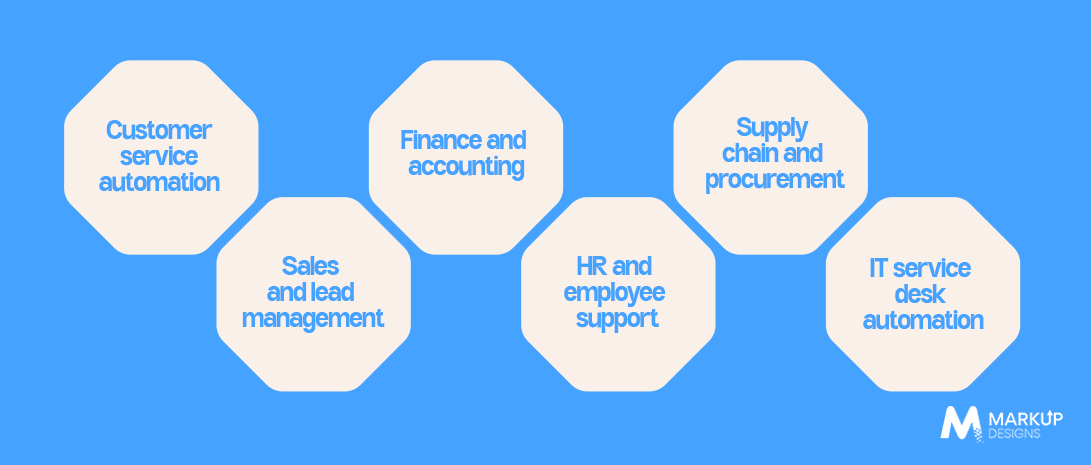
The use of AI agents in enterprises can be implemented in various departments, from front office activities to financial, IT, HR, and logistics departments. Some of the most useful applications for enterprise AI agents are as follows:
Customer service automation
The agents can answer frequently asked questions, comprehend customer requirements, file help desk tickets, give feedback, and elevate complicated issues to live agents.
Sales and lead management
Sales agents can qualify leads, do prospecting, fill CRM databases, set up meetings, and perform follow-ups.
Finance and accounting
The AI agents can help with invoice handling, expense management, accounting, reconciliation, and detection of abnormal transactions.
HR and employee support
The HR agents can respond to inquiries regarding policies, help with onboarding employees, manage routine queries, and help teams gather information from internal systems.
Supply chain and procurement
The agents can be used to manage the inventory, supplier data, detect possible shortages, and perform purchasing tasks.
IT service desk automation
The AI agents can handle standard technical requests, create and classify tickets, handle access requests, and escalate issues that need special handling.
How Enterprise AI Agents Work With Existing Business Systems
AI agents in enterprises can be more effective when integrated into the applications used by companies. They will not act separately, but will be able to interact with applications, databases, API, and internal knowledge bases to perform their task in various workflows.
For example, a sales AI agent may gather data from a CRM, analyze customer data, prepare an action plan, and document the sales data after the interaction. In a similar fashion, a financial AI agent may pull the invoice details from an ERP system.
Popular systems that can be used by AI agents are as follows:
- Customer and sales information through CRM platforms
- Finance, inventory, and operations through ERP systems
- Employee-related processes through HRMS platforms
- Internal information through knowledge bases
- Cross-application actions through business APIs
- Enterprise information analysis through data platforms
Such integration allows the AI agent to coordinate multiple steps rather than just providing an answer.
Take Your Business Automation to the Next Level
From customer service and sales to finance and IT, enterprise AI agents can help streamline complex workflows and improve operational efficiency.
Key Benefits of Enterprise AI Agents
The value of AI agents is much greater than the ability to automate a single task. With their correct integration into the right workflows, these technologies help companies increase the efficiency of their operations.
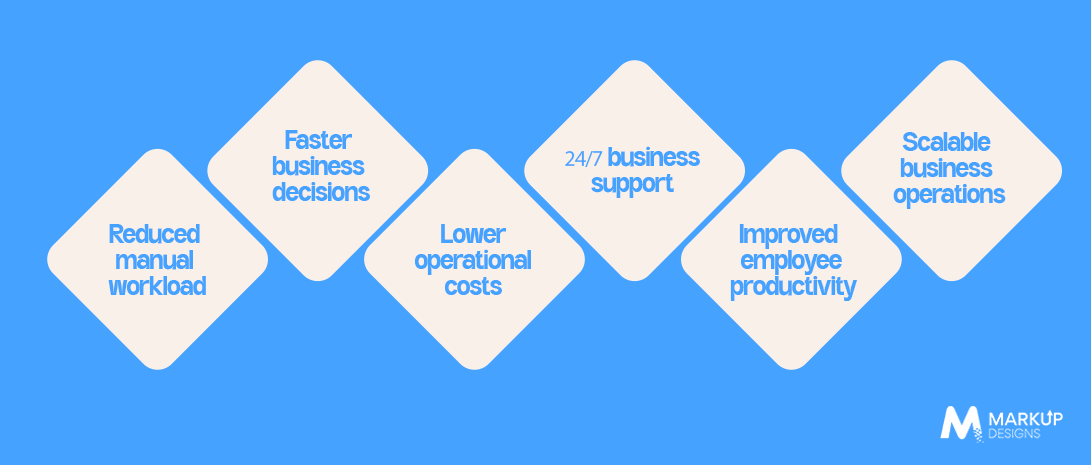
Key Benefits include:
Reduced manual workload
Agents can perform repetitive tasks and answer standard requests.
Faster business decisions
An AI can analyze large volumes of data and provide timely insights.
Lower operational costs
Automation can decrease the amount of time and effort that are required to perform routine operations.
24/7 business support
Agents can assist customers and employees at any time.
Improved employee productivity
Employees will be able to perform strategic and creative operations.
Scalable business operations
Automated processes can support an increased volume of operations without manual efforts growing proportionally.
The greatest benefit is seen when companies integrate AI agents into full end-to-end processes, not just automated tasks.
Challenges of Implementing Enterprise AI Agents
AI systems present great potential, but there are many obstacles associated with their adoption by enterprises. There are several aspects that enterprises should consider before entrusting AI systems with critical processes and data.
Data Quality and Availability
AI agents rely upon accurate and available data about business operations. Data of poor quality and fragmented in nature may impair their decisions and outputs.
Privacy and Security
The agent can operate using data that is highly sensitive and confidential for customers, finances, and employees. Good security measures become important.
System Integration
Connecting AI agents to existing systems such as legacy applications, ERP systems, CRM systems, and others may be technically challenging.
Accuracy and Control
AI agents can come up with faulty decisions because of inaccurate information or instructions. Businesses should define boundaries and escalation rules.
Employee Adoption
It is essential that employees know how the AI agent would assist in their job and when human intervention becomes necessary.
Policy and Governance
Organizations require appropriate policies to be in place regarding data use, access, monitoring, responsibility, and compliance before deploying AI agents widely.
How to Implement Enterprise AI Agents Successfully
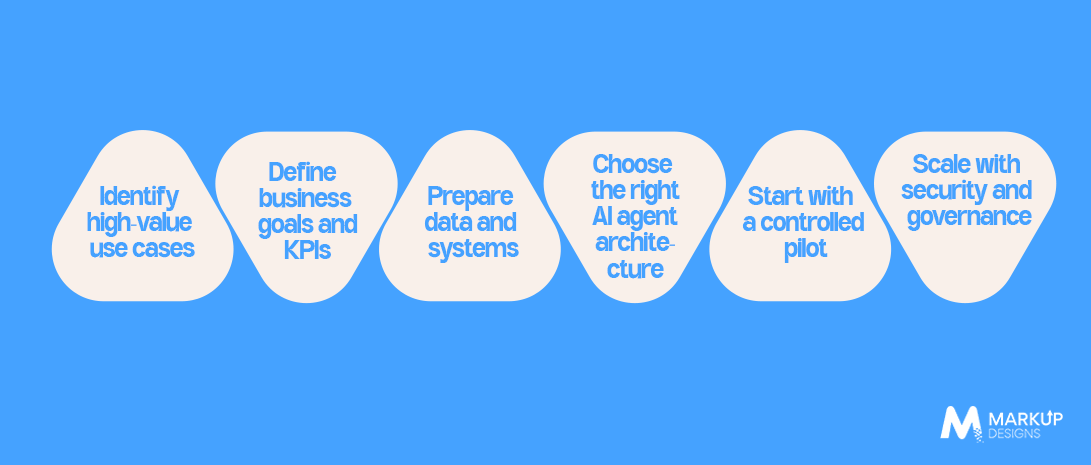
The use of AI agents involves more than merely choosing an appropriate AI approach and integrating it with business applications. Organizations should first identify their business objectives and then increase the adoption of agentic automation incrementally.
A practical approach includes:
Identify high-value use cases
Begin by identifying repetitive tasks that are very time-intensive and that will provide value through automation.
Define business goals and KPIs
Determine what success means to you, whether it’s faster response times, reduced cost, increased productivity, and so on.
Prepare data and systems
Check your data for quality, accessibility, APIs, and current technology infrastructure.
Choose the right AI agent architecture
Select which models and agent architectures fit the needs of your business.
Start with a controlled pilot
Implement the agent in a limited workflow before rolling out the solution organization-wide.
Scale with security and governance
Security measures can be introduced as the project is scaled up, along with oversight and performance measurement.
The incremental approach provides companies a chance to identify any problems, refine the agent, and ensure that employees feel comfortable with the automation process.
Read Also: Enterprise AI Model Development: Process, Tools, and Strategies
How to Measure the ROI of Enterprise AI Agents
The performance of AI agents has to be gauged in terms of its performance in the organization and not on the basis of the number of individuals in the organization using it. It should be measured prior to the implementation of the AI agent solutions.
Key performance indicators should include:
- Time saving: Has time been saved due to automation of the process?
- Cost savings: What savings in cost have been achieved due to automation?
- Resolution time: Has resolution time improved for customers/employees?
- Efficiency: Are employees working more efficiently but putting in less effort manually?
- Mistakes: Has there been a reduction in mistakes because of repetition?
- Customer satisfaction: Is there an improvement in customer satisfaction or resolution?
It is also crucial that the company measures other key performance indicators related to revenue, such as lead conversion or reduced customer churn.
Enterprise AI Agents vs. Traditional Automation
Traditional automation techniques have allowed organizations to automate repeatable processes. Traditional automation, though, is always rules-based. The enterprise artificial intelligence agent offers a better solution since it combines artificial intelligence reasoning, access to data, and execution ability.
| Traditional Automation | Enterprise AI Agents |
| Rule-based workflows | Goal-oriented workflows |
| Follows predefined instructions | Can assess situations and choose actions |
| Best for predictable tasks | Can handle more dynamic processes |
| Requires structured inputs | Can work with natural language and varied data |
| Usually automates specific steps | Can coordinate multiple tasks |
| Limited decision-making | Can support more context-based decisions |
It doesn’t mean that AI-based agents must replace rule-based automation systems completely. Oftentimes, the two can be found in use together within an enterprise environment. The former handles routine tasks, while the latter handles situations that require reasoning and understanding.
The key thing here is the selection of the right methodology based on the complexities of the workflow and its objectives.
Ready to Automate Your Enterprise Workflows?
Discover how AI agents can connect your existing business systems, automate repetitive processes, and help your teams work more efficiently.

Conclusion
Enterprise AI agents have altered how businesses view automation. Apart from asking questions and generating content, AI agents let businesses analyze their goals, interact with their data, connect with other systems, and complete sophisticated workflows.
The potential use cases span customer support and sales, finance, human resources, information technology, and logistics. Nonetheless, the success will depend on the choice of proper workflows, data preprocessing, integration with existing systems, and security considerations.
Businesses do not need to move quickly to automate everything at once; they should simply find those routine processes that add value and implement an agent.
As AI technology develops further, enterprise AI agents are likely to become an integral part of businesses’ operations.
FAQs
1. What are enterprise AI agents?
Enterprise AI agents are AI-based technologies that have the ability to comprehend goals, analyze information, make decisions, and execute business processes with a specific degree of autonomy.
2. What are some common applications of enterprise AI agents?
The common applications include customer service, sales and lead management, financial operations, HR, IT support, logistics and business process automation.
3. In what ways do AI agents differ from traditional chatbots?
Traditional chatbots mainly answer questions of the users while AI agents have the capability to understand goals, analyze information, make decisions and take actions to accomplish tasks.
4. Are AI agents compatible with other enterprise software?
Yes. AI agents can interface with enterprise systems like CRM, ERP, HRMS, databases, knowledge base systems, and more using API interfaces.
5. Are enterprise AI agents secure?
Yes. They can be used in a secure manner when companies adopt suitable access control policies and human oversight.
Author's Perspective
Enterprise AI agents are more than just another AI trend. Their real value comes from solving everyday business challenges through practical automation. Businesses should start with repetitive, time-consuming, and measurable workflows, then expand after proving results. With reliable data, proper system access, and clear boundaries, AI agents can support employees rather than replace them. The future of enterprise automation will combine AI-driven execution with human judgment, creativity, relationships, and strategic decision-making.
Discuss Your Project NowJupinder Singh Arora
Founder and CEO
Related Posts
LLM-as-a-Judge Explained: Improving Enterprise AI Governance and Evaluation
Enterprise AI Outsourcing: How to Choose the Right...
Building Enterprise AI Agents with LangChain: Architecture &...
Insights Are Valuable & Execution is Priceless
You’ve read about the digital future. Now, let’s build the infrastructure to take you there. Move your strategy from the page to the product.
Design Your Solution Now
Contact Us
Schedule The Appointment At Your Convenience Date And Time.
30 Min
Web Conference
Time Zone
Indian standard time (08:30pm)

Thanks For Getting In Touch!
You’ve Taken The First Step Toward Transforming Your Digital Presence. Our Experts Will Reach Out Shortly To Take It Forward.
Launch Your Dream Project
Provide a brief overview of your project, and our specialists will evaluate your requirements. We will connect with you to explore how the right digital solutions can help you launch faster.