

In Brief
- E-commerce fraud prevention solutions assist organizations in securing their customer accounts, payments, refunds, and data while enabling legitimate customers to make payments without much hassle.
- Some of the prevalent fraud threats are payment fraud, credit card fraud, account takeover, refund and return abuse, first-party fraud, synthetic identity creation, and promotion fraud.
- AI and ML technologies will help improve fraud detection by evaluating transactional behavior, customer behavior, devices used for purchases, geographic location, and payment behaviors to detect any fraudulent activities and calculate risk scores in real-time.
- A good fraud prevention system will help correlate data across eCommerce platforms, payments, CRM, ERP, and customer care systems while monitoring for unusual transactions, high velocity of payments, multiple failed attempts, multiple refunds, multiple accounts, and unusual login behaviors, among others.
- Enterprises must maintain a balance between customer experience and security by using risk-based authentication techniques, behavioral analytics, real-time monitoring, and reviewing false positives.
With online shopping, people can easily look at the items, make their payment, and buy them in minutes. However, as eCommerce becomes more popular, fraud has been emerging as one of the major challenges faced by companies. Fraudsters have found new ways of committing various types of fraud, such as taking money from payment details, account takeover, refunds, and automated attacks, among others.
When it comes to eCommerce business organizations, fraud detection is not just about determining whether a particular payment appears to be suspicious or not. There is a need for something else as well.
This blog will help you understand what enterprise e-commerce fraud protection is, the different types of online fraud prevalent, and what the difficulties are that come with ensuring the security of high transaction volume. We will also cover how AI can be used for better detection of fraud and how enterprises can establish their own framework for this purpose.
What is Enterprise eCommerce Fraud Prevention?
Enterprise eCommerce fraud prevention refers to the detection, prevention, and management of fraudulent acts within the enterprise eCommerce environment. This involves more than just preventing fraudulent payments. An effective way of carrying out this task will include customer account analysis, device analysis, transaction behavior analysis, payment behavior, refunds, and many more to determine if the actions being carried out are safe or not.
In the case of large eCommerce firms, this becomes extremely crucial considering that they have thousands or even millions of transactions taking place.
A successful fraud prevention system requires a blend of technology, data, business rules, and human intervention to monitor suspicious behavior. Such a system may be used to help businesses:
- Spot any unusual transactions
- Prevent account takeover and payment frauds
- Limit chargeback and refund frauds
- Keep honest customers free from any kind of security threat
- Have a seamless experience during checkout
The goal is simple: stop fraudulent activity while allowing genuine customers to complete their purchases with minimal friction.
Why eCommerce Fraud Is a Growing Enterprise Challenge
The rise in online shopping is both an advantage and a threat to businesses and shoppers. Companies are now responsible for transactions on websites, mobile applications, digital wallets, Buy Now Pay Later options, and other payment gateways. Each new platform presents a possible opportunity for scammers.
There has been an increase in complex fraud methods as well. Attackers can make use of credential theft, bot attacks, synthetic identities, and social engineering to impersonate legitimate users. At the same time, there has been an increase in the problem of refund/return abuse among online merchants, especially those that are easy on their customers.
However, for companies, the problem is not limited to monetary losses. Fraud can cause chargebacks, expenses incurred, loss of customer trust, and false denials of payment transactions. The legitimate customer, whose transaction was declined wrongly, would just switch to another company. Therefore, it becomes necessary for companies to create anti-fraud measures that can detect real fraud while avoiding customer friction.
Common Types of eCommerce Fraud
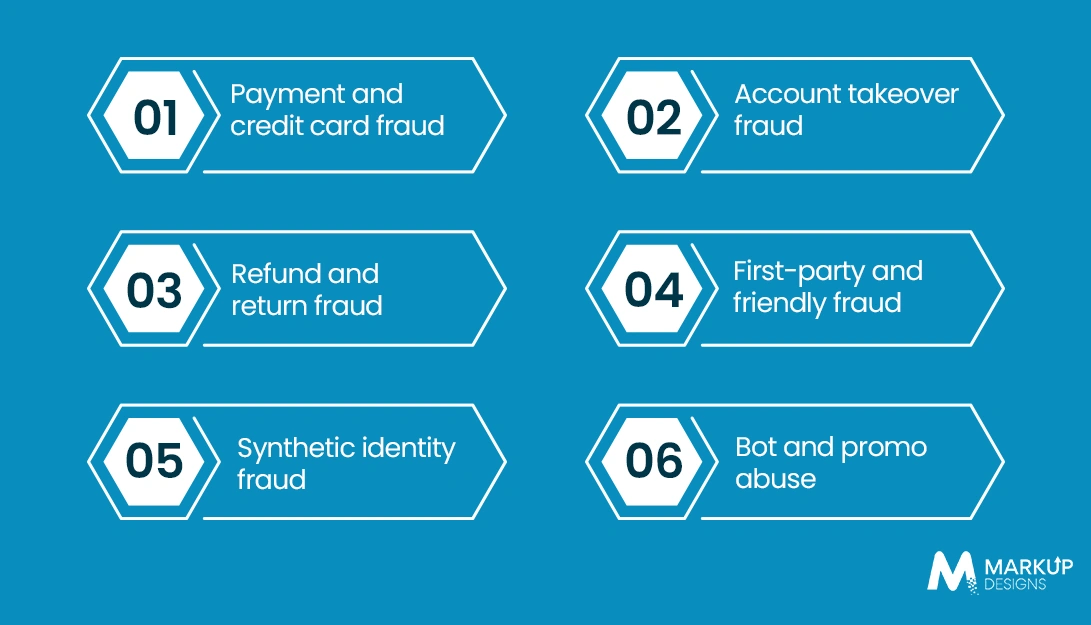
E-commerce fraud occurs in many ways, and firms need to be aware of each form in order to formulate appropriate defenses against them. Criminals are likely to use multiple strategies to execute their plans; therefore, firms need to observe all aspects of their customers experiences and transactions.
Payment and credit card fraud
Fraudsters exploit stolen credit card information or vulnerable payment accounts to carry out unauthorized transactions.
Account takeover fraud
Cyber criminals access the user’s account by exploiting passwords or by launching phishing and credential stuffing attacks.
Refund and return fraud
The customers exploit refund policies with the help of fraudulent claims or fake return processes.
First-party and friendly fraud
A legitimate user challenges the legitimate transaction or exploits the payment or return policies of the firm.
Synthetic identity fraud
The criminals generate fake identities and accounts by combining actual information with fake data.
Bot and promo abuse
Bots can generate accounts, abuse promotions, manipulate inventory, and exploit discount or referral programs.
Read Also: Choosing the Right AI Cybersecurity Consultant for Enterprise AI Security
Key Challenges in Enterprise eCommerce Fraud Prevention
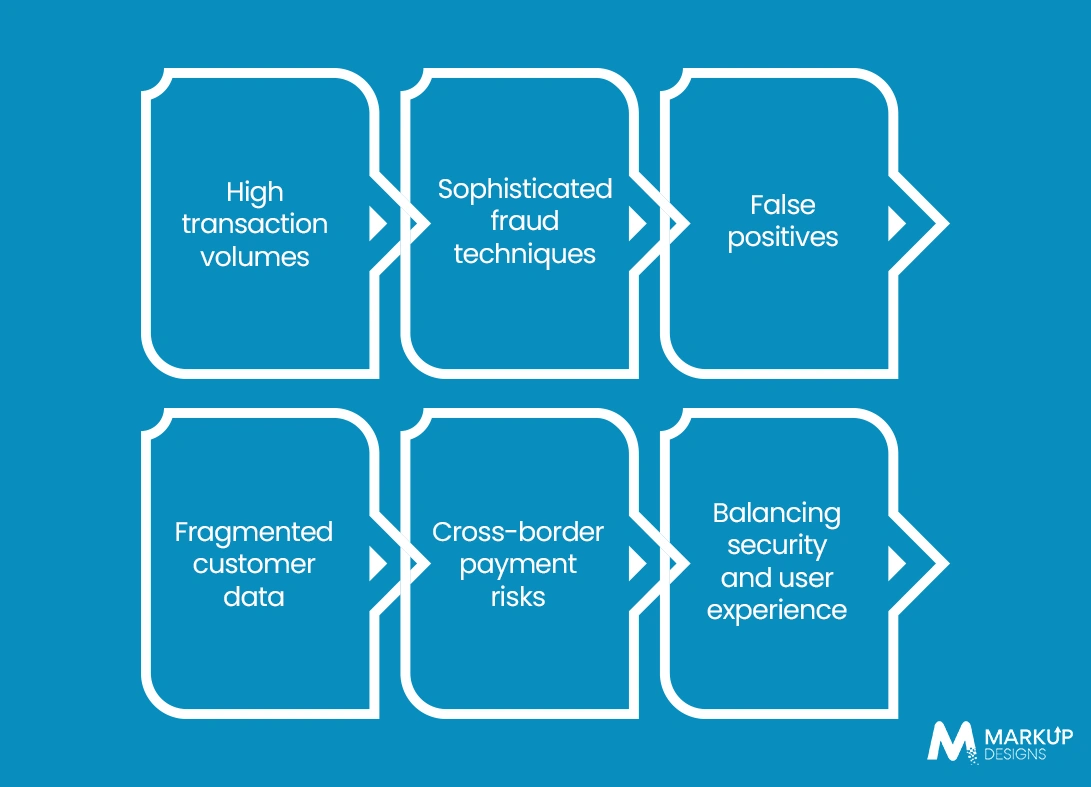
eCommerce companies deal with numerous transactions, many customer interactions, and evolving fraud techniques. Therefore, protecting against fraud cannot be achieved by creating just some policies or blocking any suspicious payments. There is a need for flexible systems capable of adjusting to emerging threats but without disrupting legitimate transactions.
High transaction volumes
Major businesses handle thousands of transactions daily, which makes the process of manually detecting any fraud more complicated.
Sophisticated fraud techniques
Fraudsters evolve in their techniques all the time; hence, old detection criteria become irrelevant.
False positives
The real customers might be rejected as their transactions are marked as fraudulent.
Fragmented customer data
Customer, payment, order, and behavioral data could be scattered through multiple business applications.
Cross-border payment risks
There could be various payment systems used by different customers across borders.
Balancing security and user experience
The process of verification could become too cumbersome for users, leading to abandoned shopping carts.
Looking to strengthen your eCommerce security?
Fraud risks can grow quickly as your eCommerce business expands across customers, channels, and payment methods. A modern fraud prevention strategy can help you protect transactions without compromising the customer experience.

How AI is Transforming eCommerce Fraud Prevention
AI technology is transforming the manner in which organizations recognize and counter eCommerce fraud. The current rule-based approach relies heavily on pre-defined parameters like unusually high transaction amounts and multiple failed payments. These rules are effective in fraud detection, but they may not be able to identify newer forms of fraud. AI technology in online shopping helps to analyze vast amounts of data and spot anomalies quickly.
Through AI technology, the system is able to consider transaction history, device data, location, consumer behavior, payments, and many other factors to assign risk scores dynamically. Transactions that have multiple anomalies are subject to further verification, while lower-risk transactions are allowed through without any obstacles.
Machine learning will also be able to draw lessons from past fraudulent transactions and develop the ability to detect them in the future. Companies can employ artificial intelligence to detect account takeovers, anomalous purchase patterns, bot activities, refund fraud, and fraudulent payments.
However, artificial intelligence operates well with human intervention. Fraud investigation teams can look at complicated cases, analyze the performance of the model, and update their security strategies as threats evolve.
Building an Enterprise Fraud Prevention Framework
An effective fraud prevention strategy will help enterprises structure the process of risk identification, incident handling, and protection of legitimate users. Rather than having a single security system, companies should integrate various elements, including data, technology, processes, and people.
Firstly, enterprises need to determine the key fraud risks at all stages of customer interactions. These include account registration, logins, payments, checkout, order processing, returns, and refunds. After identifying the key risk areas, enterprises need to create a list of signals and triggers for investigations.
Secondly, companies can integrate the data coming from the company’s eCommerce platform, payment gateways, CRM, ERP, customer service systems, and others. After doing so, the enterprises will have a more complete picture of customer and transaction activities. Further, they can utilize artificial intelligence and machine learning in analyzing the data and calculating risk scores.
It is essential to incorporate well-defined procedures for handling and escalating responses. Low-risk transactions could be processed automatically, while suspicious ones could be blocked or subjected to further checking. Monitoring, evaluation, and updating of the model are equally important since fraud detection trends keep on changing.
Key Fraud Indicators Enterprises Should Monitor
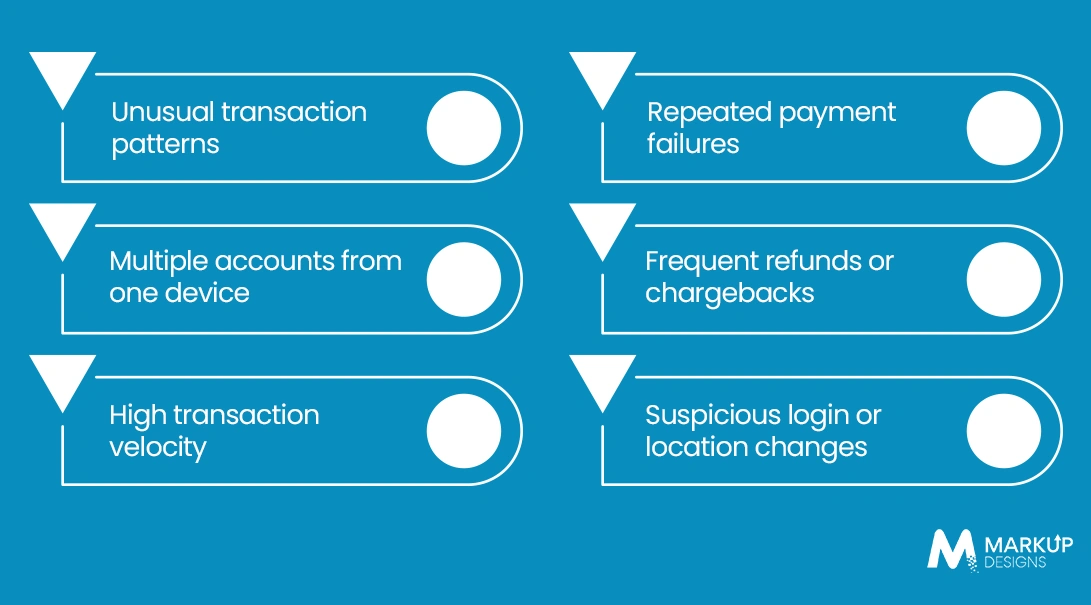
Detecting any sort of suspicious behavior early will enable companies to avoid financial loss. Rather than relying on just one signal, companies need to look at all signals simultaneously to figure out whether an activity or an account is actually suspicious.
Unusual transaction patterns
Sudden change in transaction value, transaction rate or choice of products could be a red flag for fraud.
Multiple accounts from one device
Multiple accounts that have been created using the same device or environment may be used to abuse promotions or accounts.
High transaction velocity
A large number of transactions or attempts to make payments over a short period of time may mean automated fraud.
Repeated payment failures
Multiple failures in attempting to make a payment, followed by a successful transaction, first-party, and a test-payment fraud.
Frequent refunds or chargebacks
An excessive number of refunds or disputes could be an indication of refund fraud or first party fraud.
Suspicious login or location changes
Unexpected login or location from unfamiliar devices could be an indication of account takeover.
Read Also: Why Mobile Apps are Essential for Every eCommerce Startup
How to Reduce False Positives Without Increasing Fraud Risk
One of the largest difficulties when trying to prevent eCommerce fraud is distinguishing between a suspicious transaction and one done by a regular consumer. The system should protect from any fraudulent activity, but at the same time, it shouldn’t block legitimate purchases. That is why enterprises have to find a way to make their system consider all aspects of transactions.
A risk-based approach could be one of the solutions for that problem. Instead of blocking all transactions that raise some suspicions, businesses could assign different risks to transactions depending on various factors.
It is possible to employ step-up authentication for those actions that look suspicious. For instance, the user will be requested to provide an extra piece of information instead of being denied right away. AI and machine learning will increase the chances of detecting fraudulent activity even more since they are capable of analyzing patterns in many data points.
It is no less important to review all the instances of false positives. This way, the fraud team will be able to understand what makes legitimate transactions appear suspicious and how they can update their rule sets and models accordingly.
Want to build a secure and scalable eCommerce solution?
Strong fraud prevention should protect your business without making every customer feel like a potential threat. With the right combination of AI, real-time monitoring, secure payment systems, and risk-based controls, enterprises can reduce fraud while keeping online transactions simple.

Conclusion
Fraud committed against enterprise eCommerce has become increasingly sophisticated with the growth in digital channels, payments, and the customer base of these organizations. From payment fraud to automated fraud and refund abuse, it is necessary for enterprises to be able to detect threats at every stage of the transaction journey.
A combination of the right data, technologies, practices and even humans can help enterprises detect fraud efficiently while protecting legitimate customers. Technologies such as AI, machine learning, risk-based authentication and behavioral analysis can prove to be helpful. However, it is equally important to conduct regular reviews on the enterprise’s fraud prevention measures and false positive rate.
FAQs
1. What is enterprise eCommerce fraud prevention?
Enterprise eCommerce fraud prevention is the process of identifying and stopping fraudulent activities across online transactions, customer accounts, payments, refunds, and other eCommerce operations.
2. What are the most common types of eCommerce fraud?
Common types include payment fraud, account takeover, refund and return fraud, first-party fraud, synthetic identity fraud, and bot or promotion abuse.
3. How does AI help prevent eCommerce fraud?
AI can analyze large volumes of transaction and customer data to identify unusual patterns, calculate risk scores, detect suspicious behavior, and support real-time fraud decisions.
4. How can enterprises reduce false positives?
Businesses can use risk-based authentication, behavioral analysis, customer history, and AI-driven risk scoring instead of relying only on fixed fraud rules.
5. What are the key indicators of eCommerce fraud?
Unusual transaction patterns, high transaction velocity, repeated payment failures, multiple accounts on one device, frequent refunds, and suspicious login activity can indicate potential fraud.
Author's Perspective
As eCommerce grows, fraud prevention must become a continuous part of enterprise security. Businesses need to understand customer behavior, identify risks early, and respond quickly. AI and machine learning can improve detection, but they must work alongside clear policies, connected data, trained teams, and regular monitoring. The future of fraud prevention lies in balancing strong security with a smooth customer experience, helping enterprises reduce losses, build trust, and support digital growth.
Discuss Your Project NowGaurav Goyal
Global Sales- VP
Related Posts

High-Frequency Trading Software Development: Technology, Architecture & Challenges

Hospital Inventory Management Software Development: Features, Benefits &...

Digital Asset Management Software Development in Australia: Enterprise...
Insights Are Valuable & Execution is Priceless
You’ve read about the digital future. Now, let’s build the infrastructure to take you there. Move your strategy from the page to the product.
Design Your Solution Now
Contact Us
Schedule The Appointment At Your Convenience Date And Time.
30 Min
Web Conference
Time Zone
Indian standard time (08:30pm)

Thanks For Getting In Touch!
You’ve Taken The First Step Toward Transforming Your Digital Presence. Our Experts Will Reach Out Shortly To Take It Forward.
Launch Your Dream Project
Provide a brief overview of your project, and our specialists will evaluate your requirements. We will connect with you to explore how the right digital solutions can help you launch faster.