
In Brief
- Mobile banking applications provide banks with the means of offering their customers safe and easy-to-use banking solutions that include account management, payments, card control, notifications, AI-based analytics, and corporate banking features.
- The right architecture of the banking app solution should include a connection between the mobile application and the backend, APIs, core banking systems, payment gateways, databases, cloud infrastructure, and a security layer.
- Development expenses may vary starting from about $80,000 up to $500,000+ depending on various factors such as features, integrations, security, technology used, platforms, and complexity of the project.
- In order to develop the application successfully, one needs to follow a certain process and solve all the possible problems related to the process, such as legacy integration, fraud protection, compliance, etc.
- Working with a professional development company such as Markup Designs will help banks to create safe and user-friendly solutions with AI, cloud, analytics, integrations, and support.
Banks have evolved well past the branch model and even beyond the concept of online banking. In today’s world, customers expect to be able to view their account balance, transfer money, manage their bank cards, pay their bills, and avail themselves of all kinds of banking products via their smartphone. For banks and other financial institutions, this evolution has created a necessity for enterprise mobile banking applications.
However, the creation of a mobile enterprise application goes beyond simply developing a mobile interface. An enterprise application must serve many users, complex business processes, different integrations, large volumes of transactions, and strict security measures.
In this blog, we will discuss in detail the enterprise mobile banking app development process, which involves discussing its essential features, architecture, development process, key challenges, and costs. In addition, we will discuss the factors affecting development costs as well as the considerations banks need to make when selecting a development company. By the end, you will understand better what it takes to develop an enterprise mobile banking application.
What is Enterprise Mobile Banking App Development?
Mobile app development for enterprise mobile banking describes the creation of secure and scalable mobile applications that can be used by banks and other financial enterprises. Enterprise mobile banking apps are different from other banking apps in that they have more complicated transactions and are designed to manage large numbers of transactions and users.
They can interface with core banking systems, payment gateways, CRM systems, fraud detection systems, APIs, and other financial solutions. In this way, banks will be able to provide a digital banking solution through one mobile application.
The enterprise banking application can serve personal as well as business clients depending on the needs of the organization. It can incorporate day-to-day solutions such as account management and transfer of money, as well as sophisticated features like financial analysis, corporate payments, artificial intelligence support, and fraud detection.
Read Also: How AI Chatbots Enhance Customer Experience in Banking Through Automation
Why Should Banks Invest in Enterprise Mobile Banking Apps?
The mobile banking platform has emerged as a critical means through which customers engage with financial institutions. For a bank, creating a mobile app is not just about providing another way to access its banking services. There is potential to enhance customer experience and operational efficiency.
Here are some key reasons why banks should consider enterprise mobile banking app development:
- Customer experience improvement: Customers are able to access their accounts, pay, manage cards, and perform other banking operations from anywhere.
- Increased efficiency: Digital processes will help to minimize manual work and decrease dependence on branches and customer support for simple operations.
- Customer engagement: Personal notifications, financial recommendations, and related services will motivate customers to use the app more often.
- Scalable banking services: Using enterprise architecture, banks will be able to handle an increasing number of customers and transactions without decreasing performance.
- Increased security: Authentication, encryption, fraud detection, and access control mechanisms will help to provide secure storage of sensitive information.
- Additional digital revenue sources: Banks will be able to offer additional financial services and products through a mobile app.
For today’s financial organizations, the enterprise mobile banking application can play a vital role in the strategy for digital banking.
Key Features of an Enterprise Mobile Banking App
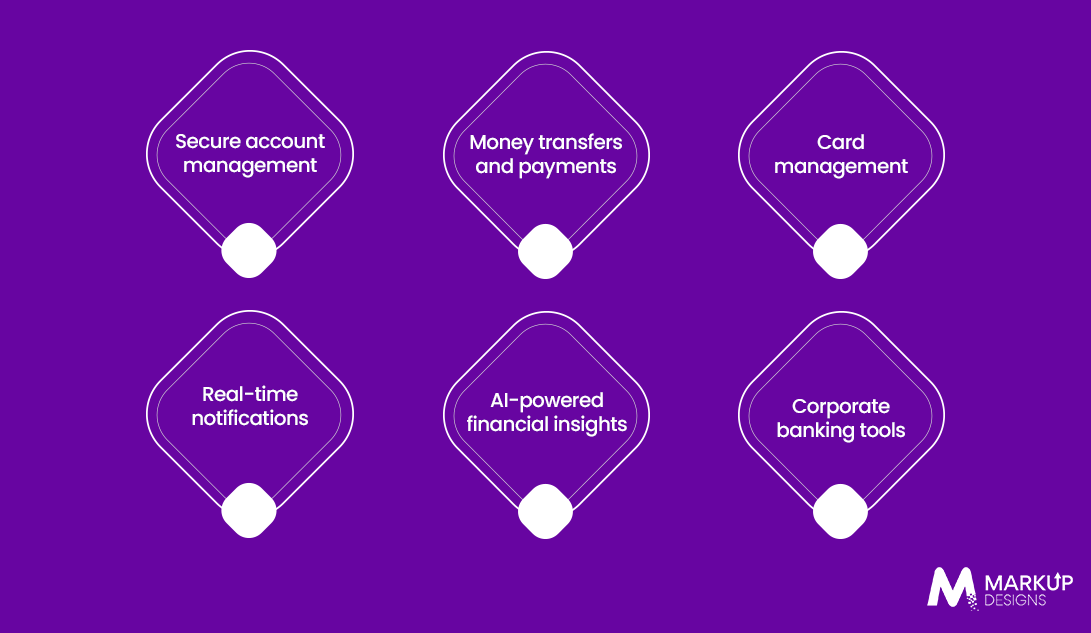
A mobile banking application from an enterprise is expected to be more than just a tool for accessing basic bank accounts. It should integrate the functions of daily banking activities with good security, performance, and financial management functionality. There are a number of mandatory features for any bank mobile application, regardless of its specific requirements.
Secure account management
Users should be able to see their account balances, transaction records, account statements, and handle multiple accounts using a single screen.
Money transfers and payments
These include services like bank transfers, peer-to-peer payments, scheduled payments, recurring transactions and many more digital money transfer services.
Card management
This involves activating cards, freezing or unfreezing the cards, setting limits on spending, viewing transactions, and handling virtual or physical cards.
Real-time notifications
This allows users to receive instant notifications regarding transaction, login, payment confirmations, changes in account balances and other suspicious activities.
AI-powered financial insights
AI can assist in analyzing spending behavior, giving customized financial advice, finding out the odd transactions and making the financial decisions for customers.
Corporate banking tools
Corporate banking features such as role-based access, payment approval, bulk transactions, expense management, and cash flow management may help.
Enterprise Mobile Banking App Architecture
Architecture plays a vital role in designing a mobile banking application since the application will process critical financial information, deal with a lot of transactions, and have multiple users and back-end systems. Having a good architecture will make it easy to scale and provide additional services later on.
The main components of an enterprise mobile banking app architecture include:
- Mobile application layer: The user interface on an iOS, Android, or cross-platform application where customers can engage with banking functionality.
- Backend layer: This layer is responsible for authentication, managing accounts, processing transactions, and other application logic.
- APIs and integration layer: Integrates the mobile application with core banking systems, payment systems, customer relationship management systems, fraud detection systems, and other external financial services.
- Data layer and database: Storage and management of customer data, transaction data, account data, and other banking data.
- Security layer: Encryption, authentication, authorization, fraud monitoring, and access controls to secure sensitive data.
- Cloud and infrastructure layer: Cloud computing power, monitoring, scalability, backup, and disaster recovery of the application.
A well-designed architecture helps banks build a mobile banking platform that is secure, scalable, flexible, and ready for future growth.
Ready to Build a Secure Enterprise Mobile Banking App?
Turn your banking services into a secure, scalable, and user-friendly mobile experience with the right technology and development strategy. From core banking integrations to advanced security and AI-powered features, Markup Designs can help you build an enterprise mobile banking solution aligned with your business goals.

How Much Does Enterprise Mobile Banking App Development Cost?
Developing an enterprise mobile banking application will come at different prices based on the features required for the application, level of security, integration needs, technology used, and complexity of the app. Unlike a regular banking application, the development of an enterprise mobile banking application will require integration with core banking systems and other enterprise applications.
As a general estimate, the development cost can fall into the following range:
| Enterprise App Type | Estimated Cost | Development Timeline |
| Enterprise MVP | $80,000–$150,000 | 4–6 months |
| Mid-Level Enterprise App | $150,000–$250,000 | 6–9 months |
| Advanced Banking Platform | $250,000–$500,000+ | 9–15+ months |
The above-mentioned prices are just estimated numbers. Final pricing will be dependent on the exact needs of the bank or any other financial institution.
For example, the development price of an application with basic account management and payments functionality will be lower compared to an application with AI-powered analytics, corporate banking processes, fraud detection, integration, authentication, and compliance.
Thus, banks should define their needs and prioritize features before finalizing the pricing of the project.
Read More: IoT in Banking: Transforming Financial Services Through Connected Technologies
Factors Affecting Enterprise Mobile Banking App Development Cost
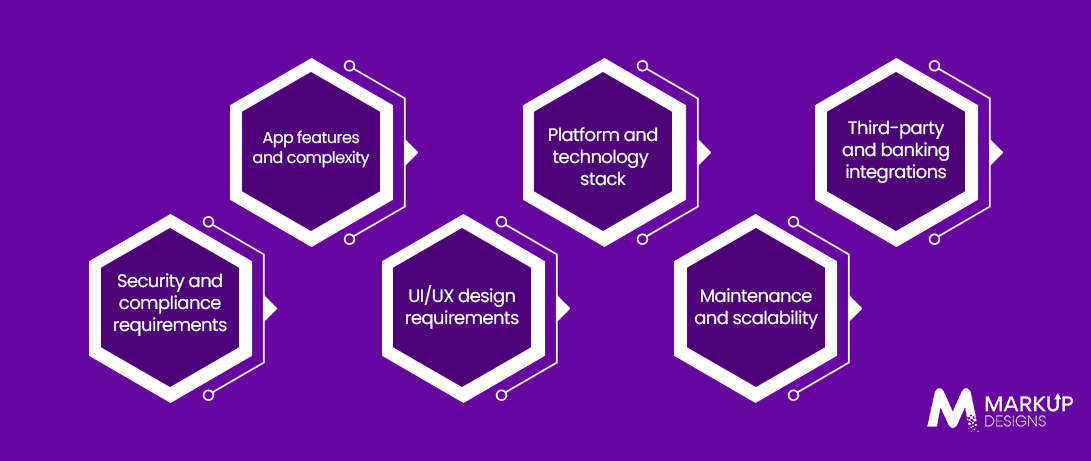
There are several factors that can impact enterprise mobile banking application development cost. Having knowledge about them from the beginning will help to estimate the costs more realistically.
App features and complexity
The number of complex features, workflows, and roles in the app can require more time to develop.
Platform and technology stack
Whether the app is developed for iOS, Android or both of them will impact the cost of the development process.
Third-party and banking integrations
Integrations with core banking systems, payment gateways, API, CRM, ERP, and other third-party services will impact the project.
Security and compliance requirements
Encryption, biometrics, fraud prevention, and other security measures will impact the cost of development.
UI/UX design requirements
The requirement to provide a highly intuitive, accessible, and personal banking experience can increase the costs.
Maintenance and scalability
Further maintenance, updates, and improvements of the banking app are an additional factors.
How to Develop an Enterprise Mobile Banking App?
Developing the enterprise mobile banking application calls for strategic planning, as the application must ensure functionality, security, performance, and a great user experience.
Step 1: Determining Requirements
Determine the users, banking services, business objectives, compliance requirements, and necessary features.
Step 2: Plan the Architecture
Choose the technology stack, backend architecture, APIs, cloud infrastructure, and security.
Step 3: Design the User Experience
Design wireframes and prototypes that will make the banking services easy and understandable.
Step 4: Build the Application
Develop the mobile front end, back end, APIs, databases, and integration with the bank systems.
Step 5: Secure the Application
Implement authentication, encryption, access control, fraud detection, and other security features.
Step 6: Test the Application
Conduct tests for functionality, security, performance, APIs, usability, and devices.
Step 7: Launch and Maintain
Deploy the application, ensure that it is performing well, fix any problems, deploy updates, and keep improving the user experience.
Challenges in Enterprise Mobile Banking App Development
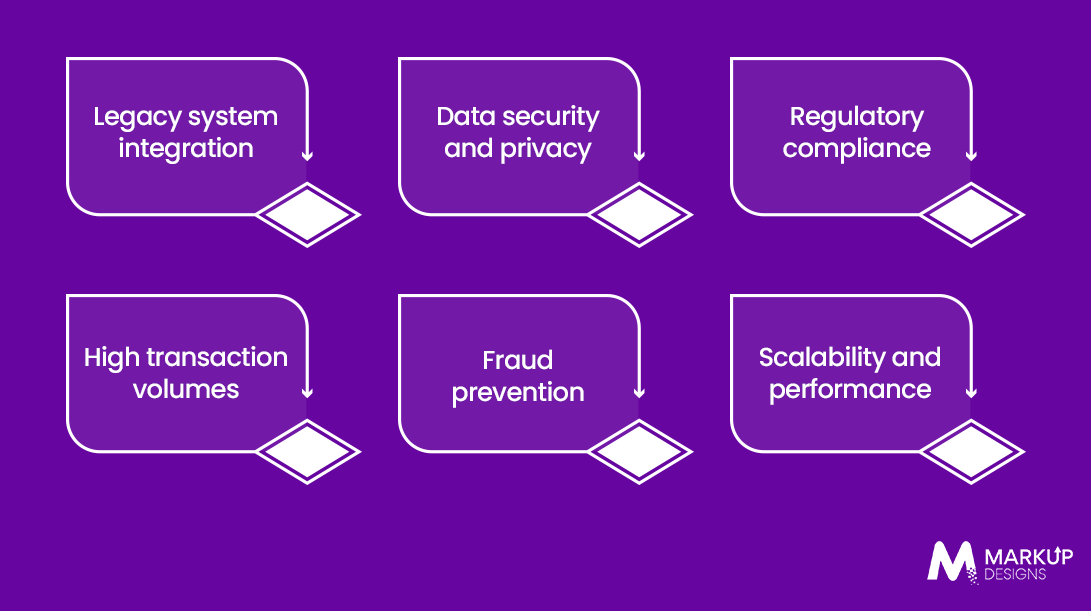
Banking enterprise software is based on sensitive financial information and complicated systems, which makes developing it more difficult compared to the development of a regular mobile application.
1. Legacy system integration
Integrating the latest mobile applications with the existing core banking system is challenging.
2. Data security and privacy:
Sensitive customer and banking details need to be secured from potential dangers.
3. Regulatory compliance
Applications need to meet applicable banking, privacy, payment, and data protection requirements.
4. High transaction volumes
The platform needs to be scalable and reliable under high traffic load conditions.
5. Fraud prevention
Real-time fraud detection capabilities are required for detecting fraudulent operations.
6. Scalability and performance
The application needs to be scalable and perform well under increased user loads.
Dealing with these challenges during the planning and architectural phase will enable the banks to develop an effective enterprise mobile banking platform.
Why Choose Markup Designs for Enterprise Mobile Banking App Development?
Choosing the proper development partner to build an enterprise mobile banking app is crucial because it takes more than just simple mobile development experience to accomplish this task. Our company will be able to assist banks and financial institutions in managing the whole development process – from planning and UI/UX design to development, integration, testing, implementation, and further support of their project. Our goal is to create a mobile banking solution that is safe, scalable, reliable, and user-friendly.
We have experience in working with the latest technologies like AI, cloud computing, APIs, and big data, which can be useful for financial institutions to implement smart solutions in digital banking. We know how to consider security aspects, performance, data safety, and other critical issues while developing a banking application. Whatever the stage of your enterprise mobile banking project is (MVP or more advanced banking platform), Markup Designs will be able to meet your needs.
Build Your Enterprise Mobile Banking App With the Right Technology Partner
Connect with Markup Designs to discuss your requirements and explore the right development approach for your financial business.

Conclusion
Enterprise banking mobile applications have become an integral element of today’s digital banking. They offer financial institutions the chance to provide services conveniently while increasing operational efficiency, engaging customers, and strengthening digital capabilities. Nevertheless, developing a successful enterprise banking application involves taking care of certain factors, such as features, architecture, security, integrations, scalability, and regulatory compliance.
As discussed in this blog, costs related to development can be affected by such factors as complexity of the application, technologies used, security issues, integration with other systems and services, and the scope of development. Consequently, banks need to set their objectives and identify the key features of the app before beginning to develop it. Financial institutions are capable of developing a safe and scalable mobile banking application with the proper strategy and an experienced development partner.
FAQs
1. How much does it cost to develop an enterprise mobile banking app?
The cost can range from around $80,000 to $500,000+, depending on features, integrations, security requirements, platforms, and overall complexity.
2. How long does it take to develop an enterprise mobile banking app?
An enterprise banking app can take around 4 to 15+ months to develop. The timeline depends on the number of features, integrations, security requirements, and testing involved.
3. What are the essential features of an enterprise mobile banking app?
Common features include secure account management, money transfers, bill payments, card management, real-time notifications, biometric authentication, financial insights, and corporate banking tools.
4. How can banks improve the security of mobile banking apps?
Banks can use multi-factor authentication, encryption, biometric verification, secure APIs, role-based access controls, fraud detection, and regular security testing to protect customer and financial data.
6. Can an enterprise banking app integrate with existing core banking systems?
Yes. Enterprise mobile banking apps can integrate with core banking platforms through APIs and integration layers, allowing the mobile application to access account, transaction, payment, and customer data.
Author's Perspective
Enterprise mobile banking is no longer only about offering basic banking services through smartphones. Banks need secure, scalable, and convenient platforms that can adapt to changing customer expectations and growing digital demands. From our perspective, successful development starts with clear business goals, strong architecture, and security-first planning. With the right technology and development partner, banks can create mobile banking experiences that deliver long-term value while remaining reliable and future-ready.
Discuss Your Project NowJupinder Singh Arora
Founder and CEO
Related Posts
How to Hire Mobile App Developers in the...

How Much Does It Cost to Build a...

How to Build a Secure Payment Gateway Integration...
Insights Are Valuable & Execution is Priceless
You’ve read about the digital future. Now, let’s build the infrastructure to take you there. Move your strategy from the page to the product.
Design Your Solution Now
Contact Us
Schedule The Appointment At Your Convenience Date And Time.
30 Min
Web Conference
Time Zone
Indian standard time (08:30pm)

Thanks For Getting In Touch!
You’ve Taken The First Step Toward Transforming Your Digital Presence. Our Experts Will Reach Out Shortly To Take It Forward.
Launch Your Dream Project
Provide a brief overview of your project, and our specialists will evaluate your requirements. We will connect with you to explore how the right digital solutions can help you launch faster.