
In Brief
- Restaurant technology is revolutionizing the hospitality industry through the enhancement of efficiency in order processing, payments, cooking processes, inventory management, interaction with customers, and decision-making.
- Examples of such technological trends include artificial intelligence in management, self-ordering kiosks, contactless payments, cloud point-of-sale systems, kitchen display systems, Internet of Things, mobile applications, voice AI, robots, predictive analytics, automation of inventory, smart reservations, and omnichannel platforms.
- The above technologies have the potential to aid restaurants in reducing the time taken for orders, improving the performance of employees, avoiding wastage of food, tailoring customer experience, enhancing processes within the restaurant, and making informed decisions.
- In picking up new technologies, businesses should pick what solves their specific operational problems and not the popular trends at any one time.
- The future of restaurant technology involves interconnected technology ecosystems that include artificial intelligence, the Internet of Things, automation, analytics, and digital platforms, among others.
The restaurant business has always been concerned with providing better service to customers, but the methods used by restaurants to provide a better experience have changed significantly. Nowadays, customers demand faster service, quick ordering, smooth payments, personalization, and an overall great digital experience on top of tasty food.
This is when the technologies being applied in restaurants make a significant difference. It includes technologies like artificial intelligence software, self-ordering kiosks, apps for smartphones, intelligent kitchen appliances, digital payment options, etc.
This blog will take you through how restaurant technology trends are transforming the hospitality industry and how the innovations are affecting the day-to-day workings of restaurants. You will learn about the advantages of using restaurant technology, considerations businesses must take before implementing new technologies, and how a good technology partner can aid in creating a scalable restaurant experience.
Why Restaurant Technology Matters More Than Ever
Operating a restaurant is not simply about cooking and serving food. Businesses have to keep track of orders, table management, inventory, staff, payment processes, customer relations, and food quality. With the rise in customer demands, it may become tough for businesses to handle all these functions manually.
Restaurant technologies make it easier for businesses to deal with these daily issues. Digital ordering can cut down waiting time, demand forecasts can be provided through AI, and inventory management can assist in eliminating unnecessary food wastage. On the other hand, customer engagement beyond the physical restaurant becomes easier through emerging technology trends in mobile app development and loyalty platforms.
Technology also allows restaurateurs to see how the operation works. Real-time data will reveal trends of customers’ behavior, the best-selling menu items, peak hours of service, and areas that need improvement.
But above all, digital transformation in restaurants is not a replacement for the human element. If implemented correctly, it will allow restaurant employees to delegate the repetitive tasks and concentrate on what really counts – serving the customer.
Top Restaurant Technology Trends Reshaping Hospitality Businesses
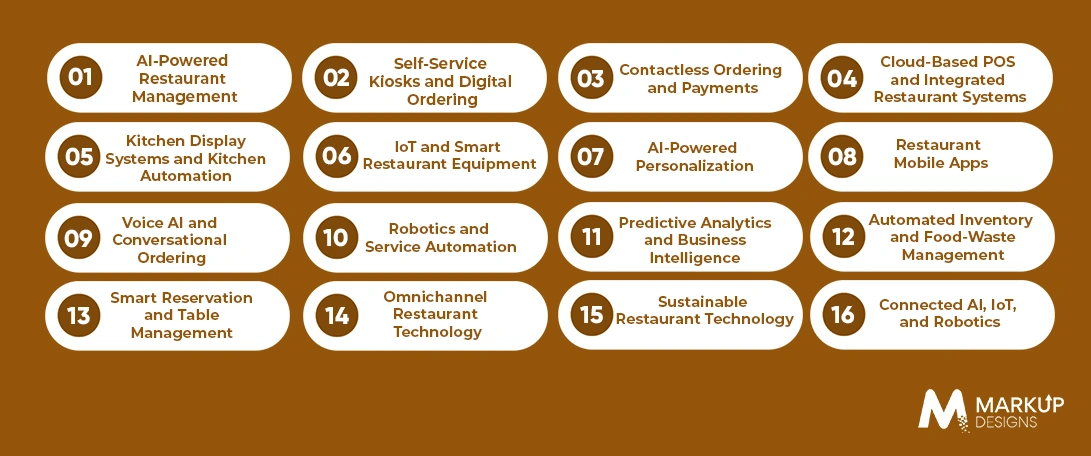
Restaurant technology has moved beyond just POS systems and online ordering. Innovative technologies are being used by restaurant companies to enhance their management of operations, customer engagement, cost management, and decision-making processes. Let us examine the current trends in the restaurant industry.
- AI-Powered Restaurant Management
Artificial intelligence is gaining importance as a practical solution for restaurant management. This may be used for the purpose of predicting demand, sales analysis, stock optimization, prediction of peak hours, and efficient employee management. AI technology can also help restaurants discover preferences and recommend appropriate products.
- Self-Service Kiosks and Digital Ordering
With self-service kiosks/digital ordering systems, customers have greater control over their meal experience as they can choose from the menus, make orders, and pay for meals.
- Contactless Ordering and Payments
Ordering via QR codes, making payments via mobile phones, digital wallets, and contactless cards is making things easier and fast in the restaurant sector. Customers will order and make payments via mobile phones, while restaurants will be able to integrate this process with POS and order management systems.
- Cloud-Based POS and Integrated Restaurant Systems
A cloud-based POS system integrates all the different functions of a restaurant within a single ecosystem. Sales, payments, inventory, customers, reporting, and multi-location management can be done via the cloud-based platform.
- Kitchen Display Systems and Kitchen Automation
The kitchen display systems utilize digital screens in place of the conventional paper tickets. This way, the employees will be able to see the incoming orders, figure out the order of serving the orders, observe the time required for cooking, and do other activities, and therefore there will not be any communication problem between the two sides.
- IoT and Smart Restaurant Equipment
Due to the assistance of the internet of things sensors, it is possible to regulate such problems as refrigerator temperatures, operation of the equipment, energy consumption, etc. Thus, it is possible to avoid food spoilage, malfunction of the equipment, and extra expenses.
- AI-Powered Personalization
Customers are interested in getting personalized experience in the restaurant. With the assistance of AI technology, it is possible to provide personalized recommendations to customers according to order patterns.
- Restaurant Mobile Apps
Restaurant mobile applications have become more and more popular means of communication directly with customers in the restaurant industry. With the assistance of these applications, it is possible to browse the menu, make orders, reserve tables, earn loyalty points, get exclusive offers, and track order history.
- Voice AI and Conversational Ordering
Voice AI agent development has opened up a whole new avenue of order placement, table reservations, addressing customer queries, and even conversations in the drive-thru section. You will not have to take the valuable time of your employees on all such mundane activities, as these will be done by the conversation system itself.
- Robotics and Service Automation
The use of robotics is slowly becoming commonplace in almost every aspect of the restaurant business, from the preparation process to serving food and cleaning.
- Predictive Analytics and Business Intelligence
A large amount of data is generated by the restaurant business through orders, payments, inventories, interactions with customers, and employee activities. This data can help get some useful information about sales patterns, behavior of customers, efficiency of the menu, etc.
- Automated Inventory and Food-Waste Management
Appropriate inventory management of ingredients at the restaurant is one of the things that is important for the restaurant. With the help of automated systems of this kind, the restaurant can effectively monitor stocks, usage of ingredients, shortage of ingredients, and make appropriate purchasing decisions. Prediction analysis can also assist in offering appropriate amounts of food which will help to reduce food waste.
- Smart Reservation and Table Management
With the help of a digital reservations system, it is possible to manage reservations, waiting list, tables, and even preferences of customers from one place. Since the digital reservations system integrates with other technologies employed by restaurants, it will improve table utilization.
- Omnichannel Restaurant Technology
Customers communicate with restaurants through various channels such as applications, websites, delivery, kiosks, social media, and physical visits. Omnichannel technology will help to integrate all these channels and manage menu, customers’ databases, prices, and orders in a unified manner.
- Sustainable Restaurant Technology
Technology can even help restaurants in achieving sustainability. With the help of this technology, restaurants will be able to consume lesser resources as well as keep their operational costs at the minimum level through energy management, e-receipts, food waste management, connectivity of equipment, and proper inventory management.
- Connected AI, IoT, and Robotics
The IoT technology used in the future for restaurants won’t consist of individual technology, but integrated technology. AI will help in analyzing the data provided by IoT and then robotics will use that data to run the equipment effectively.
How Restaurant Technology is Changing Hospitality Businesses
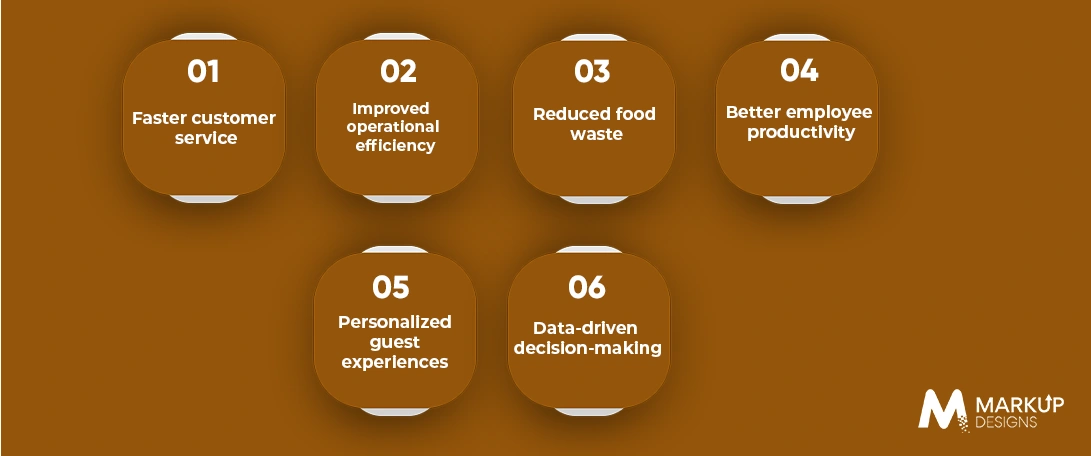
Technology does not solely affect customers and transactions in restaurants, but it has become an essential part of the management of the staff of such establishments as well as an important factor that allows restaurants to save money and maintain consistency in their operations.
Faster customer service
Digital menus, mobile ordering, kiosks, and contactless payments allow for improved process speed and provide additional opportunities for the clients to order. Customers can select their food, customize it, and pay through different digital channels.
Improved operational efficiency
Automation will handle all repetitive tasks such as processing orders, managing the inventory, making reservations, and generating reports. As a result, the staff of a restaurant will have more time to interact with clients.
Reduced food waste
Efficient inventory management and forecasting systems enable the restaurant to know what amount of stock is needed in terms of the ingredients used and their usage rate, reducing overstocking, wastage, and spoilage.
Better employee productivity
The technology does not necessarily have to overburden the employee; instead, it can be used to assist the employee in their duties. The kitchen display system, automation of orders, and scheduling, among other technologies, will enable better coordination of tasks within the team.
Personalized guest experiences
Data regarding the preferences and previous orders placed by a customer can be analyzed to help in creating relevant offers and promotions.
Data-driven decision-making
No more guesswork in running a restaurant business; there are dashboard systems to provide data regarding sales, customer behavior, inventory, most purchased menu item, and other aspects of the business that need improvement.
How to Choose the Right Restaurant Technology
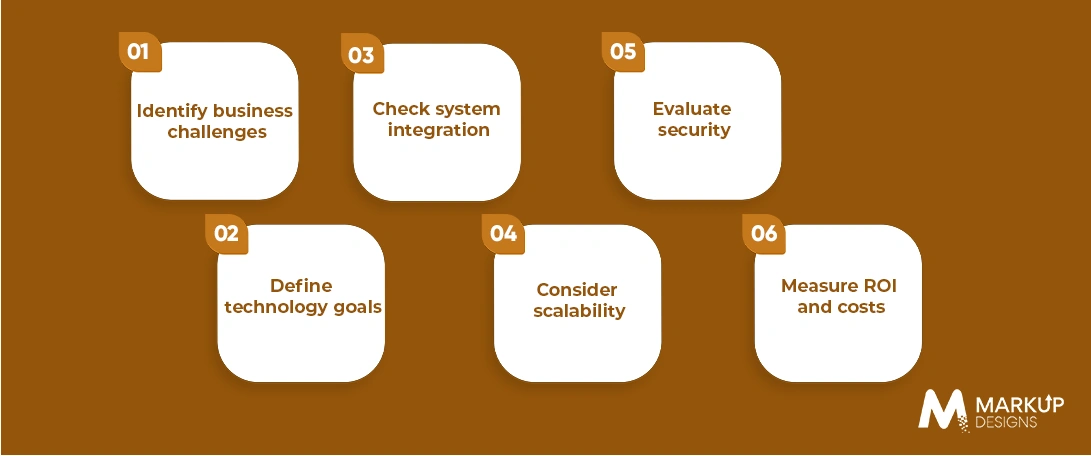
There are many restaurant technologies to choose from, but selecting the right one may prove difficult. Rather than opting for a technology just because it is trending, businesses should consider its purpose and use before deciding whether it suits their needs.
1. Identify business challenges
First, pinpoint what is holding back your business and hindering its success. For example, it could be slow ordering, unnecessary inventory losses, expensive operations, weak customer engagement, or kitchen inefficiency.
2. Define technology goals
Next, determine what exactly you wish to accomplish through this technology. Setting measurable goals like shorter wait times, more accurate orders, increased sales, and reduced waste makes things much clearer.
3. Check system integration
Select technologies that will allow for integration with your current POS system, payment processing, inventory management, CRM, loyalty programs, and other systems. Otherwise, lack of good integration may lead to additional burdens rather than resolving existing issues.
4. Consider scalability
Technology has to keep pace with the growth of your restaurant business. You need to consider whether it is possible to scale your system in case you plan on expanding your chain or using more channels of delivery of goods or services online.
5. Evaluate security
Restaurant systems store critical customer, financial, and business data, so it is important to pay attention to security, access controls, regular updates of the system, reliability, and data protection measures.
6. Measure ROI and costs
In addition to initial costs associated with development or subscription fees, think about additional expenses related to implementation, maintenance, integration, training, updates, and support of the selected technology.
Why Choose Markup Designs for Restaurant Technology Solutions?
The selection of the right technology partners can play an important role during the process of digitization of restaurant operations. In Markup Designs, we work on developing digital technologies that cater to our client’s actual requirements rather than just developing technological tools. We have experts who can help restaurant owners convert their ideas into technological solutions that can enhance their business operations and customer experience.
In order to build an ecosystem for the restaurants, we integrate various technologies, including mobile applications, software, artificial intelligence-based automation, cloud-based applications, and digital platform-based solutions. We also take into account key aspects like usability, security, scalability, and compatibility with existing systems.
Whether it is about improving digital ordering, automation of processes, customer experience personalization, or receiving more information about how the operation works, we begin by identifying your business goals. We help businesses through the entire process of product development – from initial planning and design all the way to testing and implementation.
With the right technology foundation, restaurants can stay competitive while creating experiences that customers want to return to.
Turn Restaurant Technology Into Business Growth
From AI and automation to mobile apps and integrated platforms, let Markup Designs help you build technology that works for your restaurant.

Conclusion
Restaurant technology is transforming the hospitality industry, from the manner in which customers place their orders to the internal operations of companies. Technologies such as AI, mobile app development, self-ordering kiosks, digital payment, Internet of Things (IoT), analytics, automation, and integrated restaurant systems are allowing businesses to operate more efficiently and provide a better customer experience.
However, the adoption of technology must not be based on every new trend in the market. Restaurant businesses must adopt technologies that solve their own problems and fit into existing processes, thereby providing real value for their business.
As this industry moves forward, restaurants with interconnected and flexible digital business models will be well-positioned to deal with shifting customer expectations. Technology may develop further, but one thing is clear – its purpose should remain unchanged: to help make operations in the restaurant industry smarter and more hospitable.
FAQs
1. What are the latest restaurant technology trends?
Some of the key trends include AI-powered restaurant management, self-service kiosks, contactless payments, cloud-based POS systems, IoT, mobile apps, predictive analytics, voice AI, robotics, and automated inventory management.
2. How is AI transforming restaurant operations?
AI can help restaurants forecast demand, analyze customer behavior, optimize inventory, personalize recommendations, automate repetitive tasks, and support faster business decisions.
3. How does restaurant technology improve customer experience?
Digital ordering, mobile apps, kiosks, contactless payments, personalized recommendations, and faster service can make the overall dining experience more convenient and responsive.
4. What are the benefits of restaurant mobile apps?
Restaurant apps can support online ordering, reservations, loyalty programs, personalized offers, push notifications, digital menus, and direct communication with customers.
5. How can restaurants use automation?
Restaurants can use automation for order processing, inventory tracking, reservations, kitchen workflows, customer support, payments, reporting, and other repetitive operational activities.
Author's Perspective
Restaurant technology is now part of everyday hospitality operations. From AI and automation to mobile ordering and connected systems, it helps restaurants solve practical challenges and improve customer experiences. However, adopting technology alone is not enough. Businesses need solutions that match their goals, improve efficiency, control costs, and support their teams. The future of hospitality lies in balancing smart technology with human service to create better experiences and stronger customer relationships.
Discuss Your Project NowGaurav Goyal
Global Sales- VP
Insights Are Valuable & Execution is Priceless
You’ve read about the digital future. Now, let’s build the infrastructure to take you there. Move your strategy from the page to the product.
Design Your Solution Now
Contact Us
Schedule The Appointment At Your Convenience Date And Time.
30 Min
Web Conference
Time Zone
Indian standard time (08:30pm)

Thanks For Getting In Touch!
You’ve Taken The First Step Toward Transforming Your Digital Presence. Our Experts Will Reach Out Shortly To Take It Forward.
Launch Your Dream Project
Provide a brief overview of your project, and our specialists will evaluate your requirements. We will connect with you to explore how the right digital solutions can help you launch faster.