

In Brief
- Australia’s healthcare industry is transforming due to artificial intelligence, which is helping with clinical decision-making processes, streamlining administrative work, and providing the means for more effective healthcare practices.
- Enterprise-level AI capabilities cover more than just diagnostic functions; this technology includes predictive analytics, medical imaging, patient monitoring, drug development, resource management, and population health.
- When implementing AI solutions, there are several factors that need to be considered. Even though technology is fundamental for successful AI application, other factors play significant roles.
- For AI to work properly, the issues of data quality, integration, privacy, compliance with regulations, and workforce readiness must be considered.
- To successfully implement AI technologies in healthcare systems, a clear implementation strategy must be developed.
- The implementation strategy must be well-defined, starting with identifying specific use cases, going through a pilot project, integrating AI into everyday work, monitoring the results, and moving to full-scale implementation across the organization.
Artificial intelligence is moving beyond isolated healthcare experiments and becoming a strategic technology for Australian healthcare enterprises. Hospitals, health networks, pharmaceutical organisations, aged care providers, and digital health businesses are exploring AI to analyse complex medical data, support clinical decisions, automate repetitive workflows, and deliver more personalised patient experiences. With growing volumes of healthcare data and increasing pressure to improve efficiency without compromising quality of care, AI can provide enterprises with new ways to address both operational and clinical challenges.
However, adopting AI in Australian healthcare is not simply a matter of deploying an intelligent model. Healthcare organisations must consider data privacy, clinical safety, interoperability, regulatory requirements, legacy infrastructure, workforce readiness, and measurable business outcomes before scaling AI across their operations. This makes enterprise-level AI adoption a strategic transformation rather than a standalone technology project. Understanding where AI delivers tangible value today and where emerging opportunities are heading can help Australian healthcare organisations make more informed investment and implementation decisions.
How AI Is Transforming Australian Healthcare Enterprises
AI is revolutionising Australian healthcare businesses’ clinical and operational processes. By driving timely decision-making and executing tedious tasks, its effects are felt throughout the healthcare delivery landscape.
Improving Clinical Decision Making
AI analyses patient data, medical history, and clinical information to help clinicians discover patterns with relevant risks and make quick, well-informed decisions.
Automating Administrative Workflows
AI is automating some administrative actions such as paperwork and coordination, therefore assisting employees in concentrating on higher-value tasks.
Enhancing Patient Diagnosis and Risk Prediction
AI assesses medical history and diagnostic data to define possible health risks, make early diagnoses, and help healthcare practitioners in prioritising patients’ needs.
Optimising Hospital Operations and Resources
AI empowers healthcare companies with the ability to predict patient demands, distribute staff more efficiently, and streamline patient transfers.
Enabling Personalised Patient Care
AI may interpret a patient’s personal data in order to create tailored recommendations, follow up on treatment, and offer patients healthcare options grounded on their peculiarities.
Enterprise Applications of AI in Australian Healthcare
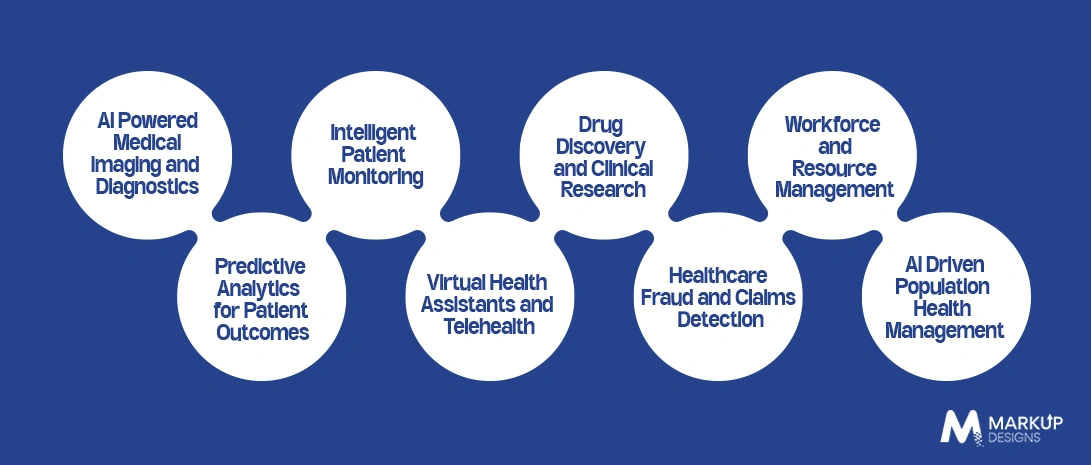
AI applications are no longer limited to clinical diagnosis; now they also assist in research, patient engagement, finance, workforce planning, and population health management.
AI-Powered Medical Imaging and Diagnostics
AI is capable of analyzing X-rays, CT scans, MRIs, and cellular pathology slides to detect abnormalities and act as a second opinion for diagnosing patients.
Predictive Analytics for Patient Outcomes
With the help of predictive AI, patient data can be scrutinized to identify and flag any risks of readmissions, complications, or deterioration of patients, making it possible for healthcare providers to take timely actions.
Intelligent Patient Monitoring
AI is able to analyze data from a network of connected devices and monitoring systems to detect any changes in the well-being of patients and issue alerts.
Virtual Health Assistants and Telehealth
AI-enabled virtual health assistants can handle routine interactions with patients, such as sending reminders, answering frequently asked questions, and providing support with scheduling, while enhancing the efficiency of telemedicine services.
Drug Discovery and Clinical Research
AI usage can speed up research efforts through analyzing biological data, indicating the right candidate for drugs, assisting in the clinical trials process, and working with complex data reported in research.
Healthcare Fraud and Claims Detection
Artificial intelligence can assess claim requests and transaction information in order to find untypical trends, fraud possibilities, billing mistakes, and other financial irregularities.
Workforce and Resource Management
Artificial intelligence helps healthcare organizations estimate personnel needs, optimize work schedules, and distribute resources according to the requirements of clients as well as work processes.
AI-Driven Population Health Management
AI analyzes population data and points out health issues, groups at risk, and points for intervening and implementing prevention and health programs.
Read Also: Pharmacy Management Software Development in Australia
AI Technologies Powering Healthcare Innovation in Australia
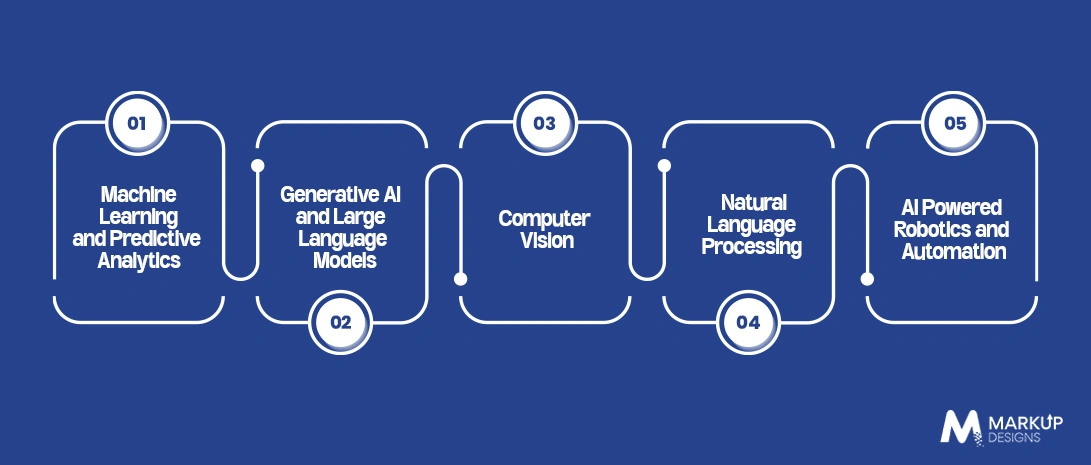
Different AI technologies are used in numerous healthcare applications: predictive analytics, medical imaging, and intelligent automation, as well as language technologies.
Machine Learning and Predictive Analytics
Machine learning detects trends using healthcare data so that it can help with risk management, forecasting, diagnosis, and clinical decision-making.
Generative AI and Large Language Models
Generative Artificial Intelligence can be applied to clinical documentation, information summarization, communication with patients, and other text-based processes.
Computer Vision
Computer vision gives the opportunity to analyze medical data and photos with the help of AI, using it for diagnostics, follow-up activities, and surgeries.
Natural Language Processing
NLP aids healthcare systems in gathering data from medical notes, clinical records, reports, and miscellaneous unstructured data.
AI-Powered Robotics and Automation
AI-based robotic technology can assist in performing surgical procedures, rehabilitation, medical laboratory work, logistics, and other healthcare operations needing precision and automation.
Key Challenges of Enterprise AI Adoption in Australian Healthcare
Healthcare enterprises need to overcome numerous challenges before adopting AI throughout their entire operations, mainly concerning sensitive data, integration, compliance, and long-term investment.
Data Privacy and Security
AI systems have to ensure the confidentiality and protection of sensitive patient information through the management of data, access restrictions, encryption, and suitable governance.
Integration With Legacy Healthcare Systems
Making AI systems work in harmony with existing electronic medical systems may face technical, process, and interoperability challenges.
Regulatory and Compliance Requirements
AI in the healthcare field has to comply with the privacy requirements, regulatory demands, and clinical safety imposed by Australian legislation in accordance with its application.
Data Quality and Interoperability
Insufficient, inconsistent, and poorly structured data might result in incorrect AI work, making the introduction of strict rules for data processing and compliance very important.
AI Skills and Workforce Readiness
Healthcare organisations need skilled teams to implement and manage AI while ensuring employees understand how to use these systems effectively and responsibly.
Cost, Scalability, and Return on Investment
AI adoption involves development, infrastructure, integration, training, and maintenance costs, making clear ROI metrics essential before scaling solutions across the enterprise.
How Australian Healthcare Enterprises Can Implement AI Successfully
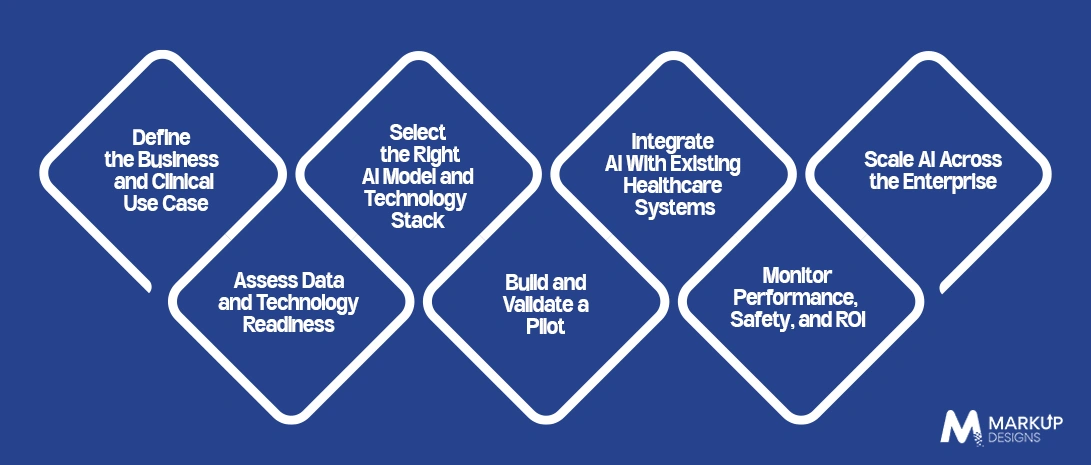
Successful AI adoption requires a structured approach that connects technology with clear clinical and business objectives. Healthcare enterprises should move from small, measurable implementations towards wider adoption while maintaining security, compliance, and human oversight.
Define the Business and Clinical Use Case
Identify a specific problem AI can solve and establish measurable goals around efficiency, patient care, cost reduction, or clinical outcomes.
Assess Data and Technology Readiness
Evaluate data quality, availability, infrastructure, existing systems, and integration capabilities before selecting an AI solution.
Select the Right AI Model and Technology Stack
Choose AI technologies based on the use case, data requirements, scalability, security, and compatibility with the organisation’s existing technology environment.
Build and Validate a Pilot
Start with a controlled pilot to test AI performance, usability, accuracy, and clinical relevance before committing to enterprise-wide deployment.
Integrate AI With Existing Healthcare Systems
Connect AI solutions with relevant healthcare platforms, electronic health records, and operational systems to ensure AI insights can be used within existing workflows.
Monitor Performance, Safety, and ROI
Continuously track model accuracy, system performance, user adoption, safety, and financial outcomes to identify issues and measure business value.
Scale AI Across the Enterprise
Once the solution demonstrates consistent value, expand it across departments, facilities, and workflows while maintaining appropriate governance and monitoring.
Future Opportunities for AI in Australian Healthcare
AI is expected to move beyond individual applications towards more connected and proactive healthcare ecosystems. Emerging capabilities could reshape how healthcare is delivered, monitored, and managed across Australia.
AI Powered Precision Medicine
AI can analyse genetic, clinical, and lifestyle data to support more personalised approaches to disease prevention, diagnosis, and treatment.
Autonomous and AI Assisted Healthcare Delivery
AI assisted robotics and intelligent systems could support clinical procedures, rehabilitation, diagnostics, and routine healthcare tasks while keeping professionals in control of critical decisions.
Predictive Population Health Management
Advanced AI models can identify population health trends and high risk groups, helping organisations move towards earlier intervention and targeted prevention.
Generative AI for Clinical and Administrative Workflows
Generative AI can streamline documentation, summarisation, information retrieval, patient communication, and other repetitive workflows across healthcare organisations.
AI Enabled Remote and Home Based Care
AI combined with connected devices can enable continuous monitoring and earlier detection of health changes, supporting more healthcare delivery outside traditional facilities.
Intelligent Healthcare Ecosystems and Interoperability
AI can help connect data across healthcare providers and systems, creating more integrated ecosystems where information can support coordinated and data driven care.
The Business Value of AI for Australian Healthcare Enterprises
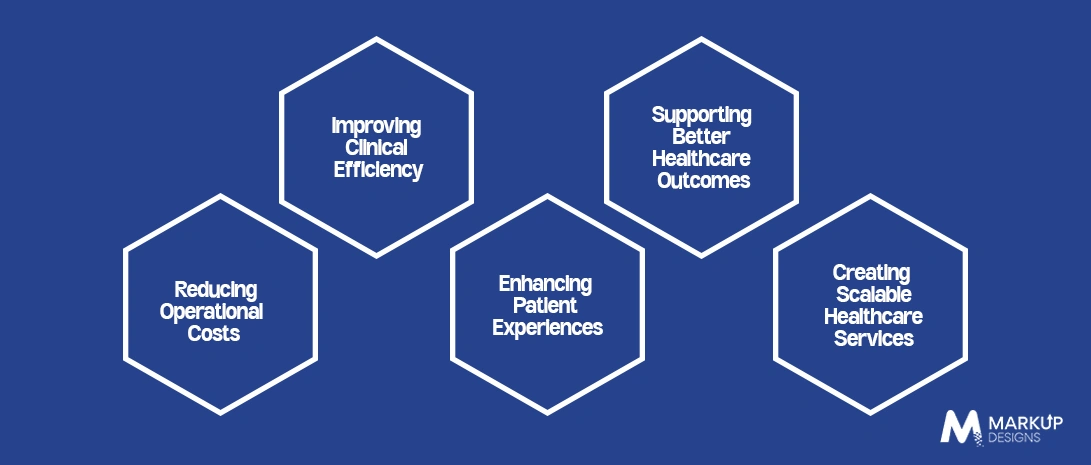
Beyond technological innovation, AI can deliver measurable value across healthcare operations, clinical workflows, and patient services. The strongest use cases are those that combine operational improvements with better healthcare outcomes.
Reducing Operational Costs
Automation and intelligent resource allocation can reduce manual effort, minimise inefficiencies, and lower avoidable operational expenses.
Improving Clinical Efficiency
AI can reduce time spent on data analysis, documentation, and routine processes, allowing healthcare professionals to focus more on clinical responsibilities.
Enhancing Patient Experiences
Faster responses, personalised services, easier access, and continuous support can create more convenient and responsive patient experiences.
Supporting Better Healthcare Outcomes
AI-driven insights can help identify risks earlier, support clinical decisions, and enable more proactive approaches to patient care.
Creating Scalable Healthcare Services
AI enables healthcare enterprises to automate and standardise selected processes, making it easier to expand services without increasing operational workloads at the same rate.
Why Choose Markup Designs for AI Healthcare Solutions in Australia?
Markup Designs helps Australian healthcare enterprises turn AI opportunities into practical, secure, and scalable solutions. From AI development and healthcare system integration to intelligent automation and secure architecture, our approach focuses on building solutions around real operational and clinical requirements. We combine modern AI technologies with robust development practices to create healthcare applications that can integrate with existing systems, support evolving business needs, and remain adaptable as AI capabilities continue to advance.
Build Smarter Healthcare Solutions With AI
Move from AI experimentation to practical healthcare innovation with secure, scalable, and enterprise-ready AI solutions. Partner with Markup Designs to develop AI solutions that integrate with your healthcare ecosystem and create measurable business and clinical value.

Conclusion
AI is becoming an important part of Australia’s healthcare transformation, with applications spanning clinical decision support, diagnostics, patient monitoring, administration, research, and resource management. However, successful adoption depends on more than choosing the right AI technology. Healthcare enterprises need strong data foundations, secure infrastructure, regulatory alignment, effective system integration, and a clear strategy for measuring outcomes. As AI capabilities continue to evolve, organisations that approach adoption strategically can use the technology to build more efficient, personalised, and scalable healthcare services.
FAQs
1. How is AI being used in Australian healthcare?
AI is being used across diagnostics, medical imaging, predictive analytics, patient monitoring, administrative automation, telehealth, drug research, and healthcare resource management.
2. What are the main benefits of AI for healthcare enterprises?
Key benefits include improved operational efficiency, faster decision support, better resource utilisation, personalised patient care, reduced administrative workload, and more proactive healthcare delivery.
3. What challenges do Australian healthcare organisations face when adopting AI?
Common challenges include data privacy, cybersecurity, legacy system integration, data quality, regulatory compliance, workforce readiness, implementation costs, and demonstrating measurable ROI.
4. How much does it cost to implement AI in healthcare?
The cost depends on factors such as the AI use case, solution complexity, data requirements, integrations, technology stack, security requirements, and ongoing maintenance. A defined use case and technical assessment are needed for a realistic estimate.
5. How can healthcare businesses ensure AI compliance and data security?
Healthcare businesses should implement strong data governance, access controls, encryption, secure infrastructure, privacy safeguards, regulatory compliance processes, and continuous monitoring throughout the AI lifecycle.
6. What is the future of AI in Australian healthcare?
The future is likely to involve greater adoption of precision medicine, generative AI, predictive population health, remote monitoring, AI assisted healthcare delivery, and connected healthcare ecosystems.
Author's Perspective
AI in Australian healthcare is moving beyond the question of whether organisations should adopt it. The more important question is where AI can deliver genuine value without compromising clinical safety, privacy, or trust. Healthcare enterprises should avoid adopting AI simply because the technology is available. The stronger approach is to identify high impact use cases, establish reliable data foundations, validate solutions through controlled implementation, and scale only when measurable value is demonstrated. This is where thoughtful AI strategy and strong technical execution can make the difference between an AI project that looks innovative and one that actually improves healthcare operations and patient outcomes.
Discuss Your Project NowGaurav Goyal
Global Sales- VP
Related Posts

Cost to Build a Mobile App in Qatar...

How Much Does It Cost to Build an...

How to Build a Car Wash App: Development...
Insights Are Valuable & Execution is Priceless
You’ve read about the digital future. Now, let’s build the infrastructure to take you there. Move your strategy from the page to the product.
Design Your Solution Now
Contact Us
Schedule The Appointment At Your Convenience Date And Time.
30 Min
Web Conference
Time Zone
Indian standard time (08:30pm)

Thanks For Getting In Touch!
You’ve Taken The First Step Toward Transforming Your Digital Presence. Our Experts Will Reach Out Shortly To Take It Forward.
Launch Your Dream Project
Provide a brief overview of your project, and our specialists will evaluate your requirements. We will connect with you to explore how the right digital solutions can help you launch faster.