

In Brief
- Enterprise BI integrates data from numerous business systems to build a strong foundation for making decisions.
- While the modern BI creation goes beyond simple reporting, including dashboards, real-time analytics, predictive insights, and artificial intelligence capabilities.
- An efficient BI architecture combines data integration, storage, analytics, visualisation, governance, and security.
- The successful implementation requires more than just the technology, since important elements include having clear KPIs, ensuring data quality, user engagement, and business alignment.
- Enterprise BI provides tangible benefits in terms of better operational efficiency, quicker decision-making, improved customer insights, cost optimisation, and revenue generation.
Modern enterprises produce huge amounts of data through CRM systems, ERP systems, financial tools, customer channels, and marketing platforms. The challenge that businesses face is not just data collection anymore. They have to integrate data, interpret it, and act on it accordingly. Enterprise Business Intelligence (BI) is the solution to transform data confusion into useful business information with the help of comprehensive reporting, business analytics, dashboards, and insights.
Modern enterprise business intelligence has changed a lot when compared to standard reporting practices. Organizations anticipate business intelligence systems that provide capabilities for real-time analysis and analytics, self-service reporting, predictive analysis, AI-based insights, and safety in every part of the organization. Nevertheless, implementing business intelligence solutions is not all about picking the right platform. It presupposes having the proper architecture, incorporating reliable sources of data, formulating relevant key performance indicators (KPIs), implementing governance, and ensuring that employees can use the information that they get from analysis.
In this guide, we will be looking at business intelligence in depth, including its architecture, solutions, features, advantages, application, implementation, and the role of AI in business intelligence.
What Is Enterprise Business Intelligence?
Business Intelligence Definition
Business intelligence refers to the application of technologies and methods for collecting, combining, and analyzing information from different parts of the business. This solution provides its users with a single perspective on the performance of the business, helping to make quick and informed decisions based on analyzed data.
How Enterprise BI Differs from Traditional BI
The traditional business intelligence approach mostly deals with branch-level reports and historical data. Enterprise business intelligence
Enterprise BI connects data across the organisation and supports broader requirements such as real-time analytics, scalability, governance, security and cross-department decision-making.
Enterprise BI vs Business Analytics
Enterprise BI is about presentation, monitoring at work, and showing how processes operate; on the other hand, business analytics is using mathematical and analytical methods to learn what is going on, foresee various occurrences, and on this basis be able to make sounder decisions.
Enterprise BI vs Data Analytics
Data analytics is more generic as it investigates data to find patterns, while enterprise BI takes data analytics and combines it with reporting, data integration, visualisation, and governance of data within the whole company.
Why Enterprise BI Matters for Large Organisations
Big companies deal with huge data volumes generated through various subdivisions, systems and locations. Enterprise BI combines this data for maintaining proper KPIs, finding out reasons for slow performance, improving business processes and making decisions.
How Does Enterprise Business Intelligence Work?
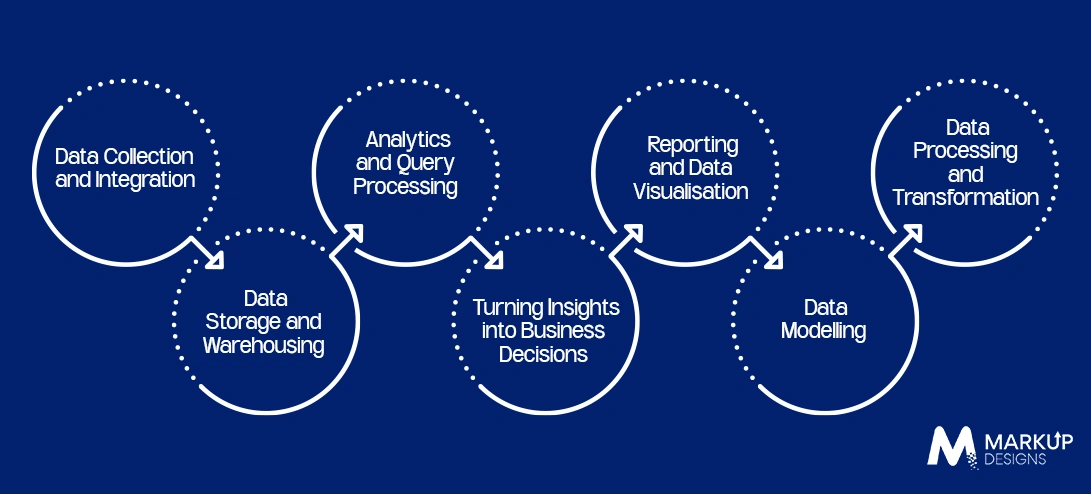
Enterprise BI consists of the following phases that lead raw data to meaningful results.
Data Collection and Integration
Data is taken from the ERP, CRM, and finance systems, personnel departments, marketing, and all the operational systems.
Data Processing and Transformation
Raw data is cleaned, standardised, and transformed to improve its quality and make it suitable for analysis.
Data Storage and Warehousing
Data that has been processed is kept in a data warehouse, data lake, or cloud storage to ensure that it remains protected while still being easily accessible.
Data Modelling
Data modelling is the act of structuring data and defining its correlations between the various data sets that lead to uniform analysis and reporting processes.
Analytics and Query Processing
Business intelligence (BI) tools work on data prepared in the processes above to derive trends, patterns, key performance indicators (KPIs), or any other information that the company requires.
Reporting and Data Visualisation
The insights from the processing steps above can be visualised in dashboards, reports, graphs, and tables, making the complex data easy to understand
Turning Insights into Business Decisions
At the last stage, the obtained insights are utilized with the aim of enhancing operations, tackling challenges, anticipating consequences, and making business decisions.
Key Components of an Enterprise BI Architecture
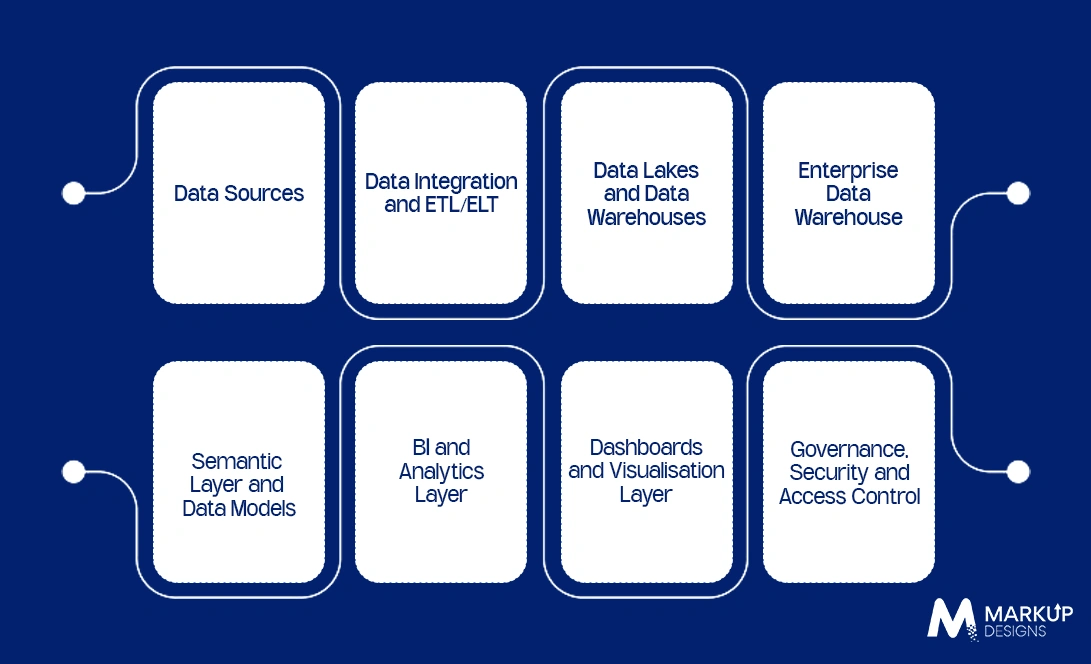
A well-structured enterprise BI architecture connects data sources, processing systems, analytics tools, and users into a single environment. Each layer has a specific role in turning raw business data into reliable and actionable insights.
Data Sources
Enterprise BI collects information from multiple internal and external sources, including:
- ERP systems for business and operational data
- CRM platforms for customer and sales information
- Finance and accounting systems
- HR and workforce management systems
- Marketing platforms
- Customer and operational applications
- IoT devices and external data sources
Data Integration and ETL/ELT
Both ETL and ELT methods are aimed at extracting different sets of data from various sources, preparing it for being put into some storage. Proper integration allows making business intelligence platforms work with reliable and interrelated data.
Data Lakes and Data Warehouses
While with the help of a data lake it possible to create a big stream of organized or unorganized information, a data warehouse helps organize processed data. Companies may take advantage of just one of these systems or use both based on data and analytical needs.
Enterprise Data Warehousing
Enterprise data warehousing offers a single storage of business data from different departments. It is the basis for reporting and KPI monitoring.
Semantic Layer and Data Models
The semantic layer denotes sophisticated data structures in easy-to-understand terms and definitions. It consists of data models that provide connections between different datasets and ensure consistent metric usage by users.
BI and Analytics Layer
This layer contains the tools that are used for making inquiries and interpreting enterprise data. It supports activities such as performance analysis, trend identification, forecasting and advanced analytics.
Dashboards & Visualization Layer
Dashboards, reports, charts, and interactive visualizations make it easy to understand complex information. Users can monitor KPIs, see what has changed, and study how a business performs from the same user interface.
Governance, Security, and Access Control
Governance defines the requirements for quality, ownership, privacy, and use of information. Security measures like role-based access ensure that staff will have access to the information that they require for their job without endangering sensitive business information.
Types of Enterprise Business Intelligence
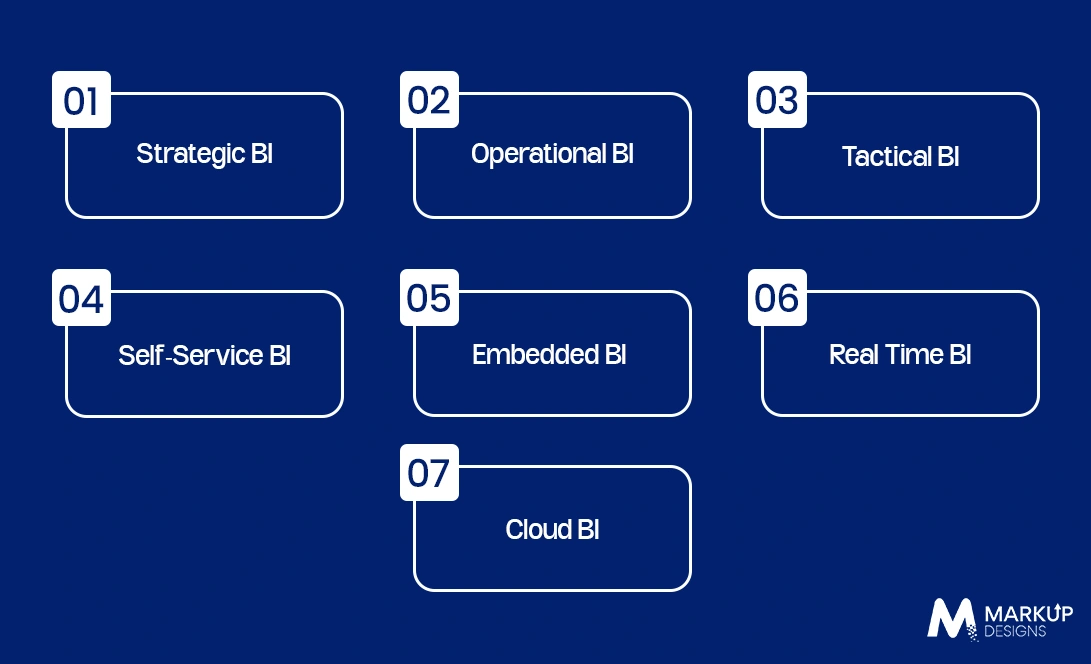
Different forms of Enterprise BI can be employed depending on the goals, users, and requirements of the decisions made.
Strategic BI
Strategic business intelligence aids management in the long-term planning process by allowing them to assess the performance of the business, market situation, available opportunities for growth, and aims of the organization.
Operational BI
Operational Business Intelligence allows getting timely information about daily operations of the company, such as sales, inventory, customer service, and supply chain performance. Thus, the teams are able to react effectively to the issues.
Tactical BI
Tactical Business Intelligence is aimed at short-term and medium-term decisions. Department managers can use it to analyse performance, allocate resources and improve processes within specific business areas.
Self-Service BI
Self-service BI provides business users with the opportunity to establish reports, examine data sources, and create data visualizations without needing assistance from IT teams. Thus, this solution improves access for users and accelerates data analysis.
Embedded BI
Embedded BI refers to analytics integrated into existing business systems. It allows users to view required data within the tools they are already using instead of switching between different platforms.
Real-Time BI
Real-time BI refers to data analysis that is taking place on continuously updated data. This method is beneficial in monitoring transactions, customers, logistics, etc.
Cloud BI
Cloud BI provides analytics services on cloud infrastructure, enabling businesses to quickly scale resources, collaborate with distributed teams, and integrate data from multiple cloud systems.
Enterprise Business Intelligence Solutions and Tools
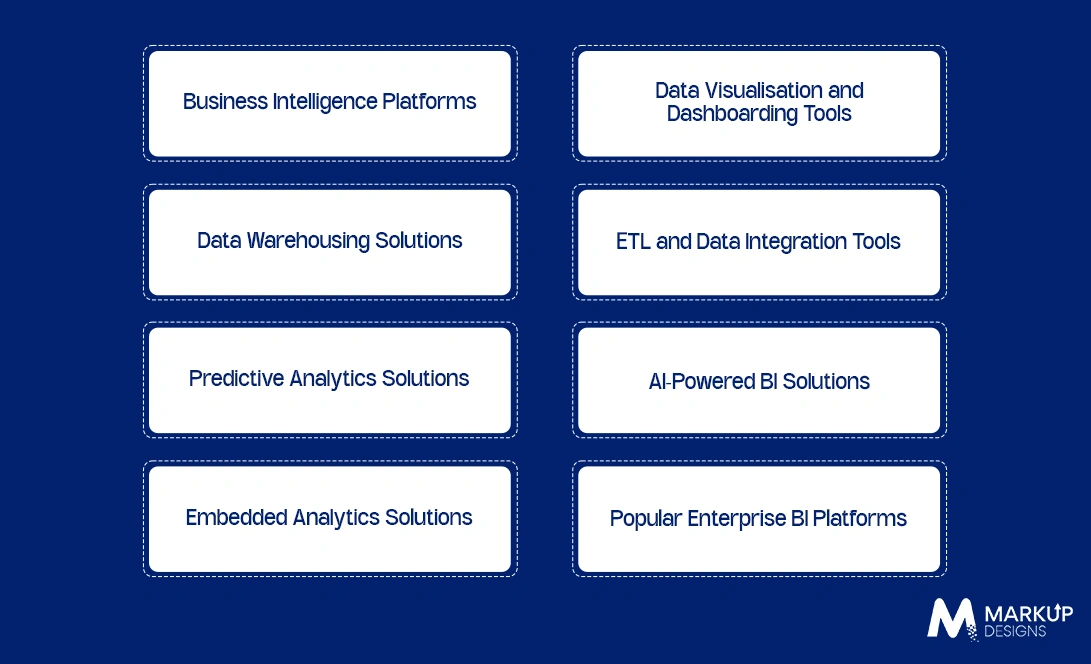
Business intelligence systems combine data management, analytics, and data visualization functionality, allowing organizations to transform data into actionable insights. The choice of an appropriate solution depends on factors such as data volume, available systems, user requirements, security considerations, and scale.
Business Intelligence Platforms
Business intelligence platforms provide an integrated environment for data analysis, report creation, performance monitoring, and sharing insights between different teams. They are the basis of enterprise BI ecosystems.
Data Visualisation and Dashboarding Tools
This kind of software takes big volumes of data and turns it into dashboards, graphs and reports to make business results easier to monitor.
Data Warehousing Solutions
These tools enable the successful integration of different types of data and facilitate the efficient reporting and analysis processes.
ETL and Data Integration Tools
ETL and integration tools connect and prepare data for its analysis in order to ensure that it comes from the same source.
Predictive Analytics Solutions
Predictive analytics involves using data to determine patterns and make predictions about what is going to happen in a business. It can help companies with demand forecasting, behavioral analysis, risk analysis and financial planning.
AI-Powered BI Solutions
BI tools based on artificial intelligence offer new intelligent approaches to business data that make it possible to be analyzed automatically.
Embedded Analytics Solutions
Embedded analytics is a solution that allows introducing dashboards and analytical reports directly into business applications.
Popular Enterprise BI Platforms
Some widely used enterprise BI platforms include:
- Microsoft Power BI: A comprehensive platform for reporting, dashboards, data modelling and analytics.
- Tableau: Known for interactive data visualisation and business dashboards.
- Qlik: Provides analytics and data integration capabilities with an emphasis on associative data exploration.
- Looker: A cloud-based analytics platform that supports governed data modelling and embedded analytics.
- SAP Analytics Cloud: Combines business intelligence, planning and analytics within the SAP ecosystem.
- Oracle Analytics: Provides enterprise analytics, data visualisation and AI-assisted insights.
- IBM Cognos Analytics: Supports enterprise reporting, dashboards, visualisation and AI-assisted analysis.
Key Features of Enterprise Business Intelligence Solutions
A competent business intelligence system must go beyond mere reporting and should enable one to carry out the entire process of accessing, analyzing, understanding, and acting on business data.
Interactive dashboards
Interactive dashboards allow the user to filter and drill down to analyze business data in accordance with certain criteria, department, or period.
Automated reporting
The automated reporting function allows for generating reports automatically on a schedule, thus relieving employees of the necessity to compile data manually, thus avoiding repetitive work and delays in reporting.
Real-Time Data Analytics
Real-time analytics means instant access to data that gets constantly updated so that organizations can keep track of certain operations and be able to respond to the changes quickly.
KPI and Performance tracking
A business intelligence system helps businesses establish, monitor, and compare their KPIs by department to define their shortcomings and achieve their goals.
Self-service analytics
Self-service analytics means giving business users the opportunity to analyze authorized data and generate reports without excessive dependence on technical experts in every analytical request.
Data visualization
Graphs, diagrams, maps and other data visualization forms make it possible to interpret complex data and see trends and connections.
Predictive Analytics
Forecasting abilities refer to the capability of analyzing past patterns and present data to signify what is to come, thus making it easier to project it and make decisions ahead of time.
Natural Language Query
Natural language processing allows people to ask a question in normal language and get responses without creating complex queries when dealing with data.
AI-Assisted Insights
AI enables finding patterns and discovery of changes in data without the user taking specific actions.
Data Alerts and Notifications
Automated notifications pass relevant information about thresholds, changes in KPIs and unusual activity in data.
Role-Based Access Control
This type of access allows employees to view and deal with only the information they are entitled to make use of.
Mobile BI
Mobile BI enables business professionals to use dashboards, reports, and key business indices using their smartphones or tablets.
Collaboration and Sharing
The feature allows individuals or groups to share or use reports with insights for products that belong to a department or any other business.
Data Governance and Auditability
Governance capabilities help organisations maintain data quality, ownership, compliance and usage standards, while audit trails provide visibility into data access and changes.
Benefits of Enterprise Business Intelligence
The significance of enterprise BI lies in its ability to convert fragmented data into useful insights that lead to timely decision-making and excellent operational outputs while enhancing business growth.
Faster and More Accurate Decision Making
BI enables the timely acquisition of relevant data to make sure that decision-makers have access to the necessary information without relying on guesswork.
Single Source of Truth
By aggregating data from different systems, enterprise BI creates coherent data that can be used by any team in the organization.
Improved Operational Efficiency
With the help of BI, businesses can benefit from visibility of their processes, thereby detecting bottlenecks and ensuring maximum productivity.
Better Financial Visibility
Organizations can use this instrument to monitor their revenues, expenditures, and profitability.
Enhanced Customer Insights
BI allows organizations to understand their customers better by analyzing customer behavior and preferences.
Improved Forecasting
BI tools collect both historical data and contemporary information, which can be employed in further trend detection.
Identification of New Business Opportunities
BI systems can provide the organization with information about changes in customer behavior and new trends that will eventually lead to the launch of new products or entering new markets.
Reduced Operational Costs
Greater visibility allows businesses to identify unwarranted costs, inefficient use of resources, and procedures that need enhancement or can be automated.
Improved Risk Management
Businesses are able to identify unusual patterns, performance indicators, and possible risks very early so that necessary preventive measures can be taken.
Automatic reporting and self-service analytics allow time to be saved on data collection and preparation, giving employees the possibility to perform more valuable tasks.
Better Customer Experience
Obtaining information from customer and operational data, enterprises find out about service problems, personalize communication, and promptly respond to requests from customers.
Increased Revenue and Competitive Advantage
Better decision-making, increased efficiency, and better understanding of customers contribute to increasing profits of companies and their ability to react faster as compared to competitors.
Enterprise Business Intelligence Use Cases Across Industries
Enterprise BI can be used in various industries to solve different operational, financial, and customer-related problems.
BI in Banking and Financial Services
Financial organizations apply BI to control transactions, study customers’ behavior, detect fraud, study financial performance, and prepare regulatory reports.
Business Intelligence in Health
Healthcare institutions utilize business intelligence in order to evaluate patient information, keep track of clinical performance, utilize resources, and enhance both operational and patient outcome results.
Business Intelligence in Retail and E-Commerce
Retailers apply the power of business intelligence to check on sales, customer behavior, product performance, and inventory levels and to improve pricing and demand planning.
Business Intelligence in Manufacturing
Manufacturers benefit from business intelligence in manufacturing products in order to track their production process, equipment efficiency, quality, costs, and supply chain activities.
Business Intelligence in Logistics and Supply Chain
Business Intelligence helps to track shipments, levels of inventory, delivery capabilities, and supplier activity, which can assist organizations in preventing delays.
Read Also: Cloud Computing in Logistics: Building Smarter, Faster, and More Resilient Supply Chains
BI in Telecommunications
Telecommunications companies make use of business intelligence technologies in order to monitor their network performance, customer usage, churn, and service operations.
Business Intelligence in Insurance
In the insurance industry, business intelligence is used for claims analysis, risk evaluation, client segmentation, fraud detection, and performance monitoring.
Business Intelligence in Real Estate
Business intelligence technology enables companies in the real estate market to monitor property rates, trends in the market, occupancy rates, and sales performance.
BI in Travel and Hospitality
Hotels, airlines, and travel businesses use BI to analyse bookings, customer preferences, occupancy, pricing, and operational performance to improve revenue and customer experiences.
Enterprise Business Intelligence Use Cases by Business Function
Enterprise business intelligence can be used to enable access to essential data, key performance indicators, and useful findings by different departments.
Sales Analytics
Sales departments can monitor revenue, conversion rates, sales undertakings, and customer acquisitions and find weaknesses in their performance and improve sales systems.
Marketing Analytics
Marketing departments can assess the results of their campaigns, find customer engagement and acquisition costs, and thus improve their resource allocation.
Financial Analytics
Finance departments can track revenues, expenses, profit, cash flow, and financial forecasting to facilitate planning and control.
Client Analytics
Client Analytics provides companies with information about clients’ buying habits, preferences, retention, and satisfaction, thus enhancing interaction with them.
Human Resources Analytics
Human resources departments can study the data about workforce organization, vacancies, employee turnover, attendance, and workforce costs, thus raising the effectiveness of staff management.
Supply Chain Analytics
Supply chain departments can keep an eye on their suppliers, shipments, demand fulfillment, and logistics to eliminate delays in operations.
Inventory Analytics
Inventory analytics makes it possible to understand stock levels, demand behavior, and movements of the products to avoid shortages and excess inventory.
Operations Analytics
Operations teams can analyse productivity, process performance, resource utilisation and operational costs to identify areas for improvement.
Risk and Compliance Analytics
BI helps organisations monitor risk indicators, compliance metrics and unusual activities, enabling earlier identification and management of potential issues.
How to Implement Enterprise Business Intelligence
Implementing business intelligence effectively necessitates a well-structured process that integrates technological concepts and business goals.
Define Business Objectives and BI Requirements
First, identify the business issues that need to be tackled using BI tools, followed by identifying the types of decision-making information necessary for success.
Identify Key Stakeholders and BI Users
Determine who will be using the BI solution, which departments are involved, and the information each will require.
Assess Existing Data Infrastructure
Evaluate the current database system, applications, data quality, integration and legacy systems, to identify the limitations of these technologies.
Define KPIs and Success Metrics
Set proper metrics that can be evaluated in order to determine whether business goals will be achieved through BI.
Identify and Integrate Data Sources
Integrate all necessary data sources and make sure that adequate processes are created for the BI system.
Establish Data Governance
Establish key data quality measures, ownership policies, security conditions, and compliance guidelines beforehand.
Select the Right BI Architecture
Choose an architecture which suits the organization’s data value and security needs.
Choose Proper Enterprise BI Tools
Review BI systems and choose the fastest, most efficient, and secure systems.
Build Data Pipelines and Data Models
Process and organize data with the help of dependable data pipelines and business-oriented data models that allow standard reporting.
Develop Dashboards and Reports
Draft dashboards and reports based upon set business needs while paying attention to the clarity of KPIs and practical information instead of unnecessary visual content.
Run a BI Pilot Project
Begin with either a particular case or a division to test the solution, find problems, and decide what needs to be done next.
Test Data Accuracy and System Performance
Examine whether data follows a specific pattern, calculations work properly, the dashboard reacts promptly, and the system is reliable.
Train Employees and Drive User Adoption
Provide necessary training and support to ensure employees learn how to use BI products and apply insights in their day-to-day work.
Deploy the BI Solution
Utilize the already validated solutions across the organization in a well-structured way to make it less disturbing.
Monitor, Optimise and Scale
Evaluate how well the system works, the extent of adaptation that has occurred, and what the results are, and constantly improve the BI process depending on what the organization needs.
Enterprise BI Implementation Strategy
A long-term strategy ensures that BI remains aligned with business growth instead of becoming another isolated technology project.
Start With High Value Business Use Cases
Prioritise use cases that address important business problems and can demonstrate measurable value early in the implementation.
Build a Centralised Data Strategy
Create a consistent approach for collecting, managing, integrating and accessing data across the organisation.
Establish Data Ownership
Assign clear ownership for datasets and ensure responsible teams maintain data quality, definitions and access standards.
Create a BI Centre of Excellence
A BI Centre of Excellence can establish standards, provide expertise, support users and coordinate BI initiatives across departments.
Follow a Phased Implementation Approach
Implement BI in manageable phases rather than attempting an organisation-wide transformation at once. Each phase can be tested, measured, and improved before expansion.
Measure Adoption and Business Outcomes
Track user adoption, reporting efficiency, decision-making improvements, and financial or operational outcomes to determine whether BI is delivering its intended value.
Continuously Improve the BI Ecosystem
Enterprise BI should evolve with new data sources, business requirements, and technologies. Regular optimisation keeps the architecture useful, scalable and aligned with organisational goals.
Enterprise Business Intelligence Challenges
Enterprise BI implementation can face challenges related to data, technology, cost and user adoption. Poor data quality and fragmented systems can create inconsistent insights, while legacy integrations and complex architectures can increase implementation effort. Organisations also need to address data security, governance, high costs and limited internal BI expertise. User resistance, poorly defined KPIs and inconsistent business metrics can further reduce the value of BI. As data volumes and users grow, enterprises must also ensure the BI environment remains scalable, high-performing and consistent across departments.
Enterprise BI Data Governance and Security
Strong governance and security are essential for ensuring that enterprise data remains accurate, accessible and protected throughout its lifecycle.
Data Quality Management
Organisations should establish processes to identify, correct and continuously monitor data quality issues.
Data Ownership and Stewardship
Clearly assigned data owners and stewards help maintain accountability for the accuracy, availability and appropriate use of business data.
Role-Based Access Control
Role-based permissions ensure employees can access only the information required for their responsibilities.
Data Privacy and Compliance
BI environments should follow applicable privacy regulations and internal policies when collecting, processing, and sharing sensitive data.
Data Lineage
Data lineage tracks where information comes from, how it changes, and where it is used, improving transparency and trust in BI outputs.
Metadata Management
Metadata provides context about datasets, fields, definitions and relationships, making enterprise data easier to understand and manage.
Audit Trails and Monitoring
Audit logs help organisations monitor data access, system activity and changes while supporting security investigations and compliance requirements.
Security Across Cloud and On-Premise BI
Enterprises using hybrid environments need consistent security controls across cloud platforms, on-premises systems, networks, and connected applications.
AI and the Future of Enterprise Business Intelligence
AI is transforming enterprise BI from traditional reporting into a more intelligent decision-making system. Modern BI platforms increasingly use AI for automated insights, natural language analytics, predictive and prescriptive analysis, anomaly detection, and conversational interactions. Generative AI can help users create reports and summarise findings, while real-time intelligence supports faster operational decisions. At the same time, data democratization, cloud native BI, and embedded analytics are making insights accessible across more business functions and workflows. Together, these capabilities are moving enterprise BI towards AI-driven decision intelligence, where organisations can not only understand what happened but also anticipate outcomes and identify appropriate actions.
How to Choose the Right Enterprise Business Intelligence Solution
Choosing the right enterprise BI solution requires evaluating business requirements, data integration, scalability, security, self-service capabilities, reporting and visualisation, AI and advanced analytics, compatibility with existing ERP and CRM systems, total cost of ownership, and vendor support. The ideal platform should not only meet current requirements but also scale with growing data volumes, users, and analytical needs while providing strong governance, ease of use, and reliable implementation support.
Enterprise Business Intelligence Cost
The cost of implementing enterprise business intelligence can range from $30,000 to $500,000 or more, depending on the organisation’s size, data complexity, number of users, integrations, BI platform, and level of customisation. Large enterprises with complex data ecosystems, advanced analytics and AI capabilities can require investments beyond this range.
Factors Affecting Enterprise BI Cost
The main cost drivers include the number of users, data volume, number of systems to integrate, dashboard complexity, security requirements, deployment model, and need for custom analytics or AI capabilities.
BI Software Licensing Costs
BI platform licensing can range from approximately $10 to $150+ per user per month, depending on the platform, plan and enterprise features. Large organisations may also have capacity-based or enterprise licensing models.
Data Infrastructure and Cloud Costs
Cloud storage, data warehouses, computing resources and data processing can cost anywhere from $500 to $10,000+ per month for growing enterprise environments, depending on data volume and workload.
Development and Integration Costs
Custom data pipelines, API integrations, data models and dashboards can account for a significant part of the implementation budget. Development and integration work can typically range from $15,000 to $150,000+, depending on complexity.
Implementation and Consulting Costs
BI strategy, architecture design, migration, implementation and consulting can add approximately $10,000 to $100,000+ to the overall project, particularly for large or multi-system deployments.
Training and Change Management Costs
Training programmes, documentation and user adoption initiatives may add $2,000 to $20,000+, depending on the number of employees and complexity of the BI environment.
Maintenance and Scaling Costs
Ongoing maintenance, cloud infrastructure, support, security updates and platform scaling can account for approximately 15% to 25% of the initial implementation cost annually.
Estimated Enterprise BI Cost by Project Complexity
| Enterprise BI Project | Indicative Cost |
| Basic BI implementation | $30,000 to $75,000 |
| Mid-scale enterprise BI | $75,000 to $200,000 |
| Advanced BI with multiple integrations | $200,000 to $350,000 |
| Large scale BI with AI and advanced analytics | $350,000 to $500,000+ |
These figures are indicative rather than fixed pricing. A business with a few data sources and standard dashboards will have a very different budget from an enterprise integrating ERP, CRM, finance, HR, IoT and legacy systems into a governed BI ecosystem.
How to Calculate Enterprise BI ROI
Enterprise BI ROI should be measured against tangible business outcomes rather than the number of dashboards created. Organisations can consider savings from automated reporting, reduced manual analysis, improved resource utilisation, lower operational costs, faster decision-making, and additional revenue generated through better customer and market insights.
A simple formula is:
BI ROI = (Financial Benefits from BI − Total BI Investment) ÷ Total BI Investment × 100
For example, if an organisation invests $150,000 in a BI implementation and generates $225,000 in measurable benefits during the evaluation period, its ROI would be 50%.
Best Practices for Successful Enterprise BI Implementation
A successful enterprise BI implementation depends on more than selecting the right platform. Organisations need to align technology, data, people and processes to ensure BI delivers measurable business value.
Align BI With Business Goals
BI initiatives should begin with clear business objectives. Every dashboard, report and analytics capability should support a specific decision, process or measurable business outcome.
Prioritise Data Quality
Reliable insights depend on reliable data. Establish processes for identifying duplicates, missing information, outdated records and inconsistencies before data reaches BI dashboards.
Keep the Architecture Scalable
Design the BI environment to accommodate increasing data volumes, users and analytical workloads. A scalable architecture prevents expensive redesigns as the organisation grows.
Build Security Into the Architecture
Security should be considered from the beginning through encryption, access controls, authentication, and appropriate data permissions rather than being added after implementation.
Design for Self-Service
Give business users access to trusted datasets and intuitive analytics tools so they can answer routine questions independently while maintaining central governance.
Focus on User Experience
Dashboards should be simple, relevant, and easy to navigate. Users should be able to understand key information quickly without working through unnecessary complexity.
Avoid Dashboard Overload
More dashboards do not necessarily mean better BI. Focus on essential KPIs and actionable information to prevent users from being overwhelmed by excessive reports.
Establish Clear KPIs
Define KPIs that directly reflect business objectives and ensure that their calculations and definitions remain consistent across departments.
Monitor BI Performance and Adoption
Track dashboard usage, query performance, user adoption, and business outcomes to identify areas where the BI environment needs improvement.
Continuously Improve Data and Analytics Capabilities
Enterprise BI should evolve with changing business requirements. Regularly review data sources, analytics capabilities, technology, and user feedback to keep the BI ecosystem effective.
Read Also: Is Your Business Ready for AI Adoption? AI Readiness Assessment Guide
Real-World Enterprise Business Intelligence Examples
Leading organisations use BI and analytics to address specific operational and customer challenges. Their examples demonstrate how data can move from fragmented information to measurable business outcomes.
Walmart
Business problem: Managing millions of products, transactions, stores and customer interactions creates a complex data environment.
BI application: Walmart uses large-scale data analytics and BI capabilities to monitor sales, inventory, customer behaviour, and store performance.
Data and analytics approach: Data from transactions, inventory systems, and other operational sources is analysed to identify purchasing patterns, demand, and operational trends.
Business outcome: These insights support inventory planning, merchandising, supply chain optimisation and more informed business decisions.
Amazon
Business problem: Amazon needs to manage enormous volumes of customer activity, product information, transactions and fulfilment data.
BI application: Data analytics supports areas including customer behaviour, sales performance, inventory and supply chain operations.
Data and analytics approach: Customer interactions, purchase history, product data and operational information are analysed to identify patterns and improve decision-making.
Business outcome: Analytics contributes to personalised recommendations, demand forecasting, inventory management and operational efficiency.
Starbucks
Business problem: Starbucks needs to understand customer preferences while managing thousands of locations and a large product portfolio.
BI application: Data analytics is used to understand purchasing behaviour, store performance, and customer engagement.
Data and analytics approach: Transaction and customer data can be analysed to identify purchasing patterns, preferences, and opportunities for personalised engagement.
Business outcome: These insights support targeted marketing, product decisions, customer engagement and store-level performance.
Uber
Business problem: Uber operates a highly dynamic marketplace where demand, driver availability, location and pricing change continuously.
BI application: Analytics supports demand forecasting, marketplace monitoring, trip performance and operational decision-making.
Data and analytics approach: Data from trips, locations, demand patterns, driver activity, and customer interactions is analysed in near real time.
Business outcome: Data-driven insights help improve driver allocation, service availability, pricing decisions, and overall operational efficiency.
Coca Cola
Business problem: Coca-Cola manages a global network of products, markets, customers, and distribution channels, generating large amounts of commercial data.
BI application: Analytics supports sales performance, marketing, customer insights and supply chain decision-making.
Data and analytics approach: Sales, market, and customer data can be analysed to understand product performance, demand patterns and market behaviour.
Business outcome: These insights help improve marketing effectiveness, sales planning, distribution, and market-level decision-making.
Netflix
Business problem: Netflix needs to understand what viewers watch, when they watch it, and what content they are likely to engage with.
BI application: Analytics plays a central role in understanding viewing behaviour and content performance.
Data and analytics approach: Viewing activity, search behaviour, engagement patterns and content interactions are analysed to identify audience preferences.
Business outcome: These insights support content recommendations, user personalisation, and content investment decisions, helping create a more relevant viewing experience.
How Can Markup Designs Help With Enterprise Business Intelligence?
Markup Designs helps enterprises build scalable business intelligence ecosystems that connect data, analytics, and decision-making. Our end-to-end services cover BI consulting and strategy, data integration and engineering, dashboard and reporting development, AI-powered analytics, cloud BI implementation, system integration, data governance and security, BI modernisation and migration, and ongoing support and optimisation, enabling businesses to turn fragmented data into reliable insights and measurable business value.
Turn Enterprise Data Into Actionable Business Intelligence
Build a scalable BI ecosystem that connects your data, delivers meaningful insights, and supports smarter business decisions.

Conclusion
Enterprise BI is no longer limited to creating reports and dashboards. It brings together data, analytics, technology, and people to help organisations make faster and more informed decisions. A successful BI environment requires reliable data, scalable architecture, strong governance, user adoption, and increasingly AI-driven capabilities. For enterprises looking to turn fragmented business data into measurable insights, the right BI strategy can become a long-term foundation for efficiency, innovation and growth.
FAQs
1. What is enterprise business intelligence?
Enterprise Business Intelligence is the use of technologies, processes and analytics platforms to collect, integrate and analyse data across an organisation, helping teams make informed business decisions.
2. How does enterprise BI differ from traditional BI?
Traditional BI often focuses on departmental reporting, while enterprise BI connects data and analytics across the organisation to support strategic, operational, and real-time decision-making.
3. What are the benefits of enterprise business intelligence?
Enterprise BI can improve decision-making, operational efficiency, financial visibility, forecasting, customer insights, risk management, and overall business performance.
4. What are the main components of an enterprise BI architecture?
Key components include data sources, integration pipelines, data warehouses or lakes, data models, analytics platforms, dashboards, governance, and security controls.
5. What are the most popular enterprise BI tools?
Popular enterprise BI platforms include Microsoft Power BI, Tableau, Qlik, Looker, SAP Analytics Cloud, Oracle Analytics and IBM Cognos Analytics.
Author's Perspective
Enterprise BI should not be treated as another reporting tool or technology upgrade. Its real value lies in creating a reliable connection between business data and business decisions. Organisations that invest in strong data foundations, clear KPIs, scalable architecture and user adoption are better positioned to gain lasting value from their BI initiatives. As AI continues to reshape analytics, enterprises should also focus on building BI environments that can evolve with emerging technologies rather than solving only today’s reporting requirements.
Discuss Your Project NowJupinder Singh Arora
Founder and CEO
Related Posts

How AI is Revolutionising Industrial Automation in Australia

How UK Enterprises Can Build an Effective AI...

AI Voice Agent for Real Estate: Features, Benefits,...
Insights Are Valuable & Execution is Priceless
You’ve read about the digital future. Now, let’s build the infrastructure to take you there. Move your strategy from the page to the product.
Design Your Solution Now
Contact Us
Schedule The Appointment At Your Convenience Date And Time.
30 Min
Web Conference
Time Zone
Indian standard time (08:30pm)

Thanks For Getting In Touch!
You’ve Taken The First Step Toward Transforming Your Digital Presence. Our Experts Will Reach Out Shortly To Take It Forward.
Launch Your Dream Project
Provide a brief overview of your project, and our specialists will evaluate your requirements. We will connect with you to explore how the right digital solutions can help you launch faster.