
In Brief
- The use of AI in logistics is transforming the transportation and logistics industry of Australia as it enables companies to automate their operations, improve their routes, make demand predictions and decisions with the help of data analytics.
- Australian logistics companies are using AI technologies to solve problems of long transportation distances, high costs, lack of manpower, delivery needs, and supply chain interruptions.
- Some of the AI technologies that can be useful for Australian companies are predictive maintenance, fleet management, warehouse automation, demand prediction, and last-mile delivery optimization.
- There is a need for proper deployment of AI logistics solutions, and there are some steps involved, which are the need for identification, data infrastructure preparation, system integration, solution testing, and optimization.
- These AI logistics solutions can be applied by Australian companies in creating smarter, robust, and sustainable supply chains for the future of intelligent transportation and automation.
The Australian logistics industry is the main engine driving the entire Australian economy and connects manufacturers, suppliers, retailers, and customers over long distances. Increased costs of transportation, complicated logistics operations, lack of labor resources, customer expectations, and any type of disruptions are compelling logistics firms to reconsider their strategies.
This is where the use of logistics software development in Australia becomes critically important, enabling AI-powered solutions to analyze large volumes of logistics data, forecast demand, optimize delivery routes, monitor fleet operations, automate warehouses, and identify potential supply chain disruptions.
However, AI-based solutions for the logistics industry in Australia are not just meant for the automation of logistics operations. The use of such solutions becomes a tool for the creation of efficient, fast, and flexible transportation and logistics chains. Owners of fleets of vehicles, freight transport companies, warehouses, and eCommerce companies could apply AI technologies in order to reduce costs and improve efficiency.
In this blog post, you will get familiar with the way how AI logistics revolutionizes the logistics industry in Australia, its applications, advantages, deployment, costs of development, challenges, and what should be done by businesses in preparation for the age of AI logistics.
What is AI-Powered Logistics?
AI logistics technology is a term for the application of artificial intelligence technology to automate, predict, analyze, and optimize logistics operations. This includes using AI with transportation data, GPS, IoT data, warehouse data, fleet management data, and other supply chain data to help make better and faster decisions.
Unlike conventional logistics technology, where most decisions depend on predetermined schedules and historical data, AI logistics uses AI to analyze historical and real-time data and make decisions.
Key technologies used in AI for logistics are:
- Machine Learning: Predicting demand, delivery time, maintenance, and risk.
- Predictive Analytics: Enabling companies to predict delays, disruptions, and inventory needs.
- Computer Vision: Assisting in monitoring the warehouse, package identification, sorting, and checking.
- Generative AI: Helping teams in answering logistics questions, preparing reports, planning, and decision-making.
- AI Automation: Automated work processes in transportation, warehouses, inventory, and customer services.
This combination of technology enables the AI system to help logistics companies move away from a reactive approach towards a more proactive and predictive one, thus making the transportation process more efficient.
Why Australian Logistics Companies Are Investing in AI
Australia’s vast geography, long transport distances, increase in eCommerce, and complexity of supply chain management in the country have made it difficult for logistics companies to cope with the situation. AI can help efficiently resolve the issues.
Key factors driving AI adoption include:
- Large Geographical Distances: AI can plan efficient routes and schedules within Australia’s vast network of roads and freight corridors.
- Increasing Transport Costs: Route, fuel, and fleet management can assist in controlling business costs.
- Workforce Problems: AI can automate routine tasks and help logistics teams make quicker decisions.
- Increased Delivery Demands: Predicted ETAs and smarter scheduling can help businesses deliver their products faster.
- Disrupted Supply Chain: AI will be able to forecast disruptions and demand in advance.
- Difficulties with Stock Management: AI can forecast demand to ensure appropriate stock levels and prevent over/understocking of products.
- Need for Real-Time Visibility: AI can provide a combination of information on fleets, warehouses, GPS, and other systems.
- Sustainability Goals: Smarter routing and better fleet management can help reduce fuel costs and decrease companies’ carbon footprint.
Key Applications of AI in Australian Logistics
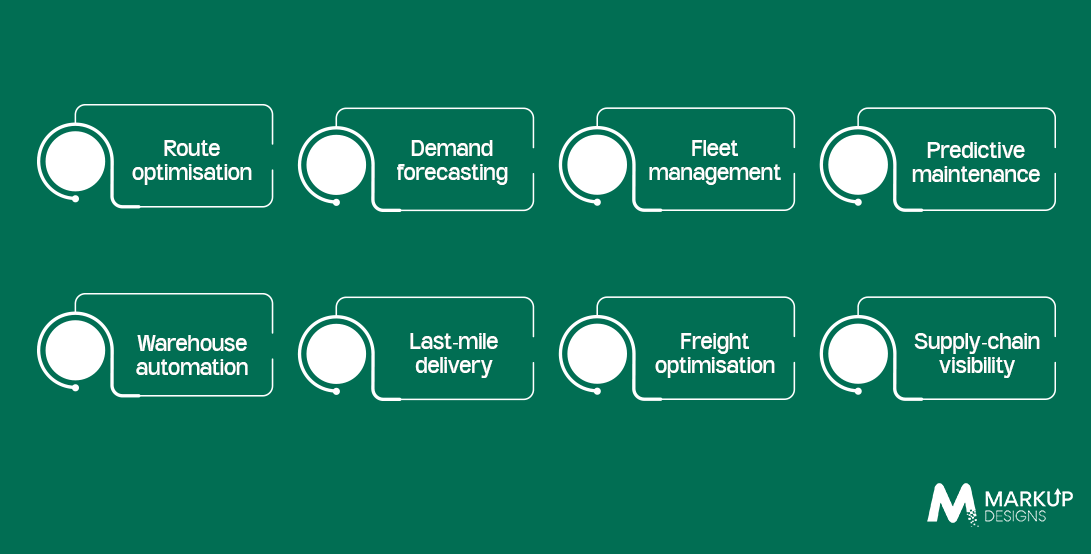
The use of AI technology can be seen in various logistics processes, including transportation, warehousing, inventory management, and customer services. AI has enabled automation of business functions and improved forecasting for quicker decision-making among Australian companies.
Route Optimisation:
The AI looks at various things like traffic, distance, delivery time, weather conditions, and others to determine routes to save time.
Demand Forecasting:
The AI uses machine learning to analyze historical sales and market information and make predictions about future demand.
Fleet Management:
AI monitors performance, use of the vehicle, fuel consumption and behavior of the driver.
Predictive Maintenance:
Using the patterns in operations, the AI is able to predict failures in vehicles and equipment and arrange maintenance ahead of schedule.
Warehouse Automation:
AI is capable of providing assistance with inventory management, order picking, sorting and handling packages, and optimization of work processes in the warehouse.
Last-Mile Delivery:
AI is used to optimize delivery schedules, forecast delivery times, manage orders, and adjust to changing delivery conditions.
Freight Optimisation:
AI uses the analysis of shipment size, vehicle capacity, and delivery routes and schedules to optimize the freight planning process.
Supply Chain Visibility:
AI is used to aggregate information from various logistics systems to see delays, problems, and other issues in the supply chain.
Read Also: How to Build an AI-Powered Mobile App in Australia
How AI is Transforming Transportation in Australia
Transportation is one of the major sectors where artificial intelligence is revolutionizing logistics operations. Businesses in Australia can leverage logistics software development in Australia to build AI-powered solutions that analyze transportation data, optimize routes, monitor fleet performance, and support faster, more informed decisions on transport issues in real time.
- Optimized Route Planning: Artificial Intelligence examines factors such as traffic conditions, road quality, delivery addresses, and delivery windows to offer an optimized route plan.
- Predictive Fleet Maintenance: AI looks into vehicle performance to detect any signs that there might be problems with the vehicle in the future.
- Effective Fleet Management: Using intelligent tools, companies can assign vehicles to shipments depending on the capacity of the vehicles.
- Accurate Delivery Predictions: Artificial Intelligence considers various factors to determine delivery times more accurately.
- Fuel Efficiency: Optimizing routing, reducing idle time, and improving vehicle utilization can assist in reducing fuel use for logistics companies.
- Efficient Driver Management: Using AI to analyze driver performance and operational activities may aid in creating safer and more efficient fleets.
- Real-Time Transportation Decisions: AI technologies can be used to make decisions based on changing traffic, delays, weather, and any other unexpected events.
- Reduced Transportation Costs: With proper routing, maintenance, fuel economy, and vehicle utilization, AI can help organizations save on costs associated with transportation.
Ready to build a smarter, faster, and more efficient logistics ecosystem?
Partner with an experienced AI development company to implement intelligent solutions that optimise transportation, automate workflows, and improve supply-chain performance.

How AI is Transforming Supply Chains in Australia
The increasing complexity of the supply chain can be attributed to changes in customer expectations, global disruptions, inventory problems, and higher operational expectations. Artificial intelligence is assisting Australian companies in developing highly connected and predictable supply chain systems.
- Real-Time Supply Chain Visibility: The AI links information from the suppliers, the warehouses, the logistics systems, and the inventory management system to ensure complete visibility of operations.
- Intelligent Demand Forecasting: The AI analyzes market trends, historical data, and consumer behavior patterns to forecast demand.
- Optimized Inventory Management: The AI enables companies to have proper inventory through reduced surplus and shortage.
- Supply Chain Risks Management: AI will be able to track the performance of the supplier and any changes that occur in the market in order to help in making proactive decisions.
- Automated Procurement Process: Automated processes for analysing purchasing trends, supplier recommendations, and automation of repetitive procurement processes.
- Warehousing and Distribution: AI will optimize the warehouse process through automation of tracking, sorting, storage and managing workflows.
- Disruption Prediction: AI is able to identify disruptions in the supply chain such as delays and transportation issues.
- Data-Driven Decision Making: AI provides actionable insights that help logistics managers make faster and more accurate supply-chain decisions.
Read Also: Why Supply Chain Digital Transformation Is a Competitive Advantage in 2026
Benefits of AI-Powered Logistics for Australian Businesses
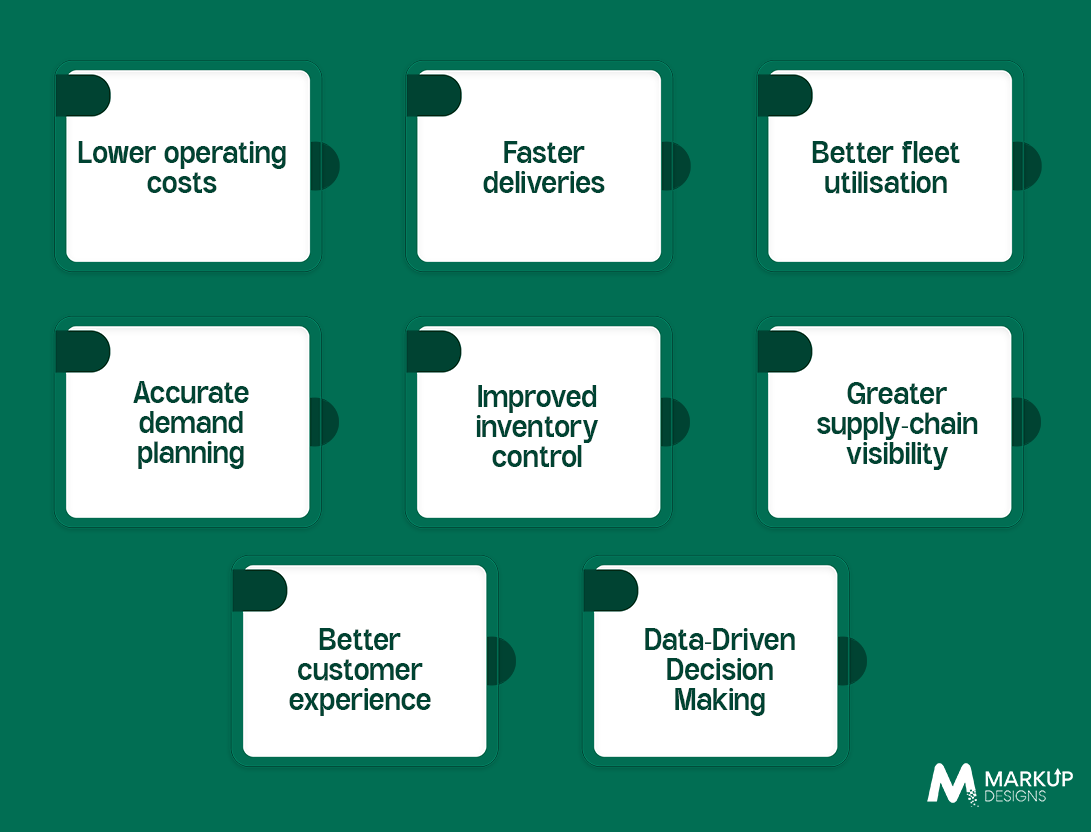
AI-powered logistics helps businesses in Australia increase efficiency, reduce costs, and build reliable transport and supply chain operations. With AI development services in Australia, businesses can leverage AI analytics and automation technologies to make better decisions, streamline operations, and deliver better customer experiences.
Lower operating costs
Through AI, the logistics companies will be able to optimize routes, fuel consumption, fleet, and warehousing activities with minimal cost of doing so.
Faster deliveries
AI-enabled scheduling and route optimization can enable business organizations to deliver orders faster and more accurately.
Better fleet utilisation
It enables monitoring of fleet performance, optimization of fleets, and minimizing downtime through predictive maintenance.
Accurate demand planning
The logistics firms will be able to predict the demand trend from customer and market data analysis.
Greater supply-chain visibility
Real-time visibility is provided on shipment status, inventory levels, suppliers, and logistics operations.
Improved inventory control
Sorting, tracking, inventory management, and warehousing processes become more efficient.
Better customer experience
Enhanced accuracy of deliveries, faster and more accurate fulfillment of orders, and improved service management will ensure high customer satisfaction.
Data-Driven Decision Making
AI provides valuable insights that help logistics leaders make faster and more informed business decisions.
Challenges of Implementing AI in Australian Logistics
While AI offers numerous benefits for logistics companies, successful implementation requires careful planning, strong infrastructure, and effective change management strategies. Partnering with a reliable software development company in Australia can help businesses address these challenges and build AI-driven logistics solutions that align with their operational needs.
- High Initial Investment: The development and implementation of AI-driven logistics solutions may involve considerable capital investment.
- Good Quality and Reliable Data: Availability of accurate data is key for AI systems to function well in their operation.
- Integration with Existing Systems: It might be difficult to integrate AI solutions with existing logistics software, ERP, WMS, and transportation systems.
- Cybersecurity Issues: Companies should ensure the safety of their data from possible cybersecurity threats.
- Lack of AI Expertise: Businesses may struggle to find professionals skilled in AI development and logistics technology.
- Employee Adoption: It may be difficult for employees to get used to AI-driven systems.
- Scaling Difficulties: AI systems should be created in such a way that they could cope with scaling and growth.
- Regulatory Issues: Businesses need to comply with Australia’s privacy laws and responsible use of AI practices.
How to Implement AI in Logistics: Step-by-Step Process
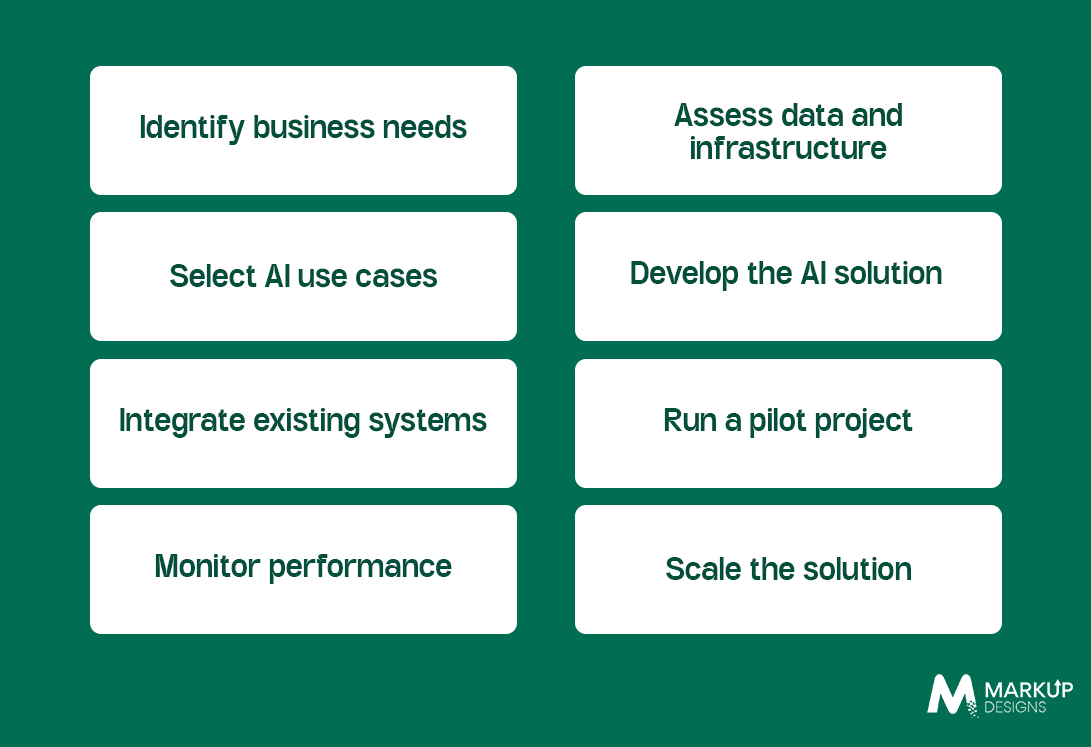
The use of AI in logistics demands a strategic plan that ensures a proper integration of the technology into the business needs of the organization. A good plan for AI implementation will enable an organization to maximize its efficiency.
Identify business needs
Begin by analyzing current logistics operations, operational limitations, and potential opportunities where AI can add significant value.
Assess data and infrastructure
Examine your company’s existing data sources and technology infrastructure to see how ready you are for AI.
Select AI use cases
Select the most relevant AI applications, such as route optimization, demand forecasting, predictive maintenance, or warehouse automation, with the support of AI development services in Australia.
Develop the AI solution
Create the required AI models, platforms for analytics, and automation tools that are capable of supporting logistics operations.
Integrate existing systems
Integrate AI solutions with ERP systems, warehouse management systems, transport management systems, IoT devices, and any other business systems.
Run a pilot project
Initiate a pilot project to test AI capabilities, track performance, and improve the solution if necessary.
Monitor performance
Monitor metrics, such as delivery time, cost, fuel consumption, and accuracy to improve the performance of the solution.
Scale the solution
Scale AI solutions across your transportation and supply chain network operations.
AI-Powered Logistics Development Cost in Australia
The cost of developing AI logistics software in Australia depends on several elements, such as business needs, solution complexity, AI technologies used, integration, and scalability. While a simple AI solution for route optimization can be cheaper than an advanced enterprise-wide solution that employs predictive analytics, automation, IoT, and real-time tracking.
Factors Affecting AI Logistics Development Cost
- Type of AI Solution: The cost depends on whether organizations will use AI for route optimization, fleet management, warehouse automation, or full-fledged AI logistics solutions.
- Complexity of AI Model: Complex machine learning algorithms, AI predictions, and automation take more time to develop.
- Data Infrastructure: The data gathering, processing, managing, and storage play a role in total costs.
- Integrations: The integration of AI-based software into ERP, CRM, TMS, WMS, GPS, IoT sensors, and other software complicates development and increases the cost of project development.
- Technology Stack: Cloud technologies, AI-based software, databases, and security solutions impact total costs of project development.
- Experience of Development Team: The experience of AI developers, data scientists, and logistics specialists impacts total costs.
- Model maintenance & scaling: The ongoing model improvements and updates require additional investments.
Estimated AI Logistics Development Cost
| AI Logistics Solution Type | Estimated Cost Range | Development Timeline |
| Basic AI Logistics Solution | $30,000 – $80,000 | 3–5 months |
| Medium-Level AI Logistics Platform | $80,000 – $200,000 | 6–9 months |
| Advanced Enterprise AI Logistics System | $200,000+ | 9–18+ months |
Businesses should evaluate AI development costs based on their operational goals, expected ROI, and long-term scalability requirements rather than focusing only on initial investment.
Why Choose Markup Designs for AI-Powered Logistics Solutions?
Markup Designs is a software development company in Australia that helps organizations build AI-powered logistics solutions to improve the efficiency of their logistics management processes. With experience in machine learning, advanced analytics, automation, and intelligent data processing, we develop solutions for fleet optimization, demand forecasting, warehouse automation, and supply chain intelligence.
We provide a complete service package comprising AI consulting, AI design, implementation, integration, and deployment so that we make sure that there is seamless integration of the logistics management system with ERP, WMS, TMS, IoT, and GPS solutions. We intend to create secure and scalable solutions through AI that can save costs for logistics organizations.
Build Smarter Logistics Operations with AI
Transform your transportation and supply-chain processes with intelligent AI solutions designed for modern logistics challenges. Partner with Markup Designs to develop scalable AI-powered systems that improve efficiency, automation, and business performance.

Conclusion
AI-based logistics is transforming the transportation and logistics industry in Australia through route optimization, predictive maintenance, demand forecasting, and visibility. By using AI-based solutions, companies will be able to reduce costs, enhance efficiency, and make better decisions. However, the effectiveness of AI depends on having a sound strategy, good data, scalable technology, and the help of a competent partner. Given the growing complexities in logistics operations, AI will help Australian companies become more efficient, sustainable, and resilient in their logistics operations. Investments in AI-based logistics will help companies prepare for the future of intelligent logistics and transportation.
FAQs
1. How is AI transforming logistics in Australia?
AI changes logistics in Australia through enhanced route optimisation, fleet management, forecasting, automation of warehouses, and supply chain transparency. It allows companies to cut down expenses and make faster decisions.
2. What are the common applications of AI in logistics?
AI in logistics is commonly used for predictive maintenance, intelligent routing, demand forecasting, optimization of freight transportation, automation of warehouses, last-mile delivery management, and supply chain tracking.
3. What is the cost of building an AI-based logistics application in Australia?
The cost of building an AI logistics system depends on a number of different elements, including the complexity of the solution, the AI model to be used, integrations, and the cost of infrastructure. Basic AI logistics systems will cost less than advanced AI platforms for enterprises.
4. How can AI enhance transport efficiency?
AI enhances transport efficiency through the analysis of traffic data, the optimization of routes, forecasting of maintenance problems, optimizing fuel use, and managing business fleets more effectively.
5. Can AI reduce logistics costs?
Yes, AI can lower logistics costs through the optimization of routes, vehicle usage, fuel use, avoiding failures, and automation of manual work.
Author's Perspective
In the future, logistics in Australia will become smarter, more connected and automated using AI. With AI helping to optimize routes, improve inventory management, automate workflows and increase visibility, organizations will be able to deal with the complexities associated with their transportation and supply chain processes. Despite the fact that the adoption of AI is increasing outside of large corporations, success will depend on picking the correct use cases, having good data infrastructure, and aligning the solution with business goals.
Discuss Your Project NowJupinder Singh Arora
Founder and CEO
Related Posts

How Artificial Intelligence Is Changing Mobile Game Development
How to Build Production-Ready Applications with AI Coding...

Cost, Benefits & Business Impact: Generative AI vs....
Insights Are Valuable & Execution is Priceless
You’ve read about the digital future. Now, let’s build the infrastructure to take you there. Move your strategy from the page to the product.
Design Your Solution Now
Contact Us
Schedule The Appointment At Your Convenience Date And Time.
30 Min
Web Conference
Time Zone
Indian standard time (08:30pm)

Thanks For Getting In Touch!
You’ve Taken The First Step Toward Transforming Your Digital Presence. Our Experts Will Reach Out Shortly To Take It Forward.
Launch Your Dream Project
Provide a brief overview of your project, and our specialists will evaluate your requirements. We will connect with you to explore how the right digital solutions can help you launch faster.