
In Brief
- AI chatbots are helping Australian businesses automate customer support, improve customer engagement, reduce operational costs, and deliver personalized experiences using technologies like NLP, machine learning, and generative AI.
- Choosing the right chatbot type, essential features, and technology stack is crucial for building a scalable solution that integrates seamlessly with existing business systems and supports long-term growth.
- A successful AI chatbot development process includes defining business goals, identifying use cases, selecting the right AI model, designing conversation flows, developing integrations, and continuously optimizing performance after deployment.
- The cost and development timeline depend on factors such as chatbot complexity, AI capabilities, custom features, third-party integrations, security requirements, and ongoing maintenance, making proper planning essential before development begins.
- By partnering with an experienced AI chatbot development company, businesses can build secure, compliant, and future-ready chatbot solutions that enhance operational efficiency, improve customer experiences, and support sustainable business growth.
Artificial intelligence is rapidly changing how businesses communicate with customers, and AI chatbots are leading this transformation. From answering customer questions and qualifying leads to automating support and streamlining business operations, AI-powered chatbots are helping organizations deliver faster, smarter, and more personalized experiences.
Across Australia, businesses in industries such as retail, healthcare, banking, education, and logistics are increasingly investing in AI chatbot development in Australia to improve customer engagement while reducing operational costs.
Unlike traditional chatbots that rely on predefined scripts, modern AI chatbots use technologies such as natural language processing (NLP) and generative AI to understand user intent, provide contextual responses, and continuously improve over time. Whether you’re a startup looking to automate customer support or an enterprise planning a large-scale AI deployment, building the right chatbot requires careful planning, the right technology, and a clear understanding of costs.
In this blog, you’ll learn how to build an AI chatbot, explore its essential features, understand the development process, discover the technology stack involved, and estimate the cost of building an AI chatbot in Australia.
What is an AI Chatbot and How Does It Work?
An AI chatbot is a kind of software program equipped with AI, which enables it to understand, analyze, and respond to human communication in a very natural way. In contrast to traditional bots that respond based on predefined rules and scripts, AI chatbots analyze users’ intention, learn during the process of interaction, and give relevant replies even if they are asked in another way.
Today’s AI chatbots use technologies like NLP, machine learning, and large language models (LLMs) to understand the context, generate human-like responses, and automate the conversation process. In addition, modern AI chatbots can be integrated with various systems such as CRM, ERP, knowledge base, and customer support systems in order to give necessary information.
The mechanism of work of the AI chatbot is quite simple: a user asks something, the bot analyzes the intention, fetches the relevant data either from its trained data or any of the integrated systems, and responds accordingly while learning during the interaction process. The result is the ability of AI chatbots to be used in different areas of business.
Why Do Australian Businesses Need AI Chatbots?
As the demands of the customers keep changing, the Australian companies find it increasingly challenging to offer fast, effective and personalized services. However, escalating costs of running their businesses along with the increased use of technology have compelled these organizations to adopt automation. The role of AI chatbots in fulfilling these demands is significant since these assist in enhancing the customer experience, automating the processes of customer support and becoming more efficient
Rising Need for 24/7 Customer Support
The customers require immediate assistance irrespective of the operating time of the organization. With the help of the AI chatbots, the companies can offer support to the customers anytime as they will answer their queries and resolve their problems.
Escalating Customer Service Expenses
Employing a customer support team involves expenses as well. AI chatbots help in cutting down the costs incurred by the companies due to automation of the tasks.
Increasing Use of AI Solutions in Various Sectors of Australia
Businesses in the health care industry, banking sector, e-commerce businesses and even in education in Australia are using AI solutions to boost their productivity and enhance customer experience. The introduction of AI chatbots in such companies plays a vital role in the process of transforming their business into a digital one.
Need for Faster and More Personalised Customer Experiences
The current customers require fast and relevant responses from the companies. Chatbots powered by AI are capable of understanding customer intent, keeping a record of past interactions and offering personalized recommendations.
Managing High Volumes of Customer Enquiries
With the growth in the volume of customers, it is difficult for organizations to handle thousands of customer queries. This is where AI chatbots play a significant role.
Key Benefits of AI Chatbots for Australian Businesses
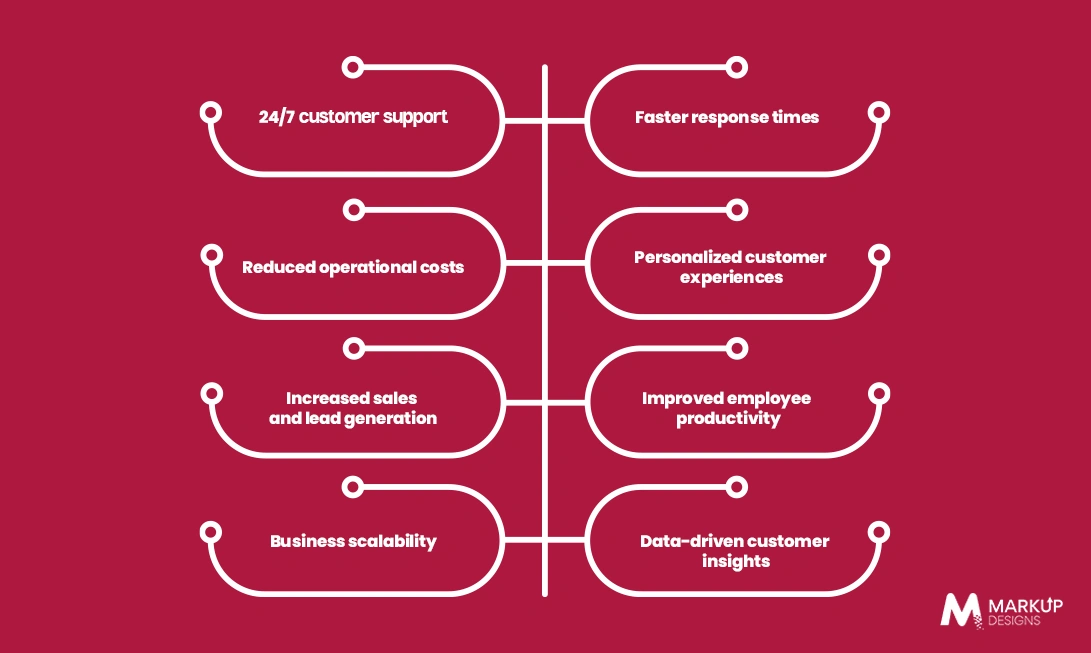
In addition to providing automated responses, chatbots powered by AI bring many benefits to companies. Such chatbots help companies make their customers happier, enhance operational efficiency, and ensure sustainable growth. Regardless of whether your company is a small startup or an established organization, AI-powered chatbots can add business value.
24/7 customer support
Since AI chatbots work continuously, they provide round-the-clock support to customers regardless of whether it is business time. This increases customer satisfaction.
Faster response times
While most customer inquiries require some time to be answered because of queueing, chatbots powered by AI answer the questions right away.
Reduced operational costs
The implementation of chatbots allows reducing support expenses by performing routine actions automatically.
Personalized customer experiences
AI-based chatbots learn about customer preferences and history to offer customized advice and product suggestions to boost engagement.
Increased sales and lead generation
AI chatbots can qualify leads, suggest products, set up appointments, and take customers through the purchasing process to generate business sales and revenues.
Improved employee productivity
AI-based chatbots can assist employees in getting answers to their queries and fetching business details, which allows employees to be more productive.
Business scalability
When there is an increase in customer demand, AI-based chatbots can have thousands of simultaneous conversations without the need for any extra support staff.
Data-driven customer insights
Each interaction with customers offers businesses valuable insights. Through chatbot analytics, organizations can learn customer behaviors and make decisions for improvement in products and services.
Types of AI Chatbots Businesses Can Build
Since each business requires something different, there are different types of AI chatbots. Selecting the most appropriate chatbot is determined by the type of business you have in mind.
Customer Service AI Chatbots
These chatbots reply to commonly asked questions, solve customer support problems, handle support requests, and ensure high levels of customer satisfaction.
Sales and Lead Generation Chatbots
These chatbots interact with website visitors and gather customer data for future sales meetings. They qualify leads and recommend certain products and services to website visitors.
E-commerce Shopping Assistants
Such chatbots help website users find products or services they want to purchase online and make the shopping experience better.
Chatbots for HR Department
The internal chatbot is used by businesses to help their employees gain information about HR policies, leave applications, onboarding, IT support, and any other workplace-related questions.
AI-Knowledge Base Assistant
These chatbots search internal documents and business knowledge bases to deliver accurate answers for customers or employees without requiring manual searches.
Voice-Powered AI Assistant
They are powered by speech recognition technology and provide hands-free communication via mobile applications, websites, smart devices, and customer service channels.
Industry-Based AI Chatbots
Customizable AI chatbots may be created for specific industries including health care, banking, education, logistics, insurance, and real estate sectors.
Must-Have Features of an AI Chatbot
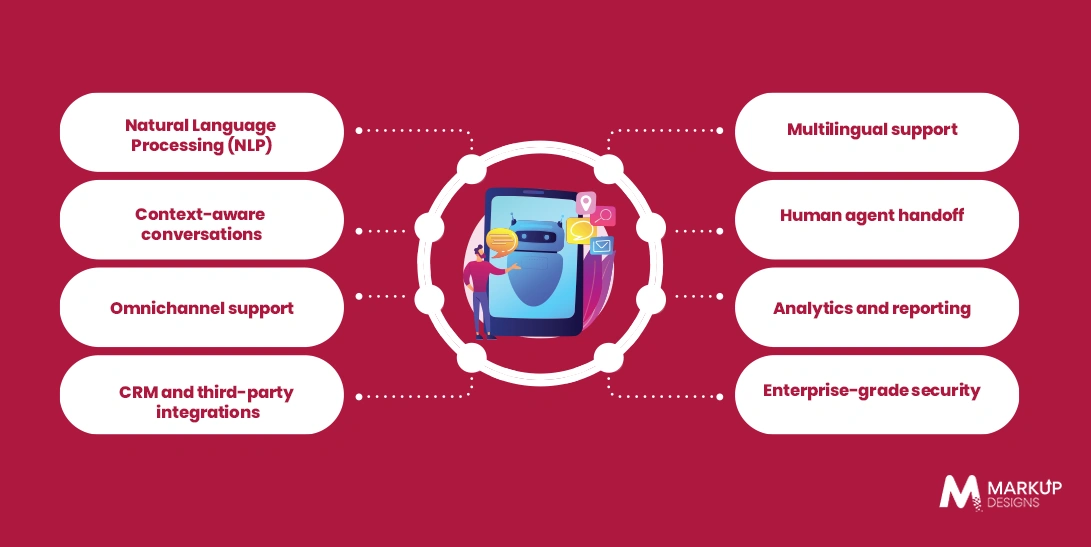
The functionality of an AI-based chatbot is critical for its effectiveness. A good chatbot must ensure that users receive accurate answers, get connected with the company’s existing systems, and enjoy a smooth experience overall.
Natural Language Processing (NLP)
With NLP, chatbots are able to comprehend the user’s intent, analyze natural language, and generate relevant responses without being restricted by a predefined set of keywords.
Context-aware conversations
In contrast to earlier chatbots, today’s AI-based ones take into account the message history during the conversation and use it to generate more meaningful replies.
Omnichannel support
Users can contact companies using websites, mobile applications, social networks, messengers, emails, and other channels. Chatbot functionality should support all these channels.
CRM and third-party integrations
Connecting the chatbot with CRM systems, ERP platforms, payment gateways, calendars, and other business applications ensures real-time access to customer and business data.
Multilingual support
Businesses serving diverse audiences can offer conversations in multiple languages, helping improve accessibility and customer engagement.
Human agent handoff
When a chatbot cannot resolve a complex query, it should seamlessly transfer the conversation to a human support agent without losing the conversation history.
Analytics and reporting
Integrated dashboards enable companies to evaluate the efficiency of their chatbots and continuously improve customer interaction processes.
Enterprise-grade security
Robust security features, such as data encryption, authentication, role-based access control, and privacy laws compliance, secure business and customer data.
Step-by-Step Process to Build an AI Chatbot in Australia
Building an AI chatbot involves an AI chatbot development process. A successful chatbot requires clear business objectives, the right technology, quality data, and continuous optimization to deliver meaningful results.
Step 1: Define Business Goals
Identify the purpose of your chatbot, whether it’s customer support, lead generation, employee assistance, or sales automation.
Step 2: Identify Use Cases
Determine the customer journeys and business processes the chatbot will handle to ensure it addresses real business needs.
Step 3: Choose the Right AI Model
Select the most suitable AI approach based on your requirements, such as conversational AI, generative AI, or a custom-trained language model.
Step 4: Design Conversation Flows
Create natural conversation paths, fallback responses, and escalation scenarios to deliver a smooth user experience.
Step 5: Develop and Integrate the Chatbot
Build the chatbot and integrate it with your website, mobile app, CRM, ERP, payment systems, or other business applications through AI chatbot integration.
Step 6: Test, Deploy, and Improve
Before launch, thoroughly test the chatbot for accuracy, security, and performance. After deployment, continuously monitor user interactions and refine responses to improve results.
Looking to build a secure and scalable AI chatbot tailored to your business?
Our AI experts can help you design, develop, and deploy intelligent chatbot solutions that improve customer experiences and automate business operations.
AI Chatbot Technology Stack
Choosing the right AI chatbot technology stack is essential for building a scalable, secure, and high-performing chatbot. The technology stack typically includes AI models, development frameworks, cloud infrastructure, databases, and integration tools that work together to deliver intelligent conversations.
The modern AI chatbot usually utilizes large language models (LLMs), like GPT, or some other AI models of enterprises in order to have conversations. NLP helps the chatbot understand what the user wants, while the backend deals with the business logic and integration issues. Databases store information related to the conversation and the business, and cloud technologies provide the necessary infrastructure for all that.
Depending on the needs of the business, such technologies as vector databases, APIs, authentication systems, analytics tools, etc., in order to enhance the performance of the chatbot.
How Much Does It Cost to Build an AI Chatbot in Australia?
The cost to build an AI chatbot in Australia depends on several factors, including chatbot complexity, AI capabilities, integrations, customization, and deployment requirements. A simple chatbot designed for FAQs typically costs much less than an enterprise AI assistant powered by generative AI and integrated with multiple business systems.
The table below provides a general comparison of chatbot types and their typical use cases.
| AI Chatbot Type | Estimated Complexity | Best Suited For |
| Basic AI Chatbot | Low | FAQs and simple customer support |
| Custom AI Chatbot | Medium | Customer service, lead generation, and sales |
| Generative AI Chatbot | High | Complex conversations and personalized interactions |
| Enterprise AI Assistant | Very High | Large organizations with multiple business systems and extensive data |
The final AI chatbot development cost in Australia varies based on business goals, feature requirements, AI model selection, security needs, and the level of customization involved. Consulting an experienced AI development partner can help you estimate costs more accurately.
What Factors Affect AI Chatbot Development Cost?
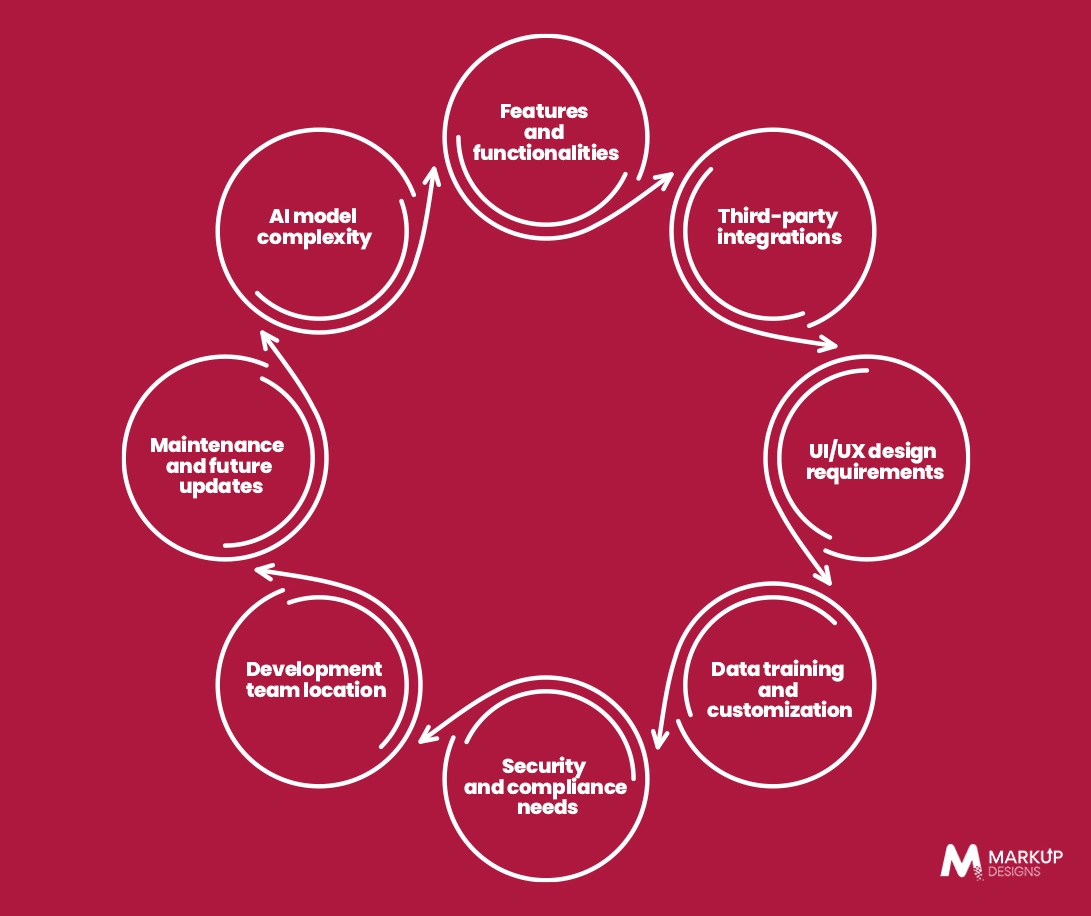
The overall development cost depends on the chatbot’s functionality, technical requirements, and long-term maintenance. Understanding these cost drivers helps businesses plan their investment more effectively.
AI Model Complexity
More advanced AI models, especially those used for generative AI chatbot development, require additional training, infrastructure, and optimization, increasing development costs.
Features and Functionalities
Adding features such as voice support, multilingual capabilities, advanced analytics, document search, or workflow automation increases the overall project scope.
Third-Party Integrations
Integrating the chatbot with ERP systems, CRM software, payment gateways, customer support platforms, and business applications requires additional development effort.
UI/UX Design Requirements
Custom user interfaces, conversational design, and personalized user experiences can influence the overall development timeline and budget.
Data Training and Customization
Training AI models using business-specific knowledge, documents, and internal data improves chatbot accuracy but also requires additional resources.
Security and Compliance Needs
Businesses handling sensitive customer information may need advanced security measures, encryption, access controls, and compliance with Australian privacy regulations.
Development Team Location
Project costs can vary depending on whether you hire an in-house team, outsource development, or work with an experienced AI chatbot development company in Australia.
Maintenance and Future Updates
After deployment, businesses should budget for regular updates, AI model improvements, monitoring, bug fixes, and feature enhancements to keep the chatbot performing effectively.
How Long Does It Take to Build an AI Chatbot?
The time required to build an AI chatbot depends on its complexity, features, integrations, and level of customization. A simple chatbot designed to answer FAQs and basic customer queries can typically be developed in 4-6 weeks. A custom AI chatbot with CRM integration, personalized workflows, and advanced automation generally takes 8-12 weeks.
For generative AI chatbot development or enterprise AI chatbot development, where the solution requires large language models (LLMs), business data training, multiple system integrations, and rigorous security testing, the timeline can range from 3-6 months or more.
Usually, the process involves requirement analysis, conversation design, AI selection, user interface/user experience design, chatbot creation, integration into the existing system, testing, deployment, and post-deployment optimizations.
Moreover, organizations need to allocate time for employee training, performance tracking, and ongoing improvements after deploying the bot. Having a skilled partner for developing the chatbot can help you complete the process faster and more effectively.
AI Chatbot Use Cases Across Australian Industries
AI chatbots are transforming businesses across various industries by improving customer experiences, automating workflows, and increasing operational efficiency.
- Healthcare: Appointment scheduling, patient support, and medical information assistance.
- Banking and Finance: Account enquiries, fraud alerts, loan assistance, and customer onboarding.
- Retail and E-commerce: Product recommendations, order tracking, returns, and personalized shopping experiences.
- Education: Student support, admissions guidance, course recommendations, and virtual learning assistance.
- Travel and Hospitality: Booking assistance, itinerary updates, customer support, and travel recommendations.
- Logistics and Supply Chain: Shipment tracking, delivery updates, warehouse support, and customer communication.
- Real Estate: Property recommendations, appointment scheduling, and buyer qualification.
- Government Services: Citizen support, document guidance, and public service enquiries.
These industry-specific applications demonstrate how AI chatbot development services can improve both customer engagement and internal operations.
Challenges in AI Chatbot Development and Their Solutions
While AI chatbots offer significant business value, successful implementation requires addressing several technical and operational challenges.
| Challenge | Solution |
| Poor response accuracy | Train AI models with high-quality business data and continuously optimize performance |
| Integration with legacy systems | Use APIs and middleware to connect existing business applications. |
| Data privacy concerns | Implement encryption, access controls, and regulatory compliance measures. |
| AI hallucinations | Use Retrieval-Augmented Generation (RAG – development), knowledge bases, and human validation for critical responses. |
| User adoption | Design intuitive conversations and provide clear escalation to human agents. |
| Scalability | Deploy cloud-based infrastructure capable of handling increasing user demand. |
| Ongoing maintenance | Continuously monitor chatbot performance and update AI models as business needs evolve. |
By addressing these challenges early, businesses can improve chatbot performance, increase user trust, and maximize return on investment.
AI Chatbot Security, Privacy, and Compliance in Australia
Security and compliance issues are essential while designing AI chatbots to ensure the protection of the information related to customers or businesses. It is important for businesses to use encryption techniques, authentication procedures, access control policies, and security audits to ensure the protection of sensitive information.
Another key requirement for the use of AI chatbots is to be compliant with the Australian privacy laws by collecting only relevant data, using transparency in data handling, and ensuring more control to users on their personal information.
How to Choose an AI Chatbot Development Company in Australia
Selecting the right development partner plays a major role in the success of your AI chatbot project. Consider these factors before making a decision:
- AI and LLM Development Expertise: Choose a company experienced in building custom generative AI solutions.
- RAG Implementation Experience: Look for expertise in Retrieval-Augmented Generation for more accurate, business-specific responses.
- Industry Knowledge: Select a partner that understands your industry’s challenges and compliance requirements.
- Security and Privacy Capabilities: Ensure the company follows secure development practices and data protection standards.
- System Integration Expertise: The development team should be capable of integrating the chatbot with your CRM, ERP, and other business applications.
- Post-Launch Support: Ongoing maintenance, monitoring, and optimization are essential for long-term success.
- Transparent Cost and Timeline Estimates: A reliable partner provides clear project planning, pricing, and delivery expectations.
Why Choose Markup Designs for AI Chatbot Development in Australia?
At Markup Designs, we provide smart AI chatbot solutions that enable businesses to streamline their customer interactions, boost efficiency, and provide a unique experience for users. Our experts provide full-cycle services including the strategic planning, design, development, integration, deployment, and optimization of chatbots.
If you require a chatbot for customer service, a generative AI chatbot, or a fully-fledged enterprise solution, our company will develop tailored and secure AI solutions that align with your business goals.
Ready to transform your customer experience with AI?
Connect with Markup Designs to build a secure, scalable, and future-ready AI chatbot tailored to your business requirements.
Conclusion
AI chatbots are becoming an essential part of modern business operations, helping organizations improve customer engagement, automate repetitive tasks, and reduce operational costs. With the right strategy, technology stack, and implementation approach, businesses can develop AI-powered solutions that deliver measurable long-term value.
If you’re planning to invest in AI chatbot development in Australia, understanding the development process, essential features, technology requirements, and cost factors will help you make informed decisions and build a chatbot that supports your business growth.
FAQs
1. How much does it cost to build an AI chatbot in Australia?
The cost depends on chatbot complexity, features, AI capabilities, integrations, and customization. Enterprise AI chatbots generally require a higher investment than basic customer support chatbots.
2. Can an AI chatbot integrate with existing business systems?
Yes. Modern AI chatbots can integrate with CRM platforms, ERP systems, payment gateways, customer support software, and other business applications through APIs.
3. What is the difference between a traditional chatbot and a generative AI chatbot?
Traditional chatbots follow predefined rules and scripted responses, while generative AI chatbots use advanced AI models to understand context and generate natural, human-like conversations.
4. Should I build a custom AI chatbot or use a chatbot platform?
If your business requires advanced features, integrations, and personalized customer experiences, a custom AI chatbot is usually the better long-term investment.
5. How do you train an AI chatbot with business data?
AI chatbots are trained using company documents, FAQs, product information, customer interactions, and knowledge bases to deliver accurate and context-aware responses.
6. What ongoing costs are involved after launching an AI chatbot?
Ongoing expenses may include cloud hosting, AI model updates, maintenance, monitoring, security improvements, feature enhancements, and continuous optimization.
Author's Perspective
As AI adoption continues to grow across Australia, businesses have an opportunity to move beyond basic automation and create more intelligent customer experiences. The key to success is not simply deploying an AI chatbot but building a solution that aligns with business objectives, integrates seamlessly with existing systems, and continues to evolve with customer needs. Investing in the right development strategy today can help businesses stay competitive in an increasingly AI-driven future.
Discuss Your Project NowGaurav Goyal
Global Sales- VP
Related Posts
AI Development Firm in the UK: How to...
Hiring an AI Development Partner in the UK:...
10 AI Innovations Transforming the UK Healthcare Industry...
Insights Are Valuable & Execution is Priceless
You’ve read about the digital future. Now, let’s build the infrastructure to take you there. Move your strategy from the page to the product.
Design Your Solution Now
Contact Us
Schedule The Appointment At Your Convenience Date And Time.
30 Min
Web Conference
Time Zone
Indian standard time (08:30pm)

Thanks For Getting In Touch!
You’ve Taken The First Step Toward Transforming Your Digital Presence. Our Experts Will Reach Out Shortly To Take It Forward.
Launch Your Dream Project
Provide a brief overview of your project, and our specialists will evaluate your requirements. We will connect with you to explore how the right digital solutions can help you launch faster.