

In Brief
- The Green App Development movement looks to create mobile applications that are energy-efficient by minimizing the battery usage of the device running the application, reducing the load on the cloud server, and digital carbon emissions from the application.
- Sustainable software development practices, light-weight application architecture, optimized data transfers, and Green Cloud Hosting improve application performance while having a positive impact on the environment.
- Eco-friendly mobile applications help businesses save money on infrastructure, achieve ESG Goals, and enhance their overall sustainability efforts.
- Green application development is made possible through technology such as AI-driven optimization, efficient caching, adaptive performance, and renewable-powered cloud infrastructure.
- By partnering with an experienced mobile app development company, you ensure that your application achieves a balance between performance, scalability, and sustainability from the design phase through the deployment phase.
As digital technologies continue to grow in popularity, they have a bigger impact on the environment than ever before. All digital applications run on devices that consume energy to complete tasks using the processing power of the device, network communication, and the cloud infrastructure to fulfil requests for the application data.
Many people may not realize the contribution of digital operations to global carbon emissions. Green App Development aims to provide solutions to the current challenges faced by application developers through sustainable software engineering by providing them with proof of energy-efficient applications that will utilize energy efficiently while still providing high-performance, secure, and user-friendly applications.
Developing a sustainable mobile application requires more than just writing code. Sustainable coders design their application in such a way that reduces the number of times they will transfer data unnecessarily, flattening their application architecture by reducing the total lines of code used in the application, utilizing sustainable Cloud Hosting resources, while providing users with an experience that requires as little data as possible to deliver a high-quality user experience.
For businesses, green app development not only supports environmental responsibility but also delivers tangible benefits such as lower operational costs, improved application efficiency, enhanced brand reputation, and alignment with evolving sustainability and ESG goals. As organizations increasingly prioritize digital sustainability, green app development is becoming a key strategy for building future-ready mobile solutions.
How Green App Development Differs from Traditional Development
App development has traditionally been about providing people with functionality and performance as well as a good user experience. Adding to these goals of app development, developing apps using ‘green’ development techniques will add a focus on being more sustainable at each stage of the software lifecycle. This includes writing code that uses as less energy as possible, by using few resources to achieve desired results, using cloud solutions that are sustainable, and using efficient cloud architectures that decrease carbon emissions while maintaining the application’s overall performance.
As more and more companies embrace ESG (environmental, social, and governance) initiatives and strive for environmental targets, green AI app development has begun to be a strategic method of creating digital products that will be ready for the future.
Green App Development vs. Traditional Development
| Aspect | Traditional App Development | Green App Development |
| Primary Focus | Features, performance, and speed to market | Sustainability, energy efficiency, and performance |
| Code Optimization | Optimized mainly for functionality | Optimized for lower CPU, memory, and battery consumption |
| Energy Consumption | Limited focus on power efficiency | Designed to minimize energy usage across devices and servers |
| Cloud Infrastructure | Standard cloud hosting | Green cloud providers and energy-efficient infrastructure |
| Data Usage | Frequent data transfers | Optimized APIs, caching, and reduced network requests |
| App Size | Larger due to additional libraries | Lightweight with minimal dependencies |
| Operational Cost | Higher long-term infrastructure costs | Lower costs through efficient resource utilization |
| Environmental Impact | Higher digital carbon footprint | Reduced emissions and improved sustainability |
Key Features of Eco-Friendly App Development
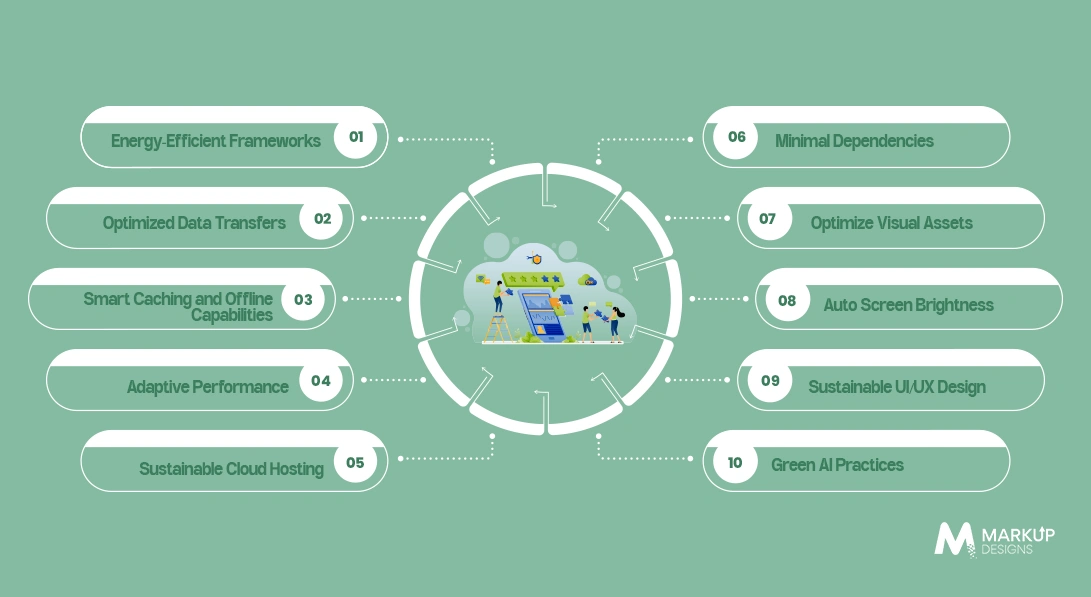
Creating environmentally conscious apps focuses on minimizing the impact of digital applications on the environment while creating quality user experiences. Designers and developers can create apps that use fewer resources, lower cost of operations, and achieve long-term sustainability by integrating sustainable design principles and energy-efficient technologies into their products.
Energy-Efficient Frameworks
The selection of a lightweight or optimized framework can drastically reduce the amount of CPU usage, memory used, and the amount of battery that is drained for a device when it runs an application. Efficient and optimized frameworks allow for increased performance in terms of responsiveness of the app while consuming less power on different devices.
Optimized Data Transfers
Optimizing the way that data is sent to and from servers can reduce API calls to the server, compress data, and only transmit essential information. By optimizing the way we send data to/from servers, we can improve load times for users, reduce the amount of bandwidth used and reduce the energy used by data processing.
Smart Caching and Offline Capabilities
Caching or temporarily storing data that is requested frequently allows users to retrieve that data from their device and prevents the user from making multiple requests to the server. In cases when users are disconnected from network and need access to information outside of the network, offline data also enhances the user experience, while reducing the amount of network traffic and resources used by the cloud.
Adaptive Performance
Adaptive performance allows the application to adjust dynamically based on how the device is operating and how the user is interacting with the application. By applying intelligent optimizations, the app will have extended battery life, while continuing to function smoothly and efficiently.
Green Cloud Hosting
By hosting applications on cloud services with renewable energy sources, you can substantially lower both your organisation’s and society’s overall environmental impact. Most cloud service providers use energy-efficient hardware in their data centres, as well as automatically scale up or down data centre resource use and optimise server use to maximise energy efficiency.
Minimal Dependencies
If you build your application using only the most essential libraries and third-party components, it will be more lightweight and easier to maintain. The fewer libraries and components in your application, the smaller the application will be; this will result in increased performance, reduced security risks, and lower resource consumption.
Auto Screen Brightness
When devices incorporate auto screen brightness features, they can reduce energy use by automatically adjusting their display brightness based on how bright or dark the room is. The result is that devices consume less energy while still providing the user with a comfortable and visible experience.
Sustainable UI/UX Design
A clean, easy-to-use, and minimalistic user interface (UI) uses fewer visual resources and encourages efficient interactions with users. Efficient navigation through an application, optimised animation, and carefully considered design choices all contribute to the application creating lower processing loads and a more sustainable digital experience.
Green AI Techniques
AI models should be designed to create maximum efficiency through minimised computational requirements and unnecessary computation. Creating lightweight AI models and optimising the use of AI models for inference while maintaining responsible data use will enable your business to be able to provide affordable intelligent features to customers while reducing the impact of energy used on the environment.
Benefits of Green App Development
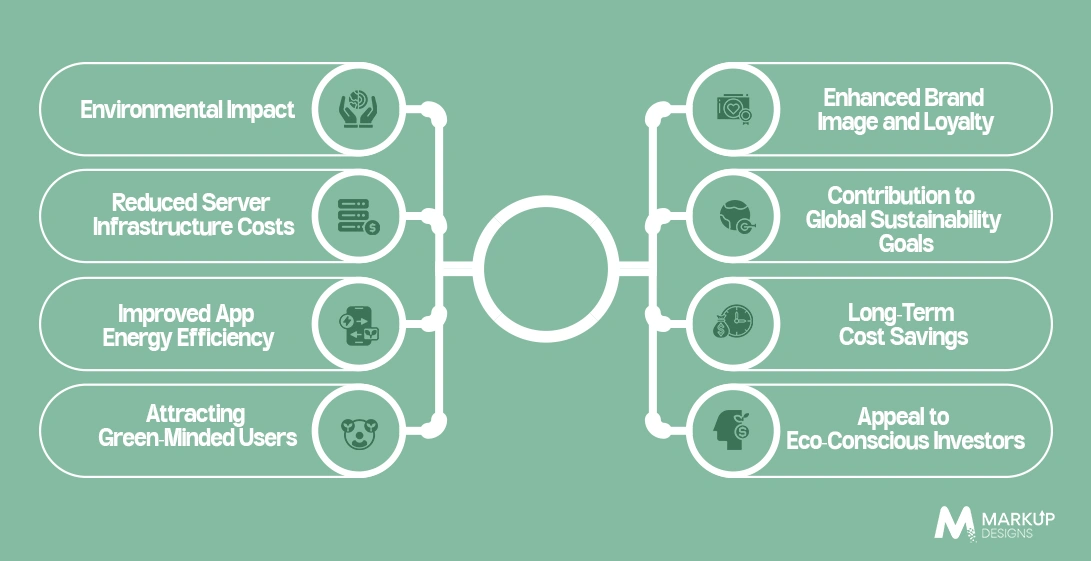
Building environmentally friendly applications offers your business more than just environmental benefits; through energy-efficient and resource-optimized apps, your organisation can also deliver ongoing value to the business. Companies implementing sustainable practices in developing energy-efficient applications will suffer lower operational costs, improved end-user experiences, and stronger commitments to sustainability, all while remaining competitive in an increasingly digitally conscious environment.
– Environmental Impact
Green-related applications consume less energy due to their effective coding, optimised infrastructure, and lower resource consumption. As a result, companies that deploy green applications contribute to reducing the total amount of carbon emissions associated with cloud-based computing, data centres, and mobile devices while contributing to a more sustainable digital ecosystem.
– Reduced Server Infrastructure Costs
Green applications are able to do more with fewer servers in order to fulfil requests and run workloads. This leads to reduced costs for cloud hosting, enhanced resource utilization, and lower overall cost of managing the infrastructure.
– Improved App Energy Efficiency
Using optimised code, efficient background processing, and lightweight architecture reduces battery consumption and resource utilization on devices, thus improving application performance as well as extending battery life and enhancing user experience.
– Attracting Green-Minded Users
The increasing focus on environmental responsibility has resulted in consumers preferring to purchase goods and services from companies that embrace sustainability as a core business value. There is a growing trend of environmentally responsible individuals wanting to use eco-friendly applications as they recognise the value of a responsible digital product.
– Enhanced Brand Loyalty and Image
Building trust at the core of your relevant market by having a documented commitment to sustainability assists you in differentiating your company from other potential competitors in the marketplace and assists in building trust within the marketplace.
Green initiatives strengthen brand reputation, encourage customer loyalty, and reinforce long-term relationships with users.
– Contribution to Global Sustainability Goals
Sustainable software development will help advance the global movement toward sustainability by reducing digital waste and social practices using technology responsibly. Businesses can use their digital transformation processes to align with global environmental commitments and ESG objectives.
– Long Term Savings
Sustainable development may require a more detailed plan; however, optimised applications will consume less energy, resulting in lower total cost of ownership (TCO) with less maintenance, lower infrastructure costs, and more operational efficiency, leading to significant savings over the long haul.
– Appeal to Eco-Conscious Investors
Ecosystems are increasingly evaluating companies on their environmental and sustainability practices, and therefore, companies that use green software development will show innovation in the form of green solutions, which makes them attractive to ESG-oriented investors and business alliances.
How to Develop a Green App – A Step-by-Step Process
To create a green application, you need to go beyond optimizing your code after developing it; you need to include sustainability into each phase of the software development lifecycle, from planning and architecture to deployment and ongoing maintenance. A systematic approach enables businesses to design and build their applications in an energy-efficient, scalable manner and in accordance with environmental standards.
Step 1: Define Clear Sustainability Goals
You will want to first determine what you expect to achieve in terms of your application’s environmental goals, for instance, reducing energy use, data use, or lowering cloud resource consumption. Sustainability objectives help to guide the design and development and performance optimisation of the application.
Step 2: Choose an Energy-Efficient Architecture
You will want to design the application’s architecture to minimise unnecessary processing, server calls, and resource consumption. Designing an application architecture to be lightweight and scalable will help improve application performance and decrease the overall environmental impact of the application.
Step 3: Design a Minimalist User Interface/User Experience
The user interface should be clean and simple, and provide intuitive navigation with minimal resource-intensive animations. A minimalist user interface makes an application easier to use while adding less burden on device processing and battery power.
Step 4: Select a Green Technology Stack
You will want to use a development framework, programming language, database and cloud solution that supports resource-efficiency and performance. Working with sustainable technology supports application performance while helping your application to minimise operational energy consumption.
Step 5: Incorporate Eco-Friendly Features
Add features to your application that enhance sustainability, such as smart caching, offline capabilities, optimized data synchronization, adaptive performance, and efficient background processing. These features will help reduce unnecessary consumption of resources while keeping an excellent user experience.
Step 6: Measure Environmental Performance
Test the energy consumption of your application, battery usage, memory usage, network efficiency, and resource performance. Regular testing of these metrics will help to identify areas for improvement before the application is launched. This way, you can ensure you meet your sustainability goals.
Step 7: Continuously Monitor and Maintain Sustainability
Once the application is launched, you should monitor application performance, server utilization, and energy efficiency continually. Through regular updates, optimizing code, and upgrading infrastructure, you will be able to maintain application performance while also helping to achieve your long-term sustainability goals.
Challenges to Green App Development & Solutions
Building a green app has many advantages for both the environment and your business, and implementing sustainable software practices also has some challenges. For an instance creating an application that uses little energy, adhering to constantly changing sustainability guidelines, and putting into place the correct strategies to build high-performance applications that also meet their environmental obligations.
Provide an Energy Efficient Application
Providing low energy consumption in relation to the high level of functionality can at times be a challenge, especially when adding new features to an application. These issues can increase battery consumption with poorly optimized code, excessive background processes, and a high frequency of requests to the network.
How to Overcome It:
Adopt efficient coding practices, optimize background tasks, reduce unnecessary API calls, implement smart caching, and regularly monitor energy consumption using performance profiling tools. Continuous optimization ensures the app remains efficient as new features are introduced.
Diverse Regional Standards
Sustainability regulations, data privacy laws, and environmental standards vary across countries and industries. Developing a single application that complies with multiple regional requirements can increase complexity during development and deployment.
How to Overcome It:
Design the application with a flexible architecture that supports regional configurations and compliance requirements. Staying informed about evolving regulations and partnering with experienced development teams helps ensure long-term compliance.
Data Integrations
Modern applications often integrate with cloud services, third-party APIs, payment gateways, and enterprise systems. Multiple integrations can increase network traffic, resource consumption, and overall energy usage if not properly optimized.
How to Overcome It:
Implement efficient API management, compress data transfers, synchronize information only when necessary, and eliminate redundant requests. Well-optimized integrations improve both application performance and sustainability.
Limited Green Resources
Many organizations face limited access to developers with expertise in sustainable software engineering, green cloud infrastructure, and energy-efficient application design. This skills gap can slow down the adoption of green development practices.
How to Overcome It:
Invest in developer training, adopt established green development frameworks, and collaborate with experienced technology partners who specialize in sustainable software solutions. Leveraging proven practices accelerates development while reducing environmental impact.
Costs for Green App Development
The cost of developing a green app depends on factors such as application complexity, platform selection, sustainability features, technology stack, cloud infrastructure, and third-party integrations. While eco-friendly development may require additional planning and optimization, it often results in lower operational costs, improved energy efficiency, and long-term savings. Businesses can begin with a sustainable MVP and gradually incorporate advanced green technologies as their application scales.
| App Type | Estimated Cost (USD) | Typical Features |
| Basic Green MVP | $20,000 – $50,000 | Lightweight architecture, optimized code, efficient data transfers, basic caching, energy-efficient UI, and sustainable cloud deployment. |
| Mid-Level Green App | $50,000 – $120,000 | Advanced caching, offline capabilities, adaptive performance, AI-powered optimization, cloud auto-scaling, analytics, and third-party integrations. |
| Enterprise Green Application | $120,000 – $300,000+ | Green AI practices, IoT integrations, renewable-powered cloud infrastructure, advanced security, global scalability, sustainability monitoring, and enterprise-grade architecture. |
Key Factors That Influence Green App Development Costs
- Application Complexity: More features, integrations, and user roles increase development effort and cost.
- Platform Selection: Native iOS, Android, or cross-platform development impacts both budget and timelines.
- Green Technology Stack: Choosing energy-efficient frameworks, databases, and cloud platforms may influence upfront investment.
- Cloud Infrastructure: Sustainable cloud hosting, auto-scaling, and renewable-powered data centers contribute to long-term efficiency.
- Third-Party Integrations: APIs, payment gateways, AI services, and IoT connectivity add to implementation costs.
- Performance Optimization & Testing: Extensive energy profiling, battery optimization, and sustainability testing require additional development time.
- Maintenance & Continuous Optimization: Regular updates, infrastructure monitoring, and performance improvements ensure long-term energy efficiency and application sustainability.
Real-World Examples of Green Applications and How They Are Making a Difference
Across industries, organizations are developing applications that encourage sustainable living, reduce waste, and promote responsible resource consumption. These green apps demonstrate how technology can positively influence user behavior while supporting global environmental goals.
Yayzy
Yayzy is a fintech application that helps users understand and reduce their carbon footprint based on everyday spending habits. By analyzing financial transactions, the app estimates carbon emissions, provides personalized sustainability insights, and offers carbon offset options, enabling users to make more environmentally conscious purchasing decisions.
Too Good To Go
Too Good To Go is a food waste reduction platform that connects consumers with restaurants, bakeries, supermarkets, and cafés offering surplus food at discounted prices. By preventing edible food from being discarded, the app helps businesses reduce waste, lowers greenhouse gas emissions, and encourage more sustainable consumption habits.
PaperKarma
PaperKarma helps users reduce paper waste by simplifying the process of opting out of unwanted postal mail and marketing materials. Users can scan unwanted mail, and the app contacts the sender to remove them from mailing lists. This reduces paper consumption, minimizes waste, and supports more sustainable communication practices.
Go Green with Markup Designs
Building a sustainable mobile application requires more than just efficient coding, it demands a strategic approach to architecture, performance optimization, cloud infrastructure, and long-term scalability. At Markup Designs, we help businesses develop eco-friendly mobile applications that minimize energy consumption without compromising speed, security, or user experience.
From selecting energy-efficient technologies and designing lightweight application architectures to optimizing cloud resources and implementing sustainable development practices, our team delivers end-to-end green app development solutions tailored to your business objectives. Whether you’re launching a new product or modernizing an existing application, we build scalable, future-ready apps that reduce operational costs, support your ESG initiatives, and create lasting value for both your business and the environment.
Build Smarter Mobile Apps with Markup Designs
Create high-performance mobile applications that reduce energy consumption, optimize resource usage, and support your sustainability goals. Whether you’re developing a new app or modernizing an existing one, Markup Designs delivers eco-friendly solutions designed for performance, scalability, and long-term business value.

FAQs
1. What is the definition of the term green app development?
Green app development refers to the process of building mobile applications that minimize their energy consumption and resources utilized, while also lowering their digital carbon footprint. The creation of green apps involves using efficient coding, maximizing the use of infrastructure, practicing sustainable development, and building high-performance, environmentally friendly applications.
2. What is the cost to create a green application?
The cost to develop a green application varies based on many factors, including complexity, platform, tech stack, sustainable features added, third-party services utilized, etc. In broad, a basic green application would be expected to cost in the range of $20-$50K, while more complex enterprise-level solutions that incorporate advanced artificial intelligence (AI), cloud optimizations, and Internet of Things (IoT) capabilities often exceed $300K.
3. What are some best practices for building a green application?
Some of the best practices for developing a green app include the writing of energy-efficient code, minimizing the amount of data being transferred(at the same time), utilizing appropriate caching mechanisms, choosing lightweight frameworks, optimizing for battery usage, using an environmentally friendly cloud hosting provider, minimizing third-party dependencies, and consistently monitoring the application to assess its overall energy efficiency.
4. Why should we care about the sustainability of an application?
Sustainable applications generally reduce their resource consumption, cost of operation, environmental impact, and the performance of the application itself. In addition, sustainable apps help companies meet their ESG (Environment, Social, Governance) objectives by improving the overall perception of the brand from an environmental standpoint and making them more appealing to potential eco-friendly users/investors.
5. How do you build a green app?
Building a green app starts with defining sustainability goals, selecting an energy-efficient architecture, designing a lightweight UI/UX, choosing a green technology stack, implementing eco-friendly features, testing energy performance, and continuously monitoring and optimizing the application after deployment.
Author's Perspective
As mobile applications continue to shape the digital economy, sustainability is becoming an essential consideration rather than an optional enhancement. Green app development enables businesses to build high-performing applications that not only deliver exceptional user experiences but also reduce energy consumption, optimize cloud resources, and support broader environmental goals. Organizations that adopt sustainable software development practices today are better positioned to lower operational costs, strengthen their ESG initiatives, and meet the growing expectations of environmentally conscious users. Investing in green app development is ultimately an investment in building digital products that are efficient, scalable, and prepared for the future.
Discuss Your Project NowAjit Kumar Jha
VP - Business Operations
Insights Are Valuable & Execution is Priceless
You’ve read about the digital future. Now, let’s build the infrastructure to take you there. Move your strategy from the page to the product.
Design Your Solution Now
Contact Us
Schedule The Appointment At Your Convenience Date And Time.
30 Min
Web Conference
Time Zone
Indian standard time (08:30pm)

Thanks For Getting In Touch!
You’ve Taken The First Step Toward Transforming Your Digital Presence. Our Experts Will Reach Out Shortly To Take It Forward.
Launch Your Dream Project
Provide a brief overview of your project, and our specialists will evaluate your requirements. We will connect with you to explore how the right digital solutions can help you launch faster.