

In Brief
- Ecommerce apps are becoming essential for businesses in 2026 because customers now prefer fast, mobile-based shopping experiences instead of traditional websites.
- Modern ecommerce apps are evolving with advanced technologies like AI recommendations, voice search, AR shopping, chatbots, blockchain security, and personalized user experiences.
- Businesses are investing in ecommerce app development to improve customer engagement, increase repeat purchases, offer faster checkouts, and build direct communication through push notifications and loyalty programs.
- The ecommerce app development process includes market research, UI/UX design, app development, testing, launch, and continuous post-launch support to ensure smooth performance and scalability.
- App development costs and timelines depend on the complexity of the project, features, integrations, AI capabilities, and whether the app is built for startups, growing businesses, or enterprise-level operations.
- Choosing the right ecommerce app development company is important because factors like scalability, security, cross-platform expertise, AI integration, and post-launch support directly impact the long-term success of the app.
E-commerce has turned out to be a regular activity in our everyday routine. These days, there is hardly anything which cannot be purchased via online channels – from apparel to electronics and even medical aids. And most customers tend to buy goods using mobile applications rather than websites.
A closer look at what happens around will clearly show that nowadays shopping applications are gaining enormous popularity. People opt for mobile applications because they are faster and easier to use, plus accessible from everywhere.
That is why companies are currently paying more attention towards development of ecommerce apps instead of limiting themselves by building websites only. Mobile applications keep them closer to clients and provide an excellent experience.
But in 2026, it will become even more complicated. E-commerce apps have already turned into something more, intelligent platforms with AI-based recommendations, highly-efficient delivery, personalized discounts and easy payment options.
Some key changes that are taking place
- Need for rapid shopping experience among consumers
- More mobile traffic compared to desktop traffic
- Use of AI to provide product suggestions
- Increasing adoption of quick commerce (rapid delivery services)
- Companies prefer to connect directly to their customers
Thus, owing to the above reasons, the deployment of ecommerce apps has become essential for any company looking to expand its digital presence.
In this guide, you will learn everything about ecommerce app development in a simple and easy-to-understand way. We will cover the latest ecommerce app trends in 2026, important features, development process, estimated cost, development timeline, common challenges, and other key things businesses should know before building an ecommerce app.
Why eCommerce Apps are Growing in 2026
The rate at which e-Commerce mobile applications are increasing in popularity in 2026 is extremely rapid due to the shift in customers’ preferences to use mobile applications rather than visiting websites to conduct transactions. In general, users demand convenience and simplicity. It is faster to use mobile applications compared to repeatedly accessing sites on the web.
Changing customer behavior is one of the biggest reasons behind the growth of ecommerce mobile apps in 2026. Today, customers expect fast deliveries, personalized recommendations, easy payment options, and instant support. Ecommerce apps help businesses provide all these services in one place while also improving customer engagement and retention. Through features like push notifications, loyalty programs, and personalized shopping experiences, businesses will stay directly connected with their customers and encourage repeat purchases.
Another important reason why businesses are investing in ecommerce mobile apps is the direct impact on sales and revenue growth. Mobile apps make the buying process faster and simpler, which helps customers complete purchases more easily. Features like personalized product recommendations, one-click checkout, push notifications, loyalty rewards, and special offers encourage users to shop more frequently. eCommerce apps also help businesses reduce cart abandonment and improve customer retention, which ultimately leads to higher conversions and long-term sales growth.
Moreover, AI technology has become a vital component in ecommerce growth as the advanced ecommerce applications have been able to identify the customer behavior and offer products accordingly. By doing this, they ensure that users get a good experience while purchasing and also maximize sales for companies.
Furthermore, another reason behind this growth is the emergence of quick commerce along with hyperlocal delivery services, which have enabled customers to receive deliveries within minutes from the moment they ordered.
The following are some of the primary reasons why ecommerce apps will continue to grow rapidly in 2026
- Increasing use of mobile phones across the world
- Convenient shopping options
- Growth of digital wallets and other payment gateways
- Integration of artificial intelligence into app design
- Growth of quick commerce and delivery services
- Improving customer engagement
- Incorporation of social media into shopping
- Offering customized user experience
- Easy order tracking and assistance
Overall, it can be said that due to several reasons, the growth of ecommerce apps is becoming an essential part of the digital business landscape of today.
Types of Ecommerce Apps
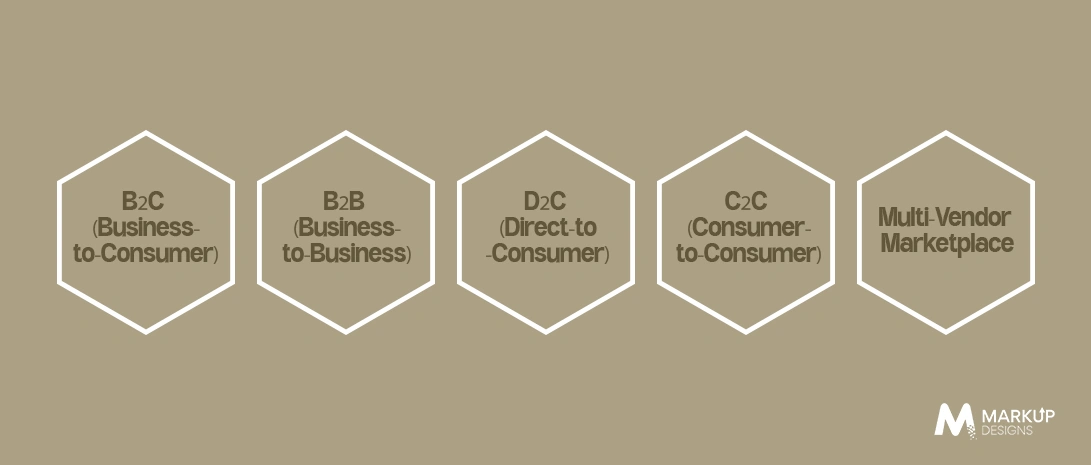
All ecommerce applications are not alike, and it would be accurate to say that the business model that you operate on will determine how your ecommerce application is architected and how much budget needs to be allocated for the same. Here is an overview of the top ecommerce business models
- B2C (Business-to-Consumer)
This is the most prevalent model in which the business sells its products directly to its customers. Examples can include fashion, electronics, or FMCG products.
- B2B (Business-to-Business)
This takes up 70.7% of the overall market in the world when it comes to ecommerce operations. Features required can include bulk orders, tiered pricing, invoice-based payments, etc.
- D2C (Direct-to-Consumer)
This is the fastest growing business model in India wherein brands connect with their buyers without any retail intervention. Personalization and branding play a major role here.
- C2C (Consumer-to-Consumer)
These are peer-to-peer sites wherein transactions take place between two buyers.
- Multi-Vendor Marketplace
This is the most complicated form of application development and requires a lot of processes in place.
Benefits of Developing an eCommerce App
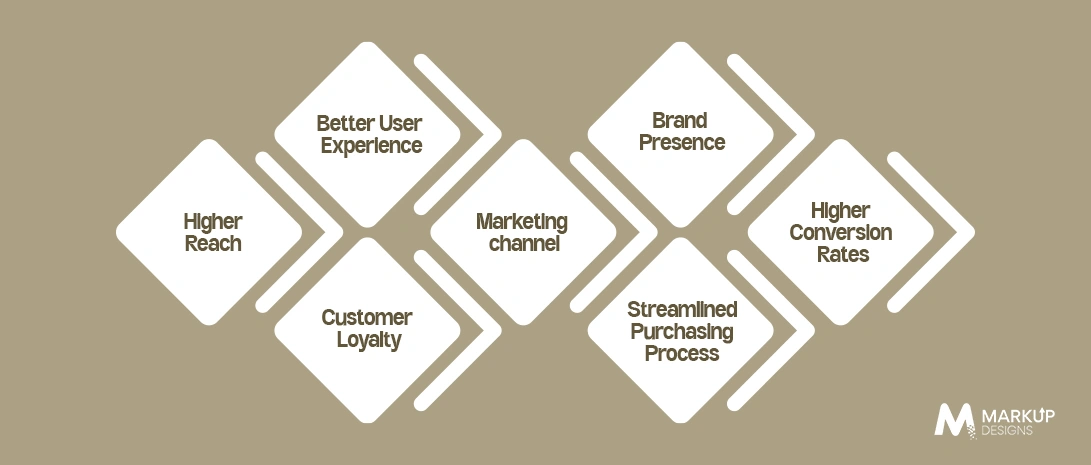
The development of eCommerce applications brings about several strengths which can help in improving business performance, as well as ensuring high customer satisfaction and profitability. Below are some of the major strengths associated with eCommerce application development
- Higher Reach
One of the benefits of eCommerce application development is the consumer reach. A customized eCommerce software ensures that your business reaches millions of people across the globe through its mobile devices.
- Better User Experience
Another significant strength of eCommerce application development is better user experience. Due to its easy-to-use nature and user-friendly interface, mobile applications improve the shopping experience.
- Customer Loyalty
Another advantage of eCommerce application development for businesses is customer loyalty. By embedding features like loyalty points, rewards programs into your ecommerce app, businesses can automatically improve customer loyalty and encourage repeat purchases.
- Marketing channel through push notifications
Your ecommerce mobile application can also work as a powerful marketing channel through push notification features. This helps brands stay connected with customers, improve engagement, bring users back to the app, and increase repeat purchases and overall sales. The push notifications feature will also enable your business to reach out to your clients in real-time through updates concerning new products or services that you are offering.
- Brand Presence
Another advantage of using custom eCommerce application development by business organizations is enhancing their brand presence among their clients in this technology-oriented market place. Having an app will help in ensuring that your brand gets noticed whenever a consumer logs into the application.
- Streamlined Purchasing Process
The purchasing process can be simplified by incorporating elements such as a one-click purchase option, saved payment methods, and easy navigation within mobile apps. This will make the purchasing experience much faster for customers and increase the conversion rates.
- Higher Conversion Rates
Conversion rates are usually higher in mobile apps compared to websites. When businesses invest in ecommerce mobile applications, they can provide faster loading speeds, personalized shopping experiences, and one-click checkout options. These features make the buying process smoother and more convenient for users, which ultimately helps improve conversions and increase sales.
Emerging Ecommerce App Trends in 2026
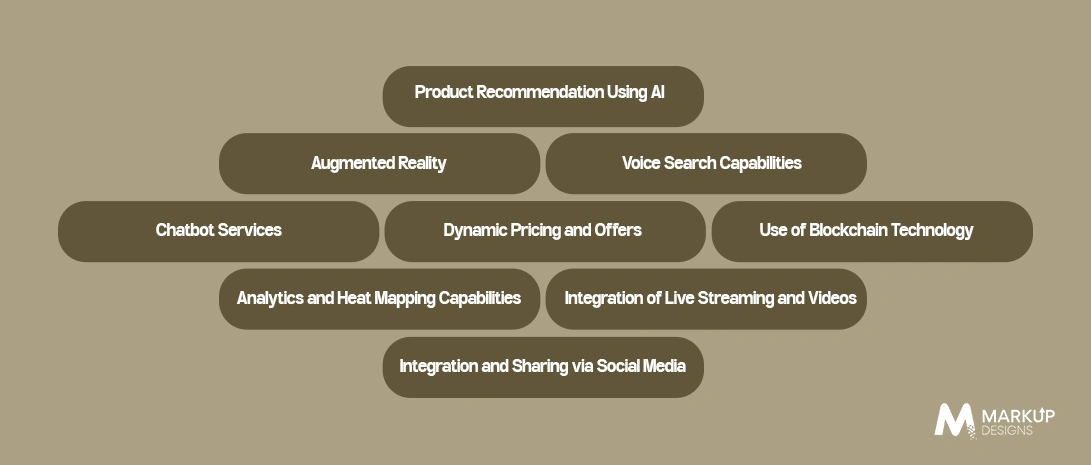
- Product Recommendation Using AI
In order to enhance the experience of customers and help eCommerce businesses sell more products, the integration of AI within eCommerce uses ML techniques to recommend products to users based on their browsing history and personal preferences.
- Augmented Reality
By utilizing the augmented reality features, it lets the customers see how the products will fit in real life scenarios. For example, you can virtually see how a furniture item will be placed in your living room.
- Voice Search Capabilities
With the help of voice recognition software, it lets users perform voice-based searches to look for different products. This enhances usability and makes searching easier.
- Chatbot Services
Using AI-Powered mobile applications provides 24/7 customer support through chatbots that offer assistance to customers.
- Dynamic Pricing and Offers
Uses AI to dynamically price the products and offers to maximize profit while still attracting the consumer.
- Use of Blockchain Technology
The application uses blockchain technology for transaction purposes to ensure there is no fraud and that the purchase process is secure for the users.
- Analytics and Heat Mapping Capabilities
Helps in determining areas of interest within the application by analyzing user activities within the application to help make improvements to the user experience.
- Integration of Live Streaming and Videos
Provides an opportunity to stream events such as product launches or use videos to demonstrate products in detail to the potential consumer.
- Integration and Sharing via Social Media
Makes sharing of products or wish list items through social media very easy and thus helps to spread the marketing message virally through social proof.
Core Features in Ecommerce App Development
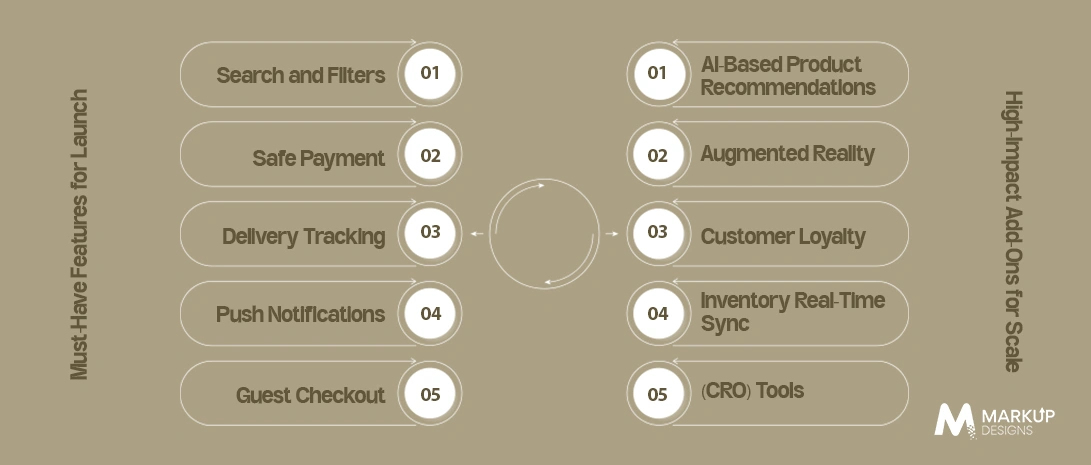
Must-Have Features for Launch
The following set of features is essential in order for an ecommerce app to run properly and achieve its primary goal
- Search and Filters
Faceted search with product category, price, and rating. Poor search can ruin the conversion of a visitor before he even gets to see his shopping cart.
- Safe Payment
Compatibility with leading payments platforms like Stripe, Razorpay, or PayPal. Multi-payment options such as card payments, UPI, wallets, and buy-now-pay-later are becoming a norm.
- Delivery Tracking
Real-time tracking of orders and deliveries eliminates concerns after purchase and reduces customer service inquiries.
- Push Notifications
Customizable push notifications based on user actions such as cart abandonment, order statuses, and promotions are some of the most valuable ecommerce app features.
- Guest Checkout
Making users create an account is a sure way to lose potential customers. Guest checkout must become a standard in ecommerce app development.
High-Impact Add-Ons for Scale
Post MVP validation, here are some add-ons that are valuable for increasing revenues
- AI-Based Product Recommendations
Amazon claims that 35% of its entire revenue comes from recommendations. When building your own custom app for commerce, recommendation algorithms are an extremely high-value investment.
- Augmented Reality (AR) Product Visualizations
Allows customers to visualize their products – be it furniture, clothing, glasses – in their own space before buying them. Cuts down on return rate.
- Customer Loyalty and Gamification Add-Ons
Rewarding your customers with points, levels, and even streaks helps ensure they keep coming back and buy again.
- Inventory Real-Time Sync
Removes issues with over-selling and associated customer discontent. Essential for multi-channel operations.
- App Conversion Rate Optimization (CRO) Tools
The integration of A/B testing features, heatmaps, and session recordings in the app ensures consistent improvements post-launch.
Technologies Used in Ecommerce App Development in 2026
Various types of technologies are used simultaneously in developing ecommerce apps to ensure good performance, secure payment processing, user experience, and advanced features.
Some of the top-used technologies for ecommerce app development include
- Flutter
Flutter app development is one of the widely used technologies in ecommerce as it allows developing Android and iOS apps from the same source code.
- React Native
React Native is an alternative technology that can be used to build fast and responsive mobile shopping apps.
- Node.js
This technology is often used by organizations for their back-end development as it can process requests in real-time and manage huge amounts of traffic.
- Python
This programming language is commonly used in building AI-based capabilities and performing analytics.
- MongoDB & PostgreSQL
Both these database management systems ensure data security in ecommerce apps.
- AWS and Google Cloud Platforms
Cloud-based platforms provide services related to hosting applications, data storage, scalability, and back up.
- AI and Machine Learning
AI and ML enhance ecommerce apps by enabling personalized recommendations, smart search, and customer behavior analysis, helping businesses improve user experience and boost conversions.
- Integration of Payment Gateway Systems
Payment gateway platforms such as Stripe, PayPal, Apple Pay, and Google Pay are integrated in e-commerce applications.
How to Build an eCommerce App- Step-by-Step Process
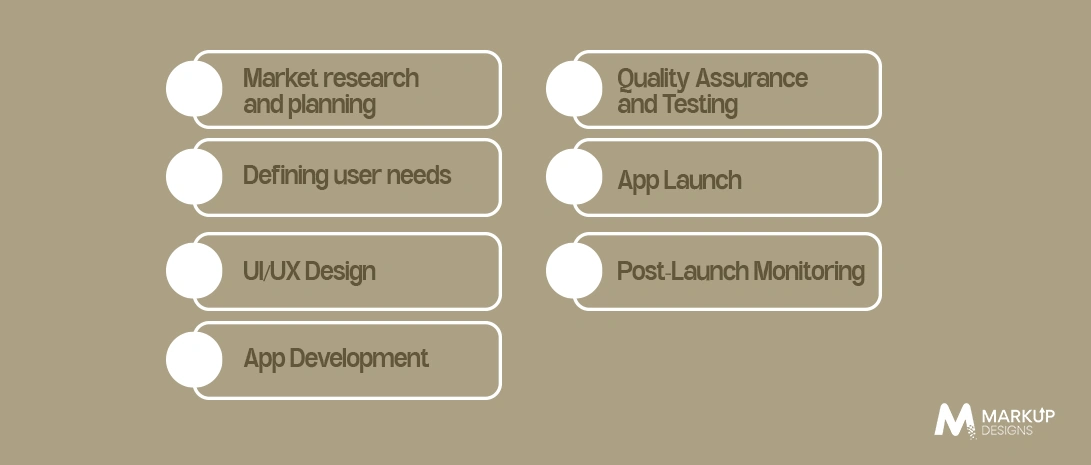
Creating an E-commerce app is a strategic process. There are multiple aspects that need to be considered when building an ecommerce app. Among those, the following are some of the most important things to do in order to guarantee that your application performs successfully and provides an excellent user experience
- Market research and planning
In order to create an ecommerce app that would be successful, you will first have to make sure you understand your target audience and their preferences. Analyzing the market in general and your competitors’ offers will help you understand what kinds of functions you will need to implement into your application.
- Defining user needs and app features
As you gain insights from your market research, clearly define what are the user requirements. Write down the list of important features that your app must have, which may include account creation, product listings, search & filter, shopping cart, payment gateways, customer care and more.
- UI/UX Design
During the mobile commerce app development process, design plays a crucial role when it comes to developing an efficient app. As part of the eCommerce app development design process, businesses must consider designing their app in a manner that will engage consumers as well as provide a seamless experience for them.
- App Development
At this point, the app development takes place where businesses must select appropriate technology stack and adhere to the best practices while developing an app. Businesses need to create both front-end and back-end of their applications. The former will be used by the consumers and the latter deals with handling the data and integration with systems such as inventory management system, payment processing system, etc.
- Quality Assurance and Testing
Quality assurance and testing ensure that there are no bugs in the software and that it runs smoothly even when different scenarios arise. There are various forms of testing, some of which include functional testing, usability testing, performance testing, and security testing.
- App Launch
Once all testing is completed, the final step in the development of an eCommerce mobile app involves launching app stores such as Google Play and Apple App Stores. At the same time, make sure you have your support staff in place to answer any questions after the launch.
- Post-Launch Monitoring and Updates
Following the launch of the application, continuous monitoring and feedback from users should be collected to make necessary changes. Updates not only ensure that any errors are corrected but also incorporate additional features to meet the changing needs of consumers.
Ecommerce App Development Timeline
Ecommerce app development timeline depends on the nature of the app. Simple applications may be developed relatively quickly, but enterprise-grade ecommerce apps with AI capabilities, real-time tracking, and advanced analytical functions will typically require more time to develop.
Before beginning the development process, a business will spend some time planning its approach to developing the application, selecting features and designing user interface and experience aspects.
Here is a general ecommerce app development timeline in 2026
| Development Phase | Estimated Time |
| Planning & Research | 1-2 Weeks |
| UI/UX Design | 2-3 Weeks |
| Frontend & Backend Development | 6-10 Weeks |
| API & Payment Integration | 1-2 Weeks |
| Testing & Quality Assurance | 2-3 Weeks |
| App Deployment | 1 Week |
| Post-Launch Support | Ongoing |
Overall Estimated Timeline
- Basic ecommerce app = 2-3 months
- Medium-level ecommerce app = 3-5 months
- Enterprise ecommerce app = 6+ months
Additionally, the timeline for the creation of the app will be prolonged depending on whether there are any custom features that you require within your application such as AI recommendation engine, AR shopping experience, multi-vendor system, or live delivery tracking among others.
What is the Average E-commerce Mobile App Development Cost
Once the cost of developing an e-commerce mobile app is understood, the second logical question to arise is, “What should we be budgeting for?” Here things start to get less clear. Prices differ widely, quotes found on the internet seem generic, and it is not easy to differentiate between an app’s budget being a bare minimum and something more ambitious.
The correct answer lies in matching the budget for developing the app with your current business model as well as its complexity and future needs. In light of this, the price ranges shown here reflect how an app’s budget changes depending on its complexity and size.
Typical eCommerce Mobile App Development Cost Ranges
| App Type | Ideal For | Estimated Cost Range |
| Basic E-commerce App | Early-stage brands, DTC startups, single-market stores | $25,000 – $45,000 |
| Growth-Stage ECommerce App | Scaling brands, multi-category stores, retention-focused businesses | $45,000 – $90,000 |
| Enterprise & Multi-Market ECommerce App | Large brands, marketplaces, global operations | $90,000 – $180,000+ |
Cost Range for Basic E-commerce Apps
Basic e-commerce apps are designed for brands entering mobile commerce or validating demand beyond mobile websites.
- Includes essential features like product listings, search, cart, checkout, payments, and basic user accounts
- Limited integrations and standard UI UX design
- Often answers queries like how much does a basic e-commerce app cost and minimum cost to build an e-commerce app.
This range works well for controlled budgets but offers limited flexibility as traffic and expectations grow.
Cost Range for Growth-Stage E-commerce Apps
Growth-stage apps are built for brands actively scaling revenue, retention, and repeat purchases.
- Advanced UI UX design focused on conversions and engagement
- Integrations with CRM, marketing automation, analytics, and logistics platforms
- Supports personalization, performance optimization, and higher traffic volumes
Search intent here often aligns with “eCommerce app development cost for scaling brands” and “mid-size eCommerce app pricing,” making this the most common investment range for 2026.
Cost Range for Enterprise and Multi-Market Apps
Enterprise eCommerce apps are built for complexity, scale, and long-term ownership.
- Custom architecture, high security standards, and performance at scale
- Multi-region support, multi-currency payments, and deep ERP CRM integrations
- Designed to handle large catalogs, heavy traffic spikes, and future feature expansion
- Brands searching “enterprise e-commerce app development cost” or “global eCommerce mobile app pricing” typically fall into this category.
Understanding where your brand fits within these cost ranges creates a natural transition into the next step- identifying the specific factors that push eCommerce app development costs up or down and how strategic choices directly influence the final budget.
Challenges in App Development
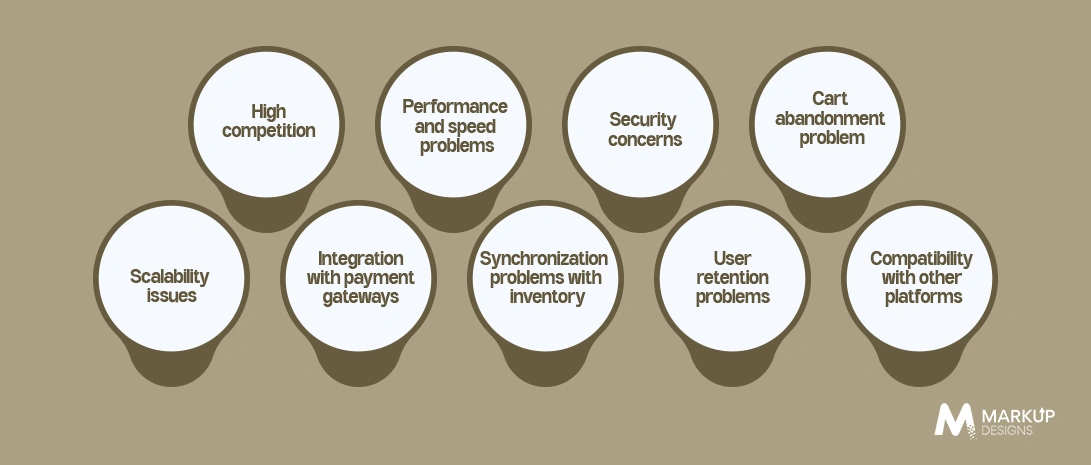
While developing an ecommerce app seems to be straightforward, most enterprises encounter various issues when developing mobile applications. Ecommerce app development is particularly challenging considering that the expectations of customers are higher in 2026.
The challenges include
- High competition
There are thousands of ecommerce apps out there, making it hard for organizations to develop apps with a unique shopping experience.
- Performance and speed problems
App developers should ensure that apps are quick in loading to avoid increasing the app uninstall rate.
- Security concerns
Since ecommerce apps deal with sensitive user data and payment, security becomes very important.
- Cart abandonment problem
Most customers usually abandon their shopping carts due to a complicated checkout process.
- Scalability issues
As the number of users increases, applications must accommodate more users, transactions, and orders.
- Integration with payment gateways
The process of integrating several payment methods can sometimes be complicated.
- Synchronization problems with inventory
Maintaining stock updates on different platforms may be problematic.
- User retention problems
Retaining users once they have downloaded an app may be the hardest thing about ecommerce businesses.
- Compatibility with other platforms
The application should be compatible across various devices and screen types.
Why Ecommerce Brands are Investing in Mobile Apps for Long-Term Growth
In the US, UK, Saudi Arabia, and Australia, e-commerce companies have started making greater efforts at developing e-commerce mobile applications due to changes in consumer behavior.
There is more usage time on mobile applications than on websites. In other words, consumer behavior has changed regarding the time spent and frequency of purchases made.
What does a mobile app offer that no other platform does? That’s consistent customer attention.
And today, ecommerce is a source of revenue.
If structured properly, mobile application development for ecommerce will lead to results that have a direct impact on performance
- More repeat purchases through direct contact
- Better retention of customers due to personalization
- Quicker buying cycles through streamlined checkouts
- Customer lifetime value improvements through loyalty programs
- Fewer dependencies on paid advertising channels
- Control over the customer experience in its totality
- Direct connection via push notifications
- Increased brand recognition due to a physical presence
This is why businesses no longer treat ecommerce mobile application development as a digital upgrade.
Ecommerce mobile app development is now seen as a revenue infrastructure.
10-Point Evaluation Framework
Selecting an ecommerce app development company is as crucial as making technological choices. Apply the following criteria when evaluating vendors-
- Portfolio With Functional eCommerce Apps
Seek a portfolio of real applications uploaded on the App Store and Play Store, not screenshots or wireframes shared on Dribbble.
- Experience With Your App Category
Even a successful vendor of B2C retail apps is not necessarily the best choice for a B2B procurement market platform. Check the vendor’s expertise in your particular application category.
- Transparent Cost Breakdown
An inability to break down costs and provide clear estimates indicates lack of expertise or intentionality on the part of the vendor.
- Post-Launch Maintenance and SLA Terms
The app is your ongoing product, and maintenance needs to be discussed and estimated before you sign the contract.
- Specialization in Cross-Platform or Native App Development
Make sure the development team is qualified to work with a particular cross-platform or native app technology you need.
- Capability to Integrate AI/ML
In case your project includes personalization/recommendation, make sure the vendor already implemented AI-enabled commerce capabilities in their past projects.
- Track Record of Security Compliance
PCI-DSS and GDPR should be minimum compliance standards. Don’t hesitate to ask the vendor for any required documentation or references.
- Cadence of Communication and Project Management Tools
It’s important to clarify sprint cadence, reporting format, and what project management tools (Jira, Linear, Notion) will be used.
- Repeat Customer Rate and Referrals
The highest metric indicating vendor quality is repeat customer rate; make sure you get some referrals and give them a call.
- Ownership of Intellectual Property
Make sure that all source code, design materials, and proprietary logic will be transferred entirely to you once the final payment is made.
Why Markup Designs Stands Out in Ecommerce App Development
Selecting the right development partner while creating an ecommerce app is very important. An effective app needs more than just design – it also requires speed, scalability, security, and usability by its users. This is what makes Markup Designs unique among other ecommerce application development companies.
The company aims at developing state-of-the-art ecommerce applications that are aligned with existing market trends and objectives of different firms. Whether you are a startup or a growing company, the team will strive to develop intuitive ecommerce experiences for your customers.
Here are some of the reasons businesses consider Markup Designs for ecommerce application development
- Experience in developing scalable mobile applications
- Expert knowledge of AI-based ecommerce applications
- User-friendly UI/UX interface design
- Development for multiple platforms using latest technologies
- Payment gateway integration for secure transactions
- Emphasis on performance improvement and scaling capabilities
- Post-launch support and maintenance
The team also understands how customer behavior is changing in 2026. This helps businesses build ecommerce apps with modern features like AI recommendations, real-time tracking, personalized shopping experiences, and fast checkout systems.
No matter if your business requires starting with a new ecommerce app or revamping your existing one, Markup Designs will offer full-fledged development support.
Ready to Build Your Ecommerce App?
Want to launch a fast, scalable, and user-friendly ecommerce app for your business? Our team helps businesses build modern ecommerce solutions with advanced features, smooth user experience, and future-ready technologies.

Conclusion
Ecommerce app development has grown increasingly important in this era of growing businesses. In 2026, customer expectations from such an application would be quick transactions, personalized suggestions, reliable payment methods, and speedy shipping services. Hence, it is important for every business looking to survive in this market to get their own ecommerce application development services.
Due to intelligent artificial technologies and scalable techniques, ecommerce applications are developing very quickly. However, for success in this area, it is important that every business focuses on performance as well as selecting the right technology partner for themselves.
FAQs
1. What is ecommerce app development?
Ecommerce app development is the process of building mobile applications that allow users to browse products, make purchases, complete payments, and track orders online.
2. How much does ecommerce app development cost in 2026?
The cost depends on app complexity, features, design, technology stack, and integrations. Basic apps cost less, while enterprise-level apps with AI features require higher investment.
3. How long does it take to develop an ecommerce app?
A simple ecommerce app may take around 2-3 months, while advanced enterprise apps can take 6 months or more.
4. Which platform is best for ecommerce app development?
Many businesses prefer cross-platform technologies like Flutter and React Native because they support both Android and iOS using a single codebase.
5. What are the must-have features in an ecommerce app?
Some important features include product search, shopping cart, secure payments, order tracking, push notifications, reviews, and AI recommendations.
6. Why are AI features important in ecommerce apps?
AI helps businesses provide personalized recommendations, smart search, chat support, customer insights, and better shopping experiences.
7. Is ecommerce app development better than an ecommerce website?
Mobile apps usually provide better engagement, faster performance, and higher customer retention compared to websites.
9. How do ecommerce apps make money?
Ecommerce apps can generate revenue through product sales, subscriptions, commissions, advertisements, delivery charges, and premium memberships.
Author's Perspective
Ecommerce app development is rapidly developing due to ever-increasing demands from customers. Users require rapid purchases, customized suggestions, secure payment methods, and good mobile apps. Companies that utilize innovative technology such as artificial intelligence, automation processes, quick commerce, and effective mobile app development are sure to have an advantage in the near future. In my view, the future of ecommerce will be significantly influenced by user experience and speed of operation.
Discuss Your Project NowJupinder Singh Arora
Founder and CEO
Related Posts

Cost to Build a Mobile App in Qatar...

How Much Does It Cost to Build an...

How to Build a Car Wash App: Development...
Insights Are Valuable & Execution is Priceless
You’ve read about the digital future. Now, let’s build the infrastructure to take you there. Move your strategy from the page to the product.
Design Your Solution Now
Contact Us
Schedule The Appointment At Your Convenience Date And Time.
30 Min
Web Conference
Time Zone
Indian standard time (08:30pm)

Thanks For Getting In Touch!
You’ve Taken The First Step Toward Transforming Your Digital Presence. Our Experts Will Reach Out Shortly To Take It Forward.
Launch Your Dream Project
Provide a brief overview of your project, and our specialists will evaluate your requirements. We will connect with you to explore how the right digital solutions can help you launch faster.