

In Brief
- Real estate applications such as Property Finder are revolutionizing property acquisition and investment through modern digital solutions.
- Depending on specific project needs, development may cost anywhere between $40,000 for an MVP and up to $300,000 for a robust enterprise solution.
- AI-powered recommendations, enhanced filtering options, virtual tours, maps, and agent management are among the major expense factors.
- Business owners should not forget about potential hidden costs related to maintenance, cloud server, API, and marketing expenses.
- Cross-platform technologies such as Flutter and React Native can assist in cutting down costs during app development and support.
- An MVP-based approach to developing a business application remains the most budget-friendly way to achieve success.
The complete global real estate industry is undergoing a major change in the digital transformation. Modern buyers are no longer looking for brokers, listings, or physical property visits to make a real estate investment decision. Rather than, they prefer to use a mobile-based platform or online searches that help them compare and shortlist the required property.
This change has led to the explosion of platforms such as Property Finder, which has become one of the most well-known real estate marketplaces in the Middle East. The app has become a standard for contemporary property platforms with millions of visitors monthly, advanced search, interactive maps, AI-based recommendations, and seamless user experiences. The growing demand for digital real estate experiences is pushing startups, enterprises, and property agencies to ask one important question:
How Does Property Finder Work? Business Model Explained
Before we get into estimating development costs, we need to understand why Property Finder has been so successful. Property Finder is a digital real estate marketplace that connects buyers, sellers, renters, brokers, and property developers in one central place.
The success is underpinned by several key drivers:
- Large Property Listings Database
- Advanced search and filter
- Discovering properties using interactive maps
- Property updates in real-time
- AI-powered property recommendations
- Broker’s management system
- Multiple language support
- safe communication channels
- Home Loan & EMI calculators
- Virtual tours of properties
The platform is said to have millions of visits a month and a leading market share in the UAE real estate sector.
How much does it cost to build a real estate app like Property Finder?
The final cost depends on several factors: app complexity, platform choice, features, third-party integrations, design requirements, AI capabilities, backend infrastructure, and development location.
In this blog, we are going to analyse all the important aspects of the cost of building a real estate app like Property Finder, from features and development phases to monetisation models, hidden costs, and the best ways to optimise your budget.
Technology Used in Real Estate Application Development
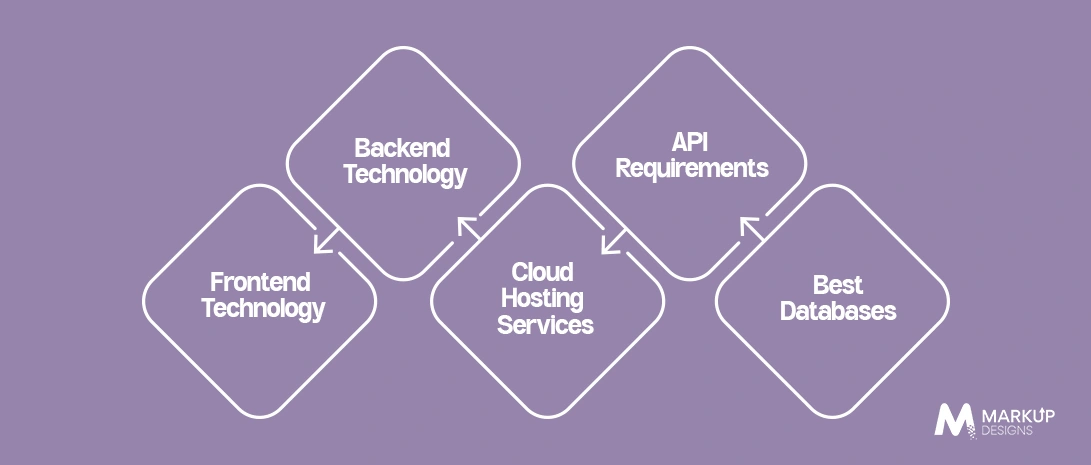
The technology stack used for a real estate app plays a major role in how fast, secure, scalable, and reliable the platform will be in the long run. Platforms such as Proper need a robust mix of frontend technologies, backend architecture, cloud infrastructure, APIs, and databases to effectively handle large numbers of property listings, user traffic, and real-time interactions.
Frontend Technology
The frontend is the technology that determines the user experience and application speed. Real estate firms operating in the United Arab Emirates like to use the cross-platform framework, including Flutter and React Native, to develop apps for both the Android and iOS platforms with the same source code. This strategy helps cut down on the development time while keeping the cost low and providing a seamless user experience.
Backend Technology
The backend forms the foundation of a real estate website. It performs several functions, including listing properties, managing users’ accounts, creating APIs, notifications, messengers, admin panels, and other tasks. Some common technologies that are widely adopted include Node.js and Laravel since they provide high performance and can manage massive amounts of real-time data efficiently.
Cloud Hosting Services
The importance of cloud hosting is known due to the factors such as guaranteeing application stability, secure data transmission, and future scalability. Cloud-hosting solutions such as Amazon Web Services (AWS) and Google Cloud make it possible to handle increasing volumes of users, images, videos, and application data without compromising their performance. Additionally, cloud hosting guarantees uptime and improved backup handling.
API Requirements
Several APIs are needed in developing sophisticated applications. Typically, APIs are used for purposes such as map integration, payment processing, push notifications, analytics, chat applications, and communication services. The use of relevant APIs facilitates the rapid creation of efficient and effective real estate applications.
Best Databases
The real estate websites deal with massive amounts of structured and unstructured data. The choice of database becomes extremely crucial. The PostgreSQL database is often considered ideal for the structured data related to properties and transactions, while MongoDB databases are chosen when there is a need for flexible data storage solutions.
Factors That Affect the Costing of the Real Estate Application

The price for real estate application development is quite high, but it depends on several aspects that play an important role. Let us analyze those key aspects to understand what affects the total price for developing such an app.
- Size Of An App – Size here means the number of different characteristics that the app should contain. For instance, if it has common characteristics, we call this type a small or basic-size application. The medium-sized app is the one that contains some extra features that the basic one does not have. Finally, if there is the largest number of features, we speak about a large-sized Real Estate Application.
- Platform – Here comes one of the main reasons why the price varies. There are four main types of platforms: native Android, web-based, iOS, and native. In other words, iOS applications cost much more than Android, which becomes one of the reasons why the cost fluctuates.
- Features, Functionalities, and Technologies – The higher the number of features incorporated in your app, determines how costly it will become. However, this is the only way you will manage to offer customers excellent customer service.
Read Also: Mobile App Development: Complete Guide for Businesses
Cost of Developing a Real Estate Application like Property Finder
| Development Stage | Scope of Work | Estimated Cost |
| Discovery & Planning | Market research, competitor analysis, business strategy, and feature roadmap planning | $5,000 – $15,000 |
| UI/UX Design | Wireframes, user journeys, prototypes, responsive interface design, and design system creation | $10,000 – $30,000 |
| Frontend Development | Mobile app and web app interface development for iOS, Android, and web platforms | $20,000 – $70,000 |
| Backend Development | Server-side architecture, APIs, databases, cloud infrastructure, and admin panel development | $20,000 – $80,000 |
| Property Listing Management System | Property uploads, listing moderation, search indexing, categorization, media handling | $8,000 – $20,000 |
| Advanced Search & Filters | Smart filters, map-based search, location-based property discovery | $8,000 – $18,000 |
| Third-Party API Integrations | Payment gateways, Google Maps, chat systems, CRM tools, analytics APIs | $5,000 – $25,000 |
| AI & Recommendation Engine | Personalized property recommendations, predictive analytics, smart suggestions | $15,000 – $40,000 |
| Chat & Communication Features | In-app messaging, calls, notifications, lead management tools | $8,000 – $20,000 |
| Virtual Tour & AR/VR Features | 360° property views, virtual walkthroughs, immersive property visualization | $20,000 – $60,000 |
| Testing & Quality Assurance | Functional testing, security testing, performance testing, bug fixing | $8,000 – $20,000 |
Real Estate App Development Cost by Complexity
| App Complexity | Estimated Cost | Timeline |
| Basic MVP | $40,000 – $60,000 | 3 – 6 Months |
| Mid-Level App | $60,000 – $120,000 | 6 – 9 Months |
| Enterprise-Level Platform | $150,000 – $300,000+ | 9 – 18 Months |
These estimates align with industry benchmarks for real estate marketplace applications.
Revenue Generation Through Real Estate Application
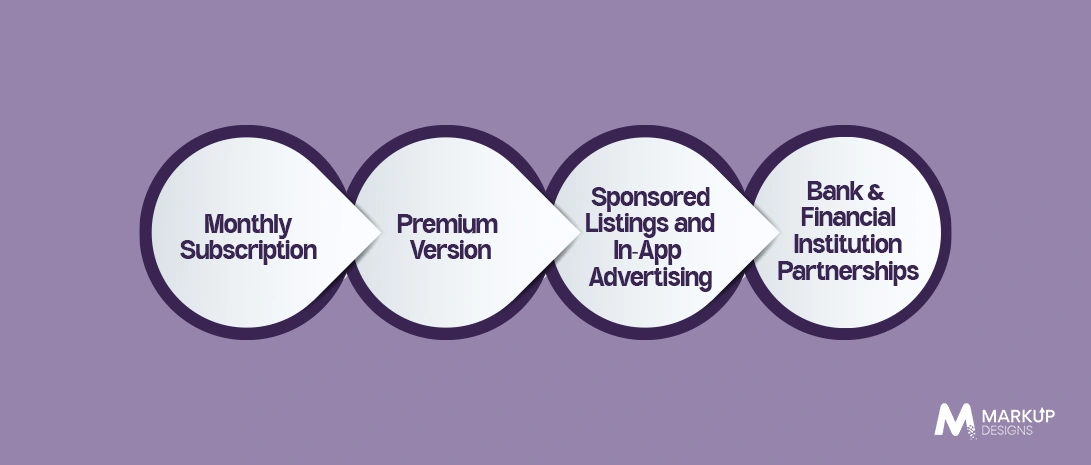
Real estate applications revenue models can differ depending on the target audience, business goals, and platform functionality. Successful platforms often combine multiple revenue streams to build long-term profitability while delivering value to users, agents, and property businesses.
Below are some of the most effective monetization strategies used in modern real estate apps.
Monthly Subscription Fees for Agencies and Agents
The most common revenue model for real estate apps is to charge subscription fees from real estate agents, brokers, or property agencies. In this model, professionals pay a monthly or annual fee to access premium features on the platform and increase their visibility to users.
Premium Version
Another way that works is to create a premium version of the app with advanced features, exclusive tools, and so on. The basic version remains free for general users, but premium users can unlock enhanced functionality to improve convenience and property search experiences.
Some premium features could be AI-powered property suggestions, better search options, saved property alerts, virtual property tours, investment insights, mortgage calculators, or early access to new listings. Encouraging users to upgrade for a more personalized and efficient experience.
Sponsored Listings and In-App Advertising
One of the most common revenue streams for real estate apps is advertising. Platforms can generate revenue by displaying ads from real estate developers, construction companies, interior designers, mortgage providers, or local businesses that provide property services.
Also, many apps have sponsored property listings, where developers or agents pay to have their listings promoted at the top of search results or homepage sections. This boosts visibility and helps advertisers get more leads.
Bank & Financial Institution Partnerships
Real estate apps may also generate revenue by partnering with banks, mortgage lenders, insurance companies, and financial institutions. This allows platforms to offer integrated financial services to users searching for properties.
For example, banks could offer mortgage loan options directly in the app, allowing users to compare interest rates, calculate EMIs, and apply for financing more easily. In return, the real estate platform receives referral fees or partner commissions for successful loan applications.
Read Also: Practical Guide to Developing Your First Mobile Apps
Features of a Successful Real Estate Application
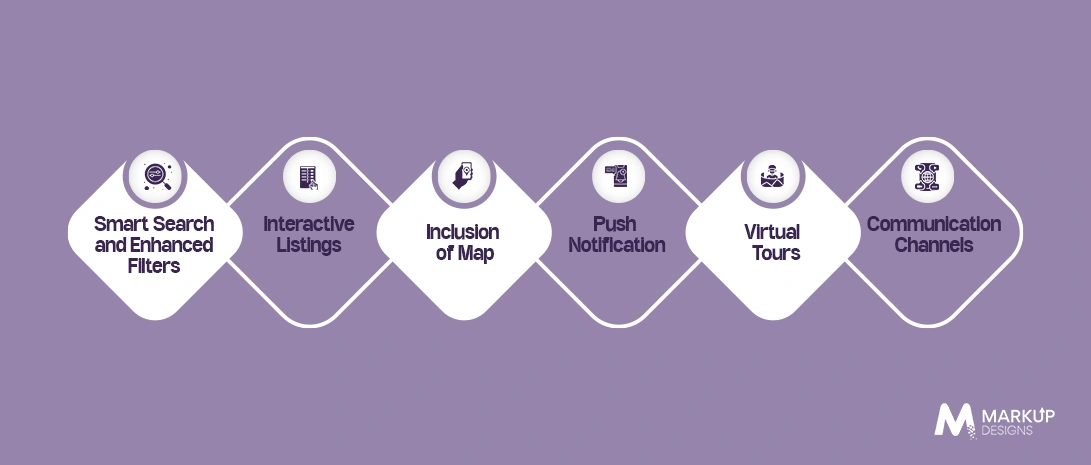
A good real estate app revolves around convenience, speed, and user experience. Today’s property portals need to provide smart search, instant communication, interactive property viewing, and smooth navigation.
Here are some of the most important features that make real estate apps attractive, engaging, and conversion-oriented to users.
Smart Search and Enhanced Filters
Search functionality is one of the vital features of any real estate app. Users should be able to easily find properties that match their exact preferences without going through hours of listings that don’t match what they’re looking for.
Interactive Listings of Properties
Property listings should offer users comprehensive and visually appealing property information. Good photos, video walk-throughs, floor plans, and detailed descriptions help users get a sense of the property before they book a visit.
Well-organized listings may also include property specs, pricing information, nearby landmarks, amenities, payment plans, and developer info. Users can make more informed decisions with confidence due to transparency through interactive listings.
Inclusion of Map and Location Services
A property’s location is crucial when making property purchase or rental decisions. As a result, integration of maps is essential in real estate mobile applications. Integration of maps allows users to see the precise location of the property they are searching for, including any surrounding facilities.
Integration with features such as location-based recommendations of properties, neighborhood insights, distance travel calculation, and discovery of nearby properties makes the application user-friendly. It also helps in integrating maps to aid property searches.
Push Notification
Users can be notified about new property listings, price changes, saved search results, appointments, promotions, and other activities through push notifications, which engage users and ensure regular updates are made regarding the user’s activities.
Virtual Tours of Properties
Virtual tours of properties have become an important part of modern real estate applications. They provide virtual exploration of properties through 360-degree views, walkthroughs, and video tours without the need to visit the site physically.
The virtual tours save time for users and enable quicker identification of potential properties. They are particularly helpful to international users, professionals, or users scouting for properties in another city altogether.
Communication Channels
Effective and secure communication channels are necessary for an effective real estate app. The communication channel may include in-app messaging options, such as voice calls, video calling options, instant messages, and inquiry forms that ensure smooth communication.
The security aspect ensures the safety of personal information while allowing quicker response times. Automated messaging features may be integrated within some apps to ensure quick replies to routine questions.
What is the Process to Build a Real Estate Application?
Research
Before beginning work on developing an application in real estate field, you should conduct some research on how people’s needs in this area are catered to by existing mobile apps in real estate. Discover gaps in the market of real estate mobile apps and use statistics to design solutions for real estate mobile apps that cater to those requirements. You can also research your competitors and use SWOT analysis to discover what their strong sides are and using the similar tactics.
Search and Filter Options
One of the main advantages of a mobile real estate app is that it will allow you to search, sort, and filter the search results based on different parameters. The mobile real estate app filters can depend on location, real estate sizes, amenities, and listing price.
Create a real estate database
After researching the real estate app, it is time to develop a real estate database. In case you intend to create real estate apps for rentals, a large and detailed database with relevant listings is very important. These real estate mobile app development capabilities can also be used for other mobile applications like shopping, evaluation, and even renting.
Add monetization elements
A primary reason why real estate applications are created is due to the need to make use of the functions of such apps. People will be paying money in order to use these real estate application features. The real estate agency services provide special access to the buyers and sellers using property listings and alert notifications on the application. Real estate agents also benefit from the monetization process through mobile real estate applications.
Why Partner with Markup Designs to Develop a Real Estate Application?
Markup Designs is an app development firm that specializes in creating high-performance, scalable real estate apps development in Dubai with great user interface design. Our development company provides customized software solutions for real estate businesses, agencies, startups, and enterprises, aiming to improve their online presence.
Our developers use their skills in mobile app development, cloud computing technology, user interface/user experience design, and custom application development to develop secure and feature-rich applications. Whether it is an enhanced search engine, interactive listings, a virtual tour, or other functionalities, we develop real estate apps.
Moreover, we offer full-cycle development services from strategy development through design, development, deployment, and maintenance. Through the use of the latest technologies and techniques, we help our clients develop future-oriented applications.
Ready to Build a High-Performing Real Estate App Like Property Finder?
No matter if you are a startup, a real estate firm, or an enterprise business, it may be useful to invest in an advanced real estate software solution. It could help you manage the process of property searching, engage with your clients better, and even generate extra income sources. With the appropriate use of technology solutions, you will turn your ideas into reality.
Ready to Build a High-Performing Real Estate App Like Property Finder?
No matter if you are a startup, a real estate firm, or an enterprise business, it may be useful to invest in an advanced real estate software solution. It could help you manage the process of property searching, engage with your clients better, and even generate extra income sources. With the appropriate use of technology solutions, you will turn your ideas into reality.

Conclusion
The need for real estate platforms that operate online is increasing at an impressive rate due to the reliance on online mobile and web applications by real estate buyers, sellers, agents, and investors. Platforms such as Property Finder have revolutionized the process through which real estate search and transactional activity takes place through their advanced search engines, AI suggestions, virtual tour capabilities, and effective communication facilities all in one application.
The cost associated with building a real estate application will vary depending on the nature of the project, ranging from application complexity, preferred platform, features, integrations, and scalability, among others. Though a basic MVP may require a moderate amount of budget allocation, more sophisticated real estate platforms with advanced features may require substantial budgeting.
FAQ
1. How much does it cost to develop a real estate app like Property Finder?
The development cost of a real estate app like Property Finder generally ranges between $40,000 and $300,000 or more. The final cost depends on factors such as app complexity, platform selection, features, integrations, UI/UX design, and scalability requirements.
2. How long does it take to build a real estate application?
The timeline for developing a real estate application depends on the project scope and feature set. A basic MVP can take around 3–6 months, while a feature-rich enterprise-level application may require 9–18 months for complete development and deployment.
3. Which technologies are commonly used in real estate app development?
Technologies such as Flutter and React Native are widely used for frontend development, while Node.js and Laravel are commonly preferred for backend development. Cloud platforms like AWS and Google Cloud are used for hosting, scalability, and data management.
4. What are the must-have features in a real estate application?
Some essential features include smart property search, advanced filters, interactive listings, map integration, push notifications, virtual property tours, AI-based recommendations, secure communication channels, and mortgage calculators.
5. Why is cloud hosting important for real estate apps?
Cloud hosting helps real estate applications manage high user traffic, property images, videos, and large databases efficiently. It also improves scalability, data security, backup management, and application uptime.
6. Can a real estate app generate revenue?
Yes, real estate apps can generate revenue through multiple monetization models such as subscription plans for agents, premium memberships, sponsored listings, in-app advertising, commissions, and partnerships with banks or financial institutions.
7. What factors affect the total development cost of a real estate app?
The overall cost is influenced by app complexity, number of features, development platform, technology stack, third-party integrations, UI/UX design requirements, AI functionalities, and ongoing maintenance costs.
8. Why are virtual property tours important in real estate applications?
Virtual tours allow users to explore properties remotely through 360-degree walkthroughs and immersive experiences. This feature improves user engagement, saves time, and helps buyers make faster property decisions.
Author's Perspective
From my point of view, the real estate market stands on a crossroads when going digital is no longer a choice but a must. It is evident from the example of Property Finder which managed to make life easier for users by consolidating all the stages of finding an apartment into a unified digital ecosystem. This trend is based on the behavioral patterns of people who appreciate convenience and time-saving.
Based on my experience, it is quite common that businesses underestimate the significance of the development process and limit themselves to building features of the platform. In reality, features such as AI-powered suggestions, virtual tours, and filtering tools are important only if a company builds its platform with a specific user journey and strategy in mind.
Discuss Your Project NowGaurav Goyal
Global Sales- VP
Related Posts

Cost to Build a Mobile App in Qatar...

How Much Does It Cost to Build an...

How to Build a Car Wash App: Development...
Insights Are Valuable & Execution is Priceless
You’ve read about the digital future. Now, let’s build the infrastructure to take you there. Move your strategy from the page to the product.
Design Your Solution Now
Contact Us
Schedule The Appointment At Your Convenience Date And Time.
30 Min
Web Conference
Time Zone
Indian standard time (08:30pm)

Thanks For Getting In Touch!
You’ve Taken The First Step Toward Transforming Your Digital Presence. Our Experts Will Reach Out Shortly To Take It Forward.
Launch Your Dream Project
Provide a brief overview of your project, and our specialists will evaluate your requirements. We will connect with you to explore how the right digital solutions can help you launch faster.