

In Brief
- Strategic Alignment: Traditional agency reporting is failing; modern business growth requires a synchronized digital roadmap that maps every dollar spent directly to bottom-line revenue.
- Human-Centered Experience: Design cannot just be aesthetic—73% of financial technology applications are deleted within a single week due to weak validation, requiring strict conversion-centered frameworks to survive.
- Native Organic Traffic: Sustained industry dominance requires platforms built to be SEO-native from the ground up to counteract zero-click searches and complex AI-driven search models.
- Predictive Architecture: Leading brands are shifting from retrospective historical data dashboards to internal machine learning models that forecast customer lifetime value and intercept churn.
- Scaled Experimentation: Leveraging generative AI as a high-tempo automation engine allows enterprises to execute programmatic asset testing at a speed impossible for standard teams.
- The Growth Sprint: Lasting market authority is captured through a rapid, four-stage loop: Discovery & Audit, Strategy & Planning, Full-Service Execution, and Automated Scaling.
The modern industrial landscape is fiercely competitive, but scaling an enterprise or digital product today is far more complex than simply executing a marketing budget or pushing out a beautiful application. Visionary brands face an array of high-stakes operational obstacles simultaneously.
Decision-makers are caught trying to capture instant user engagement while navigating strict data privacy compliance rules like GDPR and CCPA, integrating fragmented marketing tech stacks, and fighting dropping consumer retention rates across every industry sector.
Worse yet, traditional agencies keep providing surface-level dashboards and vanity metrics that fail to clearly explain actual return on investment. A minor friction point in your application’s user flow, an unoptimized search footprint, or a slow customer engagement journey quickly defaults to lost market share and missed conversions.
To reverse these vulnerabilities, modern industry leaders are transforming their digital presence into a highly integrated, data-driven growth engine.
In this comprehensive guide, we’ll map out the technical frameworks, execution strategies, experience engineering, and advanced AI methodologies required to build your platform into a dominant global force.
Why Enterprise Digital Transformation Strategy is the Real Foundation
Many businesses rush directly into website redesigns, advertising campaigns, AI integrations, or mobile app development without fixing the deeper operational inefficiencies underneath their systems. This creates fragmented digital ecosystems where marketing, customer experience, operations, analytics, and infrastructure operate independently rather than as one synchronized business engine.
This is one of the biggest reasons digital transformation initiatives fail.
True enterprise digital transformation is not simply about adopting new technologies. It is about restructuring how an organization operates, communicates, scales, stores data, automates workflows, and delivers customer value across every department.
Modern enterprises require a fully integrated digital transformation strategy capable of aligning technology investments directly with operational efficiency, scalability, security, and long-term revenue growth.
Without a structured transformation framework, organizations often face:
- disconnected software systems
- inconsistent customer experiences
- siloed business data
- poor operational visibility
- duplicated workflows
- rising infrastructure costs
- delayed decision-making
- scalability bottlenecks
To solve these issues, businesses are increasingly modernizing their core operational infrastructure through enterprise-wide digital transformation initiatives.
This includes:
- IT infrastructure modernization
- cloud migration strategies
- AI-driven business automation
- centralized data ecosystems
- enterprise workflow automation
- predictive analytics systems
- intelligent customer engagement frameworks
- cybersecurity modernization
Instead of treating departments as isolated operational units, transformation-focused enterprises build connected ecosystems where customer data, operational systems, analytics platforms, marketing infrastructure, and automation tools continuously communicate in real time.
For example, modern retail enterprises now integrate:
- inventory systems
- customer behavior analytics
- CRM platforms
- AI-powered forecasting
- logistics management
- performance marketing dashboards
into one synchronized operational infrastructure capable of making predictive business decisions automatically.
Similarly, financial institutions are modernizing legacy banking infrastructure using:
- AI fraud detection systems
- cloud-native transaction processing
- automated compliance monitoring
- predictive customer intelligence
- intelligent onboarding systems
to improve scalability, reduce risk exposure, and strengthen customer trust.
This shift toward enterprise-wide modernization is also accelerating cloud and data transformation strategies.
Businesses are increasingly replacing outdated on-premise systems with:
- hybrid cloud infrastructure
- scalable API ecosystems
- centralized data lakes
- real-time analytics pipelines
- microservices architecture
- enterprise automation platforms
This modernization enables organizations to process operational intelligence faster, improve system flexibility, reduce infrastructure limitations, and support AI-powered scalability across departments.
At the same time, digital transformation must also prioritize cybersecurity, governance, and compliance infrastructure.
As organizations process larger volumes of customer and operational data, secure digital architecture becomes critical. Businesses must integrate:
- zero-trust security frameworks
- encrypted cloud environments
- identity access management systems
- GDPR and CCPA compliance
- enterprise threat monitoring
- AI governance protocols
directly into transformation planning from the beginning.
Ultimately, successful enterprise digital transformation is not driven by isolated tools or one-time software upgrades. It is built through intelligent operational restructuring where technology, automation, data, and customer experience work together as one scalable business ecosystem.
Common Digital Transformation Challenges Enterprises Face

While digital transformation creates major growth opportunities, implementation is often far more complex than businesses initially expect. Many organizations underestimate how deeply operational systems, workflows, employee structures, and legacy technologies affect transformation success.
One of the biggest transformation obstacles is legacy infrastructure dependency.
Many enterprises still operate on outdated systems that were never designed to support:
- cloud scalability
- AI integrations
- real-time analytics
- automation frameworks
- API-based connectivity
As a result, organizations often struggle with fragmented operations, slow system performance, disconnected customer data, and limited scalability.
Data quality is another major challenge.
AI-driven transformation depends heavily on structured, centralized, and reliable data ecosystems. However, many businesses operate with:
- duplicate databases
- inconsistent reporting structures
- disconnected software tools
- incomplete customer records
- inaccurate analytics pipelines
Poor data quality significantly reduces the effectiveness of predictive analytics, AI automation, and operational intelligence systems.
Employee resistance also slows transformation initiatives across industries.
Digital transformation changes how teams work, collaborate, communicate, and manage operations. Without proper internal alignment and leadership support, organizations often experience:
- workflow disruption
- low technology adoption
- operational confusion
- inefficient implementation cycles
Cybersecurity and compliance risks further complicate enterprise modernization.
As businesses adopt cloud infrastructure, AI systems, automation platforms, and centralized data environments, security vulnerabilities increase significantly. Organizations must protect:
- customer information
- financial data
- operational systems
- cloud environments
- AI workflows
through enterprise-grade cybersecurity frameworks and compliance governance.
Another major issue is unrealistic transformation expectations.
Many businesses expect immediate growth simply by adopting AI tools or automation software. In reality, enterprise digital transformation requires:
- long-term planning
- operational restructuring
- infrastructure modernization
- continuous optimization
- cross-department integration
Organizations that approach transformation strategically are far more likely to achieve sustainable operational efficiency and scalable long-term growth.
Engineering Digital Experiences That Drive Business Growth
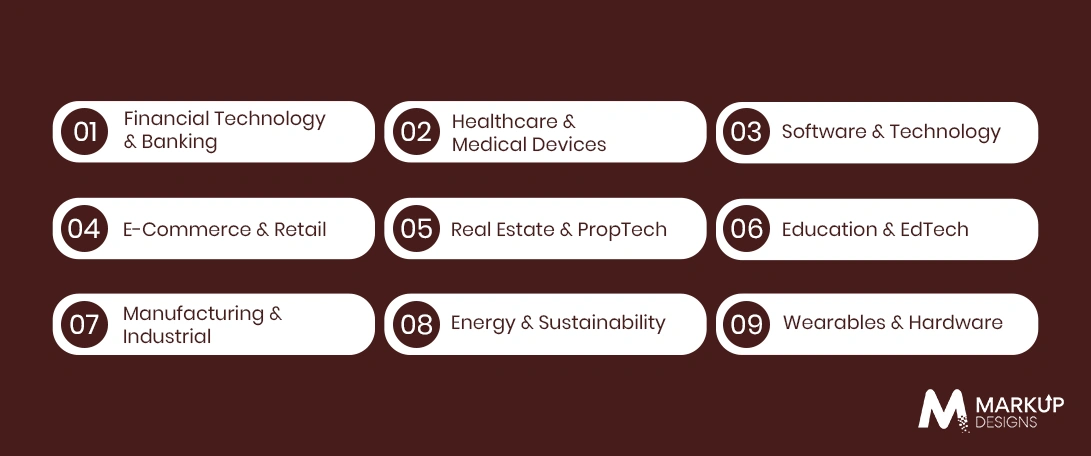
Creating industry impact today requires far more than visually appealing websites or mobile applications. Modern enterprises are increasingly investing in digital transformation strategies that combine AI-driven automation, predictive analytics, cloud modernization, intelligent customer experiences, and scalable operational infrastructure into one connected ecosystem.
Across industries, businesses are under pressure to improve operational efficiency, reduce customer friction, modernize legacy systems, and deliver highly personalized digital experiences at scale.
This shift is transforming how organizations design digital platforms, automate workflows, process data, engage customers, and make business decisions.
Financial Technology & Banking
Financial institutions are rapidly modernizing outdated banking infrastructure through AI-driven transformation and cloud-native financial ecosystems.
Traditional banking applications often struggle with:
- poor onboarding experiences
- identity verification delays
- security concerns
- fragmented customer journeys
- legacy infrastructure limitations
This directly impacts customer retention. Studies show that nearly 73% of fintech applications lose users within the first week due to onboarding friction, trust gaps, and poor user experience.
Modern fintech platforms now integrate:
- AI-powered onboarding validation
- fraud detection systems
- predictive financial analytics
- intelligent customer support
- automated compliance monitoring
- cloud-based transaction infrastructure
These systems help financial organizations:
- reduce onboarding abandonment
- improve transaction security
- strengthen customer trust
- accelerate verification processes
- improve retention rates
- support scalable digital banking operations
Enterprise banking transformation is increasingly shifting toward predictive customer intelligence, AI-powered personalization, and real-time financial automation systems capable of improving both operational efficiency and customer engagement simultaneously.
Healthcare & Medical Devices
Healthcare organizations are undergoing large-scale digital transformation as providers modernize patient experiences, operational systems, and medical data infrastructure.
One of the biggest healthcare challenges is technology adoption resistance among both patients and providers. Complex interfaces, disconnected systems, and poor usability often reduce operational efficiency and patient engagement.
Modern healthcare ecosystems are increasingly integrating:
- AI-assisted diagnostics
- predictive patient analytics
- cloud-based patient management systems
- telemedicine platforms
- automated appointment workflows
- intelligent healthcare chatbots
- wearable health monitoring systems
These technologies help healthcare providers:
- improve patient communication
- reduce administrative workloads
- accelerate diagnosis support
- optimize scheduling efficiency
- improve remote healthcare accessibility
- increase operational scalability
Cloud modernization is also allowing hospitals and healthcare providers to centralize patient data securely while improving interoperability across departments and digital systems.
As healthcare systems become increasingly data-driven, organizations are focusing heavily on cybersecurity, compliance infrastructure, and AI governance to protect sensitive medical information.
Software & Technology
The SaaS and enterprise software industry is becoming increasingly saturated, making customer retention and product adoption major operational challenges.
Many traditional B2B platforms suffer from:
- high churn rates
- poor onboarding experiences
- low feature adoption
- generic user experiences
- fragmented workflows
Modern software companies are now using AI-driven transformation frameworks to create highly personalized and intelligent digital platforms.
This includes:
- predictive onboarding systems
- AI-powered workflow automation
- behavioral analytics
- intelligent recommendation engines
- customer usage forecasting
- automated support ecosystems
Predictive analytics systems help SaaS companies identify:
- churn risk
- feature adoption behavior
- high-value customer segments
- engagement drop-off patterns
This allows businesses to proactively improve retention and customer satisfaction before users disengage.
Modern enterprise software platforms are also increasingly moving toward cloud-native infrastructure and scalable API ecosystems capable of supporting long-term operational growth.
E-Commerce & Retail
Retail and e-commerce businesses are rapidly adopting AI-powered commerce ecosystems to improve customer experiences and operational efficiency.
Traditional retail challenges include:
- abandoned shopping carts
- inconsistent customer engagement
- inventory inefficiencies
- poor personalization
- fragmented omnichannel experiences
To solve these issues, businesses are integrating:
- AI-powered recommendation engines
- predictive inventory forecasting
- customer behavior analytics
- automated marketing systems
- dynamic pricing models
- conversational commerce platforms
These technologies help retailers:
- improve conversion rates
- reduce cart abandonment
- optimize inventory management
- personalize customer journeys
- increase average order values
- strengthen customer loyalty
Cloud-based retail infrastructure also allows businesses to synchronize:
- inventory systems
- CRM platforms
- logistics operations
- customer analytics
- marketing automation
into one connected operational ecosystem.
This creates faster decision-making and more scalable retail operations.
Real Estate & PropTech
Real estate businesses are increasingly modernizing customer engagement and operational workflows through AI-powered digital transformation systems.
Traditional real estate processes often involve:
- long sales cycles
- fragmented communication
- delayed lead response
- complex documentation workflows
- inconsistent customer experiences
Modern PropTech ecosystems now integrate:
- AI-powered property recommendations
- predictive buyer analytics
- automated lead nurturing
- virtual property experiences
- cloud-based documentation systems
- intelligent CRM workflows
These systems help businesses:
- accelerate lead qualification
- improve customer engagement
- reduce administrative workload
- shorten sales cycles
- improve property discovery experiences
Predictive analytics also helps real estate firms identify:
- high-intent buyers
- investment trends
- pricing patterns
- customer behavior signals
This improves both operational efficiency and strategic decision-making.
Education & EdTech
Educational institutions and eLearning platforms are increasingly investing in AI-driven transformation to improve engagement, accessibility, and personalized learning experiences.
Traditional digital learning systems often suffer from:
- low student engagement
- inconsistent learning outcomes
- poor personalization
- limited scalability
- inefficient administrative workflows
Modern EdTech ecosystems are integrating:
- AI-powered learning personalization
- predictive student performance analytics
- automated assessment systems
- intelligent tutoring platforms
- cloud-based collaboration systems
- adaptive learning environments
These technologies help educational organizations:
- improve student engagement
- personalize learning experiences
- automate administrative operations
- improve remote accessibility
- enhance learning performance tracking
Predictive analytics systems also help institutions identify:
- at-risk students
- engagement drop-offs
- performance patterns
- learning behavior trends
This supports more data-driven educational decision-making.
Manufacturing & Industrial
Manufacturing industries are increasingly modernizing operations through AI-powered automation, industrial IoT systems, and predictive operational intelligence.
Traditional manufacturing environments often struggle with:
- equipment downtime
- supply chain inefficiencies
- manual operational workflows
- delayed maintenance response
- fragmented production visibility
Modern industrial transformation systems now integrate:
- predictive maintenance analytics
- AI-powered production monitoring
- smart factory infrastructure
- industrial automation systems
- supply chain intelligence platforms
- cloud-connected operational ecosystems
These technologies help manufacturers:
- reduce equipment failures
- improve operational visibility
- optimize production efficiency
- lower maintenance costs
- improve supply chain forecasting
Industrial digital transformation is becoming critical for long-term scalability, operational resilience, and global competitiveness.
Energy & Sustainability
Energy and sustainability sectors are increasingly using AI-driven systems to improve resource management, operational efficiency, and environmental monitoring.
Modern energy transformation strategies involve:
- predictive energy analytics
- smart grid infrastructure
- automated resource monitoring
- cloud-based sustainability reporting
- intelligent energy optimization systems
These technologies help organizations:
- improve energy efficiency
- reduce operational waste
- optimize resource allocation
- support sustainability compliance
- improve infrastructure visibility
As sustainability regulations continue evolving globally, intelligent operational systems are becoming increasingly important for long-term energy management strategies.
Wearables & Hardware
Wearable technology and connected hardware ecosystems rely heavily on seamless digital experiences, cloud connectivity, and real-time operational intelligence.
Modern wearable ecosystems increasingly integrate:
- AI-powered health analytics
- cloud synchronization
- predictive monitoring systems
- real-time data processing
- IoT-enabled infrastructure
Businesses developing wearable products must focus heavily on:
- usability engineering
- battery optimization
- cloud scalability
- secure data processing
- intuitive customer experiences
Successful adoption depends on simplifying highly complex technologies into frictionless, user-friendly digital ecosystems capable of delivering measurable everyday value.
Conversion-Centered Design Frameworks
To build scalable digital systems capable of handling modern enterprise challenges, organizations must rely on structured, conversion-centered experience engineering frameworks.
These include:
- User Research & Persona Development
Analyzing customer behavior patterns, intent signals, and operational workflows before platform development begins. - Information Architecture & User Flows
Designing frictionless navigation systems that reduce confusion and improve engagement. - Wireframing & Interactive Prototyping
Validating usability and workflow efficiency through early-stage functional testing. - Visual Design Systems
Creating scalable, component-based UI ecosystems for consistency across platforms. - Interaction Design & Microinteractions
Improving usability through responsive feedback systems and intelligent interaction patterns. - Accessibility (WCAG) Compliance
Ensuring platforms remain inclusive, globally accessible, and compliant with modern accessibility standards. - Predictive Experience Optimization
Using behavioral analytics and AI systems to continuously optimize user journeys and conversion performance in real time.
Building an SEO-Native Discovery Engine
Organic visibility cannot be treated as a post-launch add-on. To unlock real compound growth, digital infrastructure must be engineered to be SEO-native from the ground up. This intentional design makes organic traffic a core platform capability rather than an afterthought, placing your brand directly in front of buyers at the precise moment they are looking to buy.
Modern search engine optimization requires moving beyond basic keyword stuffing. It demands an enterprise-grade approach designed for a complex algorithmic environment:
- Technical & Programmatic SEO: Organizing crawlable, high-performance site architectures paired with automated, structured page generation to capture massive search intent.
- AI and Generative SEO: Optimizing brand content to rank prominently inside generative search engine ecosystems and aggregate models.
- GEO-Targeted SEO: Customizing visibility footprints to capture high-intent geographic and regional user traffic.
- Voice Search Optimization (VISO): Structuring conversational data layers to match natural spoken queries used on mobile and smart devices.
- Mobile-First SEO: Ensuring the entire technical discovery framework is completely optimized for mobile speed and responsiveness.
- Zero-Click Search Optimization: Formatting content to win rich snippets and direct answers so your brand captures authority on the search page.
The 360-Degree Performance & Acquisition Architecture
Paid customer acquisition shouldn’t rely on guesswork or unvalidated vanity metrics. Scale demands a unified, programmatic methodology that looks across platforms to run predictable, calculated campaigns focused squarely on pipeline validation and unit economics.
An enterprise acquisition framework requires connecting Google Ads, Microsoft Advertising, and major paid media networks into one synchronized system. By running cross-channel advertising strategies through Full-Funnel Acquisition Systems, businesses can stop assessing channels in silos.
Instead, predictive pay-per-click campaign optimization and real-time budget re-allocations automatically move capital to top-performing assets, while programmatic ad creative testing identifies the exact combinations that drive sustainable growth.
How Enterprises Use AI for Competitive Advantage
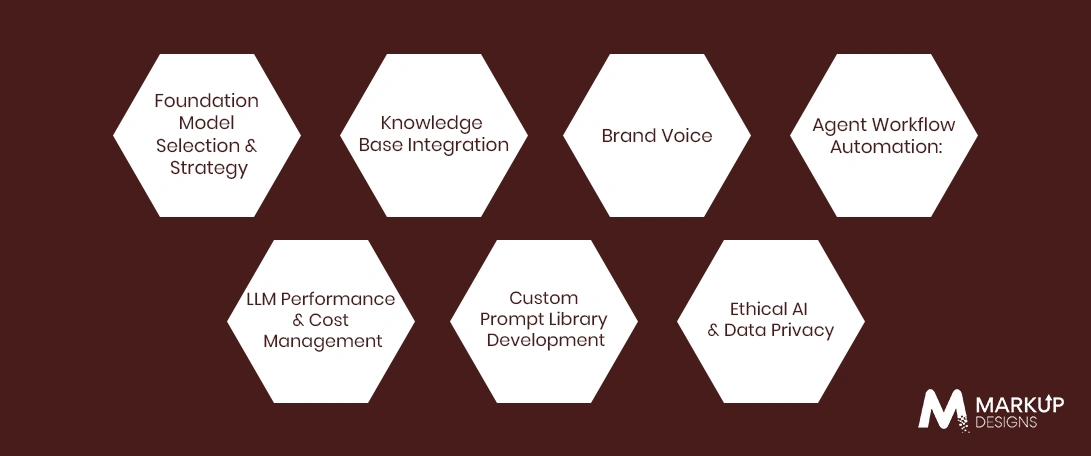
Most companies use artificial intelligence superficially, relying on basic out-of-the-box prompts. To build a true competitive advantage, leaders take general foundational models like ChatGPT, Gemini, Claude, and Perplexity and transform them into proprietary, high-value corporate intellectual property.
This deep optimization requires embedding specialized AI architecture directly into your company’s core operational infrastructure:
- Foundation Model Selection & Strategy: Identifying and deploying the exact core models that fit your specialized business vertical.
- Knowledge Base Integration (RAG): Connecting secure internal databases through Retrieval-Augmented Generation to allow AI to utilize unique data safely.
- Brand Voice Tone Fine-Tuning: Training models to perfectly match and execute your company’s specific voice and communication guidelines.
- Agent Workflow Automation: Designing intelligent, autonomous sales and marketing systems that reduce manual effort and execute complex tasks.
- LLM Performance & Cost Management: Monitoring token usage, API response speeds, and resource constraints to maximize software efficiency.
- Custom Prompt Library Development: Building specialized, tested internal prompt structures to keep operational output highly predictable.
- Ethical AI & Data Privacy Implementation: Ensuring all integrated generative workflows remain completely compliant with data privacy laws.
Cybersecurity, Compliance & Enterprise Risk Management

As enterprises accelerate digital transformation initiatives, cybersecurity is becoming one of the most critical operational priorities across industries.
Modern digital ecosystems process enormous volumes of:
- customer information
- financial transactions
- behavioral analytics
- operational intelligence
- AI-generated outputs
- cloud-based business data
Without strong governance frameworks, organizations become highly vulnerable to:
- ransomware attacks
- data breaches
- unauthorized access
- AI manipulation risks
- cloud vulnerabilities
- compliance violations
This is why modern enterprise transformation strategies increasingly integrate cybersecurity directly into infrastructure planning rather than treating it as a secondary IT function.
Organizations are adopting:
- zero-trust security models
- multi-factor authentication systems
- encrypted cloud architecture
- endpoint monitoring solutions
- identity access management frameworks
- AI governance policies
- automated threat detection systems
Compliance modernization is equally important.
Enterprises operating globally must align digital infrastructure with regulations such as:
- GDPR
- CCPA
- SOC 2
- ISO standards
- regional data privacy laws
AI-driven transformation also introduces new governance challenges around:
- algorithm transparency
- AI decision accountability
- secure model training
- ethical automation systems
Businesses that fail to prioritize cybersecurity and compliance during transformation often face operational disruption, financial penalties, reputational damage, and reduced customer trust.
Modern digital transformation, therefore, requires balancing scalability, automation, intelligence, and security simultaneously within one operational ecosystem.
Shifting From Retrospective Data to Predictive Intelligence
Looking back at historical reports only tells you how a campaign used to perform. True market authority requires predictive marketing, using machine learning to analyze past data so you can accurately anticipate market trends and customer behavior ahead of time.
By embedding custom ML models into your data pipelines, your business can run Predictive Audience Segmentation & Targeting. This architecture calculates your most valuable cohorts and forecasts lifetime value right from their initial interactions.
Instead of reacting after a customer drops off, AI-powered churn prevention systems identify subtle behavioral shifts, triggering automated retention workflows before the account leaves. Combined with predictive lead scoring and multi-touch attribution modeling, your sales teams can focus their energy exclusively on high-intent targets, making revenue generation predictable and stable.
High-Tempo Creative & Copy Intelligence
To find out which messages resonate best with customers, modern growth engines run high-frequency, automated testing variations that would take traditional creative teams weeks to build.
Using generative AI as an engine for scaled experimentation lets you produce thousands of ad variants and copy iterations instantly. These variations are automatically paired with Dynamic Landing Page Optimization, meaning your landing page layout, messaging, and calls-to-action adapt in real time based on user data, traffic source, and visitor intent. This agile, high-frequency approach maximizes conversion rates at a highly efficient scale.
Measuring Digital Transformation Success Through KPI Tracking

One of the biggest reasons enterprise transformation initiatives fail is the lack of measurable operational visibility. Businesses often invest heavily in modernization projects without clearly defining how success will be tracked across departments.
Modern digital transformation requires data-driven KPI frameworks capable of measuring both operational and financial impact.
Organizations increasingly monitor metrics such as:
- customer acquisition cost (CAC)
- customer lifetime value (CLV)
- churn reduction rates
- operational efficiency improvements
- workflow automation savings
- infrastructure scalability
- AI model performance
- employee productivity
- application performance
- conversion optimization rates
- system uptime and reliability
For example, businesses implementing predictive analytics systems often track:
- forecasting accuracy
- retention prediction efficiency
- lead scoring effectiveness
- sales cycle acceleration
Meanwhile, enterprises adopting AI-powered automation frameworks measure:
- manual workload reduction
- operational turnaround speed
- support ticket automation rates
- workflow optimization efficiency
KPI visibility allows organizations to continuously refine transformation strategies, allocate resources intelligently, and scale operations based on measurable business outcomes rather than assumptions.
Enterprise Digital Transformation Roadmap
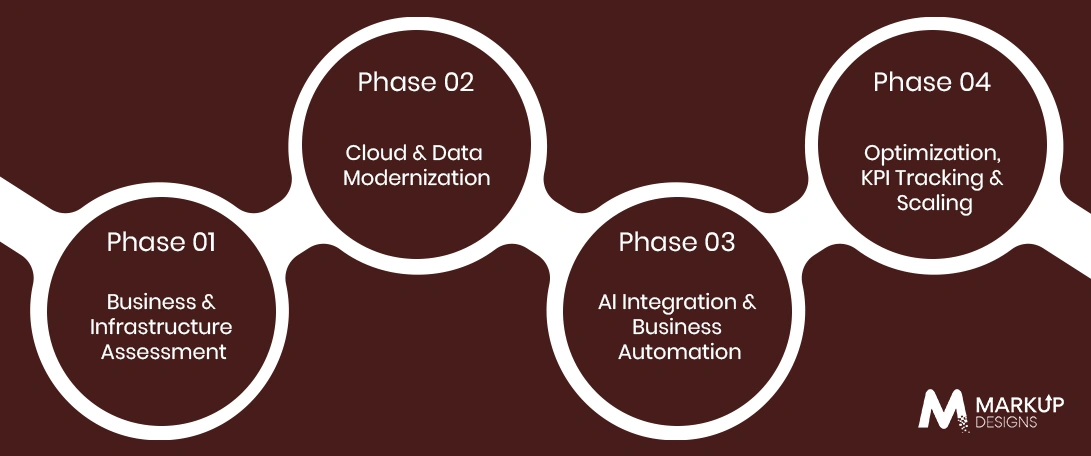
Successful digital transformation requires far more than deploying new software tools. Enterprises need a structured implementation roadmap capable of modernizing operations without disrupting scalability, security, or customer experience.
Most successful transformation initiatives follow a phased operational framework.
Phase 1: Business & Infrastructure Assessment
The first stage focuses on identifying operational inefficiencies, infrastructure limitations, and growth bottlenecks across the organization.
This includes:
- legacy system audits
- customer journey analysis
- workflow inefficiency mapping
- infrastructure performance evaluation
- cybersecurity risk assessment
- data architecture analysis
The goal is to understand where operational friction exists before introducing modernization systems.
Phase 2: Cloud & Data Modernization
Once operational gaps are identified, businesses begin restructuring their technology foundation.
This stage often includes:
- cloud migration strategies
- centralized data infrastructure
- API ecosystem integration
- ERP modernization
- analytics architecture deployment
- scalable storage environments
Modern cloud ecosystems allow organizations to process, analyze, and distribute operational intelligence much more efficiently.
Phase 3: AI Integration & Business Automation
After infrastructure stabilization, enterprises begin implementing intelligent systems capable of automating workflows and improving decision-making.
This includes:
- predictive analytics systems
- AI-powered customer engagement
- automated reporting workflows
- intelligent support systems
- machine learning models
- enterprise automation platforms
Organizations increasingly use AI-driven transformation frameworks to reduce manual dependency while improving operational speed and scalability.
Phase 4: Optimization, KPI Tracking & Scaling
Transformation does not stop after deployment.
Modern enterprises continuously optimize:
- operational efficiency
- infrastructure performance
- AI model accuracy
- customer engagement
- automation workflows
- predictive forecasting systems
This phase focuses heavily on KPI tracking, operational intelligence, and continuous scalability improvement.
The 4-Step Sprint to Scalable Growth
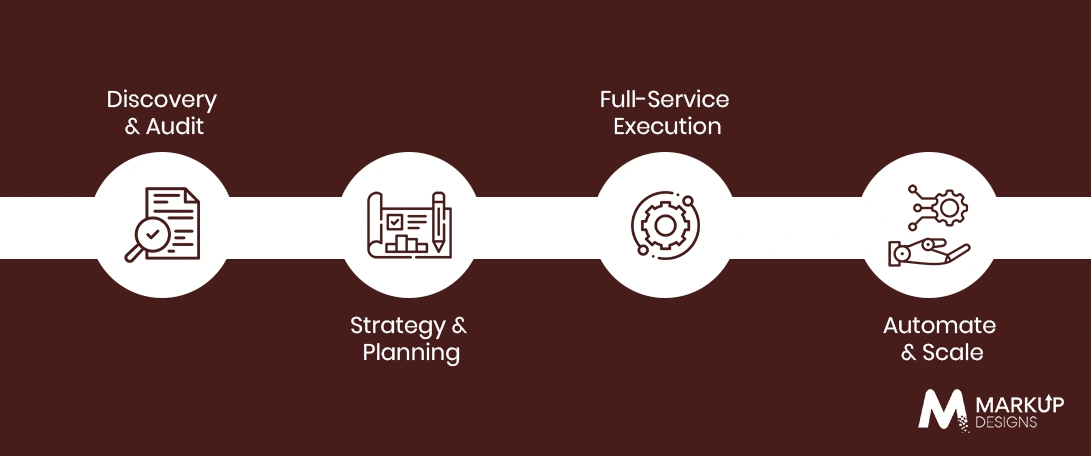
To help businesses move past stalled performance and build a self-sustaining growth engine, we run a repeatable, data-backed 4-Step Sprint Framework:
1. Discovery & Audit
We perform a comprehensive analysis of your entire digital presence to identify the biggest growth levers and revenue leaks. This uncovers structural vulnerabilities within your product flows, data pipelines, and acquisition campaigns.
2. Strategy & Planning
We align your core business objectives with an actionable, technical roadmap. This step prioritizes features, maps system architecture, outlines concrete timelines, and ensures complete data compliance across your tech stack.
3. Full-Service Execution
Our engineering and marketing teams deploy your validated growth plan. We build custom UI/UX design systems, write clean code, launch programmatic search networks, and activate full-funnel acquisition systems simultaneously.
4. Automate & Scale
We hand over full ownership of the underlying growth infrastructure to your business. Next, we embed custom machine learning models, launch autonomous workflow engines, and use high-velocity testing variants to scale your market share efficiently.
Choosing the Right Growth Tier for Your Business
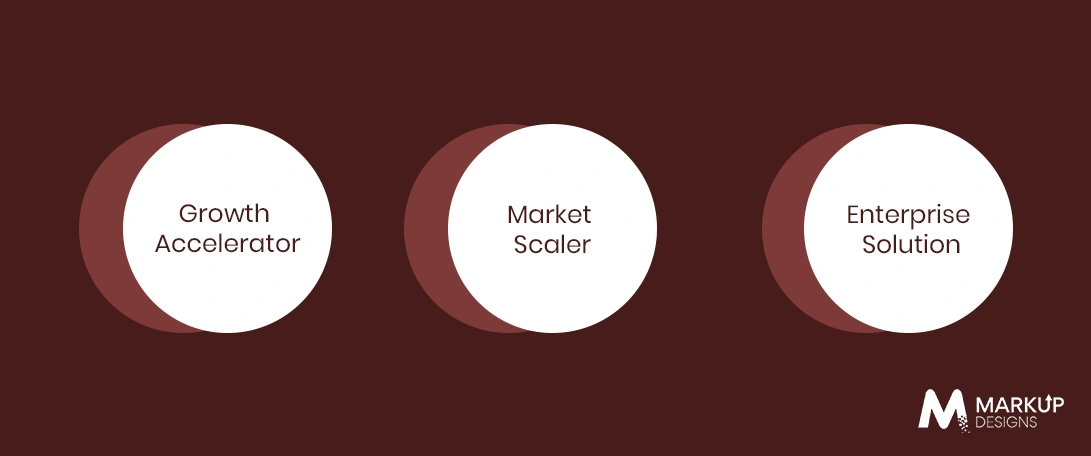
Every company requires a different level of operational support depending on its maturity, infrastructure, and current market position.
Growth Accelerator
Perfect for startups and emerging businesses. We set up your core marketing and analytics foundation, ensuring you have the data and systems needed to find your first wins and optimize your core funnel.
Market Scaler
For established companies ready to expand. This solutions layer includes everything in the Accelerator, plus advanced analytics, predictive modeling, and automated systems to help you scale efficiently.
Enterprise Solution
Our most comprehensive offering for market leaders. You get a dedicated team of experts and custom-built solutions, including bespoke AI models, to maintain and extend your competitive advantage.
Transform Your Vision with Markup Designs
Building a dominant digital platform is not just about writing clean code or running generic ads. It requires engineering a reliable, highly integrated digital system that users trust completely with their sensitive data and daily interactions. That is exactly where Markup Designs can step in to accelerate your business growth.
As a battle-tested digital transformation and technology partner, we help businesses navigate the complexities of modern engineering. From structural code optimization and advanced UI/UX design to custom AI deployment and automated acquisition systems, we build scalable platforms tailored to your precise revenue goals.
We prioritize secure, conversion-centered app engineering from day one. By wrapping your applications in predictive intelligence and modern data compliance frameworks, we eliminate performance bottlenecks and help you capture lasting market authority.
Conclusion
Digital transformation is no longer a future initiative or optional upgrade. It has become the foundation of sustainable business growth, operational scalability, and long-term market relevance. Organizations that successfully integrate AI-driven automation, predictive analytics, cloud modernization, intelligent customer experiences, and secure digital infrastructure into one connected ecosystem are the ones shaping the future of their industries. As markets become increasingly competitive and data-driven, businesses that continue operating on fragmented systems and outdated processes risk losing efficiency, customer trust, and growth opportunities.
The companies that lead tomorrow will be those that treat digital transformation not as a one-time technology investment, but as a continuous strategy for innovation, agility, and scalable enterprise growth.
FAQs
1. Why do generic digital marketing reports often lead businesses astray?
Most traditional agencies focus on surface-level vanity metrics and historical dashboards, which don’t map back to revenue. High-impact growth requires building a technical data infrastructure that connects every dollar spent directly to bottom-line conversions and business intelligence.
2. Why do nearly three-quarters of financial technology apps fail within the first week?
73% of fintech applications are uninstalled within seven days due to poor user validation and weak engagement design. Overcoming this requires human-centered, conversion-focused engineering choices like seamless information architectures and interactive microinteractions.
3. How do you transform a general AI model into a competitive business asset?
Instead of using public tools superficially, enterprises must fine-tune foundation models on their proprietary business workflows and safely integrate internal knowledge bases via Retrieval-Augmented Generation.
4. What is the business advantage of predictive marketing over historical reporting?
Historical reporting only looks backward at past performance. Predictive machine learning models embed directly into your infrastructure to analyze behavioral data trends in real time, forecast customer lifetime value early, and score inbound sales leads automatically.
5. How does the 4-Step Sprint framework accelerate business scaling?
The sprint framework breaks down growth into four practical stages: a comprehensive audit to stop revenue leaks, structured strategic planning, full-service technical execution, and automated scaling to hand over a high-performing growth engine.
Author's Perspective
Many leadership teams get caught up trying to launch digital products quickly, frequently overlooking how critical deep integration, data compliance, and predictive infrastructure are for long-term survival. In a fast-moving market, minor gaps in user flows or unoptimized data tracking can completely stall user retention and drag down acquisition margins. True industry impact isn’t built on one-off creative campaigns; it is won by engineering a reliable, highly responsive digital system centered entirely around customer validation. Investing in a structured, data-driven growth plan from day one is what separates enduring market leaders from short-lived digital trends.
Discuss Your Project NowGaurav Goyal
Global Sales- VP
Related Posts

Why Businesses in Oman Need Digital Transformation Services

Digital Transformation in Financial Services: Trends, Benefits &...
IoT in Banking: Transforming Financial Services Through Connected...
Insights Are Valuable & Execution is Priceless
You’ve read about the digital future. Now, let’s build the infrastructure to take you there. Move your strategy from the page to the product.
Design Your Solution Now
Contact Us
Schedule The Appointment At Your Convenience Date And Time.
30 Min
Web Conference
Time Zone
Indian standard time (08:30pm)

Thanks For Getting In Touch!
You’ve Taken The First Step Toward Transforming Your Digital Presence. Our Experts Will Reach Out Shortly To Take It Forward.
Launch Your Dream Project
Provide a brief overview of your project, and our specialists will evaluate your requirements. We will connect with you to explore how the right digital solutions can help you launch faster.