
In Brief
- The secure patient portal will help users see their medical records, check test results, schedule appointments, manage their prescriptions, and communicate with physicians without exposing sensitive information about their health.
- The major security measures required for developing such a portal are multi-factor authentication, data encryption, role-based access control, patient consent management, audit logging, and secure messaging.
- The process of creating a secure patient portal consists of requirements definition, technology selection, design of the user interface, EHR/EMR integration, implementation of security measures, security testing, and maintenance of the solution.
- Costs of developing a basic portal are estimated at $15,000–$30,000, the cost of a mid-range one at $30,000–$70,000, and an advanced portal at $70,000–$150,000+. The development period varies from 2 to 4 months for basic portals to 4 to 9 months for advanced ones and more.
- Security auditing, software updates, staff training, activity logging, and backups will ensure that the portal remains safe. Markup Designs is ready to assist in your patient portal project.
In healthcare, a lot of confidential patient information is handled every day, from their medical history to their prescriptions, diagnostic tests, and even personal data. Proper handling of such information ensures the security of patient data and fosters trust among patients. In such a scenario, the development of a patient portal can prove highly beneficial.
A patient portal enables patients to access their medical records, make appointments, check test results, communicate with healthcare professionals, and perform various other activities pertaining to their healthcare. Nevertheless, there are also associated risks of unauthorized access, data breaches, and insecure authentication for these services.
The development of a secure patient portal goes beyond just developing an application that offers these services. There are certain considerations that need to be taken into account. In this blog, we will look into the development of a secure patient portal in healthcare, its security requirements, challenges faced during its development, and many other aspects.
What is a Secure Patient Portal?
A secure patient portal refers to an internet-based application through which patients can access their healthcare information through a website or mobile application. This enables the patients to access medical records, view test results, schedule appointments, refill prescriptions, and communicate with the healthcare provider.
The security of the patient portal lies in the proper implementation of safeguards to ensure the safety of health information. Such safeguards may include the means of accessing the portal, data encryption, access controls, and security monitoring. The only people who should have access to particular patients’ records are those authorized to do so.
While the patient portal helps healthcare providers with various activities related to daily operations, such as reduced paperwork and improved communication, it should also be noted that it involves security. The security of the portal should be implemented alongside its usability since the patients need to access the required services with minimal effort, while the confidentiality of information should be protected.
Why is Security Important in Patient Portal Development?
The patient portal may have personal information like medical record, prescription, test results, and many other things. It is important to protect this information since it helps to ensure the trust of the patients and good management of information by the healthcare provider. In case of lack of protection, patient portals may be vulnerable to various cyberattacks, unauthorized access, and data leaks.
Here are some key reasons why security matters in patient portal development:
- Protects Patient Privacy: The security system helps to protect the patient’s information from leaking outside and being available to any person.
- Reduces Data Breach Risks: Encryption and many other measures help to prevent data breaches and unauthorized access to the patient’s record.
- Increases Patient Trust: People tend to use e-healthcare services if they are sure about the safety of their information.
- Supports Regulatory Compliance: Healthcare providers should meet regulatory requirements for data protection and healthcare privacy.
- Enhances Access Control: The right permissions will enable the patients, medical practitioners, and administrative personnel to access only the data that is necessary for them.
- Provides Consistent Healthcare Services: The effective implementation of security measures enables healthcare providers to deliver their services consistently and effectively.
Key Security Features Every Patient Portal Should Have
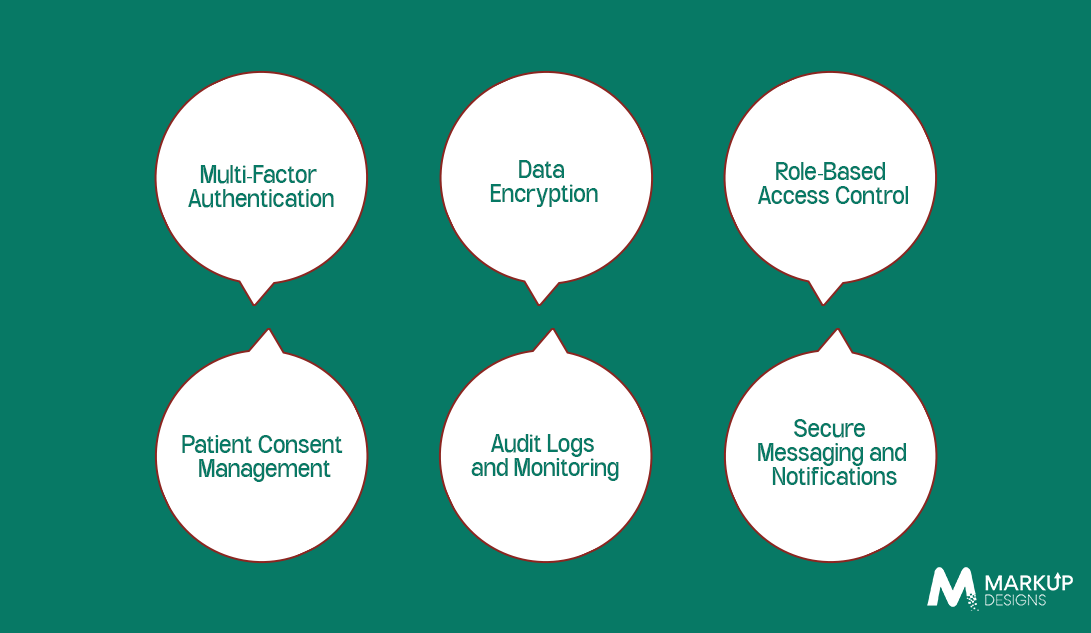
However, to ensure that patient portals are secure and reliable platforms, certain characteristics should be in place. For example, there should be several components that will provide security for patient data and prevent access to it by people who are not authorized.
- Multi-Factor Authentication
This characteristic involves providing additional means for user authentication through a different method of verification.
- Data Encryption
It ensures that patient information is protected during the transfer between systems and when stored in databases.
- Role-Based Access Control
Patients, doctors, nurses, and other people involved in healthcare have access only to the information and functions that they require according to their roles.
- Patient Consent Management
It allows healthcare organizations to register and manage patient permissions related to access to the information.
- Audit Logs and Monitoring
Records important activities, such as logins and record access, so suspicious behaviour can be identified and investigated.
- Secure Messaging and Notifications
This makes sure that messages exchanged between patients and medical practitioners are secure and that no unnecessary information is disclosed through notifications.
Including these features during development helps establish a stronger security foundation for the portal.
How to Develop a Secure Patient Portal for Healthcare
A good and secure design of the patient portal can be developed through proper planning, correct technologies and understanding of the healthcare processes. Every stage of the development process should provide the safety of patients’ personal information and simplicity for the patients and healthcare professionals to use the portal.
Step 1: Definition of Requirements and Security Goals
Define what exactly patients and healthcare workers would need from the portal. It means defining the features of the portal, the type of patient data, roles of the users and the requirements for safety of the portal.
Step 2: Choosing the Proper Architecture and Technologies
It is necessary to define which technologies will help to develop a proper portal providing safety of the data, reliability of the work of the portal, and further scalability of the portal.
Step 3: Create a User-Friendly and Secure Interface
Design an intuitive interface through which patients could search their medical files, manage appointments, and interact with care providers.
Step 4: Connecting EHR/EMR System and Other Healthcare Systems
The portal should be connected to the electronic health records system, the laboratory systems, the pharmacy systems, and the appointment scheduling system, where necessary using APIs that ensure that information is secure through the process of transferring it between the various systems.
Step 5: Implementing Security Features
This step requires implementing encryption, multi-factor authentication, role-based permissions, session management, and audit logging to ensure that users have access to information that they are permitted to see.
Step 6: Conduct Security Testing and Risk Assessments
At this stage, vulnerability assessments, access control testing, configuration assessments, and data leakage tests need to be done to test the portal’s security features before it is implemented.
Step 7: Deployment, Monitoring and Updating the Portal
It is advisable to deploy the portal in phases whenever possible. The portal will have to be monitored on a regular basis to ensure its performance.
Read Also: How Patient Scheduling Software Improves Healthcare Operations
Common Security Challenges in Patient Portal Development and How to Address Them
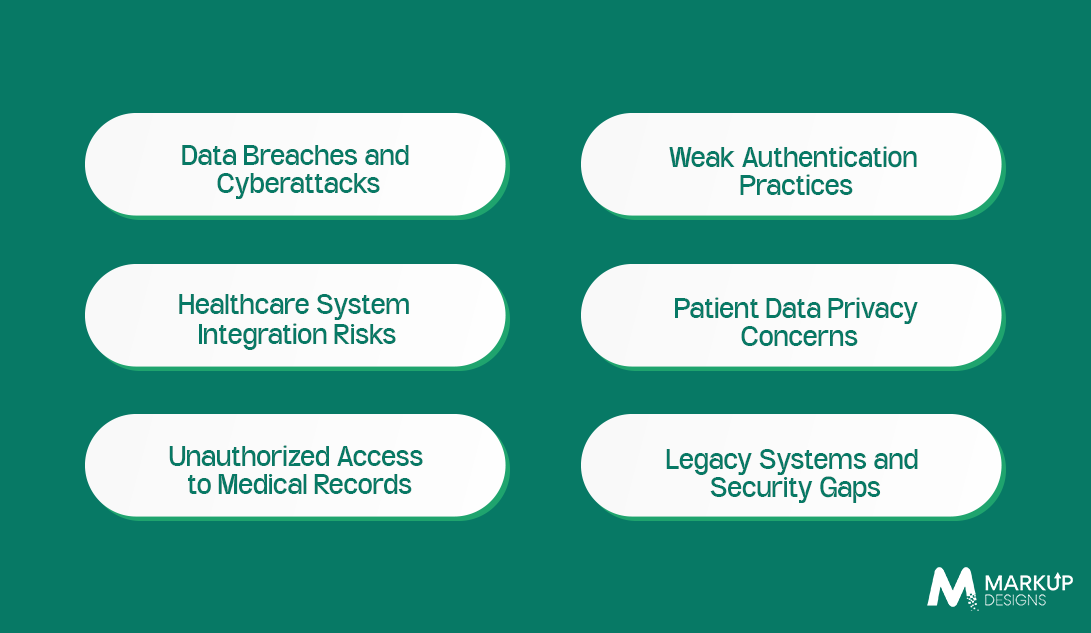
Building a safe patient portal is associated with certain difficulties, especially considering the nature of medical data and healthcare system integration. Determination of those risks in advance will help healthcare providers to design a better and more reliable platform.
Data Breaches and Cyberattacks
Patient portals might be at risk from phishing, malware attacks, and other cyber threats. Apply encryption, cybersecurity, frequent vulnerability assessments, and an incident response policy to decrease such risks.
Weak Authentication Practices
Easy-to-crack passwords and unsecured login processes are common problems. Implement multi-factor authentication, password recovery, and restrictions on frequent login attempts.
Healthcare System Integration Risks
Connecting EHR/EMR systems and other third parties will lead to security threats. Use secure API integration, verify third-party systems, and grant them restricted access to the data.
Patient Data Privacy Concerns
Patients can have fears regarding how their personal data is being collected and used. Ensure privacy policies are communicated to them and handle the issue of consent properly, while also keeping the collection of data limited to only necessary aspects.
Unauthorized Access to Medical Records
Mismanaged permissions might result in confidential information being available to unauthorized personnel. Role-based permissions and access should be ensured, permissions should be reviewed regularly, and audit logs should be kept.
Legacy Systems and Security Gaps
Older healthcare systems might be without modern security capabilities. Assess the current environment, update outdated software, and apply secure integration practices when system replacement cannot be done at once.
Handling all these issues during development and maintenance ensures the protection of personal data while providing effective digital healthcare services.
How Much Does It Cost to Develop a Secure Patient Portal?
Factors such as the functions of the portal, security standards, and complexity of the portal affect the price. It will be cheaper to develop a basic portal that allows users to schedule appointments and have access to their medical files than an advanced portal that has telemedicine capability and other additional features.
Here is an indicative cost breakdown:
| Patient Portal Type | Estimated Development Cost | Features Included |
| Basic Patient Portal | $15,000-$30,000 | Basic functionality, secure access, and basic access to patient records. |
| Intermediate Patient Portal | $30,000-$70,000 | Advanced functionality, integration with the health care system, and more secure access. |
| Advanced Patient Portal | $70,000-$150,000+ | Complex integrations, telehealth, more advanced security controls, and scalable infrastructure. |
All the above amounts are preliminary estimates rather than market pricing. The actual price may depend on location, skills of the development team, compliance issues, etc.
Also, there are additional costs such as interface design, cloud hosting, security operations services, maintenance, and costs for additional services. Healthcare facilities should account for the cost of updates, monitoring, and vulnerability assessment after the initial deployment.
In order to save money, one should start with basic functionality, identify security requirements at the beginning, and gradually develop advanced functionalities. This will help save the budget while keeping patient data protection from being optional.
Best Practices for Maintaining Patient Portal Security
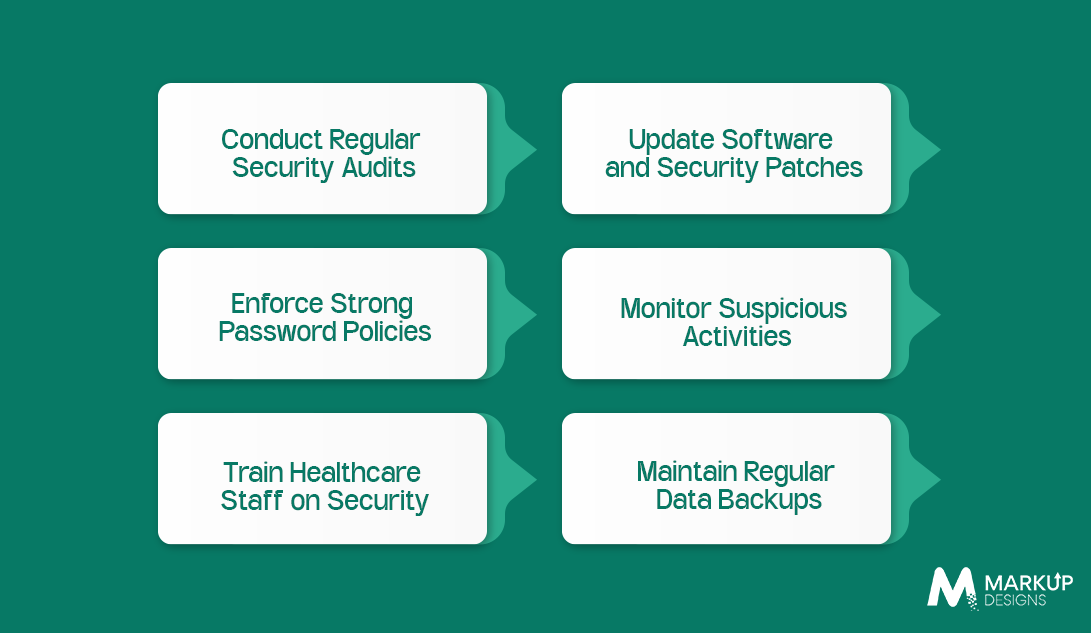
Setting up a secure patient portal is just the beginning. There will always be more security reviews and enhancements that need to take place as the portal is improved and as there is an emergence of new security threats. The following steps will ensure that patient information stays safe and secure.
Conduct Regular Security Audits
Test the portal for potential security risks and any misconfigurations or access control flaws. Schedule security assessments in independent organizations whenever possible.
Update Software and Security Patches
Update all frameworks, libraries, servers, and related systems in order to address potential security issues.
Enforce Strong Password Policies
Implement multifactor authentication when possible, as well as account recovery and login attempt prevention methods.
Monitor Suspicious Activities
Check audit logs and security alerts to look for any suspicious login behavior or data access.
Train Healthcare Staff on Security
Teach the employees about phishing scams, how to use patient information properly, and secure access practices.
Maintain Regular Data Backups
Perform data backup in a protected location, limit access to it, and test the restoration process for recovery in case of any data loss or cyber attack.
These measures must be assigned to specific personnel within the healthcare facility and monitored for the regularity of implementation. Proper maintenance will ensure the safe and stable operation of the healthcare portal.
Why Choose Markup Designs for Secure Patient Portal Development?
A proper design of patient portal development is possible only through understanding the workflow in healthcare, issues of data privacy, technology integration, and usability. Markup Designs helps healthcare organizations develop digital products depending on organizational processes and the needs of the patients.
Markup Designs, being experienced in digital products and integration technologies, may assist the organization in defining patient portal requirements, choosing the proper technology and system integration, as well as implementing proper security measures during the process of development.
The primary aim is to create a portal that will be easy to use and, at the same time, provide patients with secure access to personal data. Each step of development, from planning and designing the interface to testing, deployment, and enhancement, should contribute to the reliability and security of the portal.
If your organization plans to develop or enhance a patient portal, a proper development approach will help you to make health care easier and more effective.
Ready to Improve Your Digital Healthcare Experience?
From secure patient access to healthcare system integration, build a portal that supports better communication and smoother operations. Connect with Markup Designs to discuss your project requirements.
Conclusion
Implementation of a secure patient portal represents one of the necessary steps for healthcare institutions that want to enhance the convenience and accessibility of their operations. Still, all benefits associated with this approach rely on the ability to keep patients’ personal and other private information safe through all stages of development and further maintenance of the portal.
The use of multi-factor authentication, encryption, access control mechanisms, audit logging, and security testing contributes to risk management and data protection. At the same time, the healthcare organizations should be aware of their compliance requirements and maintain up-to-date versions of their systems despite constant changes in the realm of security.
It is possible to achieve the balance between high-level protection and a convenient patient experience during the planning of the development process. By cooperating with a company like Markup Designs, healthcare organizations will have an opportunity to plan the process that takes into account the necessity to protect the data.
FAQs
1. How do you develop a secure patient portal?
Start by defining patient and provider requirements, selecting a suitable technology stack, and designing secure access controls. Then integrate healthcare systems, implement data protection measures, test for vulnerabilities, and establish ongoing monitoring and maintenance.
2. What security features should a patient portal have?
Essential features include multi-factor authentication, data encryption, role-based access control, patient consent management, audit logs, secure messaging, and session management. The exact requirements depend on the portal’s functionality and the sensitivity of the information it handles.
3. How long does it take to develop a patient portal?
A basic patient portal may take around 2–4 months to develop, while a more complex platform may require 4–9 months or longer. Integrations, compliance requirements, security testing, and project scope can affect the timeline.
4. How much does secure patient portal development cost?
The cost may range from approximately $15,000 for a basic solution to $150,000 or more for an advanced platform. The final budget depends on features, integrations, security requirements, development resources, and ongoing maintenance.
5. How can a patient portal protect sensitive healthcare data?
A patient portal can protect sensitive information through encryption, strong authentication, access restrictions, secure APIs, activity monitoring, regular security testing, and protected backups. Healthcare providers should also maintain clear privacy policies and incident response procedures.
Author's Perspective
Developing a secure patient portal is about more than providing online access to healthcare services. It requires a clear focus on patient privacy, data protection, and ease of use. Healthcare providers need to ensure that patients can access their medical information without worrying about unauthorized access or data misuse. Strong authentication, secure integrations, regular testing, and ongoing maintenance play an important role in achieving this goal. As healthcare continues to adopt digital solutions, secure patient portals can help improve communication, simplify everyday processes, and build patient trust. A well-planned development approach helps healthcare organizations create reliable platforms that support both patient needs and long-term operational goals.
Discuss Your Project NowAjit Kumar Jha
VP - Business Operations
Related Posts
Healthcare App Development Cost in 2026: Complete Pricing...
How to Build a Compliant HealthTech App in...

Complete Guide to Healthcare App Development in Saudi...
Insights Are Valuable & Execution is Priceless
You’ve read about the digital future. Now, let’s build the infrastructure to take you there. Move your strategy from the page to the product.
Design Your Solution Now
Contact Us
Schedule The Appointment At Your Convenience Date And Time.
30 Min
Web Conference
Time Zone
Indian standard time (08:30pm)

Thanks For Getting In Touch!
You’ve Taken The First Step Toward Transforming Your Digital Presence. Our Experts Will Reach Out Shortly To Take It Forward.
Launch Your Dream Project
Provide a brief overview of your project, and our specialists will evaluate your requirements. We will connect with you to explore how the right digital solutions can help you launch faster.