
In Brief
- Mobile app development costs in Kuwait vary based on app complexity, features, platform, technology, and development requirements.
- A structured development process covers discovery, UI/UX design, development, testing, deployment, and post-launch support.
- Essential features such as secure authentication, payments, notifications, analytics, and admin controls form the foundation of modern mobile apps.
- AI, cloud computing, digital payments, IoT, and personalised experiences are shaping the next generation of mobile applications.
- Consider security, scalability, data protection, and integration requirements from the early stages of app development.
Mobile applications have become an important channel for businesses in Kuwait to deliver digital services, engage customers, simplify transactions, and support day-to-day operations. From fintech and retail to healthcare, logistics, hospitality, and on-demand services, organisations are using mobile apps to create more accessible and connected customer experiences. As expectations around speed, personalisation, and convenience continue to grow, businesses need applications that are designed around both current requirements and future scalability.
However, developing a successful mobile app involves more than choosing a platform and building a set of features. Businesses need to consider development costs, technology selection, UI/UX, security, integrations, testing, and ongoing maintenance. This guide explores the cost of mobile app development in Kuwait, the development process, essential and advanced features, technology considerations, and key trends shaping the local mobile app landscape.
What Is the Average Mobile App Development Cost in Kuwait?
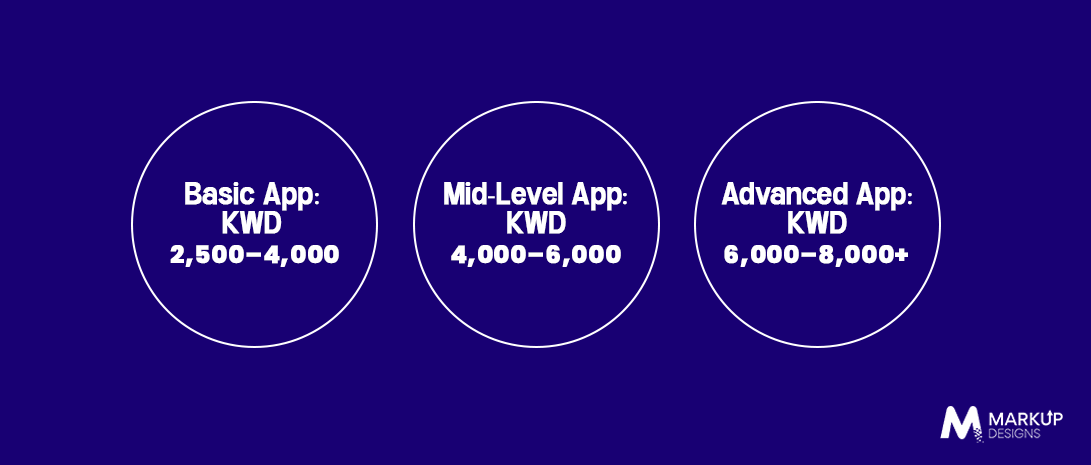
The cost of mobile app development in Kuwait can range from KWD 2,500 to KWD 8,000+, depending on the app’s complexity, features, platform, technology requirements, integrations, and development approach. A basic application with a focused feature set requires less development effort, while advanced applications with real-time functionality, AI, complex backend systems, and multiple integrations require a larger investment.
| App Complexity | Typical Features | Estimated Cost in Kuwait | Approx. Cost in USD |
| Basic App | User login, basic profiles, standard UI, push notifications, basic backend | KWD 2,500–4,000 | $8,100–$13,000 |
| Mid-Level App | Custom UI/UX, payments, APIs, maps, chat, admin panel, analytics | KWD 4,000–6,000 | $13,000–$19,500 |
| Advanced App | AI/ML, real-time features, advanced integrations, complex backend, high scalability | KWD 6,000–8,000+ | $19,500–$26,000+ |
USD figures are approximate and can vary with exchange rates.
These figures should be treated as planning ranges rather than fixed development prices. The final cost depends on the specific scope, technology stack, number of platforms, design requirements, integrations, security needs, and post-launch support involved in the project.
9 Key Factors That Affect Mobile App Development Cost in Kuwait
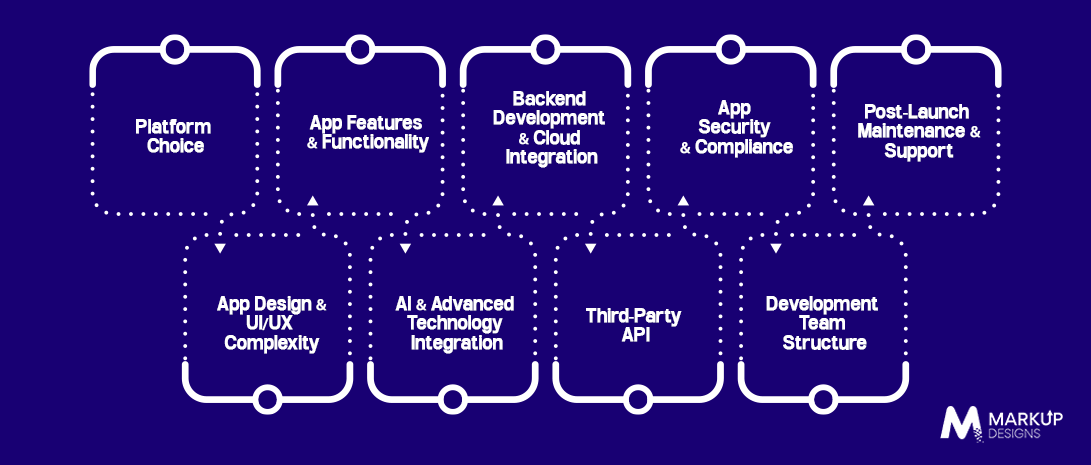
Several technical and business decisions can influence the overall cost of developing a mobile application in Kuwait. Understanding these factors early can help businesses define a realistic scope and allocate their development budget more effectively.
1. Platform Choice
The choice between iOS, Android, cross-platform, and native development directly affects development effort. Building separate native applications for iOS and Android generally requires platform-specific development, testing, and maintenance. Cross-platform frameworks such as Flutter and React Native can allow businesses to share a significant portion of the codebase across platforms.
The right approach depends on the target audience, required device capabilities, performance expectations, and long-term product roadmap.
2. App Design and UI/UX Complexity
Design requirements also influence development costs. A basic interface with standard components requires less effort than a highly customised experience involving animations, interactive elements, prototypes, extensive user research, and multiple design iterations.
For businesses targeting competitive consumer markets in Kuwait, UI/UX should account for usability, local user expectations, responsive layouts, and consistent experiences across supported devices.
3. App Features and Functionality
The number and complexity of features are among the most significant cost drivers. A basic application may require registration, profiles, notifications, and simple content management, while a more advanced app may include payments, maps, real-time chat, custom APIs, analytics, AI recommendations, live streaming, or AR-VR app development functionality.
| Feature Level | Typical Functionality | Cost Impact |
| Basic | Login, profiles, notifications, basic content | Lower |
| Standard | Payments, maps, chat, analytics, admin panel | Moderate |
| Advanced | AI, live streaming, AR, custom APIs, real-time systems | Higher |
The more complex the feature set, the greater the development, integration, testing, and maintenance effort.
4. AI and Advanced Technology Integration
AI can add significant functionality to mobile applications, but the development effort depends on how it is implemented. Basic integrations such as AI chatbots or smart search typically require less work than custom machine learning models or advanced predictive systems.
Common AI applications include:
- AI-powered chatbots
- Smart search
- Personalised recommendations
- Natural language processing
- Predictive analytics
- Image recognition
- Voice recognition
- Fraud detection
- Custom machine learning models
The cost will depend on whether the application uses existing AI APIs or requires the development, training, integration, and maintenance of custom models.
5. Backend Development and Cloud Integration
The backend supports the application’s data, business logic, APIs, authentication, integrations, and communication between different services. A simple app may require a relatively straightforward backend, while a large application may need real-time processing, microservices development services, automated deployment, monitoring, and auto-scaling.
Cloud platforms such as AWS, Microsoft Azure, and Google Cloud can support scalable infrastructure, while technologies such as Firebase can simplify selected backend and real-time capabilities.
Backend complexity generally increases with the number of users, transactions, integrations, data requirements, and real-time functions the application needs to support.
6. Third-Party API Integrations
Third-party integrations can extend an app’s capabilities without requiring every service to be developed from scratch. Common examples include payment gateways, maps, social login, analytics, communication services, cloud storage, and external business systems.
However, each integration requires API configuration, authentication, data mapping, testing, error handling, and ongoing compatibility management. The number and complexity of these integrations can therefore affect both the initial development cost and long-term maintenance requirements.
7. App Security and Compliance
Security requirements should be considered from the beginning of development rather than added after the application is built. Applications that handle personal information, payments, financial data, healthcare information, or business-critical data may require additional security controls.
Development effort can include secure authentication, encryption, access controls, API protection, secure data storage, vulnerability testing, monitoring, and privacy-related requirements.
8. Development Team Structure
The composition of the development team can also affect the overall investment. Depending on the project scope, a team may include a project manager, business analyst, UI/UX designer, mobile developers, backend developers, QA testing engineers, Cloud DevOps specialists, and AI or security experts.
The required team size and expertise depend on the application’s complexity. A focused MVP may need a smaller team, while an enterprise-grade application with multiple integrations and advanced functionality may require a broader technical team.
9. Post-Launch Maintenance and Support
Mobile app development costs do not end when the application is launched. Ongoing work may include bug fixes, operating system updates, security patches, performance optimisation, infrastructure management, feature improvements, and compatibility updates.
Businesses should therefore include a maintenance budget in their overall app development plan. A commonly used planning benchmark is around 15–20% of the original development cost annually, although the actual requirement can vary significantly based on the application’s complexity, release frequency, infrastructure, and support needs.
Hidden Costs of Mobile App Development in Kuwait
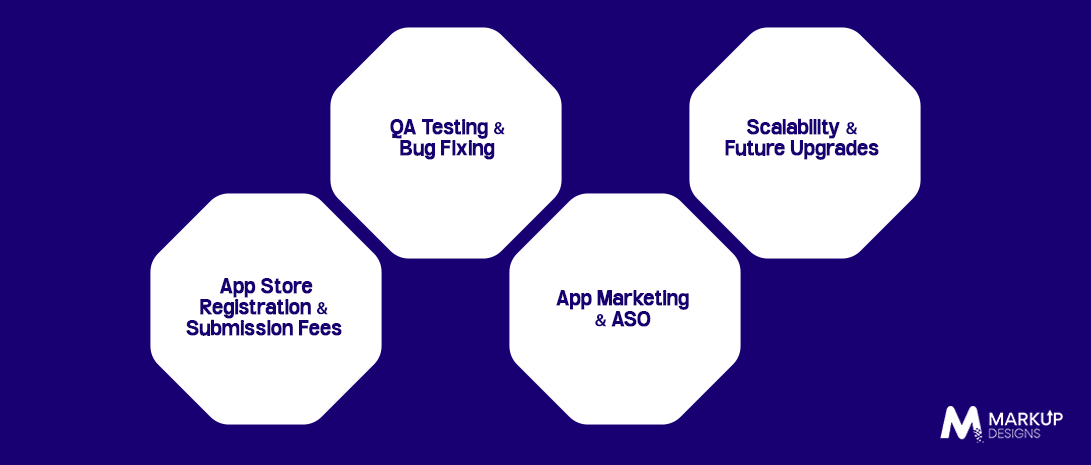
The initial development quotation does not always represent the complete investment required to launch and maintain a mobile application. Businesses should also account for costs related to app store publishing, testing, marketing, infrastructure upgrades, and future development.
1. App Store Registration and Submission Fees
Publishing an application requires developer accounts and compliance with the submission requirements of the relevant app stores. Additional development or testing work may also be required if an application does not meet platform guidelines or encounters issues during the review process.
2. QA Testing and Bug Fixing
Testing costs can extend beyond the initial development phase. Mobile applications need to be tested across different devices, operating systems, screen sizes, browsers, and network conditions. Post-launch issues may also require additional debugging, fixes, and performance optimisation.
3. App Marketing and ASO
Launching an application does not automatically generate downloads or users. Businesses may need to invest in App Store Optimisation (ASO), keyword targeting, creative assets, paid advertising, social media campaigns, and other user-acquisition activities.
4. Scalability and Future Upgrades
As the application gains users, its technical requirements can change. Businesses may need additional infrastructure, database optimisation, backend improvements, new features, integrations, or architectural changes to support increased demand.
Regulatory or platform changes can also require updates to the application. Planning for these future requirements from the beginning can help reduce unexpected development work later.
Depending on the application and its requirements, these additional expenses can add KWD 500–2,000+ to the overall investment. The actual amount varies based on the app’s scope, infrastructure, marketing strategy, and long-term development requirements.
How Can Markup Designs Help You Build a Mobile App in Kuwait?
Markup Designs helps businesses move from an initial app concept to a market-ready mobile product through a structured development approach. The team can support different stages of the product lifecycle based on the project’s requirements.
Product Discovery and Strategy
Define the application’s target users, business objectives, core functionality, technical requirements, and MVP scope before development begins.
UI/UX Design
Create user journeys, wireframes, prototypes, and interfaces focused on usability, accessibility, brand consistency, and the target audience.
Custom Mobile App Development
Develop feature-rich mobile applications for iOS, Android, or multiple platforms based on the project’s technical and business requirements.
Backend and API Development
Build secure backend systems, APIs, databases, authentication mechanisms, third-party integrations, and cloud infrastructure required to support the application.
AI and Advanced Technology Integration
Integrate AI-powered digital solution features, automation, analytics, recommendation systems, chatbots, and other advanced technologies where they provide value to the application.
Testing and Quality Assurance
Perform functional, usability, compatibility, performance, security, and device testing to identify and resolve issues before and after launch.
Deployment and Post-Launch Support
Support application deployment, monitoring, maintenance, performance optimisation, updates, bug fixes, and future feature enhancements as the product evolves.
Build a Scalable Mobile App for Your Kuwait Business
Turn your app idea into a secure, scalable, and user-focused mobile solution with the right strategy, technology, and development expertise.

Conclusion
There is no single fixed price for mobile app development in Kuwait. The final investment depends on factors such as the chosen platform, feature complexity, UI/UX requirements, backend architecture, integrations, security, AI capabilities, development team, and ongoing maintenance.
Businesses should also consider costs beyond initial development, including app store publishing, QA, marketing, infrastructure, and future upgrades. Defining the MVP clearly, prioritising essential functionality, and selecting an appropriate technology and development approach can help establish a more realistic budget and development roadmap.
FAQs
1. What Is the Average Cost to Build a Mobile App in Kuwait for a Startup?
A basic mobile app may cost around KWD 2,500–4,000, while mid-level and advanced applications can range from KWD 4,000–6,000 and KWD 6,000–8,000+, respectively. The actual cost depends on the application’s features, platform, design, integrations, backend requirements, and development scope.
2. How Much Does iOS App Development Cost in Kuwait Compared to Android?
The cost depends on the application’s complexity and the development approach. Developing separate native iOS and Android applications can require more development and maintenance effort than using a cross-platform framework. The target audience, device requirements, features, and technology stack should be considered when selecting the platform strategy.
3. Does Integrating AI Features Significantly Increase Mobile App Development Cost in Kuwait?
AI can increase development costs depending on its complexity. Integrating an existing AI API or chatbot may require less investment than developing custom machine learning models, predictive analytics, image recognition, or advanced recommendation systems.
4. What Are the Ongoing Mobile App Maintenance Costs After Launch in Kuwait?
Ongoing costs can include bug fixing, security updates, operating system compatibility, cloud infrastructure, performance optimisation, monitoring, and new feature development. A commonly used planning benchmark is around 15–20% of the original development cost annually, although actual maintenance requirements vary by application.
5. How Can I Hire Dedicated Mobile App Developers in the Middle East at Competitive Rates?
Businesses can work with a dedicated development team based on their technical requirements, project duration, and budget. Before choosing a development partner, it is useful to evaluate their relevant experience, technical expertise, development methodology, communication process, security practices, and post-launch support capabilities.
Author's Perspective
Mobile app development in Kuwait should be planned around the product’s long-term requirements rather than focusing only on the initial development quotation. Features, platform selection, scalability, security, integrations, and ongoing maintenance can all influence the total investment. Defining a clear MVP, prioritising high-value functionality, and selecting the right development approach can help businesses manage costs while building an application that is prepared for future growth.
Discuss Your Project NowGaurav Goyal
Global Sales- VP
Related Posts

10 Key Factors to Choose the Right Mobile...

Navigation App Development Guide: Building GPS Apps Like...

iOS vs. Android App Development in Abu Dhabi:...
Insights Are Valuable & Execution is Priceless
You’ve read about the digital future. Now, let’s build the infrastructure to take you there. Move your strategy from the page to the product.
Design Your Solution Now
Contact Us
Schedule The Appointment At Your Convenience Date And Time.
30 Min
Web Conference
Time Zone
Indian standard time (08:30pm)

Thanks For Getting In Touch!
You’ve Taken The First Step Toward Transforming Your Digital Presence. Our Experts Will Reach Out Shortly To Take It Forward.
Launch Your Dream Project
Provide a brief overview of your project, and our specialists will evaluate your requirements. We will connect with you to explore how the right digital solutions can help you launch faster.