

In Brief
- Learn the key steps involved in building a scalable social media app for users in the UK.
- Explore essential features, advanced functionalities, and the technology stack required for development.
- Understand the factors that influence social media app development cost and timeline in the UK.
- Discover UK-specific privacy, security, accessibility, and content moderation considerations.
- Explore monetisation models and strategies for launching, scaling, and improving your social media app.
Social media has evolved beyond general-purpose networking platforms, creating opportunities for businesses to build focused communities around specific interests, industries, creators, and user needs. For businesses in the UK, a well-planned social media app can provide a dedicated space for interaction, content sharing, communication, and community building. However, turning an app concept into a reliable platform requires careful planning across product strategy, user experience, technology, security, and scalability.
Building a social media app involves much more than developing profiles and news feeds. You need to consider real-time communication, media management, personalised content, content moderation, data protection, accessibility, and the infrastructure required to support growing user activity. This guide explores how to build a social media app in the UK, covering its essential and advanced features, development process, technology stack, estimated cost, timeline, monetisation options, and key considerations for creating a platform that can scale with your users.
Why Build a Social Media App in the UK?
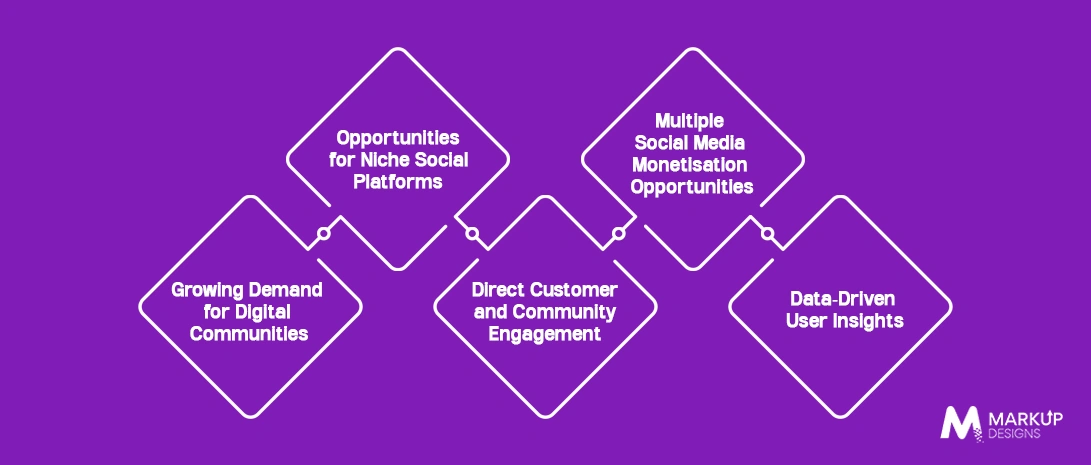
Explain the growing demand for digital communities in the UK and the business opportunities available to organisations that build social platforms around specific audiences, interests, or use cases.
Growing Demand for Digital Communities
Discuss how social platforms support online communities, content sharing, networking, and ongoing user engagement across different demographics and interests.
Opportunities for Niche Social Platforms
Explain how focused platforms can serve specific communities, industries, interests, or professional groups with more relevant experiences than broad social networks.
Direct Customer and Community Engagement
Show how social platforms create direct channels for businesses to communicate with users, build communities, collect feedback, and strengthen long-term engagement.
Multiple Social Media Monetisation Opportunities
Cover revenue models such as advertising, subscriptions, premium features, creator monetisation, sponsored content, commissions, and in-app purchases.
Data-Driven User Insights
Explain how user interactions, engagement patterns, and content preferences can generate insights that support personalisation, product improvements, and business decisions.
How Does a Social Media App Work?
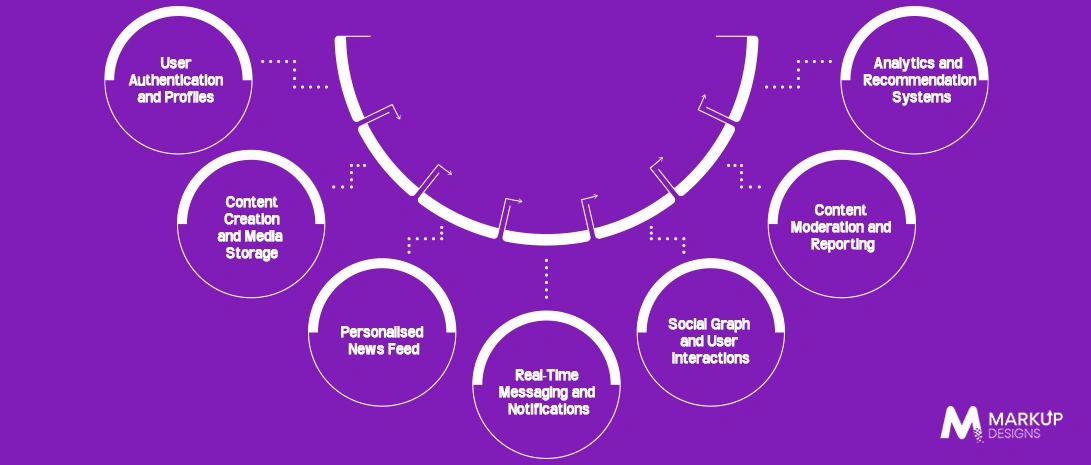
Explain the technical foundation behind an AI social media platform, from user registration and content publishing to personalised feeds, communication, moderation, and analytics.
User Authentication and Profiles
Explain registration, login, social sign-in, profile creation, account settings, privacy controls, and user authentication.
Content Creation and Media Storage
Cover text, images, videos, stories, and other user-generated content, along with media processing, storage, and content delivery.
Personalised News Feed
Explain how backend services, engagement signals, user preferences, and recommendation algorithms determine the content displayed to each user.
Real-Time Messaging and Notifications
Discuss private messaging, group conversations, push notifications, activity alerts, and the technologies that support real-time communication.
Social Graph and User Interactions
Explain relationships such as follows, connections, likes, comments, shares, mentions, and how these interactions contribute to the platform’s social graph.
Content Moderation and Reporting
Cover automated and human moderation, reporting mechanisms, community guidelines, spam detection, and processes for handling inappropriate or harmful content.
Analytics and Recommendation Systems
Explain how analytics platforms track engagement and how recommendation systems use behavioural and contextual data to improve content discovery.
How to Build a Social Media App in the UK?
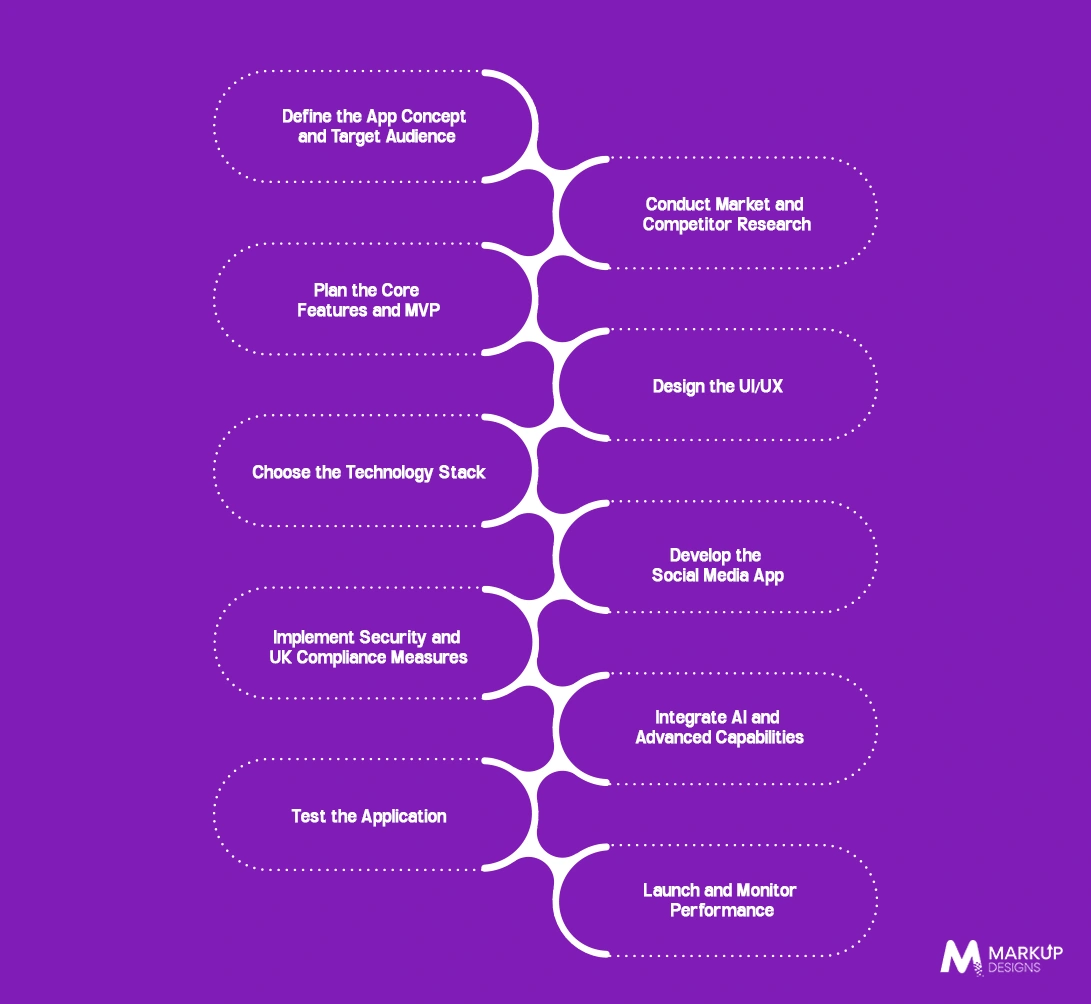
1. Define the App Concept and Target Audience
Establish the platform’s purpose, niche, target users, core value proposition, and primary use cases before development begins.
2. Conduct Market and Competitor Research
Analyse competing platforms, audience expectations, existing features, user pain points, market gaps, and opportunities for differentiation.
3. Plan the Core Features and MVP
Prioritise essential functionality for the initial release while separating advanced capabilities that can be introduced through later iterations.
4. Design the UI/UX
Create user journeys, wireframes, prototypes, navigation flows, and an accessible interface that makes content discovery and social interactions easy to use.
5. Choose the Technology Stack
Select suitable technologies for frontend and backend development, databases, cloud infrastructure, APIs, real-time communication, security, analytics, and media processing.
6. Develop the Social Media App
Build the frontend and backend, integrate APIs, configure databases, implement authentication, develop content and media handling, and enable messaging, notifications, and social interactions.
7. Implement Security and UK Compliance Measures
Apply privacy-by-design principles, secure authentication, encryption, access controls, consent management, privacy settings, and relevant UK data protection and platform requirements.
8. Integrate AI and Advanced Capabilities
Introduce AI-driven recommendations, personalised feeds, content moderation, spam detection, intelligent search, content classification, and other capabilities based on the platform’s requirements.
9. Test the Application
Perform functional, usability, security, compatibility, performance, load, scalability, and real-time communication testing across supported devices and environments.
10. Launch and Monitor Performance
Deploy the application to the relevant app stores and production infrastructure, then monitor performance, crashes, security events, engagement metrics, and user feedback to guide continuous improvements.
Essential Features of a Social Media App
A social media app needs a combination of user-facing features for content sharing and interaction and administrative tools for managing users, content, security, and platform performance.
User-Side Features
User Registration and Login
Enable users to create accounts and securely log in using email, phone numbers, social sign-in, or other supported authentication methods.
User Profiles
Allow users to create personalised profiles with photos, bios, interests, links, privacy settings, and other relevant information.
News Feed
Provide a personalised feed where users can discover posts, updates, media, and recommended content based on their interests, connections, and activity.
Post Creation and Sharing
Allow users to create, edit, publish, and share text, images, videos, links, and other supported content formats.
Likes, Comments, and Reactions
Enable users to interact with posts through likes, comments, replies, reactions, mentions, and other engagement options.
Follow and Friend System
Support follows, friend requests, connections, and relationship management according to the platform’s social model.
Search and Discovery
Help users find people, posts, hashtags, communities, topics, and other relevant content through search and discovery tools.
Stories and Short-Form Content
Allow users to publish temporary stories, short videos, and other quick-consumption content to encourage regular engagement.
Direct Messaging and Group Chat
Enable private and group conversations with support for text, media sharing, reactions, message management, and other communication features.
Push Notifications
Send real-time alerts for messages, comments, likes, follows, mentions, friend requests, and other relevant activities.
Media Sharing
Support the upload and sharing of images, videos, GIFs, audio, and other media based on the app’s requirements.
Privacy and Account Controls
Give users control over account visibility, profile information, content audiences, blocked users, notifications, and other privacy preferences.
Reporting and Blocking
Allow users to report inappropriate content or accounts and block unwanted users or interactions.
Content Bookmarking
Enable users to save posts, videos, articles, or other content for later access through bookmarks or saved collections.
Admin-Side Features
User Management
Provide administrators with tools to manage accounts, review user activity, and suspend, deactivate, or restore users when required.
Content Moderation
Allow moderation teams to review flagged content, enforce community guidelines, and manage content that violates platform policies.
Report and Complaint Management
Centralise user reports and complaints so administrators can review cases, track their status, and manage resolutions.
Analytics Dashboard
Provide insights into user growth, engagement, retention, active users, content performance, and other important platform metrics.
Notification Management
Allow administrators to create, schedule, and manage system notifications, announcements, and targeted communications.
Role and Permission Management
Define different access levels for administrators, moderators, support teams, and other internal users.
Revenue Management
Track subscriptions, advertising revenue, premium features, transactions, commissions, and other monetisation activities.
Security Monitoring
Monitor login activity, access attempts, suspicious behaviour, security events, and other potential threats.
Content and Community Management
Give administrators control over communities, categories, hashtags, featured content, platform rules, and community settings.
Advanced Features to Make a Social Media App More Competitive
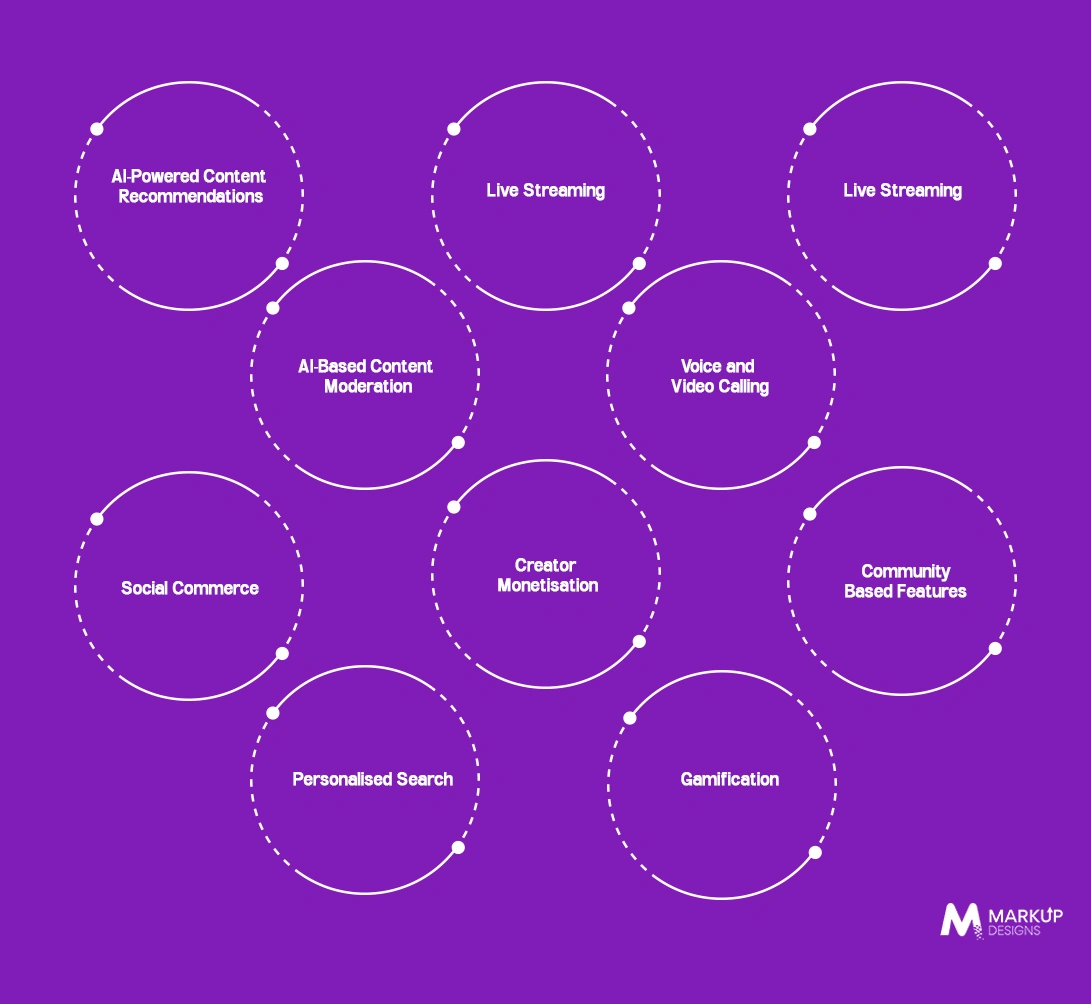
Advanced functionality can help differentiate a social media platform, improve personalisation, and create additional engagement and monetisation opportunities.
AI-Powered Content Recommendations
Use AI and machine learning to analyse user interests, interactions, and behaviour to recommend relevant posts, accounts, videos, and communities.
AI-Based Content Moderation
Use AI to identify spam, abusive behaviour, inappropriate content, and potential policy violations while assisting human moderation teams.
Live Streaming
Allow creators, businesses, and communities to broadcast live video and interact with audiences through real-time comments and reactions.
AR Filters and Effects
Integrate augmented reality filters, visual effects, virtual backgrounds, and interactive elements for richer content creation.
Voice and Video Calling
Enable one-to-one and group voice or video communication directly within the application.
Social Commerce
Allow businesses and creators to showcase products, integrate shopping experiences, and facilitate transactions through the platform.
Creator Monetisation
Provide eligible creators with monetisation options such as subscriptions, paid content, virtual gifts, memberships, or revenue-sharing models.
Community-Based Features
Support interest-based groups, forums, discussions, events, and dedicated communities where users can interact around specific topics.
Personalised Search
Use user preferences, search history, engagement data, and recommendation models to deliver more relevant search results.
Gamification
Introduce badges, points, challenges, achievements, leaderboards, or rewards to encourage continued participation.
Technology Stack for Social Media App Development
The technology stack should align with the app’s feature requirements, expected user base, scalability needs, security requirements, and development approach.
| Development Area | Technologies |
| Frontend | React Native, Flutter, Swift, Kotlin |
| Backend | Node.js, Python, Java |
| Database | PostgreSQL, MongoDB, Redis |
| Real-Time Communication | WebSockets, Firebase |
| Cloud | AWS, Google Cloud, Microsoft Azure |
| Media Storage | Amazon S3, Cloud Storage |
| AI/ML | Python, TensorFlow, ML frameworks |
| Notifications | Firebase Cloud Messaging, APNs |
| Analytics | Google Analytics, Firebase Analytics |
| Security | OAuth 2.0, MFA, Encryption |
The final technology choices may vary depending on whether the application uses native or cross-platform development and whether it requires advanced media processing, real-time communication, AI capabilities, or large-scale cloud infrastructure.
How Much Does It Cost to Build a Social Media App in the UK?
The cost of developing a social media app depends on its feature set, technical complexity, supported platforms, scalability requirements, and development team. A practical estimate can be divided into three levels.
| App Type | Estimated Cost | Development Timeline |
| Basic Social Media MVP | £30,000–£60,000 | 3–5 months |
| Mid-Level Social Media App | £60,000–£120,000 | 5–8 months |
| Advanced Social Media Platform | £120,000–£300,000+ | 8–12+ months |
A basic MVP may include profiles, news feeds, content publishing, reactions, search, notifications, and basic messaging. A mid-level application can add richer media capabilities, communities, advanced messaging, analytics, and stronger moderation. An advanced platform may require AI recommendations, AI moderation, live streaming, social commerce, advanced real-time functionality, and scalable infrastructure.
The actual cost depends on functionality, platform selection, UI/UX complexity, backend architecture, integrations, security and compliance requirements, AI capabilities, development team location, and post-launch support.
Factors That Affect the Cost of Social Media App Development
Number and Complexity of Features
The number and technical complexity of features directly affect development effort, infrastructure requirements, and testing time.
UI/UX Design Complexity
Custom interfaces, personalised feeds, animations, interactive elements, accessibility requirements, and complex user journeys can increase design and development effort.
iOS, Android, or Cross-Platform Development
Building for multiple platforms can affect the project cost and timeline depending on whether native or cross-platform technologies are selected.
Backend Architecture and Scalability
Social media applications require backend infrastructure capable of handling users, content, media, interactions, traffic spikes, and growing data volumes.
Real-Time Messaging and Notifications
Messaging, group chats, live interactions, and instant notifications require real-time communication infrastructure and additional testing.
AI and Machine Learning Integration
AI-powered recommendations, automated moderation, intelligent search, and personalisation require additional development, data processing, and infrastructure.
Third-Party API Integrations
Payment gateways, analytics platforms, social login, communication services, advertising systems, and other external APIs can add development and maintenance requirements.
Security and Compliance Requirements
Authentication, encryption, access controls, privacy features, security testing, and applicable regulatory requirements can influence the overall project scope.
Testing and Quality Assurance
Functional, usability, security, compatibility, performance, load, and real-time testing are essential for a reliable social media platform.
Development Team Location and Expertise
Development costs can vary according to the team’s location, technical expertise, project complexity, and engagement model.
Post-Launch Maintenance and Support
Ongoing costs may include infrastructure, monitoring, bug fixes, security updates, feature enhancements, third-party services, and technical support.
How Long Does It Take to Build a Social Media App?
The development timeline depends on the number of features, technical architecture, supported platforms, integrations, and testing requirements.
| Development Stage | Estimated Time |
| Discovery & Planning | 2–4 weeks |
| UI/UX Design | 3–6 weeks |
| Development | 10–24 weeks |
| Testing & QA | 3–6 weeks |
| Deployment | 1–2 weeks |
A focused MVP can generally be developed within 3–5 months, while a mid-level social media platform may require 5–8 months. Platforms with advanced AI, live streaming, sophisticated moderation, real-time communication, or large-scale media processing can take 8–12+ months.
Feature-heavy platforms may require additional time for architecture planning, integration, security validation, performance testing, and scalability testing before launch.
How to Monetise a Social Media App?
A social media platform can combine multiple monetisation models depending on its audience, engagement patterns, business model, and platform capabilities.
Advertising
Generate revenue through display ads, native advertising, sponsored posts, video ads, or targeted advertising placements.
Premium Subscriptions
Offer paid plans with additional features, exclusive content, enhanced privacy controls, or an ad-free experience.
In-App Purchases
Allow users to purchase virtual goods, digital items, premium features, or other platform-specific offerings.
Freemium Features
Provide core functionality for free while charging users for advanced tools, enhanced features, or additional services.
Creator and Business Accounts
Offer premium tools, advanced analytics, promotional capabilities, enhanced visibility, and other features through paid creator or business plans.
Social Commerce
Generate revenue through product sales, transaction fees, commissions, affiliate models, or other commerce-related activities.
Sponsored Content
Allow brands to collaborate with creators or communities to promote products, services, campaigns, and events.
Paid Communities
Enable creators, professionals, and organisations to operate subscription-based private groups or exclusive communities.
UK-Specific Considerations for Social Media App Development
Building a social media app for the UK market involves more than selecting features and technologies. Privacy, online safety, accessibility, age-appropriate design, and secure data practices should be considered throughout the product lifecycle.
UK Data Protection and User Privacy
Social media apps handling personal information should account for the UK GDPR and the Data Protection Act 2018. This includes establishing appropriate data-processing practices, obtaining valid consent where required, providing clear privacy information, and giving users suitable controls over their personal data.
Content Moderation and Online Safety
Social platforms need mechanisms to identify, report, review, and manage harmful or inappropriate content. Moderation workflows, user reporting, content controls, and appropriate safety measures can help platforms manage risks while supporting a safer user experience.
Accessibility and Inclusive Design
Accessibility should be incorporated from the early stages of UI/UX design. Clear navigation, readable interfaces, appropriate contrast, keyboard accessibility, captions, alternative text, and support for assistive technologies can make the platform easier to use for people with different accessibility needs.
Age-Appropriate Design
Apps that may be accessed by children or younger users should consider age assurance, privacy controls, parental or guardian-related safeguards where applicable, and measures designed to protect younger audiences. The product experience should account for the specific risks associated with collecting and processing children’s data.
Secure Data Storage and Processing
User data should be protected through encryption, secure authentication, access controls, protected APIs, data minimisation, and appropriate retention policies. Security should be incorporated into the architecture rather than treated as an additional layer after development.
Read Also: UK Online Safety Act Compliance: A Practical Guide for Social Media Platforms
Common Challenges in Social Media App Development
Social media platforms must support large user communities while managing real-time interactions, user-generated content, privacy requirements, and continuously changing usage patterns.
Managing High User Traffic and Scalability
As the user base grows, traffic can increase rapidly during peak activity.
Solution: Use scalable cloud infrastructure, caching, content delivery networks (CDNs), load balancing, and architecture that allows individual services to scale according to demand.
Protecting User Data
Social platforms process profiles, messages, media, preferences, and other sensitive user information.
Solution: Implement encryption, secure authentication, role-based access controls, monitoring, API security, and privacy-by-design practices.
Preventing Spam and Harmful Content
Large volumes of user-generated content can make manual moderation difficult.
Solution: Combine automated detection, AI-assisted moderation, user reporting, content controls, and human review for cases that require additional assessment.
Maintaining User Engagement
Users expect relevant content and interactions without unnecessary friction or notification overload.
Solution: Use personalisation, recommendation systems, community features, meaningful notifications, and continuous UX optimisation based on user behaviour.
Managing Large Volumes of Media
Images, videos, live streams, and other media can create significant storage and bandwidth requirements.
Solution: Use scalable cloud storage, media compression, CDN delivery, format optimisation, and adaptive processing based on device and network conditions.
Supporting Real-Time Interactions
Messaging, notifications, live activities, and other interactive features require low-latency communication.
Solution: Use WebSockets, event-driven architecture, message queues, and dedicated real-time infrastructure where required.
How to Build a Scalable Social Media App Architecture
A scalable architecture should allow the application to handle increasing users, content, transactions, and real-time activity without requiring a complete redesign as the platform grows.
Frontend Layer
The frontend handles user interactions across web or mobile applications. It should provide responsive interfaces, efficient media handling, accessible navigation, and optimised performance.
API and Backend Layer
The backend manages business logic, user activity, content, notifications, integrations, and communication between application components. Well-structured APIs make it easier to scale and integrate additional services.
Authentication and User Management
This layer manages registration, login, identity verification, sessions, permissions, account settings, and privacy controls. Secure authentication mechanisms should be integrated from the beginning.
Database Layer
Databases store user profiles, posts, relationships, messages, interactions, and other application data. A combination of relational, NoSQL, and caching technologies may be used depending on the platform’s requirements.
Media Storage and Processing
Images and videos should be stored separately from core transactional data using scalable cloud storage. Processing services can handle compression, resizing, transcoding, and format optimisation.
Real-Time Communication Layer
Real-time infrastructure supports messaging, notifications, live interactions, presence indicators, and other features requiring fast data exchange.
AI and Recommendation Layer
AI and machine learning services can analyse user behaviour, personalise feeds, recommend content, improve search, and support moderation workflows.
Moderation and Security Layer
This layer combines content moderation, reporting, abuse detection, authentication controls, encryption, access management, and security monitoring to protect the platform and its users.
Analytics and Monitoring
Analytics and monitoring tools track application performance, user behaviour, infrastructure health, errors, and security events. These insights can support ongoing optimisation and capacity planning.
How Can Markup Designs Help You Build a Social Media App in the UK?
Markup Designs can support the social media app development journey from initial product planning through development, testing, deployment, and ongoing improvement.
Product Discovery and Strategy
Define the target audience, product objectives, core use cases, MVP scope, technical requirements, and long-term roadmap.
UI/UX Design
Create intuitive interfaces and user journeys focused on usability, accessibility, engagement, and consistent experiences across devices.
Custom App Development
Develop the core application features, user experiences, social interactions, content systems, and platform-specific functionality.
Backend and API Development
Build the backend architecture, APIs, databases, integrations, authentication systems, and infrastructure required to support the application.
AI and Advanced Feature Integration
Integrate AI-powered recommendations, content moderation, search, personalisation, analytics, and other advanced capabilities based on the product requirements.
Testing and Quality Assurance
Test functionality, performance, security, compatibility, usability, and scalability across relevant devices, platforms, and usage conditions.
Deployment and Post-Launch Support
Support production deployment, monitoring, performance optimisation, maintenance, feature enhancements, and scalability as the user base grows.
Build Your Social Media App for the UK Market
Turn your social media app idea into a scalable, secure, and user-focused digital product with the right technology, features, and development strategy.

Conclusion
Building a social media app in the UK requires a combination of product strategy, user-focused design, robust technology, security, compliance, and scalable architecture. From defining the target audience and MVP to selecting the technology stack, developing core features, testing the platform, and preparing for growth, each stage can influence the final product.
Most importantly, cost and development time depend on the app’s scope and technical complexity. A focused MVP will have very different requirements from a large social platform with AI, real-time communication, advanced moderation, live streaming, and high-scale media processing. Planning these requirements early can help establish a realistic development roadmap and budget.
FAQ
1. How much does it cost to build a social media app in the UK?
The cost depends on the app’s features, platforms, UI/UX complexity, backend architecture, integrations, security requirements, AI capabilities, and development team. A basic MVP will generally require a smaller investment than a feature-rich social platform designed for large-scale usage.
2. How long does it take to develop a social media app?
Development time depends on the product scope and technical complexity. A focused MVP may take around 3–5 months, while mid-level and advanced platforms can require 5–8 months or 8–12+ months respectively.
3. What features should a social media app have?
Core features typically include registration, profiles, feeds, content creation, reactions, comments, following or connections, search, messaging, notifications, media sharing, privacy controls, and reporting. Advanced platforms may add AI recommendations, live streaming, social commerce, communities, and creator monetisation.
4. What technology stack is used to build social media apps?
A typical stack may include React Native or Flutter for cross-platform development, Swift or Kotlin for native applications, Node.js, Python, or Java for backend development, PostgreSQL or MongoDB for data storage, cloud platforms such as AWS or Azure, and WebSockets or Firebase for real-time functionality.
5. Should I build a native or cross-platform social media app?
The choice depends on the required performance, platform coverage, budget, development timeline, and complexity of device-specific functionality. Native development can provide deeper platform-specific optimisation, while cross-platform development can support multiple platforms from a shared codebase.
Author's Perspective
Social media app development should be approached as a long-term product development process rather than a one-time software project. Building the first version is only the starting point; scalability, security, moderation, accessibility, user experience, and continuous feature improvement need to remain part of the product strategy as the platform evolves.
Discuss Your Project NowAjit Kumar Jha
VP - Business Operations
Insights Are Valuable & Execution is Priceless
You’ve read about the digital future. Now, let’s build the infrastructure to take you there. Move your strategy from the page to the product.
Design Your Solution Now
Contact Us
Schedule The Appointment At Your Convenience Date And Time.
30 Min
Web Conference
Time Zone
Indian standard time (08:30pm)

Thanks For Getting In Touch!
You’ve Taken The First Step Toward Transforming Your Digital Presence. Our Experts Will Reach Out Shortly To Take It Forward.
Launch Your Dream Project
Provide a brief overview of your project, and our specialists will evaluate your requirements. We will connect with you to explore how the right digital solutions can help you launch faster.