

In Brief
- The cost to develop CRM software in Australia will depend on the complexity of the system, its features, integrations, UI/UX, security measures, technology stack, the development team used, and other aspects. Systems that have more advanced functionality like artificial intelligence, will require a higher budget.
- There are several types of CRM that companies could use, and they vary depending on their needs. There are operational, analytical, collaborative, sales, marketing, customer service, industry-specific, and AI-driven CRMs. Each business needs to select the best type for itself.
- Critical CRM features are lead management, contact management, sales pipeline, workflow automation, customer communication, reports and analytics, notifications, integration capabilities, and AI-driven insights. Companies could start with key features and add others later as required.
- CRM development usually includes such stages as requirements analysis, architecture design, UI/UX, development, integrations, testing, deployment, and support services. It is possible to reduce costs by starting with the MVP, prioritizing features, integrating systems early, and using scalable architecture.
- The custom CRM software offers increased flexibility for companies in terms of workflow and data management, integrations, automation, scalability, and upgrades in the future.
Nowadays, CRM software is widely used in businesses for managing customer relations, sales management, leads and other operations. In Australia, a well-developed CRM helps to integrate customer data, internal communications, sales process and reports.
Nevertheless, there are several questions which arise at the initial stage of work and the main of them is, what is the cost of developing CRM software in Australia? It all depends on several aspects such as type of CRM, required features, integration capabilities, design requirements, security requirements, technology and approach to the development.
Certainly, the simple CRM system with the minimum set of functionality will be cheaper than a complex platform with automation, analytics or AI technologies.
In this blog, we will discuss about the cost of CRM software development in Australia, the main factors influencing the cost, the required features, development process, cost saving solutions and the benefits of custom development of a CRM.
What Factors Affect CRM Software Development Cost?
The cost of CRM software development will depend on the size and complexity of the project. A simple CRM with just customer management capabilities will cost less than a complex solution with automated functionality, artificial intelligence, analytics, and integration possibilities.
Let’s see what factors might increase the cost of CRM development:
- CRM complexity: The number of workflows, roles, and complex features affects the development duration.
- Features: The amount and complexity of the features influence the price.
- UI/UX design: Customised interface is something which will take more time and money.
- Integration with third-party services: Connecting such systems as payments, email services, marketing tools, accounting systems, or ERP might cost extra.
- Security and compliance: Customer data safety, access management, encryption and other security measures, as well as compliance with Australian privacy regulations, increase development scope.
- Technology stack: Programming languages, frameworks, databases, and cloud solutions will be selected and developed.
- Development team: Price might differ from in-house team to developers from Australia or an offshore software development service.
Types of CRM Software You Can Build
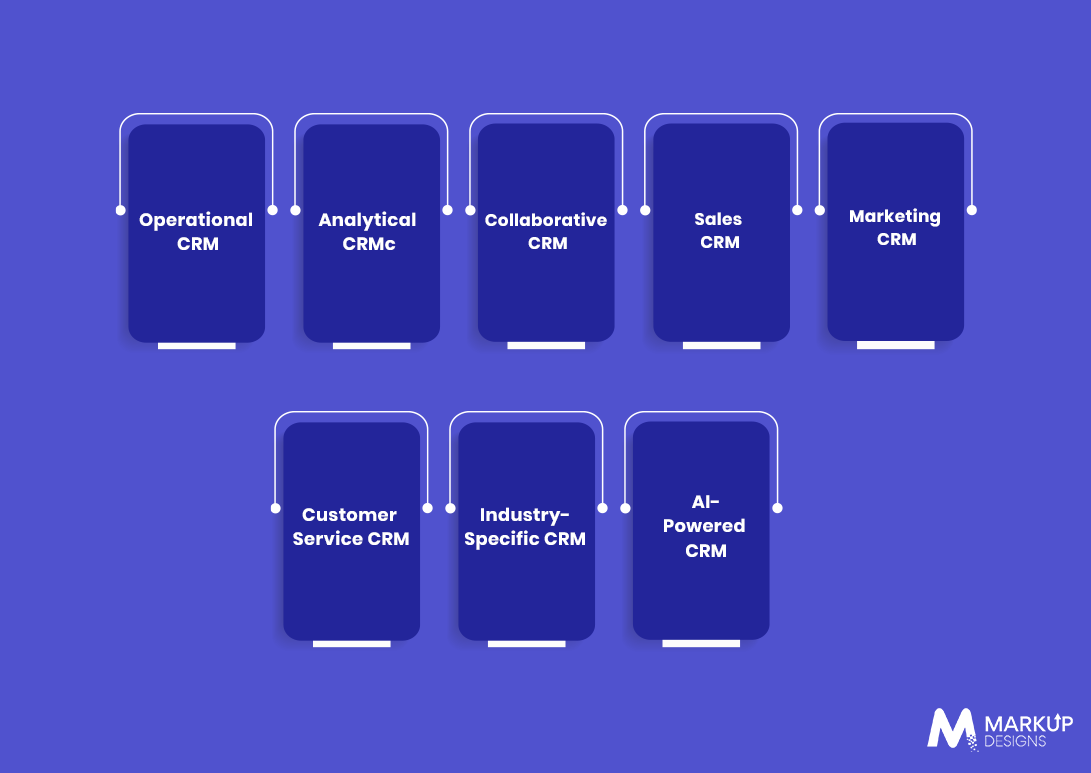
The CRM software may be developed differently based on how the company operates concerning its customer management, sales, marketing and internal processes. The right selection of such a solution in advance may help define what features, technology, and budgets are needed.
- Operational CRM: Provides assistance in the automation of all routine sales, marketing and customer services functions such as lead management, follow up and workflow.
- Analytical CRM: Collects all customer data for further analysis and generation of valuable reports and performance data.
- Collaborative CRM: Provides assistance in sharing all customer information by all sales, marketing and support departments.
- Sales CRM: Concentrates on lead management, opportunities, sales pipeline, follow-ups, quotations, and customer interactions across the entire sales process.
- Marketing CRM: Provides features such as campaign management, customer segmentation, email marketing, lead nurturing, and marketing analytics.
- Customer Service CRM: Enables customer care team to manage customer inquiries, complaints, tickets, feedback, and other service requests.
- Industry-Specific CRM: Built specifically for industries like real estate, healthcare, finance, education, retail, and professional services based on industry-specific workflow.
- AI CRM: Provides additional features such as AI lead scoring, automatic responses, sales predictions, customer recommendations, and workflow automation.
Choosing the right type of CRM depends on the business model, organization structure, customer experience, and objectives. The business may also choose a hybrid CRM that incorporates several CRM functionalities within a single platform.
Key Features of CRM Software
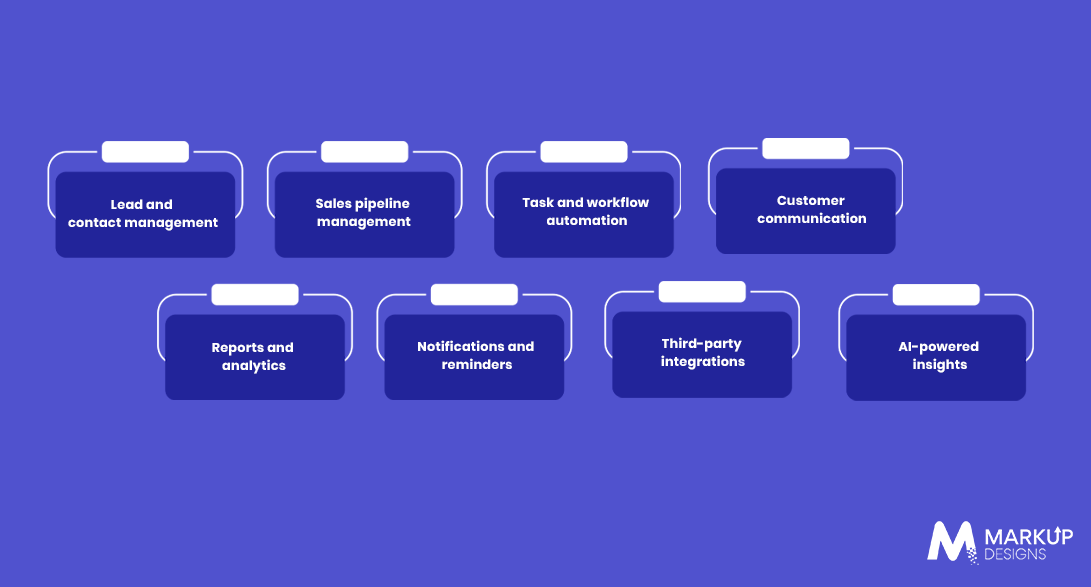
Features included in the CRM affect the cost of development, ease-of-use, and the overall value of the solution. Even if each business has unique demands, there are some features that usually get implemented into modern CRM solutions.
- Lead & Contact Management: Store customer data, lead management, and handle contacts using one system.
- Sales Pipeline Management: Manage the process of moving opportunities through various sales stages.
- Automation of Tasks and Workflows: Automate routine tasks, follow-up actions, reminders, and workflow processes.
- Customer Communications: Handle emails, messages, calls, and other interactions using one tool.
- Reports & Analytics: Provide dashboards and reports on sales, customer behavior, performance of the salespeople, and business trends.
- Notifications & Reminders: Inform users of the CRM about meetings, follow-ups, tasks, and other customer-related events.
- Third-Party Integrations: Integrate the CRM with accounting systems, marketing tools, emails, payments, ERP systems, and other tools used within the business.
- Artificial Intelligence: Use AI technology to provide features such as lead scoring, forecasting of sales, customer recommendations, automatic responses, and other intelligent features.
The business does not necessarily have to incorporate all advanced features right at the beginning. Building on essential features and incorporating advanced features later on as the CRM evolves can aid in managing costs and time.
CRM Software Development Process
Developing CRM application consists of several steps from requirement analysis to delivery and support of the end product. Having a systematic way to develop CRM application will help in aligning the project with business needs and controlling the process of development and costs.
Step 1: Requirement Analysis
The development team gathers all business requirements, target users, workflows, features, integration, and technical requirements of the project.
Step 2: Planning & Architecture
CRM architecture, technology stack, database, APIs, security solution, and overall architecture are defined at this step.
Step 3: UI/UX Design
Designers design simple and intuitive screens for the dashboard, customer card, pipeline, reporting module, and other CRM features.
Step 4: Development
Developers code the frontend, backend, database, APIs, user roles, workflows, and chosen CRM features.
Step 5: Integration
Third-party applications such as emails, accounting systems, payment systems, marketing applications, and ERP systems are integrated with each other.
Step 6: Testing
Testing of the CRM system will be done for functionality, performance, security, usability, compatibility, and integration.
Step 7: Deployment and Support
After getting the final approval, deployment of the CRM takes place. Support, updates, and monitoring ensure the security of the software.
Ready to Build CRM Software for Your Australian Business?
Turn your CRM idea into a secure and scalable solution designed around your workflows, customers, and growth plans.

Cost of Developing Different CRM Modules
The CRM software consists of several modules; each of the modules requires different design, development, testing, and integration phases. This means that the total cost of development may vary depending on the number of selected modules.
| CRM Module | Key Functions | Cost Impact |
| Lead Management | Lead capture, tracking, scoring, follow-ups | Low–Medium |
| Contact Management | Customer profiles, contact history, segmentation | Low–Medium |
| Sales Pipeline | Deals, opportunities, sales stages | Medium |
| Marketing Automation | Campaigns, email automation, lead nurturing | Medium–High |
| Customer Support | Tickets, queries, feedback, service management | Medium |
| Reporting & Analytics | Dashboards, reports, business insights | Medium–High |
| Communication | Email, calls, messages, notifications | Medium |
| AI & Automation | AI lead scoring, predictions, recommendations | High |
| Admin Dashboard | User roles, permissions, settings, monitoring | Low–Medium |
How to Reduce CRM Software Development Costs
Developing a CRM does not necessarily require the allocation of huge funds for development at the very start. Companies can manage expenses by developing a thoughtful strategy and concentrating on useful modules.
For example, companies may consider launching an MVP with all crucial functionality like contact management, lead generation, sales funnels, and reports. Advanced modules can be developed in later versions of the product based on feedback and needs of clients.
Selecting a suitable technology architecture at the initial stage will also eliminate high costs for redevelopment when the company increases the functionality of the CRM system. Planning integration with third-party applications is equally important since modification of the system architecture in the course of development will result in spending more time on the development process.
In addition, companies should refrain from customisation in the first release and focus on needed features. Working with experienced developers, conducting thorough testing during the process, and making a feature roadmap will also minimize unforeseen expenses.
Challenges of CRM Software Development in Australia
In order to develop CRM software in Australia, several aspects need to be considered in advance. Some common challenges include:
- Development Cost Management: The implementation of certain complex functions, integration possibilities, or custom workflows could increase the total cost.
- Privacy and Security Controls: As CRMs store sensitive data about customers, certain privacy controls need to be implemented.
- Integration Possibilities: Integrating the CRM software with an existing ERP system, accounting systems, marketing tools, communication platforms, or payment systems would require extra development efforts.
- Feature Scope: Too many features at the early stages of development would increase the development period and complicate the management process.
- Scalability: The software needs to be scalable for increasing amounts of customer data, users, transactions, and business processes.
- Data Migration: Migrating the existing customer and sales data to the new CRM system would require additional effort.
- User Adoption: Certain training and a user-friendly interface would be necessary for the proper use of the CRM system.
- Maintenance Needs: The CRM software will require regular updates, security measures, bug fixing, and other support services in the future.
Benefits of Building Custom CRM Software
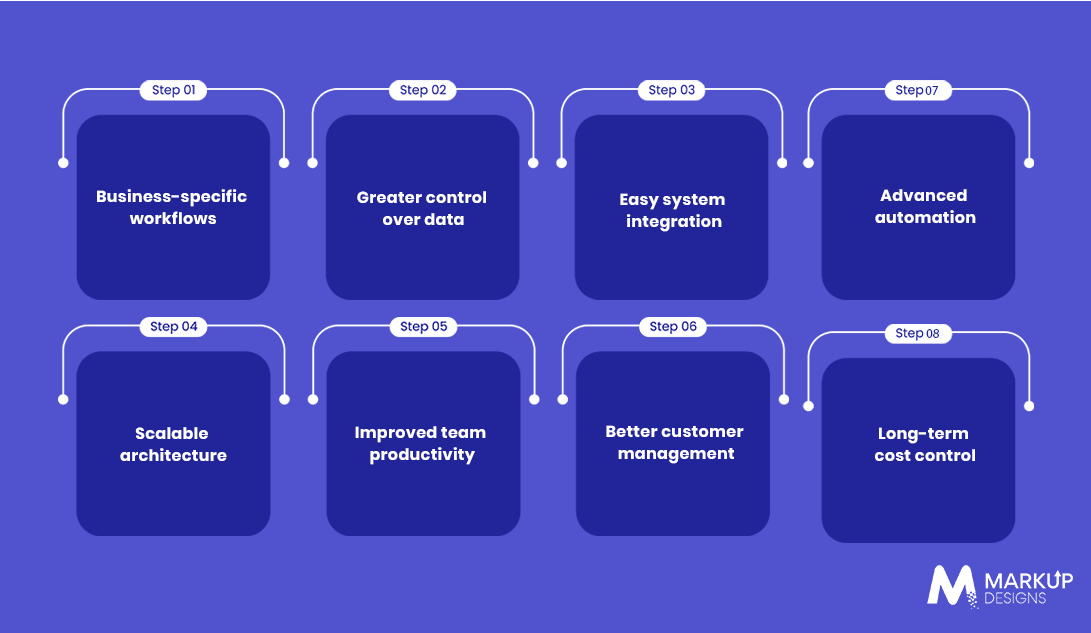
The custom CRM solution is created based on unique processes, customers, and business needs of an organization. Compared to the generic CRM platform, it offers companies more freedom concerning features, processes, integration with other solutions, and future enhancements.
1. Business-specific workflows
Create a workflow around your existing sales, marketing, customer service, and business processes rather than adjusting these processes to the generic platform.
2. Greater control over data
Store customer and business data in a solution created around your security and data management needs.
2. Easy system integration
Integrate the CRM system with the ERP, accounting, marketing, communications, payments, and other systems.
3. Scalable architecture
Develop a scalable architecture that will allow your company to handle a growing number of users, customer entries, transactions, and other needs.
4. Improved team productivity
Automate routine work, provide easy access to data, and create a centralized place for data storage.
5. Better customer management
Get a comprehensive overview of your customers’ interactions, preferences, sales activities, service requests, and communications.
6. Advanced automation
Introduce automation workflows, reminders, lead scoring, customer segmentation, and other processes to automate more.
7. Long-term cost control
A custom CRM can minimize future costs by making sure that a company is able to extend its system with new features, integrations, and users.
In addition, a custom CRM can evolve along with a business. Businesses do not need to replace their whole system when new requirements emerge, but rather implement new modules, integrations, and functionality over time.
Why Choose Markup Designs for CRM Software Development in Australia?
Selecting a suitable technology partner for the development of CRM software becomes very important. Markup Designs provides a solution to assist companies to convert their CRM ideas and operational requirements into secure, scalable, and intuitive software. Having rich experience in the fields of custom software development, AI, integration, and enterprise technology, they could provide you assistance in your CRM projects from conception to implementation and maintenance.
Markup Designs gives its full attention to the business process flow, customer journey mapping, user roles and requirements analysis before the development of any project. This allows for building CRMs that would actually be helpful in business operation and would not include some extra functionality. The approach to development includes the possibility of customization of the UI/UX, development of CRM itself, integration with third-party products, automation, analytics and AI.
Security and scalability are also taken into account during development, which helps enterprises prepare their CRM for further user growth, larger data volumes and additional functionality. From the development of MVP to more sophisticated enterprise solutions, enterprises can scale up their systems gradually in accordance with changing needs.
Markup Designs can help Australian enterprises develop their CRM software thanks to the end-to-end development and support provided by our company.
Ready to Build a Custom CRM for Your Business?
From CRM strategy and development to AI integration and ongoing support, Markup Designs can help turn your CRM requirements into a scalable digital solution.

Conclusion
The cost for developing CRM software in Australia is influenced by many factors, such as the CRM type, functions, integrations, design, security requirements, technology stack, and development approach. For example, a simple CRM with the necessary functions of management of customers and sales may require less investments, while a sophisticated solution with the use of AI and automation along with many other integrations may require more.
There are certain steps that can help businesses control their costs during the process of CRM development. It is possible to start from an MVP, to focus on important functions, to choose a scalable technology stack and to make sure to plan all integrations from the very beginning. A well-planned development roadmap will help avoid unexpected changes and expenses.
It doesn’t matter whether businesses plan to develop a sales CRM or a customer service platform or an enterprise CRM, it is important to understand all the requirements before starting the development process.
FAQs
1. How much does it cost to build CRM software in Australia?
The cost depends on the CRM’s complexity, features, integrations, technology, security requirements, and development team. A basic CRM will generally cost less than an advanced enterprise platform.
2. How long does it take to develop CRM software?
Development time depends on the project scope and number of features. A basic CRM can take a few months, while a complex platform with advanced integrations and AI capabilities may require a longer development cycle.
3. What features should a CRM include?
Common features include contact and lead management, sales pipeline management, task automation, customer communication, reporting, notifications, integrations, and analytics.
4. Can AI be integrated into CRM software?
Yes. AI can be used for lead scoring, sales forecasting, customer recommendations, automated responses, predictive insights, and workflow automation.
5. Can CRM software integrate with existing business systems?
Yes. A custom CRM can be integrated with systems such as ERP, accounting, marketing, payment, email, communication, and other business platforms.
Author's Perspective
CRM software is no longer limited to storing customer information. Modern CRM platforms can connect sales, marketing, customer service, automation, analytics, and AI within a single system. For Australian businesses, the right approach is to define clear requirements, prioritise essential functionality, and plan for future growth from the beginning. A well-planned CRM can improve customer visibility, streamline everyday processes, and support better team collaboration. Whether starting with an MVP or building a feature-rich enterprise platform, careful planning and the right technology partner can help create a CRM that delivers long-term business value.
Discuss Your Project NowGaurav Goyal
Global Sales- VP
Related Posts

How to Build Production-Ready Applications with AI Coding...

Case Management Software Development: Enterprise Features & Implementation...
Farm Management Software Development in Australia: Features, AI...
Insights Are Valuable & Execution is Priceless
You’ve read about the digital future. Now, let’s build the infrastructure to take you there. Move your strategy from the page to the product.
Design Your Solution Now
Contact Us
Schedule The Appointment At Your Convenience Date And Time.
30 Min
Web Conference
Time Zone
Indian standard time (08:30pm)

Thanks For Getting In Touch!
You’ve Taken The First Step Toward Transforming Your Digital Presence. Our Experts Will Reach Out Shortly To Take It Forward.
Launch Your Dream Project
Provide a brief overview of your project, and our specialists will evaluate your requirements. We will connect with you to explore how the right digital solutions can help you launch faster.