

In Brief
- AI-powered wealth management platforms in UAE are evolving beyond digital interfaces and becoming intelligent, compliant, and scalable financial ecosystems.
- Growing investor expectations, increasing HNWI populations, and demand for personalized experiences are accelerating the adoption of white-label wealth management solutions.
- Building a successful platform requires strong regulatory alignment, scalable architecture, secure integrations, and AI capabilities that deliver measurable value.
- Features such as portfolio automation, intelligent onboarding, predictive analytics, and goal-based planning are shaping the future of wealth services.
- Long-term success depends on continuous optimization, cloud-first infrastructure, embedded compliance, and localized experiences for UAE investors.
- Businesses that invest early and collaborate with experienced technology partners will be better positioned to deliver trusted and future-ready wealth management solutions.
Financial organizations planning to develop an artificial intelligence-based wealth management system in UAE cannot rely on merely comparing software functionalities anymore. In 2026, the difficulty lies in designing intelligence that works within the sovereignty of data, explains its every move to regulatory bodies, and works under real market time pressures.
In terms of wealth platforms, these have become a regulated part of the financial infrastructure for any bank, office, and wealth management firm operating within DIFC and ADGM. In response to this development, there has been growing demand for AI-enabled and white-label wealth platforms that come with explainability, zero-trust security, and a UAE cloud architecture right from the start.
However, the real transformation is happening beneath the surface. Business leaders now recognize that future competitive advantage will be driven not by interfaces, but by intelligent platforms. From automated portfolio management to advanced risk intelligence, AI has become the foundation powering next-generation financial innovation.
This guide is your ultimate manual for creating a white-label wealth management platform in UAE, which you can trust. You will learn about the main criteria for AI-based wealth management platform development and success factors in one of the most active financial markets around the globe.
Understanding UAE Wealth Management Market
One of the fastest increases in the number of high-net-worth individuals anywhere in the world is taking place in UAE. According to a report by Khaleej Times, there are currently 240,343 millionaires in UAE who have accumulated USD 785 billion in wealth.
This represents a huge chance for financial organizations to create digital-first products, particularly in the form of white-label wealth management software that UAE customers will find reliable, compliant, and tailored to their needs. This is the reason behind the increased need for wealth management software solutions in UAE that can integrate automation with advisories – from wealth management CRM software to wealth management accounting software. Most of this traction comes from the growing use of AI in wealth management in UAE.
Factors affecting investor expectations include the following:
- Emergence of a fast-growing number of HNWIs seeking intelligent, mobile wealth solutions.
- Hybrid advice is becoming commonplace, whereby investors accept digital investment management but still require human reassurance.
- Offshore diversification patterns are driving up the need for multi-currency and multi-market technology for wealth management.
With evolving investor profiles, companies that will make an early investment in AI-enabled and customizable software solutions, especially those compatible with AI wealthtech platform creation and customized wealth management software, will have a competitive advantage in the coming decade.
Steps to Build an AI-White-label Platform for Wealth Management in UAE
The development of a wealth platform in UAE is not just about picking the right technology. It requires a well-defined strategy shaped by regulatory requirements, investor expectations, and the growing demand for data-driven financial guidance. Whether your goal is to build an AI wealth management platform in UAE trusted by institutions or accelerate deployment through an existing solution, adopting the right approach will drive stronger scalability, faster time to market, and long-term business value.
The steps outlined below provide a proven framework adopted globally and align with the practical requirements for developing white label wealth management software for financial institutions in UAE.
Begin With a Clear Insight Of Your Clients and Business Goals
Every successful wealth platform starts with a clear understanding of its users. Define the audience you want to serve, whether beginner investors, affluent clients, or ultra-high-net-worth individuals. Each segment comes with unique expectations around personalization, advisory services, and user experience. Establishing these goals early creates a stronger foundation and makes every stage of platform development more strategic and efficient.
Root the Platform in the Regulatory Requirements of UAE
UAE’s financial system has strict regulations and awareness of the same can help avoid challenges down the line. DIFC, ADGM, AML/KYC compliance impacts the ways in which your onboarding process and reporting should be implemented. It will make your platform more stable in the long run and also build trust for your clients and regulators.
Select a Scalable White Label Platform
A robust white-label platform will enable you to operate at a faster pace while defining your platform based on your brand and client requirements. Such platforms include features like:
- Modular and flexible components
- Clean API integrations
- Multi-asset and multi-currency support
- Embedded compliance processes
- Security enterprise-wide
Leverage AI Where It Adds True Value
The best applications of AI should be those that facilitate better decisions rather than make them more difficult. These are generally those that help improve portfolio management or lighten the operational burden, like:
- Risk analysis
- Predictive signals for portfolios
- Rebalancing automation
- Real-time advice delivery
- Smart workflows
Design an Experience for UAE
The investor landscape in UAE is diverse, digitally mature, and highly focused on convenience and seamless experiences. To meet these expectations, an effective wealth management platform should typically include the following components:
- Arabic and English languages
- AED, along with other currencies
- Regional investments, including Sukuk and property funds
- Communication style that corresponds to local culture
Localized experience helps to build trust, which cannot be achieved by technology only.
Integrate Seamlessly and Securely
Every successful wealth platform runs on an array of integrations that work behind-the-scenes. This comprises CRM integration, custodian, market data feeds, core banking system, and identity verification tools, among others.
A good integration strategy will make your platform consistent, accurate, and robust, all attributes that ensure secure wealth management platform development.
Thorough Testing for Compliance, Accuracy, and Performance
Testing should verify not only functionality but also ensure that AI logic works correctly, transactions can be traced, audit trails are adequate, and platform works well even when overloaded. It is important to meet UAE regulatory requirements for wealth platforms.
Implementing in Stages
The measured approach will enable you to learn about client and advisor usage of the platform early on. This feedback helps in fine-tuning the experience, optimizing the AI suggestions, and making sure that operations are ready for the official launch.
Evolving the Platform After Launching
Wealth management evolves constantly, and so must AI models. Observe how your clients interact with the platform, what aspects make them engage, and where their decision-making could be improved upon. It’s continuous improvement enables you to stay competitive.
Technical Considerations for White-label Wealth Platforms
Constructing a powerful wealth platform goes beyond merely having an efficient design or useful functionality. The true strength of any such platform lies in its behavior under the hood, in its ability to process information and integrate seamlessly with an existing infrastructure without compromising scalability.
When developing an AI wealth management platform for UAE institutions or implementing a fast deployment with a pre-existing template, the technology will dictate the level of potential growth of your platform, particularly as the requirements for development of wealth management software change. One of the key aspects of such development is picking the right tech stack for AI wealth management platforms.
AI Wealth Architecture for UAE-Grade Platforms
The latest artificial intelligence wealth management platforms in UAE tend to rely more on Agentic RAG (Retrieval-Augmented Generation) systems instead of generic AI systems.
Unlike open-ended answers of language models, business-class AI wealth platforms rely on:
- RAG pipeline linked to proprietary research, compliance guidelines, and portfolio guidelines
- Vector databases like Pinecone or Milvus for semantic searching of investor notes, market insights, and audit logs
- Bounded AI agents producing advice only in line with the DIFC and ADGM decision-making framework
A Modular and Scalable Architecture
The platform should be able to scale up along with you. Select a solution that is constructed using a flexible architecture of modules that would enable you to add new functionality easily without having any impact on the underlying system. This also gives room for innovations in the future, particularly when you think about use cases powered by AI.
Seamless Integration With Financial Ecosystems
Wealth platforms do not function in silos. Such platforms need to be integrated seamlessly with CRMs, custodians, market data providers, core banking systems, and identity verification mechanisms. APIs and integration layers will help in creating a seamless user experience, something that is required for a white-label wealth management platform in UAE.
Enterprise-grade Security and Data Protection
Data safety is one of the primary things that investors look for in a platform. Encryption, multi-factor authentication, audit trails, and secure cloud hosting are essential aspects. These measures create a secure foundation for wealth management platforms, ensuring the protection of sensitive financial data and maintaining investor trust.
Compliance Tools Built Into the System
Compliance is not another module that needs to be added. Compliance is something that should be integrated into the whole system itself. Create processes that will automate KYC/AML workflows, record-keeping, flagging, and reporting that follow UAE financial regulations for wealth platforms.
Cloud-first Infrastructure for Agility
With cloud infrastructure, there is an improved performance, durability, and easier integration with current technology used in fintech applications. Moreover, cloud infrastructure ensures fast updates of the wealth management application, which is important in order to stay competitive.
AI-Powered Features in White-label Wealth Management Platforms
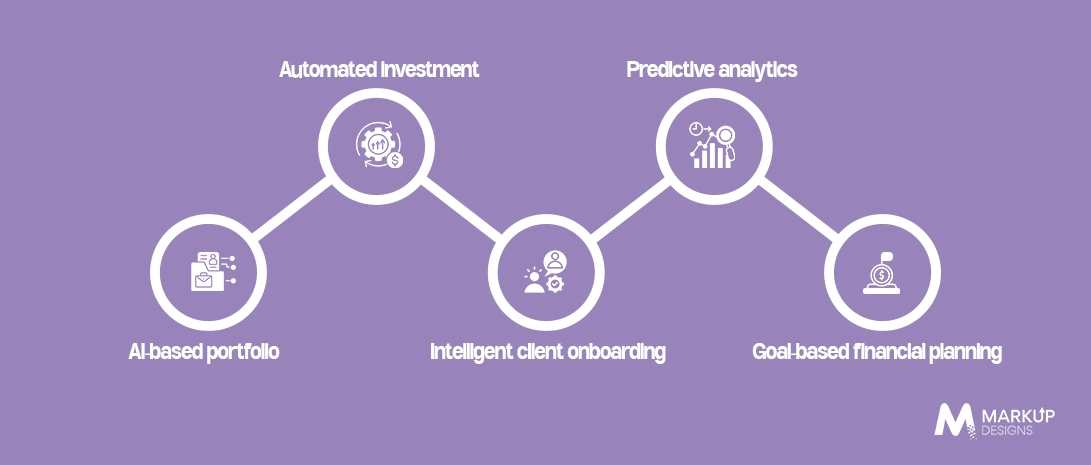
AI-based portfolio
Portfolio management using artificial intelligence helps in the formulation of the investment portfolio by taking into consideration the preferences and requirements of the customer, along with their tolerance towards risks. It enables continuous monitoring of market changes and portfolio performance, allowing timely adjustments and informed decision-making.
Automated investment advisory tools
The automated advisory system is an example of artificial intelligence that makes investment decisions on behalf of the users with minimal human effort. The system analyses the user profile, the user’s objectives, and the market situation to determine the best course of action regarding investments.
Intelligent client onboarding
AI makes onboarding easier through automation of data gathering, documentation verification, and profile creation. AI makes the process quicker and less tedious. Smart workflow improves compliance and customer satisfaction. This makes onboarding easier for both businesses and customers.
Predictive analytics and forecasting
Predictive analytics utilizes past and current data in order to discover any trends and predict how the market will change in future. Predictive analytics is useful for wealth managers in making their investment and risk evaluations proactively.
Goal-based financial planning
Investment strategies in AI-based financial planning become compatible with the particular needs of clients, such as retirement, education, or wealth growth. Progress is constantly monitored, and changes are advised when the situation demands. These personalized suggestions help maintain discipline and transparency in financial matters.
Launch Your AI-Powered Wealth Management Platform
Transform your financial services vision into an intelligent wealth management solution designed for the evolving UAE market. Leverage AI capabilities to automate advisory services and personalize investment experiences.

Cost to Build an AI-Powered White-label Wealth Management Platform in UAE
Indeed, the money required to create an AI-based wealth platform can be different depending on its goals. Some companies seek to build a clean, ready-for-use white-label development service that could be implemented by UAE customers immediately. Meanwhile, some organizations aim to create an AI wealth management platform in UAE, which will be used for providing intelligent guidance and decision-making to the investors.
It is not surprising that the majority of such projects cost around $40,000 – $400,000 (AED 147,000 – AED 1.47 million), as this price corresponds to the average cost of developing an AI wealth management platform in UAE markets.
| Development Component | Estimated Cost (AED) |
| Discovery & Business Analysis | AED 18,000 – 44,000 |
| UI/UX Design | AED 29,000 – 73,000 |
| Core Platform Development | AED 110,000 – 294,000 |
| AI & Automation Features | AED 73,000 – 220,000 |
| Client Onboarding & KYC Integration | AED 37,000 – 92,000 |
| Third-Party Integrations | AED 37,000 – 110,000 |
| Security & Compliance | AED 37,000 – 110,000 |
| Cloud Infrastructure & DevOps | AED 29,000 – 92,000 |
| Testing & Quality Assurance | AED 29,000 – 73,000 |
Read: Also: How AI Innovations Are Transforming Dubai Businesses
How AI is Enhancing Wealth Management in UAE
The use of AI technology has brought about an innovative approach to wealth management in UAE, and this innovation has practical day-to-day implications. Today’s clients require more than simply digital access; they require advice that is pertinent, relevant, and customized for the decisions they are making. This is the reason why there is such a widespread interest in the development of AI-based wealth management platforms within the industry, both as a way of improving advisory processes as well as upgrading legacy wealth management investment systems.
Here’s what we’re seeing on the ground:
Better decisions can be made by clients: Rather than relying on assumptions or manual interpretation of data, both advisors and investors gain actionable insights and more confident decision-making, an expectation that has become standard among users of digital wealth management platforms in UAE.
The experience begins to become more personalized: Investors respond more positively to guidance that reflects their individual preferences, behaviors, and financial goals rather than relying on broad customer categories. AI enables this level of personalization by continuously learning from small but repeated interactions and behavioral patterns. Over time, the platform adapts its recommendations and communication style to align more closely with each investor’s expectations and decision-making approach.
People aren’t surprised by risk anymore: Whether markets move gradually or experience rapid changes, AI can identify emerging trends early. It detects potential risks before they develop into larger issues, making it especially valuable for clients managing diversified portfolios across multiple regions.
Advisors can now have enough room to engage in meaningful discussions: Many activities, such as repetitive tasks, portfolio tracking, reporting, and threshold checks, among others, can be automated using AI automation for wealth management. This will give investors time to concentrate on strategic planning.
Compliance becomes part of the flow, not a separate chore: With DIFC and ADGM setting a high bar, AI helps track activity, spot anything unusual, and keep records clean. It makes compliance work less heavy and a lot more reliable.
How to Overcome the Challenges of Building an AI-Powered White-label Platform in UAE
Building an AI powered wealth management platform in UAE presents significant opportunities, but it also introduces a unique set of challenges. Regulatory compliance, evolving investor expectations, and the added complexity of integrating AI capabilities require a strategic and carefully planned approach. This becomes even more important for platforms aiming to outperform traditional wealth management software and existing digital investment solutions.
Whether your objective is to develop white label wealth management software in UAE or create a fully customized platform, these challenges can be effectively managed with the right development strategy and technology foundation. Below are some of the most common challenges organizations face when building a wealth management platform in UAE:
Starting off on the Right Foot with Compliance
Regulatory expectations set by DIFC and ADGM are structured and clearly established, making it essential to build compliance into the platform from the beginning. Integrating automated KYC and AML verification, comprehensive audit trails, and workflow processes aligned with UAE financial regulations helps create a secure, compliant, and scalable wealth management platform.
AI Usage Where It Makes Sense
The AI may simply take too much capacity if implemented across the board. The focus should be on what is important: enhanced risk profiling, improved predictive analytics, and genuine automation. In doing so, your AI-driven wealth management platform development will be realistic and easy to adopt.
Ensuring Easy and Seamless Integrations
Financial institutions depend on an interconnected ecosystem, including core banking, CRMs, market data, and many others. Good APIs and integration testing in stages will definitely prevent any disruptions while you launch your white-label wealth management system in UAE.
Creating Websites Catering to UAE Investors
Local investors prefer websites that mirror their own surroundings. Websites with support for Arabic and English languages, AED and other currencies, and Islamic financial flows create a customized environment.
Guarding Data without Sacrificing Performance
Wealth information is delicate in nature, and AI technology depends on it. Proper security architecture, encryption, and strict access management ensure that the platform is secure yet offers clients the performance they demand.
It is becoming common practice for many organizations to consult AI experts in Dubai so as to deal with such situations with clarity and avoid any costly mistakes.
How to Choose the Right Partner for Your AI-Powered Wealth Management Platform
It is not only a matter of procurement; it also sets the stage for the future life of the product. What you need is a team that knows everything about technology, regulations, and how UAE-based investors think.
Whether you’re aiming to build an AI wealth management platform in UAE that clients can trust or expand through a white-label wealth management platform in UAE approach, the right partner should bring clarity and confidence to every step.
What really matters when choosing a partner:
- Practical experience in wealthtech: They need to know the dynamics of portfolio management, the psychology of investors, and the usage patterns of such platforms by advisors.
- Effective use of AI skills: Hire those teams who have experience in implementing AI to make predictions, automate certain operations, help with decision-making, etc. That is the key component of the successful development of any AI-based wealth management platform.
- Awareness of UAE market: DIFC, ADGM, Shariah-compliant flows, investors’ expectations – all of this is a must-have for your partner. This is what defines how your platform should work.
- Ease of integration: The partner should be capable of integrating your platform with the core banking system, custodians, CRMs, and other sources of data without making it a nightmare.
- Teamwork and collaboration: You need a partner who will work with you, stimulate your thoughts, will participate in creating the product.
How Markup Designs Can Help in Building an AI-Powered Whitelabel Platform for Wealth Management in UAE?
At Markup Designs, we help businesses build scalable and secure AI-powered white-label wealth management platforms tailored for UAE market. Our team develops intelligent solutions with features such as portfolio automation, investment advisory, client onboarding, predictive analytics, and goal-based planning while ensuring seamless integration, compliance readiness, and long-term scalability.
Accelerate Digital Wealth Innovation
Develop secure and scalable AI-driven wealth management solutions that enhance customer engagement and streamline financial operations. Partner with experts to create future-ready platforms aligned with UAE compliance.

Conclusion
Building an AI-powered white-label wealth management platform in UAE is no longer only about digitizing financial services; it is about creating intelligent, compliant, and scalable ecosystems that can adapt to changing investor expectations and regulatory standards. As wealth institutions move toward personalized advisory experiences, automated decision support, and data-driven operations, AI is becoming a core layer of modern wealth infrastructure. Success depends on combining the right technology architecture, regulatory readiness, seamless integrations, and investor-focused experiences.
FAQs
1. What is an AI-powered white-label wealth management platform?
It is a customizable digital wealth management solution that allows financial institutions to launch services under their own brand while using AI capabilities for portfolio management, advisory, onboarding, and analytics.
2. How much does it cost to build a wealth management platform in UAE?
The development cost generally ranges from AED 147,000 to AED 1.47 million, depending on platform complexity, AI features, integrations, security requirements, and compliance scope.
3. Which AI features are commonly used in wealth management platforms?
Popular features include AI-based portfolio management, automated investment advisory, predictive analytics, intelligent onboarding, risk assessment, and goal-based financial planning.
4. Why is compliance important for wealth platforms in UAE?
Financial institutions operating in UAE must align with regulatory expectations, including KYC, AML, reporting, security, and governance requirements to ensure platform reliability and trust.
5. Can a white-label wealth platform integrate with existing banking systems?
Yes, modern platforms are designed to integrate with CRMs, banking infrastructure, custodians, market data providers, and identity verification systems through APIs.
Author's Perspective
The discussion on the use of AI in wealth management usually centers on automation; however, the true potential is in fostering trust at a scalable level. Within UAE, organizations are not just deploying AI to lower their workload; rather, they are deploying it to provide them with better advice, enhanced customer experience, and improved agility in adapting to changing markets. The winning platforms in the coming decade won’t just be those that offer the most capabilities; they will be the ones that integrate intelligence, compliance, transparency, and agility into a financial journey.
Discuss Your Project NowGaurav Goyal
Global Sales- VP
Related Posts

How to Build Production-Ready Applications with AI Coding...

Cost, Benefits & Business Impact: Generative AI vs....

Enterprise AI Agents: Practical Use Cases Driving Business...
Insights Are Valuable & Execution is Priceless
You’ve read about the digital future. Now, let’s build the infrastructure to take you there. Move your strategy from the page to the product.
Design Your Solution Now
Contact Us
Schedule The Appointment At Your Convenience Date And Time.
30 Min
Web Conference
Time Zone
Indian standard time (08:30pm)

Thanks For Getting In Touch!
You’ve Taken The First Step Toward Transforming Your Digital Presence. Our Experts Will Reach Out Shortly To Take It Forward.
Launch Your Dream Project
Provide a brief overview of your project, and our specialists will evaluate your requirements. We will connect with you to explore how the right digital solutions can help you launch faster.