

In Brief
- AI queue management improves customer experiences by reducing wait times and streamlining service delivery.
- Predictive analytics helps businesses forecast demand and allocate resources more efficiently.
- Real-time monitoring enables faster decisions and prevents queue congestion during peak hours.
- Intelligent routing ensures customers are directed to the right service channel quickly.
- Integration with existing systems and cloud scalability supports long-term business growth.
- Compliance with UAE data protection and security standards is essential for successful deployment.
AI queue management is an intelligent system that uses artificial intelligence to monitor, predict, and optimize customer flow and service operations in real time. By analyzing factors such as customer arrivals, wait times, staff availability, and historical patterns, it automatically improves queue handling and resource allocation to reduce delays and enhance service efficiency. Businesses across industries such as retail, healthcare, banking, and customer support use AI queue management to deliver faster service.
UAE has been among the digitally mature markets in the world for a long time now. According to the data report by DataReportal, there was a digital penetration rate of 99% in UAE at the beginning of 2025. From the high levels of digital maturity that have prompted businesses operating in areas with a lot of traffic to develop an AI-based queue management system.
In this blog, we will learn precisely how to create the next-generation queue management system for Dubai and UAE.
Development Blueprint For an AI-Powered Queue Management System
If one intends to implement an AI-driven queue management system in Dubai, they should treat the blueprint as the backbone of the project. UAE service industry is highly dynamic. The traffic of customers changes depending on whether there are public holidays, tourist seasons, or even when government staff come to perform their activities.
Having a blueprint helps in developing an AI-driven queue management system that is dynamic enough to meet these demands.
Requirement Analysis
This step sets out what the system needs to do. This will involve a thorough analysis of the flow of people, services required, counter capacity, seasonal peak flow, VIP flow and the time it takes for each service provided. Insights from Deloitte about Middle East Government Services have noted that the Gulf states need to design their systems based on the changing volume of users and not the average per day.
Your analysis needs to cover the following:
- Visitors’ type: resident, expat, tourist, VIP
- Daily and seasonal visitor traffic pattern
- Needs for Arabic and English language support
- Types of service and the estimated time needed to complete
- People of determination needs
- Multiple branches and allocation of counters
- Appointment versus walk-in ratio
- Digital touch point considerations like WhatsApp check-in
This will be important in setting the tone for the development of the AI queue management software.
User Journey Mapping
Then, plot out the journey maps for all the user categories that your system will cater to. The Dubai and Abu Dhabi service environments typically consist of multiple user categories at one place, and hence precision is key.
Some of the aspects that make a good journey map are:
- Footfall journey: Kiosk check-in, scanning ID, generating digital tokens, and waiting time estimation.
- Appointment journey: Booking through an app or WhatsApp, QR check-in, and exclusive appointment queues.
- VIP or priority journey: Automated route to priority counters without manual intervention. Vital for banks, airports, and government service centers.
- Tourist journey: Multilingual screens and assisted kiosk usage.
- People of determination journey: User-friendly UI, counter mapping, voice guidance, and kiosk setup.
Technical Architecture
Good architecture will provide stability, scalability, and compliance for all locations in UAE.
Modern design consists of:
- Microservices architecture: Ticketing, routing, identity, notifications, reporting, and analytics are separate microservices to scale faster.
- AI/ML engine: Crowd forecast, routing intelligence, sentiment detection, and facial recognition algorithms. This is the heart of AI-powered queue system development and design.
- Event-driven architecture: Every change in queue status, counter availability, and routing decision is propagated instantly through real-time events.
- Front-end ecosystem: Mobile app, integration with WhatsApp Business, kiosks, digital signs, and staff dashboard with Arabic and English language support.
UI & UX Engineering
In UAE, UI/UX needs to cater to a diverse mix of languages and cultures. This phase is all about designing an interface that everyone can understand immediately.
Some important things to consider are:
- Compulsory Arabic and English versions
- Option of Hindi, Urdu, and Filipino languages depending upon the demographic of the branch
- Bright screens for high temperature and sunlight conditions
- Proper touch targets and font sizes
- Use of visual hierarchy for quick scanning
- Mode of operation for tourists unfamiliar with the system
- Audio help for people of determination
- Escalation path when the queue crosses the threshold
Integration Architecture
Queue management systems in Dubai, UAE do not work in isolation. These systems should integrate with existing systems to ensure that the journeys of customers remain consistent.
Some of the integration systems are:
- CRM systems for customer information
- ERP systems for automated workflows
- Hospital Information Systems for synchronization of patient journeys
- Banking workflow engine for priority routing
- POS and billing systems
- UAE Pass for identification purposes
- DubaiNow for government service workflows
- WhatsApp Business API for digital check-in
Testing & Compliance Validation
In UAE, testing is more than just normal QA. The tests have to be compatible with regulatory requirements and high requirements.
The tests include:
- Load test: Testing for traffic load, like the Dubai mall on the weekends, RTA rush hour in the mornings, or airport peaks.
- Security testing: Penetration testing, encryption testing, and protection from impersonation.
- PDPL compliance validation: Consent, storage and retention, and accessing processes checks.
- Biometric testing: Face recognition test for ethnic diversity in UAE.
- Failover and disaster recovery: Making sure everything still works fine even if one of the branches or cloud nodes fails.
Deployment and Scalability
For enterprise deployment, scalability is needed from day one.
Deployment factors are as follows:
- Selecting UAE Cloud locations or on-premises infrastructure
- Configuring containers for use by various branches
- Auto-scaling for spikes during particular seasons
- Ensuring redundancy via availability in multiple zones
- Edge computing to process kiosks in remote locations or where there is heavy traffic
- Update without any downtime by using rolling deployments
Change Management and Staff Enablement
Even the best system fails without proper adoption. This phase ensures staff, managers and administrators can operate the new system with confidence.
Activities include:
- Staff training on kiosk flows, priority routing, and AI recommendations
- Admin dashboard training
- Creation of SOPs for multi-branch operations
- Quick response guides for counter staff
- On-site support during the early weeks
- Feedback cycles to tune AI routing models
Cost of Building an AI Queue Management System in UAE
The cost of building an AI queue management system in UAE typically ranges from AED 80,000 to AED 500,000+, depending on the complexity, AI capabilities, integration requirements, and deployment scale. A basic solution with virtual queuing, appointment scheduling, and analytics requires a lower investment, while advanced platforms with predictive analytics, real-time monitoring, computer vision, multilingual support, and enterprise integrations demand a higher budget.
| System Type | Estimated Cost (AED) |
| Basic AI Queue Management | 80,000 – 150,000 |
| Mid-Level AI Solution | 150,000 – 300,000 |
| Advanced Enterprise Platform | 300,000 – 500,000+ |
| Large-Scale Multi-Location System | 500,000+ |
Benefits of an AI-Powered Queue Management System
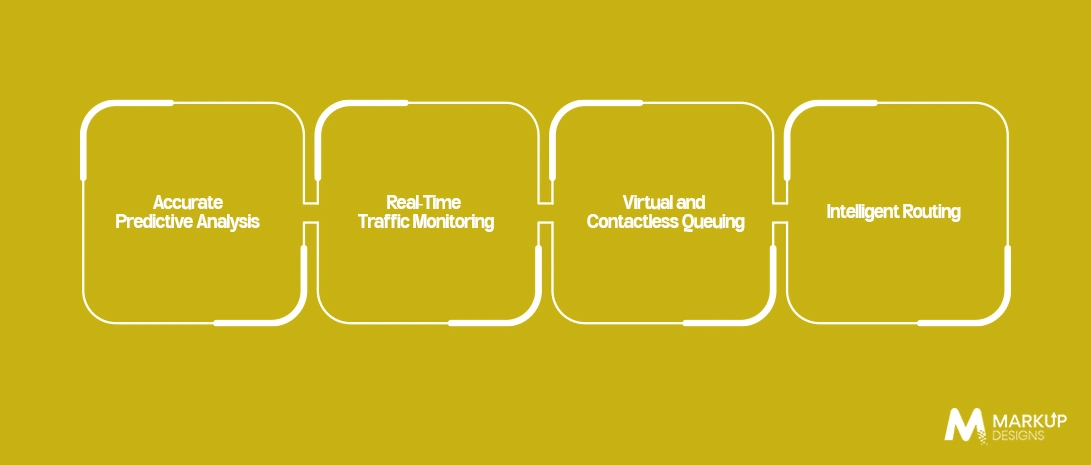
Accurate Predictive Analysis
AI-powered queue management uses historical data, customer behavior, and real-time demand patterns to predict traffic volume and waiting times with greater accuracy. Businesses can proactively allocate staff, optimize service points, and prevent bottlenecks before they impact customer experience.
Real-Time Traffic Monitoring
There is continuous monitoring of queue flow, arrival of customers, service speed, and capacity. With this, it becomes possible for organizations to make immediate changes, minimize congestion, and maintain a smooth flow of services.
Virtual and Contactless Queuing
Customers can join queues remotely through mobile apps, QR codes, kiosks, or web platforms without physically standing in line. This creates a faster, more convenient experience while reducing overcrowding and improving customer satisfaction.
Intelligent Routing
The AI automatically directs customers, tickets, or requests for service to the best employee or department to handle them, considering priority, availability, and specialization. This saves time and makes the process more efficient.
Transform Customer Experiences with AI Queue Management
Reduce wait times and deliver seamless customer journeys with intelligent queue management solutions built for UAE businesses. Use real-time analytics and automation to improve service efficiency, customer satisfaction, and operational performance.

What an AI-Powered Queue Management System Include
The advantage of developing an AI queue management system in Dubai is defined by the ability of the system to learn, adapt, and personalize the journey. Below are the key features of an AI queue management system that are necessary for dynamic service settings in UAE.
AI Prediction Engine:
AI predicts customer flow using historical and real-time data such as footfall patterns, service durations, holiday cycles, and aircraft movement. This enables the queue management system to prepare before congestion occurs by dynamically adjusting counters, allocating staff, and optimizing customer routing for smoother operations.
Sentiment Analysis
AI analyzes customer emotions such as stress, frustration, and dissatisfaction through facial expressions, behavioral cues, and posture detection. When signs of negative experiences are identified, supervisors receive timely alerts to intervene proactively, improving customer satisfaction and reducing service pressure during peak hours.
Virtual Ques and Contactless Check-Ins
AI-powered chatbots enable users to join virtual queues, generate digital tickets, check estimated wait times, schedule appointments, upload required documents, and receive real-time turn notifications. With multilingual intent detection and automated interactions, the process becomes faster, more convenient, and contactless.
Insight into Occupancy with the Help of IoT
IoT-enabled sensors continuously monitor movement patterns and occupancy levels across environments such as malls, airports, and service centers. Combined with AI analytics, this data helps optimize counter allocation, manage crowd distribution, reduce waiting times, and maintain operational efficiency during busy periods.
Multi-Lingual AI Assistants
AI-driven multilingual assistants guide users throughout the queue journey, including registration, check-ins, queue updates, and service notifications in their preferred language. This enhances accessibility, reduces communication barriers, and improves the overall customer experience for diverse user groups.
UAE Compliance and Security Requirements
Compliance plays an important role when building an AI-powered queue management system in Dubai. Under UAE Personal Data Protection Law, businesses that collect customer data, including personal or biometric information, one must follow strict privacy and security rules. Since queue systems often handle identities, mobile numbers, and service data, compliance must be built into the system from the beginning rather than added later.
UAE Personal Data Protection Law (PDPL)
PDPL governs how personal data is collected, processed, stored, shared, and retained within UAE. It establishes clear requirements around user consent, purpose limitation, breach notification, cross-border data transfers, and individual data rights. For AI-powered queue management systems that handle sensitive information such as Emirates ID details, phone numbers, or facial recognition data, compliance with PDPL requires implementing strong encryption, restricting unnecessary data collection, and maintaining secure data management practices.
Dubai Data Law
Dubai Data Law outlines the classification, processing, and sharing of data by public and private organizations. It affects the routing log data, the identity verification process, and service history data. All the data needs to be processed with secure access and governance guidelines.
NESA Information Assurance Standards
NESA delivers cybersecurity policies for the critical infrastructure of UAE. Such standards demand comprehensive protection for endpoints, network segmentation, device hardening, readiness for incidents, and constant monitoring. The systems using kiosk terminals, Internet of Things, or biometric devices have to comply with NESA standards to maintain their security.
Cloud Hosting and Data Residency
Data residency is a crucial factor since the PDPL prohibits data transfer unless certain conditions are met. Organizations usually favor cloud hosting within the jurisdiction and use either AWS UAE, Azure UAE, or G42 services. The growing market is evidence of same. Mordor Intelligence states that UAE cloud computing market amounted to $12.84 billion in 2025 and will grow to $45.41 billion in 2030.
Challenges and Solutions of Building an AI-Powered Queue Management System
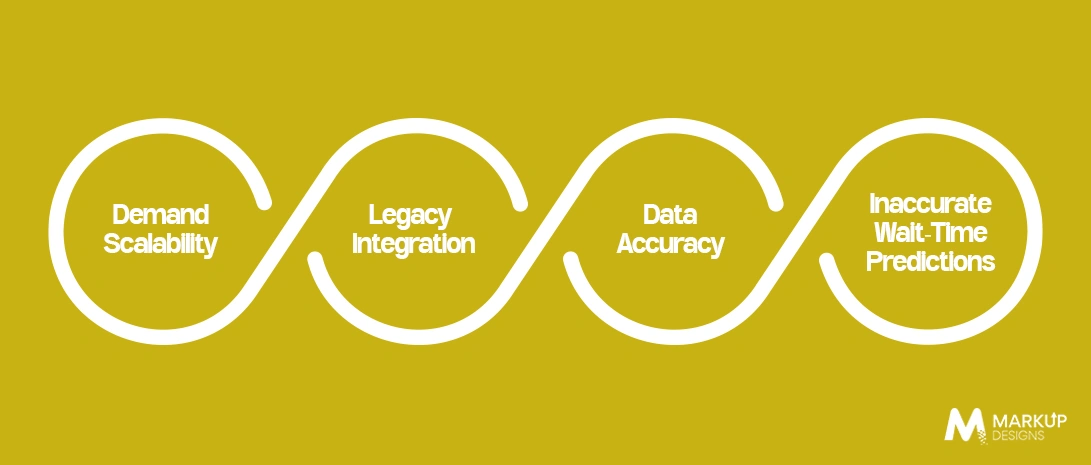
Demand Scalability
Challenge: Customer traffic can change rapidly during peak hours, holidays, or promotions. Traditional queue systems often struggle to handle sudden increases in demand, resulting in delays and poor service experiences.
Solution: Build the system on scalable cloud infrastructure with AI-driven demand forecasting. Auto-scaling resources and predictive analytics help manage traffic spikes while maintaining consistent performance.
Legacy Integration
Challenge: Many businesses still operate with older CRM, ERP, ticketing, and customer management systems that may not connect easily with modern AI platforms. This can slow implementation and create data silos.
Solution: Use APIs, middleware, and integration layers to connect existing systems with the AI queue platform. A phased integration approach reduces disruption and supports smoother adoption.
Data Accuracy
Challenge: AI performance depends heavily on data quality. Incomplete, outdated, or inconsistent customer and operational data can lead to poor decisions and unreliable queue optimization.
Solution: Implement data validation, automated cleansing, real-time synchronization, and centralized data management to maintain accurate and reliable inputs for AI models.
Inaccurate Wait-Time Predictions
Challenge: Queue systems may generate incorrect wait estimates due to unpredictable customer behavior, changing service times, or limited historical data, reducing user trust.
Solution: Continuously train AI models using real-time and historical data, monitor prediction performance, and apply adaptive algorithms to improve forecasting accuracy over time.
Future Trends in AI Queue Systems for UAE
UAE is rapidly progressing towards digitized, contactless, and artificial intelligence-based services. The upcoming generation of queue management systems would not only be limited to routing and queuing. Here’s what’s in store for the future of AI-based queue management solutions in Dubai and UAE.
Autonomous, Self-Learning Queue Engines
The queueing system will not follow any hardcoded set of guidelines. The AI models will learn from the behavior of the branches, patterns in the service times, and seasonal influxes in customers in order to optimize the routing process automatically.
Full Integration with UAE Pass and Unified Digital Identity
Since UAE Pass is now the only digital ID that will be recognized in the nation, the next generation of queuing systems will recognize people as soon as they scan in and retrieve all their service records.
Contactless Experiences Through Biometrics and IoT
Technology such as facial recognition, movement tracking, and Internet of Things (IoT) sensors will enable check-in, counter routing, and crowd management through non-touch technology at the kiosks. This is an emerging trend due to increased biometric use by airports, malls and government agencies.
Hyper Personalised Service Flows
AI will design individualized routes depending on the history of visitation, language of choice, appointment type, and/or priority of request. For instance, UAE nationals will get quick route navigation in case of frequently visited places, whereas tourists get step-by-step guidance according to their requirements.
Predictive Branch Management
The managers will depend on predictive dashboards to predict the load days in advance, spot any staffing shortfalls, and conduct what-if scenario testing. This enables businesses to plan effectively during long weekends and holiday seasons.
Omnichannel Queue Experiences
In WhatsApp, mobile applications development, website plug-ins, and self-service kiosks, all of them will come together to offer a seamless experience. The user will be able to queue up from anywhere, get alerts, and then reroute to less crowded branches.
Modernize Queue Operations with AI
Implement an AI-powered queue management system that optimizes customer flow and enhances service delivery across touchpoints.
Create smarter, faster, and more personalized experiences while improving resource utilization and business outcomes.

Conclusion
Queue management systems driven by artificial intelligence are revolutionizing the way companies operate within Dubai and UAE. Through the use of technologies such as predictive analytics, real-time monitoring, intelligent routing, and touchless interaction, organizations can increase their efficiency. In order to make the implementation of such systems successful, the right development process, proper integration, scalability, and conformity to UAE laws must be ensured.
FAQs
1. What is an AI-powered queue management system?
An AI-powered queue management system uses artificial intelligence to predict customer demand, optimize queue flow, automate routing decisions, and reduce waiting times in real time.
2. How much does it cost to build an AI queue management system in UAE?
The development cost typically ranges from AED 80,000 to AED 500,000+, depending on AI complexity, integrations, features, deployment scale, and infrastructure requirements.
3. Which industries benefit most from AI queue management?
Industries such as healthcare, banking, government services, retail, hospitality, airports, and customer support benefit significantly from AI-based queue optimization.
4. Is AI queue management compliant with UAE regulations?
Yes, when designed correctly. Businesses must align with UAE data protection requirements, implement secure data handling practices, and ensure privacy controls for customer information.
5. Can AI queue systems integrate with existing business software?
Yes. Modern AI queue platforms can integrate with CRM, ERP, POS, appointment systems, mobile apps, and communication channels through APIs and middleware.
Author's Perspective
Customer expectations in UAE continue to evolve toward faster, smarter, and more seamless service experiences. AI queue management is no longer only about reducing lines; it is becoming a strategic tool for improving operational visibility, customer satisfaction, and resource efficiency. Businesses that adopt intelligent queue systems early will be able to create more personalized service journeys while staying prepared for the future.
Discuss Your Project NowAjit Kumar Jha
VP - Business Operations
Related Posts
How to Build Production-Ready Applications with AI Coding...
Cost, Benefits & Business Impact: Generative AI vs....
Enterprise AI Agents: Practical Use Cases Driving Business...
Insights Are Valuable & Execution is Priceless
You’ve read about the digital future. Now, let’s build the infrastructure to take you there. Move your strategy from the page to the product.
Design Your Solution Now
Contact Us
Schedule The Appointment At Your Convenience Date And Time.
30 Min
Web Conference
Time Zone
Indian standard time (08:30pm)

Thanks For Getting In Touch!
You’ve Taken The First Step Toward Transforming Your Digital Presence. Our Experts Will Reach Out Shortly To Take It Forward.
Launch Your Dream Project
Provide a brief overview of your project, and our specialists will evaluate your requirements. We will connect with you to explore how the right digital solutions can help you launch faster.