

In Brief
- Custom electronic Clinical Outcome Assessment (eCOA) software solutions allow CROs to digitize the collection and management of patient-reported, clinician-reported, observer-reported, and performance-based assessments. Custom eCOA software allows replacing paper-based processes with software tailored specifically for particular clinical trials’ needs.
- Development of eCOA software involves analysis of the clinical workflow, requirements gathering, planning of features, UI/UX design, selection of technologies, implementation of the platform, integration with clinical systems, and completion of testing, validation, deployment, and maintenance.
- Features include mobile and web applications user-friendly to patients, digital questionnaires, auto-reminders, offline data collection, synchronization, investigator dashboard, real-time reporting, role-based access control, audit trail, and multi-language support.
- Custom development of eCOA software solutions may cost approximately $50,000 to $500,000+. The cost of a basic platform is between $50,000-$100,000, a mid-level solution – between $100,000-$250,000, and an enterprise platform – between $250,000-$500,000+.
- Main challenges involve regulatory compliance, accuracy of data, offline synchronization, user experience, integration with clinical systems, security, and scalability. Markup Designs provides services related to custom development of eCOA solutions through scalable architecture, clinical systems integration, security measures, and end-to-end development and maintenance.
Clinical trials yield a lot of data about patients, and accurate processing of these results is crucial for successful research. Paper-based tests and isolated software solutions can complicate and prolong the data collection process. In this case, Electronic Clinical Outcome Assessment (eCOA) software proves to be useful. It makes it possible for clinical researchers to collect and process the patient-reported and clinician-reported data via digital solutions.
But every trial is unique in its own way, and the ready-made solution does not always have the ability to take into account all these aspects. That’s why custom eCOA software development can be beneficial for many companies. It will make it possible to create a platform for research and data collection that will meet all your requirements.
In this blog, we will tell you about the custom eCOA software development process, necessary features, technology stack, architecture, and software development cost.
What is Custom eCOA Software Development?
The electronic version of the Clinical Outcome Assessment (eCOA) software is an electronic system that is implemented in clinical studies for the collection and management of the data that relates to patient health, symptoms, treatment experience, and clinical outcomes.
Custom eCOA software development refers to the development of an application that is tailored to the needs of a certain clinical research organization, pharmaceutical firm, or clinical trial. It is possible to develop unique workflows, assessment forms, integrations, and reporting tools without having to use pre-fixed functionality.
eCOA software generally supports four types of clinical assessments:
- Electronic Patient-Reported Outcomes (ePRO): Captures patient-generated data.
- Clinician-Reported Outcomes (ClinRO): Permits clinicians to capture clinical observations.
- Observer-Reported Outcomes (ObsRO): Captures observations made by caregivers and/or others.
- Performance-Based Outcomes (PerfO): Captures performance data resulting from standardized tasks completed by patients.
With all these functionalities, customized electronic COA systems enable researchers to effectively manage their clinical data with respect to their requirements.
Step-by-Step Process of Custom eCOA Software Development
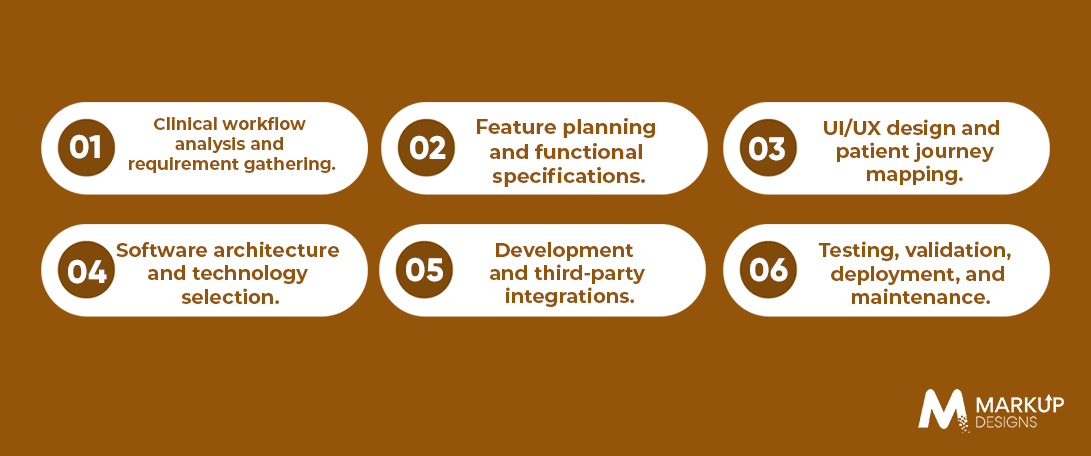
Creation of custom eCOA software involves a thorough understanding of clinical trial processes, patient needs, and regulatory requirements. A well-organized software creation process can help ensure that the developed platform allows proper data collection and operation, as well as future scalability. The following steps are included:
Clinical workflow analysis and requirement gathering.
The first step is to understand clinical trial requirements and how the software will be used. The software development team discusses with clinical researchers and investigators, among others:
- Required types of clinical assessment.
- Target patients and trials.
- Data collection and reporting requirements.
- Requirements regarding regulation and security.
Feature planning and functional specifications.
In the case of defined requirements, the features and functionalities of the platform must be defined. The list of features includes patient questionnaires, assessment scheduling, notifications, dashboards, and reporting tools that must correspond to clinical workflows.
UI/UX design and patient journey mapping.
The interface must be designed in such a way that patients, clinicians, and researchers can easily use it. Designers work on wireframes and prototypes for mobile and web applications, paying attention to convenient navigation, filling out forms, clear content, and easy assessment completion.
Software architecture and technology selection.
Now, the software architecture of the application needs to be designed, and technologies should be selected for frontend and backend development, database management, cloud computing, and integration with other applications.
Development and third-party integrations.
Afterwards, developers create modules according to the plans and integrate the platform with other clinical systems such as EDC, CTMS, IRT, and EHR.
Testing, validation, deployment, and maintenance.
Prior to implementation, the software goes through functional, performance, security, usability, and integration testing. Validation processes assist in verifying that the system performs correctly and complies with regulations. Post-implementation maintenance ensures continued proper performance of the software.
A properly designed development process facilitates the creation of an eCOA system that meets the requirements of clinical trials and provides a quality user experience.
Key Features to Include in Custom eCOA Software
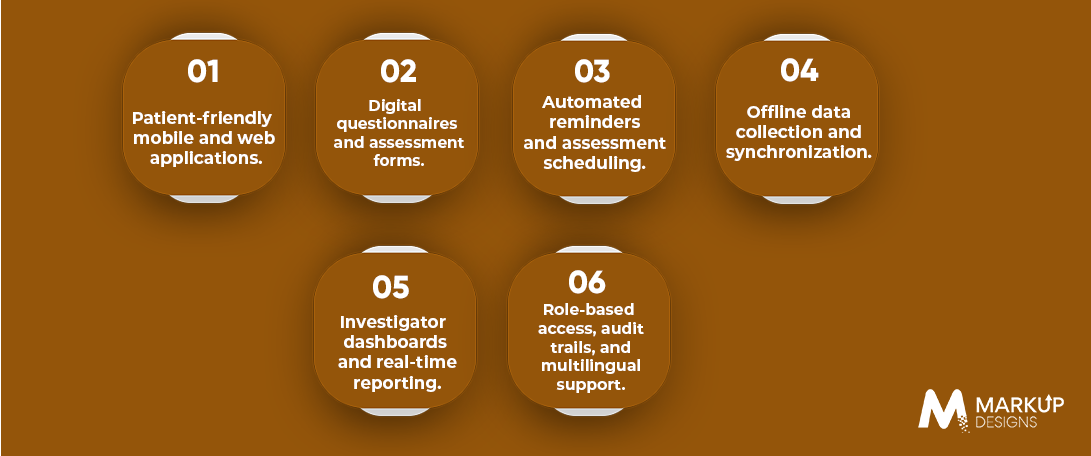
The features of an eCOA platform have a direct influence on patients’ responses and the ability of researchers to manage clinical data. A properly developed solution must allow data collection to be convenient for all parties, while ensuring that investigators have everything necessary to control the trial process. Let us list the top six characteristics that must be included in the eCOA solution:
Patient-friendly mobile and web applications.
The platform must provide user-friendly mobile and web applications for patients to access information about the study, complete assessments, and keep track of upcoming tasks.
Digital questionnaires and assessment forms.
These are electronic forms that enable patients, clinicians, and caregivers to record clinical data electronically. Customized questionnaires allow organizations to configure assessments based on their needs.
Automated reminders and assessment scheduling.
Automated notifications alert the participants about assessment deadlines. The system allows configuring the schedule in accordance with study requirements.
Offline data collection and synchronization.
Participants may lack stable internet access. Using offline capabilities, users can complete their tasks even if there is no active connection. When connectivity is re-established, the acquired data will be synchronized securely within the main system.
Investigator dashboards and real-time reporting.
Dashboards allow users to track whether participants have completed assessments, identify any missing data, and analyze the acquired data. In addition, reporting tools provide insights into the participants’ activity.
Role-based access, audit trails, and multilingual support.
Role-based access control enables participants, investigators, and administrators to view only the necessary information. The system also keeps audit logs and offers multilingual interfaces for participants.
Together, these features help create a flexible eCOA platform that supports clinical trial workflows, improves the data collection experience, and makes research operations easier to manage.
eCOA Software Architecture: How Does the System Work
A good architectural design plays an essential role in the development of a reliable and scalable eCOA solution. Architecture determines the way components interact with each other, the flow of clinical data in the platform, and data storage and protection methods. A common architecture of an eCOA solution includes the following layers:
Presentation Layer
It is the user side of the solution. It is represented by mobile apps used by patients and web dashboards used by investigators, clinicians, and administrators. The interface helps users to conduct assessments, browse information, and conduct activities during a trial.
Application and Business Logic Layer
It handles the main functions of the platform, including assessment scheduling, questionnaire management, notifications, user authorization, and other actions according to the clinical trial protocol.
Data Management Layer
It contains patient assessments, clinical observations, study records, and other relevant information. Data storage can be provided by databases like PostgreSQL and MongoDB, depending on the platform requirements. Information protection is ensured by encryption, access control, and backups.
Integration Layer
This layer acts as a bridge between the eCOA platform and external clinical systems using API connections and data exchange standards. This layer can integrate the eCOA platform with EDC, CTMS, EHR, IRT, wearables, and laboratory systems.
Security and Infrastructure Layer
This layer provides infrastructure for hosting the platform and ensures the availability and security of the system. Cloud services, identity management, encryption, and logging help to provide a secure environment.
How Much Does Custom eCOA Software Development Cost?
The cost of developing customized eCOA software will vary based on the number of features of the software, the technicality involved in development, and the time taken for development. An affordable basic software will have core features to conduct clinical assessments, while an advanced software will be costly due to the numerous clinical research and complexities involved.
There is no fixed price for development since every clinical research organization will have unique requirements. Nonetheless, the total cost of investment can be estimated based on the technicality of the software.
Based on the development scope, custom eCOA software can fall into the following investment categories:
Estimated Cost by eCOA Software Complexity | ||
|---|---|---|
| Development level | Estimated cost | Typical scope |
| Basic eCOA platform | $50,000–$100,000 | Patient assessments, digital questionnaires, basic dashboards, and data collection. |
| Mid-level eCOA platform | $100,000–$250,000 | Multiple user roles, offline functionality, reporting, and clinical system integrations. |
| Enterprise eCOA platform | $250,000–$500,000+ | Global trial support, advanced integrations, multilingual capabilities, analytics, and extensive compliance requirements. |
Key Factors Affecting Custom eCOA Software Development Cost
A number of choices, both technological and functional, might affect the overall budget of application development.
- Complexity of Features: Usage of advanced tools for assessing patients, automatic scheduling, analytics, and user dashboards increases costs.
- Platforms to Develop on: Development of apps separately for iOS, Android, and Web versions raises the overall costs of development.
- Third-Party Integrations: Integration with EDC, CTMS, EHR, and wearable devices introduces extra costs.
- Security: Encryption, access management, and other compliance procedures will have to be implemented and tested.
- Offline: The ability to work offline raises the technical complexity of development.
- Maintenance and Infrastructure: Cloud hosting, security updates, and support will add to the maintenance and infrastructure costs.
Common Challenges in Custom eCOA Software Development and Their Solutions
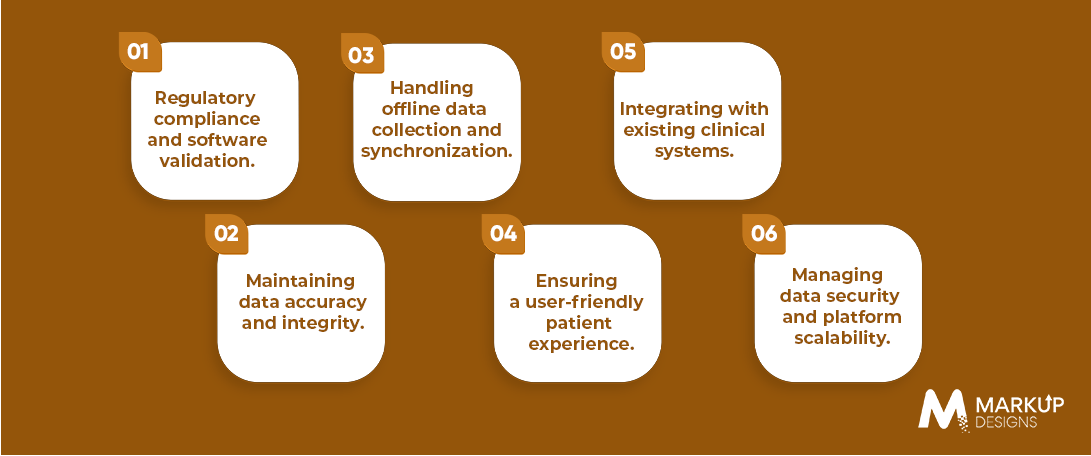
The creation of custom eCOA software entails not only developing digital questionnaires for collecting relevant information but also managing other aspects that need to be considered to create an efficient platform.
Regulatory compliance and software validation.
Custom eCOA software has to satisfy the appropriate regulatory requirements, including FDA 21 CFR Part 11, HIPAA, and GDPR, depending on the nature and location of the clinical trial being conducted. Compliance with regulatory requirements makes software development more complicated.
Solution: The compliance requirements have to be identified during the planning stage. It is essential to introduce audit trails, electronic signatures if necessary, role-based access, and validation procedures.
Maintaining data accuracy and integrity.
Incomplete assessments, duplicated records, and inaccurate information submissions will impact clinical research. The management of information provided by multiple sources is an additional challenge.
Solution: Use data validation rules, automated procedures, timestamps, and audit trails.
Handling offline data collection and synchronization.
Since patients involved in decentralized or remote trials may have restricted internet access, assessment submissions may be hampered, and delays in data availability can occur.
Solution: Provide the option of secure offline data collection with automatic synchronization when connectivity is restored. Conflict resolution methods will be helpful in dealing with any changes made on different devices.
Ensuring a user-friendly patient experience.
Complex user interfaces and long questionnaires may create difficulties for patients to complete assessments regularly. It may impact patient participation and data collection efforts.
Solution: Ensure that interfaces are intuitive, easy to navigate, and compatible across all devices. Usability testing will identify potential issues ahead of time.
Integrating with existing clinical systems.
Different clinical research organizations often have separate systems for managing their trials, collecting electronic data, keeping track of patient records, and performing randomizations. Integration of these systems is not an easy task.
Solution: Secure API integrations and proper data exchange formats, such as HL7 FHIR where applicable, should be used. Integration needs should be anticipated in advance.
Managing data security and platform scalability.
When clinical trials grow in size, eCOA platforms might have to manage increased numbers of subjects, large volumes of data, and multiple locations for studies. Poor security and infrastructure can have an effect on the reliability of the system.
Solution: Implement scalable cloud infrastructure, encryption, security assessment, backup, and performance monitoring.
Addressing these challenges during development helps organizations build eCOA platforms that support clinical research requirements while maintaining data quality, usability, and system reliability.
Why Choose Markup Designs for Custom eCOA Software Development?
Partnering with the right developer is critical when creating dependable eCOA software applications for clinical research. Markup Designs assists organizations in developing custom-built software applications for their research process needs, technical requirements, and business needs. This involves developing robust software application architectures that can accommodate increased amounts of data, multiple users, and clinical operations.
Whether it is integrating with other third-party clinical software applications or the use of the right frontend, backend, database, and cloud technologies, everything is carefully thought out based on project needs. Markup Designs also considers the incorporation of security and access controls and even audits. Organizations can thus build eCOA platforms that meet their research requirements.
Planning to develop an eCOA platform for your clinical research operations?
Connect with Markup Designs to discuss your requirements and build a solution that supports your study workflows, integration needs, and future growth.

Conclusion
With custom software development for eCOA, clinical research organizations can control the collection of patient assessments and clinical data using digital platforms tailored to their unique needs. Depending on the type of features implemented, the process of conducting research can become easier and more convenient.
At the same time, there are many important aspects that should be considered when creating a functional platform, including proper planning, choice of a technology stack, scalable architecture, data security, and other issues. The organizations should take into account the cost of software development according to the required features and integrations.
Choosing a professional software development company will enable organizations to create such customized solutions. A proper development strategy is essential for this purpose.
FAQs
1. How long does it take to develop custom eCOA software?
The development timeline depends on the platform’s complexity, features, integrations, and validation requirements. A basic solution may take a few months, while an enterprise-grade platform can require significantly more time.
2. What is the difference between eCOA and ePRO?
eCOA is a broader category that includes different types of clinical outcome assessments. ePRO is one type of eCOA that collects health-related information directly from patients through digital questionnaires and applications.
3. What technologies are used to develop eCOA software?
Common technologies include React.js, Angular, Flutter, React Native, Node.js, Python, Java, PostgreSQL, and cloud platforms such as AWS and Microsoft Azure. The final technology stack depends on the platform’s requirements.
4. How much does it cost to build custom eCOA software?
Custom eCOA software development can cost approximately $50,000 to $500,000 or more. The actual investment depends on feature complexity, platform requirements, integrations, security measures, and validation needs.
5. Does custom eCOA software need to comply with FDA 21 CFR Part 11?
FDA 21 CFR Part 11 applies when electronic records and signatures fall within its scope. Organizations must evaluate the intended use of their eCOA platform and implement appropriate controls for compliance.
Author's Perspective
Custom eCOA software is becoming an important part of modern clinical research as organizations look for better ways to collect and manage clinical outcome data. However, successful implementation requires more than choosing the right technology or adding digital questionnaires.
The real value comes from building a platform that fits the clinical trial workflow, provides a simple experience for participants, and supports accurate and secure data management. Organizations should focus on scalability, integration, usability, and regulatory requirements from the beginning rather than treating them as later development considerations.
A well-planned custom eCOA solution can help research teams manage changing study requirements and create a more organized approach to clinical data collection.
Discuss Your Project NowGaurav Goyal
Global Sales- VP
Related Posts

How Much Does It Cost to Develop DICOM...

How Healthcare ERP Software is Transforming Hospital Management...

How to Build a Hospital Management System in...
Insights Are Valuable & Execution is Priceless
You’ve read about the digital future. Now, let’s build the infrastructure to take you there. Move your strategy from the page to the product.
Design Your Solution Now
Contact Us
Schedule The Appointment At Your Convenience Date And Time.
30 Min
Web Conference
Time Zone
Indian standard time (08:30pm)

Thanks For Getting In Touch!
You’ve Taken The First Step Toward Transforming Your Digital Presence. Our Experts Will Reach Out Shortly To Take It Forward.
Launch Your Dream Project
Provide a brief overview of your project, and our specialists will evaluate your requirements. We will connect with you to explore how the right digital solutions can help you launch faster.