

In Brief
- Financial Platform Connections: Fintech integration enables connections between banking applications, payment systems, accounting systems, and other financial platforms for better data exchange.
- Increased Efficiency: Automating operations, minimizing mistakes, and simplifying processes of finance management.
- Protection and Compliance: Secure APIs, encryption, identity management, and regulatory compliance to protect sensitive financial data.
- Improved Customer Experience: Payment system integrations, digital wallets, and real-time finance services to offer fast and easy transactions.
- Scalability and Flexibility: Modern integration architecture to support higher volumes of transactions, additional services, and changing business needs.
The field of financial technology is developing and introducing digital banking solutions, online payments, lending applications, and automation of financial services. However, handling these services without integration is associated with the creation of data silos, inefficiency, and poor protection of sensitive data. Fintech software integration solves these problems by creating a connected ecosystem that includes financial applications, third-party services, and business infrastructures.
Fintech software integration is not limited to connecting different financial platforms for businesses. Integration of financial applications includes aspects such as creating secure data flows, automating processes, and exchanging information between systems in real time. Technologies such as APIs, cloud computing, AI, and open banking help organizations improve operational efficiency, strengthen security, and deliver better customer experiences. A well-planned integration strategy also provides the flexibility needed to scale financial services as business requirements evolve.
Understanding Fintech Integration in the Enterprise
The fintech integration helps in connecting the financial applications, banks and businesses to facilitate safe data exchange and coordinated operation. The integration of fintech is beneficial for enterprises as it helps to streamline financial processes and makes them accessible and more efficient.
What Is Enterprise Fintech Solutions Integration?
Enterprise fintech integration refers to the integration of financial software with business systems and banking services. It allows enterprises to manage payments, data, and transactions using integrated workflows.
Types of Fintech Software Integration Businesses Must Know About
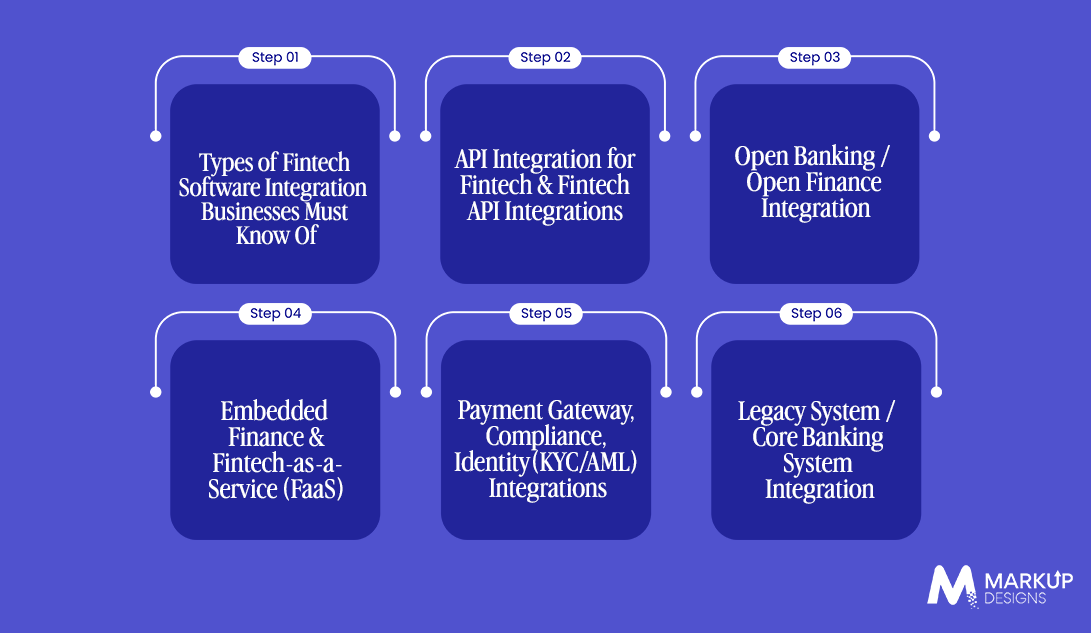
Businesses can use various financial technologies in their processes depending on their needs.
API Integration for Fintech & Fintech API Integrations
It allows integrating financial applications with third-party services such as banking institutions, payment processors, and accounting software.
Open Banking/Open Finance Integration
In open banking, third parties have access to financial data using secure APIs. In open finance, financial data can be accessed by third-party services beyond banking.
Embedded Finance/Fintech-as-a-Service (FaaS)
It allows integrating financial services with non-financial platforms such as e-commerce applications. They enable secure communication and real-time data exchange.
Payment Gateway, Compliance, Identity (KYC/AML) Integrations
The payment gateway performs digital transactions, while KYC and AML integration enables identity checks and compliance verifications. Together, these enable businesses to handle safe and efficient financial transactions.
Legacy System & Core Banking Integration
Such integrations allow for the integration of modern fintech applications with traditional banking systems. This way, businesses are able to scale up their systems’ capabilities without changing legacy elements.
How Does Fintech Software Integration Work?
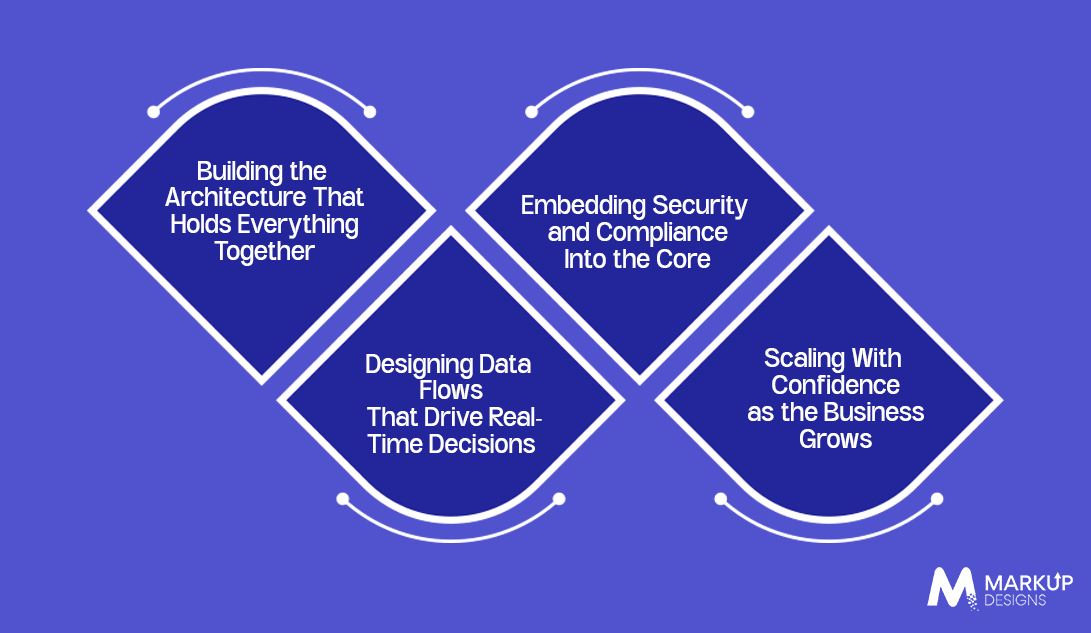
The process of fintech integration includes connecting applications, data flows, and implementing security controls in the financial systems. The right architecture will ensure connectivity of the different platforms.
Building the Architecture That Holds Everything Together
The developers create a proper integration architecture via APIs, middleware, and microservices. This allows creating connections between various financial applications, databases, and service providers.
Designing Data Flows That Drive Real-Time Decisions
The data flows allow defining the movement of financial data between connected systems. This helps businesses get real-time transaction records and account information.
Embedding Security and Compliance Into the Core
The security controls, including encryption, authentication, and access control, help protect sensitive financial information. Compliance is included in the data and transaction processes.
Scaling With Confidence as the Business Grows
The cloud infrastructure and the use of modularity make it possible for systems to cope with increasing transactions and users. The integration of new financial services is easier for the same reasons.
Applications of Fintech Software Integration for Businesses
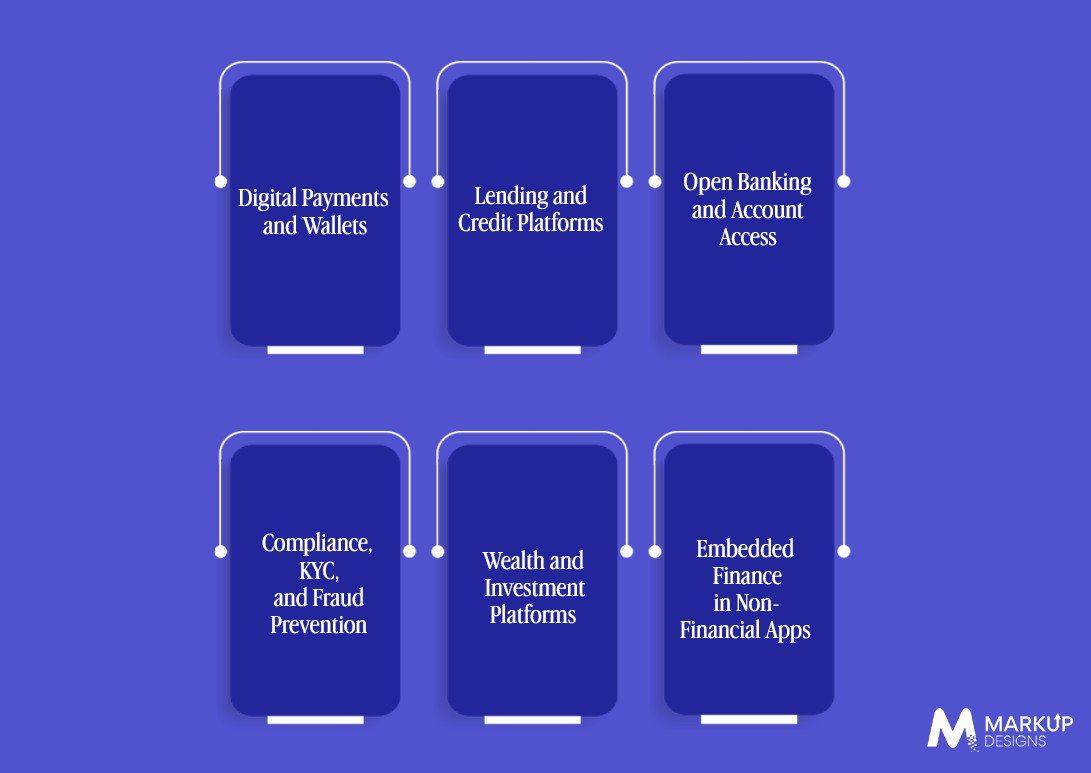
Financial software integration helps carry out diverse operations by integrating specialized solutions and delivering services through automation. Applications range from payments and lending to banking and wealth management.
Digital Payments and Wallets
The integration is needed to link the payment gateways, banking networks, and digital wallets in order to perform the payments and to automate reconciliation.
Lending and Credit Platforms
Credit platforms require integration of credit assessment systems, banking APIs, and identity verification systems. This will allow businesses to automate loan applications and loan repayment processes.
Open Banking and Account Access
The open banking integration will allow other applications to gain access to account information. Businesses will be able to manage finances using the integration of accounts.
Compliance, KYC, and Fraud Prevention
This integration is aimed at automating identity verification, transaction monitoring, and suspicious activity detection. Financial organizations will be able to improve their risk management and compliance operations.
Wealth & Investment Platforms
Integration helps connect the investment apps with market data vendors, portfolio management solutions, and payments. It is aimed at portfolio management and enhanced accessibility of the investment solutions.
Embedded Finance in Non-Financial Applications
It is possible to embed lending, insurance, and payment functionalities in business applications to offer financial services without transferring users between different applications.
Why Does Fintech Software Integration Matter More Than Ever?
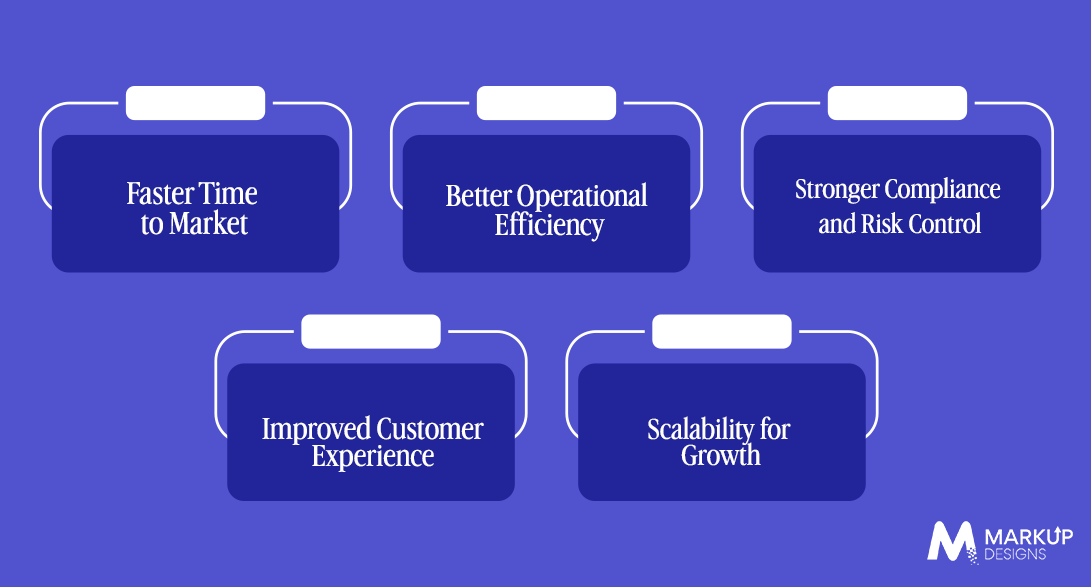
The connected finance software solution helps businesses enhance service delivery, simplify operations, and respond to customer requirements. At the same time, it becomes easier to introduce innovative financial products.
Faster Time to Market
Reusable APIs and external financial services decrease the effort needed to introduce innovations. Financial products could be launched without developing all components by yourself.
Better Operational Efficiency
Data exchange automated by connections eliminates manual reconciliation and other routine operations. At the same time, it improves collaboration within financial departments.
Stronger Compliance and Risk Control
Monitoring and verification tools help to detect suspicious operations and keep financial records. Integrated solutions provide a chance to build efficient compliance processes.
Improved Customer Experience
Connected platforms enable faster transactions, convenient account access, and personalized financial services. Customers benefit from fewer manual steps and more consistent interactions.
Scalability for Growth
Modular integrations allow businesses to add services and accommodate higher transaction volumes. This supports expansion without requiring complete infrastructure replacement.
What Are the Biggest Challenges of Fintech Software Integration?
Despite its benefits, fintech integration involves technical and operational challenges that can affect implementation and performance. Businesses need to address these issues during the planning and development stages.
- Legacy Systems That Don’t Connect: Older infrastructure may lack compatibility with modern APIs and applications, requiring middleware or system upgrades.
- Data Silos and Inconsistent Flows: Disconnected databases can create duplicate records and inaccurate financial information.
- Rising Compliance Demands: Changing financial regulations require continuous monitoring and updates to integration workflows.
- Security Risks: Poorly secured APIs and data exchanges can expose sensitive financial information to cyber threats.
- Limited Scalability: Rigid architecture may struggle to handle increasing transactions and additional service integrations.
What Is the Role of Artificial Intelligence in Fintech Software Integration?
AI improves integrated financial systems by analyzing data, automating decisions, and identifying potential risks. Its capabilities help businesses make financial operations more responsive and efficient.
- Fraud Detection and Risk Scoring: AI analyzes transaction patterns to identify suspicious activities and potential fraud.
- Predictive Analytics: Machine learning models analyze financial data to forecast trends and assess potential risks.
- Automated Onboarding: AI-powered document processing and verification tools help simplify customer onboarding.
- Personalized Recommendations: Customer data analysis supports tailored financial products and service recommendations.
- Process Automation: AI automates repetitive activities such as document classification, data extraction, and transaction reviews.
What Are the Best Practices for Secure Fintech Software Integration?
Financial integrations deal with confidential customer information and money-related processes, which means that securing your fintech solution is another crucial requirement in its development. You need to have proper protection measures implemented into your APIs, databases, and applications involved in integration.
Secure API Design and Management
You can use API authentication and access limitations along with rate limiting as protection measures. Proper API testing will help you find any possible vulnerabilities and configuration issues.
Encryption, Tokenization, and Secure Data Storage
Encryption will secure all financial information that is being transferred or stored. Tokenization will replace sensitive payment information with tokens.
Identity Verification, Fraud Detection, and Prevention
It is possible to use KYC verification along with multi-factor authentication and transaction monitoring to detect suspicious actions and verify user identity.
Audit Trails, Logging, and Monitoring
You should keep detailed logs of all system accesses, transactions, and integrations. Monitoring can help you detect any abnormal activity.
Regulatory Standards and Certifications
You should follow financial regulations and standards, like PCI DSS compliance in case of working with payment cards. The requirements for regulations and certifications should be considered while developing an integration.
How Much Does Fintech Software Integration Cost, and What Is the ROI?
Fintech integration costs depend on the number of connected systems, technical complexity, security requirements, and implementation scope. Businesses should evaluate both initial investment and long-term operational value.
What Drives Fintech Integration Costs?
API complexity, compatibility of legacy systems, licensing of third-party components, infrastructure needs, and security issues impact the cost of integration. Custom-made integrations typically cost more in development effort compared to standard connectors.
Estimating Timeframes and Budgets
Basic API integration might take weeks, whereas complex enterprise integration can take several months. The timing depends on system interdependencies, testing, and compliance needs.
How to Measure ROI and Business Value
Firms can evaluate returns through lower processing fees, transaction speed, reduced human error, and better client retention. These metrics are used by businesses to estimate the value of investments in integration.
What Are the Future Trends in Fintech Software Integration?
Financial software integration keeps developing as companies adopt smarter and more intelligent systems. Future trends are changing the way financial services will be created and delivered.
Deeper Use of AI in Integrations
Advanced AI systems start to automate workflow processes and provide fraud detection capabilities.
Rise of Real-Time Financial Services
The instant payment processing and immediate information transfer increase demand for fast financial operations and updates.
Stronger Push for Open Finance
Open finance increases the connectivity of banking, insurance, lending, and investment solutions.
Cloud-Native as the Default
Cloud-native architecture allows for a flexible infrastructure, quick deployment, and ease of integration with third-party financial services.
Security and Compliance by Design
Businesses are designing their applications in a way that allows security controls and compliance to be built in from the start.
DeFi, ESG, and Sustainability
Decentralized finance and ESG-based financial tools bring in new integration needs related to digital assets, transaction visibility, and sustainability reporting.
Why Work With Markup Designs on Fintech Software Integration?
We can help you build and integrate fintech software solutions that will enable your business to conduct financial transactions in a secure and interconnected environment. We can help integrate financial apps with other business infrastructure using APIs, custom software development, cloud technology, and third-party integrations. From integration planning to development, testing, and implementation of fintech solutions, we focus on delivering fintech solutions according to specific business requirements.
If you need integration with any payment gateways, bank APIs, automation of financial processes, or fintech app development, we will help you build scalable fintech solutions.
Connect Your Financial Systems With Smarter Fintech Integration
Build secure, scalable, and connected financial solutions with integration strategies designed around your business requirements.

Conclusion
Fintech software integration helps businesses connect financial platforms, automate operations, and improve the security and efficiency of financial services. From API connectivity and digital payments to AI-powered fraud detection and open banking, integrated systems create opportunities for better customer experiences and operational growth. However, successful integration requires careful technology selection, secure architecture, and compatibility with existing infrastructure. Businesses that adopt a well-planned integration strategy can build flexible financial ecosystems that support evolving requirements and long-term growth.
FAQ
1. What Is the Return On Investment of Integrating Fintech Software Into Existing Systems?
ROI can be improved through automation of processes, cost reduction, and error prevention. The actual ROI depends on integration costs, volume of business, and optimization.
2. What Is the Role of Fintech Integration in Future-Proofing Financial Operations?
This allows companies to connect new technologies and financial operations without replacing all of the existing infrastructure. Modular APIs and scalable architecture also simplify further upgrades.
3. What Is the Procedure for Selecting the Right Fintech Software Integration Partner?
The company needs to evaluate the partner’s experience with financial APIs, security measures, systems integration, and compliance with regulations. Previous projects, technical expertise, and post-integration support also need to be considered.
4. Can Fintech Integration Reduce the Operational Costs of Enterprises?
Yes, fintech integration allows automation of transactions, synchronizes data, and generates financial reports. However, actual reduction of costs depends on the integration costs and processes that are automated.
Author's Perspective
In essence, fintech integration does not mean connecting financial applications anymore. It means the creation of a stable ecosystem, which integrates data, transactions, and services. Security, scalable architecture, and regulatory compliance should be among the priorities in the integration plan. At Markup Designs, we believe that the right integration approach should simplify financial operations today while providing the flexibility to accommodate future technological advancements.
Discuss Your Project NowAjit Kumar Jha
VP - Business Operations
Related Posts
Open Banking in Australia: Complete Enterprise Implementation Guide...

Building NPP-Enabled Digital Payment Platforms in Australia: A...
Complete Guide to Forex Trading App Development in...
Insights Are Valuable & Execution is Priceless
You’ve read about the digital future. Now, let’s build the infrastructure to take you there. Move your strategy from the page to the product.
Design Your Solution Now
Contact Us
Schedule The Appointment At Your Convenience Date And Time.
30 Min
Web Conference
Time Zone
Indian standard time (08:30pm)

Thanks For Getting In Touch!
You’ve Taken The First Step Toward Transforming Your Digital Presence. Our Experts Will Reach Out Shortly To Take It Forward.
Launch Your Dream Project
Provide a brief overview of your project, and our specialists will evaluate your requirements. We will connect with you to explore how the right digital solutions can help you launch faster.