
Slug: ai-integration-in-erp-systems
In Brief
- The combination of AI technology within the ERP solution enables companies to automate repetitive processes, analyze data, discover patterns, and make decisions on finance, inventory, procurement, sales, and many other processes.
- Machine learning, natural language processing, predictive analysis, generative AI, intelligent document processing, and AI agents are some of the technologies that allow companies to perform demand forecasting, invoicing, reporting, inventory control, and process automation.
- The main advantages are increased efficiency, error and cost reduction, improved resource planning, accurate demand forecasting, and superior customer experience.
- Successful implementation includes setting business objectives, assessing the current ERP system, obtaining accurate data, selecting the right AI use cases, implementing and testing solutions, training employees, and continuously monitoring performance. Typical problems are inaccurate data, system compatibility issues, security threats, cost of implementation, and AI reliability.
- The cost of AI-ERP implementation can vary depending on the scope of work. It can be $15,000-$50,000 for a pilot project, $50,000-$150,000 for one department, and $150,000-$500,000 for an enterprise-wide solution. Markup Designs is ready to help businesses to set up custom AI solutions that will streamline processes and help in making smart decisions.
Modern business organizations use ERP systems for the management of their diverse activities, such as finance, inventory management, procurement, sales, and human resource management. But in most cases, these ERP systems tend to be rule-based and manually intensive, thus making them incapable of meeting changing business demands. This is where AI comes in handy.
The incorporation of AI in ERP systems enables companies to automate the process of handling repetitive tasks, analyzing big data, finding patterns, and making informed decisions. From forecasting inventory needs to automated invoice processing, companies can greatly benefit from AI.
It is important to note that the process of incorporating AI tools into existing systems entails much more than just implementing the software.
In this blog, we will learn about the mechanism of integrating AI in ERP systems, key technologies required for the same, their advantages, and practical use cases in businesses. We will also learn about the implementation process, the associated challenges, cost, and timeline, along with the selection of integration partners.
What is AI Integration in ERP Systems?
ERP systems incorporating AI are those that combine the use of AI technology in ERP software to enhance the management process of businesses. The technology makes it possible for ERP systems to make analysis of business data, detect trends, automate processes, and make decisions with minimal human intervention.
In traditional ERP systems, there is mainly the application of a set of defined rules for processing and managing information. With AI technology, it is possible for these systems to take it further through prediction from data, detection of anomalies, and suggestion of appropriate courses of action.
For example, an ERP system integrated with AI can predict the need for products by analyzing the previous sales data, detect unusual financial transactions, and even process invoices automatically.
There are several ways to integrate AI with ERP systems using AI capabilities, third-party software applications, APIs, or custom-built solutions. It will depend on various factors such as ERP system capabilities, the needs of a company, availability of data, etc.
The primary goal is to improve ERP systems by making them more intelligent and useful in business operations.
Key Technologies Behind AI-Powered ERP Systems
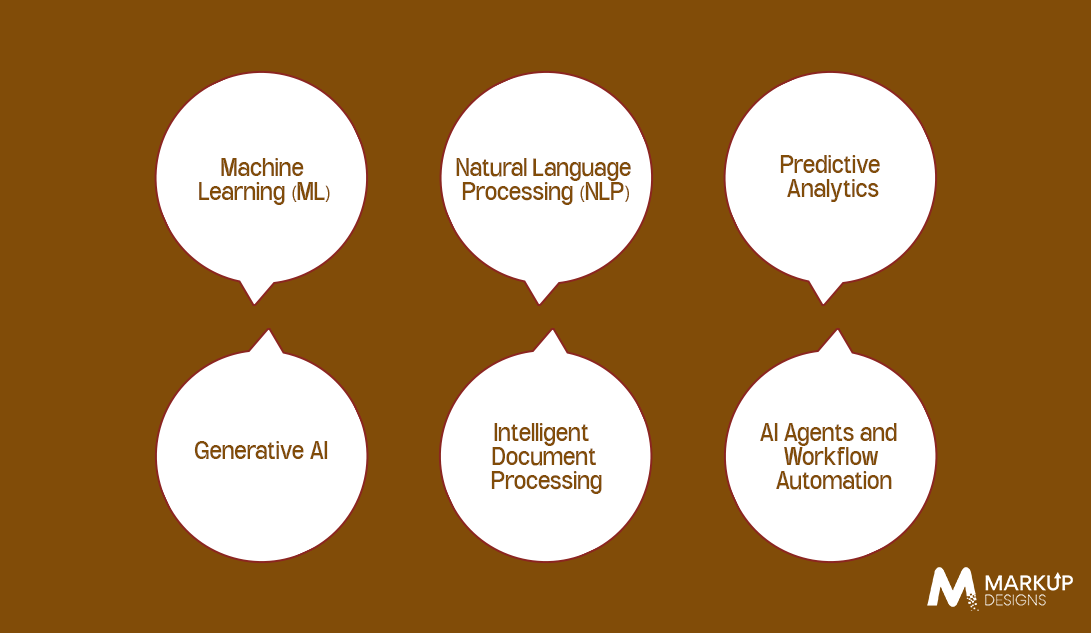
Various types of AI technologies are used together to enhance the performance of ERP systems. Every type is dedicated to a certain aspect of operation, from analysis of business data to automation of tasks and improved decision-making.
Machine Learning (ML)
ML assists ERP systems in analyzing historical data and detecting patterns in them. Business entities can use ML for predicting the demand for products, foreseeing the failures of machinery, and optimizing inventory management based on previous results.
Natural Language Processing (NLP)
NLP lets ERP systems process human speech and interpret it. With NLP, employees of organizations will be able to use conversational search to find financial reports, check inventory levels, or access other kinds of business information.
Predictive Analytics
Predictive analytics applies past and present data in making predictions of the future. Predictive analytics enables companies to predict their sales trends and possible supply chain issues.
Generative AI
The capability of generative AI includes summarizing reports, answering queries on business-related data, document creation, and aiding employees in getting ERP information through conversations.
Intelligent Document Processing
Intelligent Document Processing technology helps in extracting and processing information from invoices, purchase orders, receipts, and various other types of business documents. This technology reduces data entry work.
AI Agents and Workflow Automation
AI agents are capable of doing multi-step tasks like collecting data, searching records, and planning action items for approvals. With proper access and controls, they help in the automation of workflows.
Benefits of Integrating AI into ERP Systems
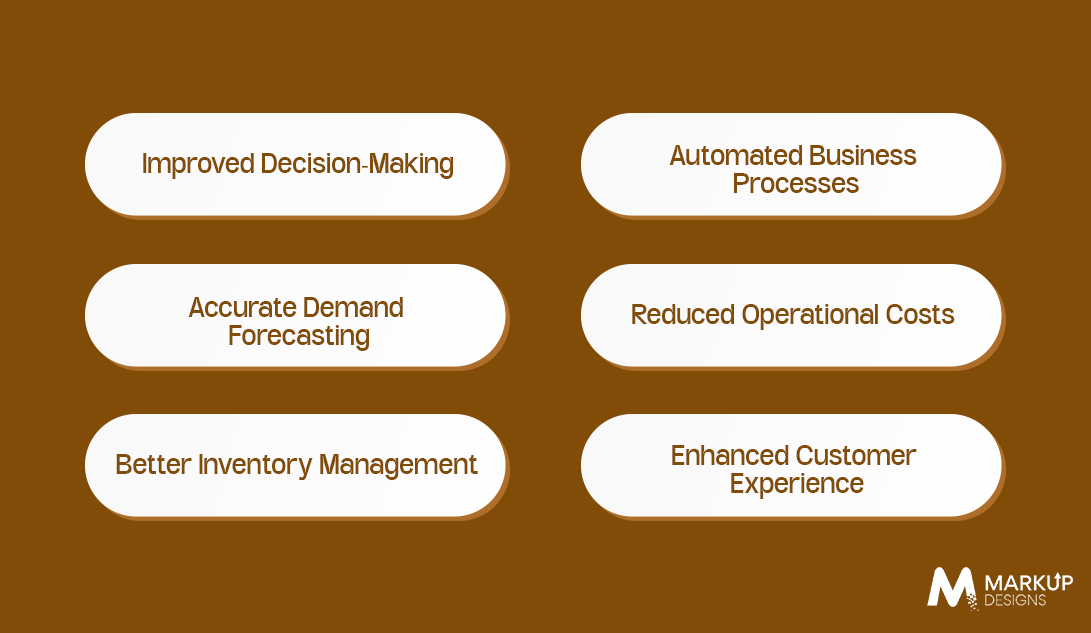
Integration of AI in ERP will enable companies to operate effectively, utilize resources efficiently, and ensure decision-making is based on proper analysis. Some of the advantages include:
Improved Decision-Making
Through the use of AI in analyzing business data provided by various departments, managers are able to understand the business performance and identify possible problems in order to make an informed decision.
Automated Business Processes
Through the use of AI, various business processes such as invoicing, data collection, report writing, and purchase orders will become automated.
Accurate Demand Forecasting
Using past sales data and market trends, artificial intelligence can assist companies in predicting the demand for their product line. It will allow for the proper organization of manufacturing and will help avoid overproduction.
Reduced Operational Costs
With the use of artificial intelligence, companies will be able to automate their tasks and detect some unnecessary expenses.
Better Inventory Management
Artificial intelligence can track inventory stocks, identify changes in demand, and notify companies about the time to restock. This will ensure that the company maintains a proper level of its stock and optimizes warehouse processes.
Enhanced Customer Experience
Artificial intelligence can help teams learn more about customers, their preferences and needs, and communicate with them promptly.
How to Integrate AI into an ERP System: Step-by-Step Process
The integration of AI into the ERP system is only possible through proper planning, adequate technologies, and a good understanding of the business needs. Here is the step-by-step process that businesses can use to achieve this.
Step 1: Define Your Objectives
First, it is important to know the challenges that need to be solved by AI, such as the slow process of invoicing, poor demand forecasting, and reporting. The objectives and measurable KPIs must be set.
Step 2: Assess Your ERP System
An evaluation of the current ERP platform, modules, integrations, and technological limitations must be done. It will be necessary to understand whether the built-in capabilities of AI are enough or not.
Step 3: Analyze Your Data
AI uses data to produce useful conclusions. Therefore, it is important to review your data before implementing AI into your ERP system.
Step 4: Pick the Right AI Use Cases
Picking appropriate use cases is critical, focusing on business value, technical suitability and complexity, as well as efforts required to implement them. Starting off with one specific use case can help validate the method and then move on to applying it to other departments.
Step 5: Choose the Right AI Technology
Picking the right technology, which includes models, software, and integration methods, will help achieve your needs. Options may include built-in ERP functionality, third-party AI platforms, API or even customized AI solutions.
Step 6: Design the Integration Architecture
Designing the architecture for the integration of ERP systems with AI involves determining how data exchanges will take place between ERP and AI tools. It includes defining data flow and access controls, security controls, and how AI recommendations or decisions will be processed.
Step 7: Develop the AI Solutions
Configure available AI tools or develop customized AI solutions for particular use cases. Make sure the developed solution works with your ERP data and follows business rules.
Step 8: Testing and Piloting
Conduct testing for accuracy, efficiency, security, and reliability. Run a pilot test of a limited workflow and get feedback from the employees, comparing it against your objectives.
Step 9: Deployment, Training, and Monitoring
Deploy the solution in stages, train the employees to work with it, and monitor the results, making improvements according to changing business needs.
Common Challenges of Integrating AI into ERP Systems
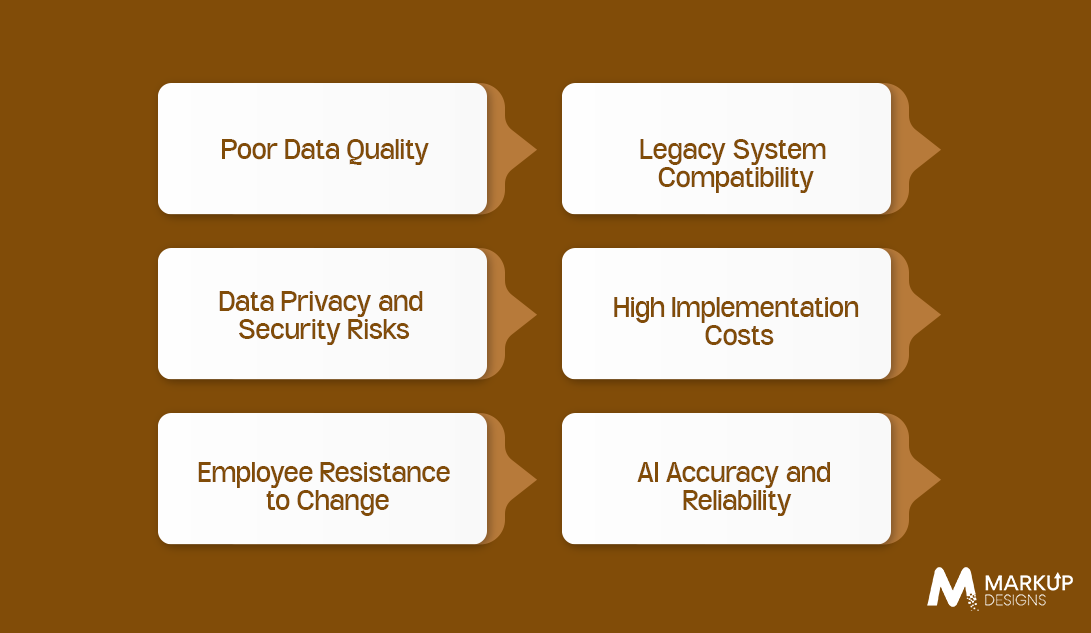
Even though AI has the potential to enhance the functioning of ERP, there are some challenges associated with its integration with existing software solutions. Knowledge about such challenges will help firms to prepare for integration more efficiently.
Poor Data Quality
In order for AI to work effectively and deliver valuable results, it requires quality data. Missing, duplicate, and outdated data might distort predictions and recommendations that businesses can get from AI. Data needs to be cleaned, standardized, and validated.
Legacy System Compatibility
Legacy ERP platforms do not always have the necessary infrastructure and technology that would allow integration with modern AI solutions. Thus, additional steps might be required to make systems compatible.
Data Privacy and Security Risks
ERP contains valuable business information, which includes financial, personnel, supplier, and customer data. There is a risk that AI integration can jeopardize data security if proper controls are not used.
High Implementation Costs
Costs associated with the implementation of AI include software licensing, development, data preparation, infrastructure, testing, and employee training. It is essential for businesses to identify high-value applications of AI and consider both the costs and returns.
Employee Resistance to Change
Employees might be reluctant to embrace AI-based processes either due to a lack of knowledge of the system or fear of a possible transformation of their responsibilities. This obstacle can be overcome by training and motivation.
AI Accuracy and Reliability
Predictions and recommendations generated by AI cannot be entirely correct due to insufficient data or transformations in the business situation. Proper monitoring and validation of results are required to preserve the system’s reliability.
How Much Does AI Integration into ERP Systems Cost?
AI adoption in an ERP system is priced based on the business needs, existing ERP platform, complexity of the workflow, and the degree of customization involved. Implementation of a simple AI feature in an existing ERP system will be easier than customizing an AI system that spans various departments and sources of data.
In some organizations, AI may only be needed for reporting or invoice processing functions, while in other firms, AI may be used for predictive analysis, process automation, or an AI agent to handle complex processes.
Key Factors That Affect AI-ERP Integration Costs
- ERP platform: The more modern cloud-based ERP solutions with well-structured APIs could need less integration effort than old, highly customized ERP.
- AI capabilities: Reporting or document analysis tasks are simpler to implement than predictive models and multistep AI agents.
- Data pre-processing: The efforts spent on cleaning, structuring, and linking the data from various sources could become considerable.
- Integration complexity: The complexity of linking various ERP modules, third-party services, and workflow approval processes could influence the budget.
- Security and compliance: The aspects of access control, auditing, data protection, and regulatory compliance could impact the budget as well.
- Support and maintenance costs: These efforts include cloud computing, use of AI models, monitoring, software updates, and integrations.
Estimated AI-ERP Integration Cost
The following ranges provide an initial budgeting reference for different implementation scopes. Actual costs depend on the ERP platform, project requirements, and service provider.
| Integration scope | Estimated cost (USD) |
| Focused AI pilot for one use case | $15,000–$50,000 |
| Single-department AI deployment | $50,000–$150,000 |
| Multi-module enterprise integration | $150,000–$500,000+ |
How Long Does AI Integration into an ERP System Take?
The amount of time required for AI integration in the ERP depends on the nature and scope of the work involved, data readiness, existing infrastructure, and other factors such as the complexity of the requirements. Small integrations may take a couple of weeks, while bigger projects can take months.
For example, incorporating the AI reporting function in an ERP that already exists can be rather simple. The same is not true of integrating predictive analytics functions into finance, inventory, procurement, and logistics operations.
Key Factors That Affect Implementation Timelines
- Project Scope: The integration of one AI aspect usually takes less time compared to connecting several ERP aspects.
- Data Readiness: Incomplete data or data that does not match could delay development and testing.
- System Compatibility: Legacy ERPs could necessitate more integration.
- Requirements for customization: AI models and customized workflows will take more time to develop and validate.
- Security and testing: Validation of performance, access, and compliance are critical prior to deployment.
- Training of employees: Employees will need time to learn the processes and utilize AI-enabled aspects.
How to Choose the Right AI and ERP Integration Partner
Partner selection is another important consideration when implementing AI successfully. A good partner is one who understands your ERP platform, business process flows, data needs, and plans. Working with a technically sound partner that understands your business processes will prevent unnecessary complications.
Assess AI and ERP Expertise
A good partner should have experience in ERP integration, machine learning, predictive analysis, and automated processes through AI. It is necessary to know how they have tackled similar technical issues before.
Assess Customization and Integration Expertise
Since every business has varying processes and technical needs, a partner who has the capability to review your current systems and implement appropriate solutions either through APIs, existing AI capabilities, third-party applications, or custom development is ideal.
Focus on Security and Data Management
Your integration vendor must have knowledge of data security, access control, encryption, audit trails, and compliance. Moreover, your integration vendor must clarify how confidential information from the business will be managed in AI models and other external tools.
Determine Scalability and Future Maintenance
The implementation of your first AI project may be limited to a single department in your business. However, future needs may demand much more. You must estimate if the solution can scale, integrate, and respond to changes.
Analyze Development Cost and Business Value
You must receive all cost information related to development, implementation, licensing, testing, and maintenance. Your trusted integration partner should assist you in identifying KPIs to measure business value.
Integrate AI into Your ERP System with Markup Designs
Markup Designs helps businesses explore AI-powered solutions that align with their existing systems and operational goals. From AI integration and workflow automation to customized software development, the focus is on building practical solutions that support efficiency, informed decisions, and long-term growth.

Conclusion
The implementation of AI in ERP systems will be a great solution to transform routine processes and allow business owners to make informed decisions, perform predictive analysis, and automate the workflow. For instance, demand forecasting, invoice processing, inventory management, and anomaly detection are just some examples of areas where businesses may apply AI to benefit from the process.
However, such an integration will not be easy since businesses need to collect and prepare appropriate data, analyze their current ERP system, solve security-related issues, and find appropriate use cases to start the process of integration and get the desired results.
In addition, one needs to evaluate implementation costs and timeframe depending on the project specifics and requirements. Starting from the specific use case and proceeding further after analyzing the outcome may help in minimizing possible risks and facilitating the adoption process for employees.
It is possible to integrate AI into your ERP system successfully if you have a good plan and enough support.
FAQs
1. What is AI integration in ERP systems?
AI integration in ERP systems involves adding artificial intelligence capabilities to enterprise resource planning software. It helps businesses analyze data, automate repetitive tasks, forecast demand, identify unusual activities, and support better decisions.
2. What are the main benefits of integrating AI into ERP systems?
The main benefits include improved decision-making, automated workflows, better demand forecasting, reduced manual errors, more effective inventory management, and improved operational visibility.
3. Can AI be integrated into an existing ERP system?
Yes. AI can be integrated into many existing ERP systems through built-in features, APIs, third-party tools, middleware, or customized solutions. The available options depend on the ERP platform, system architecture, and business requirements.
4. How much does AI-ERP integration cost?
The cost depends on the selected AI features, ERP complexity, data preparation, customization, and security requirements. A focused pilot typically costs less than a multi-module enterprise implementation. Businesses should also budget for licensing, hosting, maintenance, and support.
5. How long does AI integration into an ERP system take?
A limited integration may take a few weeks, while a complex enterprise-wide implementation may take several months or longer. Data readiness, system compatibility, customization, and testing all affect the timeline.
Author's Perspective
AI integration works best when it addresses real business needs and improves everyday operations. Businesses should identify areas where automation, better data analysis, and accurate predictions can make a difference. Starting with small, measurable projects helps teams evaluate results before expanding AI across departments. Reliable data, strong security, and employee training are equally important for successful implementation. With clear goals, proper planning, and continuous improvement, businesses can use AI effectively, improve efficiency, and make better decisions while adapting to changing operational requirements.
Discuss Your Project NowGaurav Goyal
Global Sales- VP
Related Posts

Geopatriation and Sovereign AI in the Middle East:...

Build vs Buy RAG Solutions: Choosing the Right...
How AI is Revolutionising Industrial Automation in Australia
Insights Are Valuable & Execution is Priceless
You’ve read about the digital future. Now, let’s build the infrastructure to take you there. Move your strategy from the page to the product.
Design Your Solution Now
Contact Us
Schedule The Appointment At Your Convenience Date And Time.
30 Min
Web Conference
Time Zone
Indian standard time (08:30pm)

Thanks For Getting In Touch!
You’ve Taken The First Step Toward Transforming Your Digital Presence. Our Experts Will Reach Out Shortly To Take It Forward.
Launch Your Dream Project
Provide a brief overview of your project, and our specialists will evaluate your requirements. We will connect with you to explore how the right digital solutions can help you launch faster.