
In Brief
- A fitness application for women assists its users in reaching their fitness objectives via workout schedules, nutrition counseling, tracking progress, and personalizing programs. Companies may create apps that revolve around workout routines, weight loss, nutritional needs, yoga sessions, women’s health issues, or personalized fitness training.
- Features required for such an app include profiles and goal-setting, personalized workout routines, tracking fitness progress, nutrition scheduling, integration with wearables, and subscriptions. Additional optional features can be live training classes, social challenges, and age-group-specific fitness programs.
- The app development includes the following steps: market research, defining the idea and the business model, selection of MVP features, user interface design, technology stack selection, development, testing, launch, and improvement based on user feedback.
- Development cost estimation in India in 2026 would be as follows: ₹4 – ₹10 lakh for a basic app, ₹10 – ₹25 lakh for an intermediate app, ₹25 – ₹50 lakh for an advanced one, and ₹50 lakh to ₹1 crore+ for an enterprise solution. Cost depends on features, integration, design, platforms, technologies, and maintenance.
- Challenges can be associated with the protection of sensitive data of users, personalization of workouts, retention of clients, wearables integration, accessibility issues, and privacy regulations. It is important to start with the MVP to consider user needs and create a scalable and secure application. Markup Designs can provide assistance in developing a fitness app that will meet business objectives.
Today’s women have various aims for getting fit, ranging from losing weight and building muscles to being flexible and staying healthy overall. In connection with the fast-paced life and varied fitness purposes, lots of ladies want to get a fitness program that suits them well. A women’s fitness app might be an optimal way to achieve this goal since, with it, women will be able to train and track their results and eat the right food no matter where they are.
The creation of such apps is also beneficial for businesses because there are many customers who are searching for easy ways to become healthier. But creating an effective women’s fitness app requires certain strategies, appropriate designs, useful features, and knowledge of the development cost of the app.
This blog post will cover all the issues related to the creation of a women’s fitness app, from the features you need to implement in it, through the process of developing an application, to the cost of its creation. We’ll also speak about the monetization of the app and the obstacles of the development process.
What is a Women’s Fitness App?
A women’s fitness app is a mobile application aimed at helping women to organize their fitness program, develop positive habits, and track their progress all in one application. The app can provide workout sessions, nutrition advice, a fitness tracker, and personal programs according to the needs and requirements of a person.
Unlike regular fitness apps, the woman-oriented fitness app can have additional programs for various stages of life, including pregnancy, recovery period, or menopause. These features have to be provided with proper security and professional recommendations.
For instance, a beginner will be able to work out using the basic home exercises program, whereas more experienced people will benefit from strength training and progress tracking. Some users may want to take advantage of online courses, a nutrition planner, or wearable devices.
From a business perspective, the main task is to develop an app that would make the process of fitness training easier and more sustainable. A women’s fitness app is a combination of useful features, a user-friendly interface, and a personalized approach.
Why Invest in Women’s Fitness App Development?
With the use of fitness applications, businesses have a chance to reach out to those customers who seek convenient means of engaging in physical activities and managing their health. Thus, a properly designed application for women’s fitness may allow businesses to establish better relationships with customers and earn some profit from this activity.
The following are some of the reasons why businesses should develop an application for women’s fitness:
- Rising need for personalized fitness programs: Users would prefer workout programs and tips that fit their fitness goals, preferences, and experience level.
- Convenience and flexibility: Users would be able to work out from any place and at any time convenient for them without relying on a timetable.
- Opportunities for earning recurring income: There is a possibility of developing subscription packages, premium exercises, and live fitness classes.
- Higher engagement of users: Progress tracking, reminders, fitness challenges, and rewards will contribute to higher engagement of users.
- Fitness programs for different needs: Companies can provide fitness programs for beginner levels, strength, flexibility, and other specific fitness goals, as well as optionally include age-specific content.
- Scalability: Companies may choose to grow their offerings by including new workout programs, expert sessions, integration with wearables, and personalization tools in the future.
The point here is not in adding more features but in providing what users really need. The app that offers a useful, safe, and easy-to-use program is the way to success.
What Types of Women’s Fitness Apps Can You Build?
It is necessary to determine which type of fitness application you are going to develop before proceeding with its development. Each type of fitness application has a specific purpose and caters to certain audience segments, fitness needs, and requirements of businesses.
The following are some popular types of fitness applications for women that you may develop:
- Workout & Exercise Apps: These include home workouts, gym workouts, strength training, yoga, and flexibility workouts for various fitness levels.
- Weight Management Apps: Such fitness applications help people measure physical activities, set fitness goals, and track their achievements.
- Nutritional and Dieting Apps: The application provides people with meal plans and healthy diets according to their preferences.
- Yoga and Meditation Applications: Such applications are concerned with yoga classes, breathing exercises, meditation, and relaxation for physical activities and overall well-being.
- Women’s Health and Fitness Applications: Such applications are concerned with fitness routines, an optional period tracker, and other content according to the specific life stage of a female person, with proper privacy.
- Personalized Fitness Coaching Applications: Such applications help a user find their own personal coach or provide personalized training programs.
Choosing among these options will depend on your target audience and business plan. You could choose one major category of fitness routines for your application to begin with.
Key Features to Include in a Women’s Fitness App
The features included in your fitness application for women will have direct effects on how the users will interact with it and their future usage. In addition, do not include all possible features; rather, concentrate on those features that address actual problems and fitness objectives of your targeted customers.
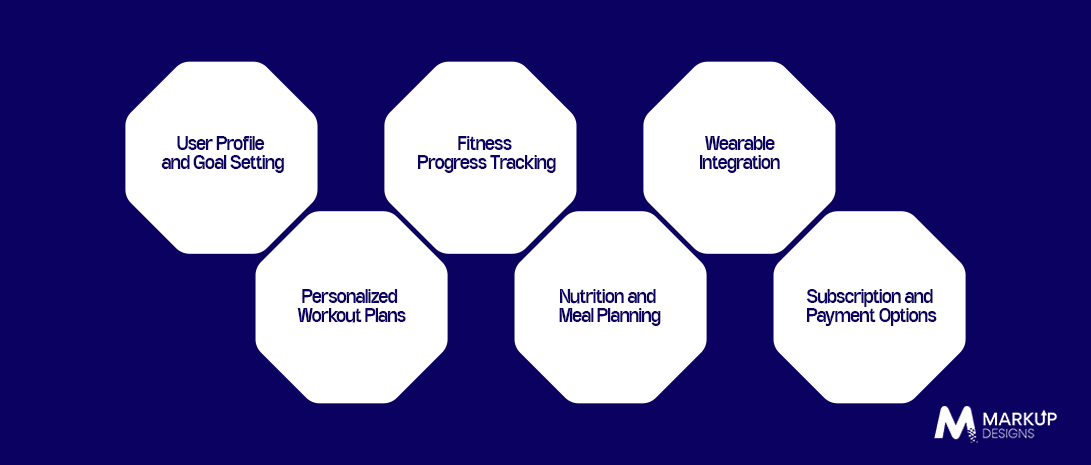
The following are six important features to be considered:
- User Profile and Goal Setting
Give options to users to build user profiles, set fitness goals, determine their levels of experience, and provide preferences.
- Personalized Workout Plans
Provide customized exercise plans based on fitness level, goal, available exercise equipment, and workout period.
- Fitness Progress Tracking
Provide options to track completed exercises, activity level, achievements, and fitness improvement.
- Nutrition and Meal Planning
Offer meals, food logs, and nutrition facts to encourage proper eating.
- Wearable Integration
Integrate the application with compatible smartwatches and health apps to exchange information related to physical activity, like steps taken, heart rate, and workout length, upon user permission.
- Subscription and Payment Options
Enable payments via safe and trusted services to access paid services such as premium workout programs, personal training from specialists, and more.
Based on your target audience, there is also room for optional features like live classes, challenges, and female-specific fitness tracking. Personal health data should be collected only when needed and with user consent. Well-selected features allow maintaining the simplicity of the app and its future development.
How to Build a Women’s Fitness App: Step-by-Step Development Process
Designing an application for women’s fitness is an intricate task that includes several steps, starting from market research and finishing with a product launch and its improvement. Adherence to a certain development approach allows you to control expenses, pay attention to key functions, and design an app that satisfies users’ needs.
Step 1: Conduct Market Research and Get to Know Your Target Audience
Find out who your target audience is and what kind of fitness goals, problems, and requirements it has. Do research on the existing competing applications to know what they do and what your product may be better at.
Step 2: Establish Your App Concept and Business Model
Think about what kind of product you want to develop: home training, strength training, nutrition services, coaching, or a combination. Choose the business model that suits your target audience.
Step 3: Defining Features for the MVP
An MVP is the product that includes all necessary features needed to test an idea and get it on the market. The following features may be included at first: profiles for users, workout plans, goal setting, progress monitoring, and notifications. Additional features can be added later depending on user feedback.
Step 4: Building an Intuitive and Simple Interface
Wireframes and prototypes should be created at this stage to design navigation in the app. It should be easy to use and understand, as well as appropriate for people with various levels of experience in sports. Important actions such as starting a workout and checking one’s progress should be easily reachable.
Step 5: Technology Selection
Technologies should be chosen depending on your budget, the requirements of a specific platform, scaling possibilities, and integration options. Native development may be selected for iOS and Android or cross-platform technologies.
Step 6: Build the App with Important Features
Develop the front-end, back-end, database, and all other integrations that are necessary. Incorporate functions such as workouts, users, progress, payments, and any other features that were planned.
Step 7: Test the Performance, Security, and Usability of the App
Test the app on all possible devices and operating systems. Make sure there are no bugs, delays, payment problems, or usability and security problems. In addition, make sure that the integrations of wearables and fitness tracking are working well.
Step 8: Release the App and Collect User Feedback
Publish the app on the respective app stores after testing it and fulfilling all necessary requirements. Observe the initial user feedback and other metrics to see problems and possibilities for improvement.
Step 9: Enhance Features and Scale the Application
Improve the product based on user feedback and performance analytics. As demand rises, features like live lessons, personal recommendations, challenges, etc., can be introduced progressively.
Following these steps will help you create a women’s fitness application with a defined purpose, manageable development scope, and potential for growth. The point here is to start with the basics, validate your concept, and develop further based on user needs.
How Much Does It Cost to Build a Women’s Fitness App?
The expenses required for developing a fitness app for women will be contingent on the functionalities to be implemented in the application, its complexity level, the platforms it will run on, and the developers you pick. The development cost for an app with workout plans and monitoring features is likely to be lower than the price tag of a platform with extensive features like live classes, integration with wearable devices, subscription, and recommendation modules.
Prior to budgeting, you should determine if you wish to develop a minimum viable product (MVP) or a fully-fledged fitness platform from the outset.
The below-mentioned ranges could assist in formulating the budget for the development of a fitness app for women in India. These figures are indicative and not final quotes.
| App Type | Estimated Development Cost |
| Basic fitness app (MVP) | ₹4–10 lakh+ |
| Mid-level fitness app | ₹10–25 lakh+ |
| Advanced fitness app | ₹25–50 lakh+ |
| Enterprise-level fitness platform | ₹50 lakh–₹1 crore+ |
A basic app can have such features as user profile, fitness exercises, goal setting, and progress tracking. A mid-range app might include subscriptions, personalization, and integration options. An advanced or an enterprise app could need such capabilities as artificial intelligence recommendations, live workouts, and other back-end options.
Factors That Affect Women’s Fitness App Development Costs
The overall cost of developing a women’s fitness app is determined not only by the number of features in it. Knowing about them can be quite useful for you in the process of planning and budgeting.
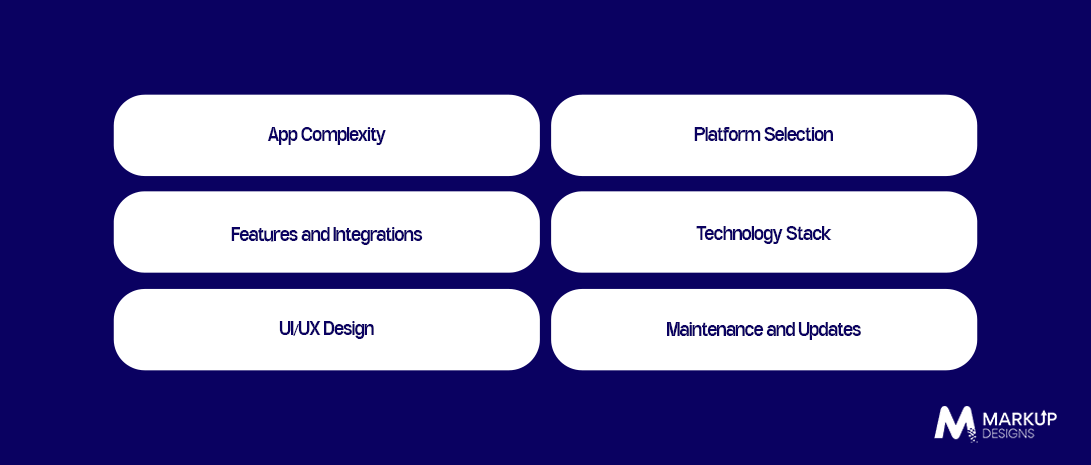
Here is a list of six factors that affect the overall cost of development:
App Complexity
The creation of the application with a variety of personalizations, including workouts, trainers’ dashboard, etc., is more complicated and thus expensive than that of the app with only video and progress.
Features and Integrations
There are also features such as a payment gateway, integration with wearables, nutrition tracker, workout plans, etc., that add to the cost of development.
UI/UX Design
While the design of a relatively simple interface is not too costly, the design of a very customized interface with interactive dashboards, animations, etc., is rather pricey.
Platform Selection
The choice of developing the app for one or both platforms (Android or iOS) is likely to affect the cost estimation. For the case of a native application, there will be a necessity to double the expenses in case of two platforms; cross-platform development can save duplicated efforts in some cases.
Technology Stack
The selection of a particular technology stack (frameworks, backend, databases, etc.) impacts both the cost of development and operation of the project in the future.
Maintenance and Updates
Having released your product, it is necessary to budget for the expenses related to maintenance and updates.
To avoid spending additional resources, you first need to create an MVP with all the required features for your audience. You may include new features in your product depending on the feedback from the users.
Read Also: Fitness App Development Pricing, Features, and Cost in 2026
Common Challenges in Women’s Fitness App Development
A good women’s fitness app does not simply require creating the exercise functions and fitness tracking mechanisms but also requires consideration of other aspects like the issue of privacy, personalization, engagement, and usability to create a trusted and sustainable application for its users.
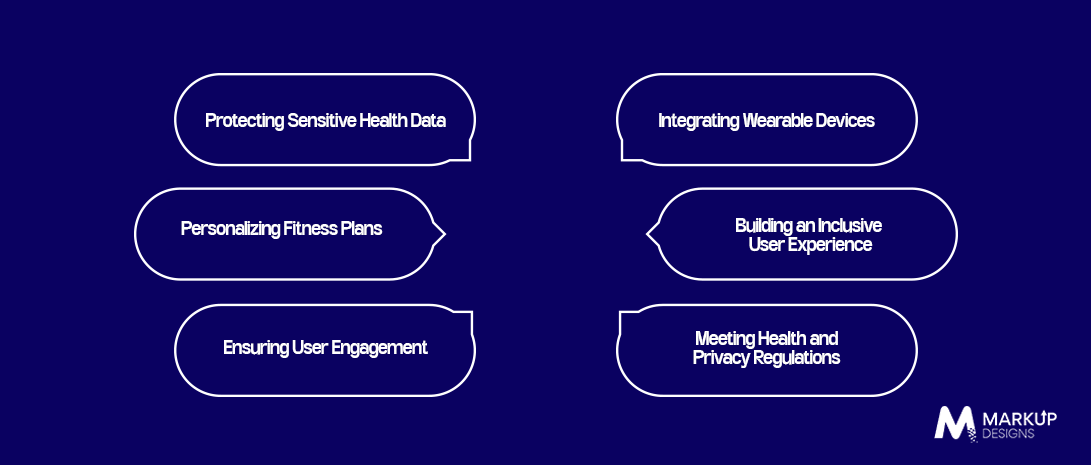
Here are some of the typical issues businesses face when creating a fitness application for women and how to solve them.
Protecting Sensitive Health Data
Applications will often incorporate features such as menstrual cycle tracking, which involves sensitive personal information. Protect this information by implementing encryption and access control measures.
Personalizing Fitness Plans
People are at different fitness levels and will have different preferences, schedules, and workout goals. Allow people to make customizations and personalize their workout plans.
Ensuring User Engagement
People may get bored and disengage from your application as their routine becomes repetitive and hard to track. Introduce goals and rewards into the application.
Integrating Wearable Devices
Connecting smartwatches with health apps can bring about problems with compatibility and data synchronization. Select appropriate options and check data accuracy on the respective devices.
Building an Inclusive User Experience
Women are endowed with diverse skills, physical conditions, and life experience. You can provide variable workout intensity, intuitive navigation, clear instructions, and specific programs tailored to different life stages.
Meeting Health and Privacy Regulations
Fitness apps can be subject to different privacy laws and requirements of the respective platforms depending on their target audiences and markets. Define applicable regulations, collect only necessary data, and check privacy practices before launch.
Overcoming these challenges in the process of planning and development will allow you to create a more efficient and user-friendly app. In addition, you will avoid costly fixes later.
Why Choose Markup Designs for Women’s Fitness App Development?
Selecting an appropriate development partner will enable you to create a functional app from your idea. The developers at Markup Designs can assist you with creating a digital solution that corresponds to your business objectives, target audience, and budget needs. The process begins with analyzing your requirements and choosing valuable features.
The easy-to-use interface of the app facilitates users’ exploration of the training routines and tracking their progress. Moreover, custom features like individual workout plans, a nutrition tracker, coaching, and subscription services can become the basis of your business model. Scalability of technology will allow the app to accommodate more users and add additional functions over time. Your attention should also be paid to security and privacy concerns regarding personal health data.
After the launch of the app, the feedback of users and performance metrics can become the basis for further improvements and updates. Through defining your goals and requirements, you can create a realistic development schedule and a profitable women’s fitness app.
Let’s Bring Your Fitness App Idea to Life
Looking to launch a women’s fitness app? Partner with Markup Designs to build a user-friendly, scalable solution designed around your business needs.
Conclusion
The process of developing a women’s fitness application is based on understanding who your target audience is, what they want, and what they face. It is crucial to select the appropriate features, development style, and budget for creating a high-quality product.
The use of an MVP will help you implement your idea, reduce expenses, and develop the app by receiving feedback from users. Attention to accessibility, personalization, engagement, and data privacy can become an advantage for your product.
Having a good strategy, proper technology, and a competent developer, you can develop a realistic and scalable women’s fitness application.
FAQs
1. How long does it take to develop a women’s fitness app?
A basic MVP may take 2–4 months, while an advanced app may require 4–8 months or longer, depending on features and integrations.
2. What is the minimum cost to build a women’s fitness app?
A basic app may cost ₹4–10 lakh or more. Advanced features, wearable integrations, and live classes can increase the budget.
3. What features should an MVP women’s fitness app include?
Essential features include user registration, fitness profiles, workout plans, goal setting, progress tracking, and notifications.
4. How can a women’s fitness app make money?
Revenue options include subscriptions, premium workouts, paid coaching, live classes, and one-time purchases.
5. Can a women’s fitness app provide personalized workout plans?
Yes. Apps can recommend workouts based on users’ goals, fitness levels, preferences, and available equipment. Health-related recommendations should be handled responsibly.
Author's Perspective
Women’s fitness app development offers businesses an opportunity to create personalized digital fitness experiences. Starting with an MVP helps validate ideas, manage costs, and understand user needs before adding advanced features. Prioritizing simple navigation, personalized workouts, privacy, and inclusivity can improve user trust and engagement. Ultimately, a successful app combines thoughtful planning, suitable technology, and continuous improvements based on feedback. This approach helps businesses build a useful, scalable fitness solution that supports long-term user satisfaction and business growth.
Discuss Your Project NowJupinder Singh Arora
Founder and CEO
Related Posts

How to Build a Chat App Like Arattai:...
How to Hire Mobile App Developers in the...

How Much Does It Cost to Build a...
Insights Are Valuable & Execution is Priceless
You’ve read about the digital future. Now, let’s build the infrastructure to take you there. Move your strategy from the page to the product.
Design Your Solution Now
Contact Us
Schedule The Appointment At Your Convenience Date And Time.
30 Min
Web Conference
Time Zone
Indian standard time (08:30pm)

Thanks For Getting In Touch!
You’ve Taken The First Step Toward Transforming Your Digital Presence. Our Experts Will Reach Out Shortly To Take It Forward.
Launch Your Dream Project
Provide a brief overview of your project, and our specialists will evaluate your requirements. We will connect with you to explore how the right digital solutions can help you launch faster.