
In Brief
- Diet assistant mobile apps with artificial intelligence use this technology to offer customized advice regarding meals, nutritional information, food tracking, and conversation support based on the user’s goals, preferences, food allergies, and eating behavior.
- The key features include customized meal suggestions, chatbots with artificial intelligence for diets, food recognition through images, calories and nutrition tracking, intelligent grocery lists, and progress tracking.
- The development is usually carried out by carrying out requirements analysis, designing the user interface and experience, working on AI and data strategy, developing the app and backend, adding AI, testing, launching, and optimizing the app.
- The cost of development ranges from $40,000 to $400,000, and MVP development can take about 8-12 weeks. The cost and development duration depend on the AI complexity, integration, platforms, security, and functionalities.
- The development should be safe enough with good nutrition data, AI guardrails, data protection, recommendation validation, expert supervision, and monitoring of AI. MVP helps businesses to test the concept.
People have started paying attention to what they eat; however, there are some difficulties with creating a healthy diet plan. Traditional meal plans don’t always take into consideration people’s goals, likes, allergies, exercise regimes, and routine variations. This is where artificial intelligence-powered diet assistants come in as an option for companies that are related to health and well-being.
An artificial intelligence diet assistant will be capable of analyzing user information, understanding the nutritional goals, providing meal recommendations, answering any questions that users may have, and making recommendations based on users’ feedback, becoming more interactive compared to traditional diet applications.
This type of technology gives businesses the possibility to build more interactive, scalable, and personalized nutrition platforms. Regardless of whether the company is a fitness brand, wellness company, healthcare provider, or nutrition platform, all these types of businesses will benefit from using artificial intelligence technology in their nutrition solutions.
In this blog, we will discuss diet assistant app development and its features, development process, cost, timeline, security issues, and business benefits.
What is an AI Diet Assistant App?
An AI-based diet assistant is one of the most efficient nutrition apps, which uses artificial intelligence to deliver food and diet advice based on the unique characteristics of each user. Unlike other nutrition apps that give the same dieting recommendations to all users, this app considers unique characteristics of the user, such as nutrition goals, preferences, allergies, activity, and habits.
It works like a virtual personal nutritionist that gives users advice on foods to choose, tracks meals, finds alternatives, and keeps them committed to their goals. Users can also chat with the AI-powered bot about their particular meals, ingredients, calories, or nutrition.
Technologically, AI processes the user data and nutrition data to find the best recommendations. The more information users enter about their meals, habits, and preferences, the more effective future recommendations will be.
An AI diet assistant can be very helpful not only to its users but also to businesses, as it creates new possibilities in the sphere of digital health services.
How Does an AI Diet Assistant App Work?
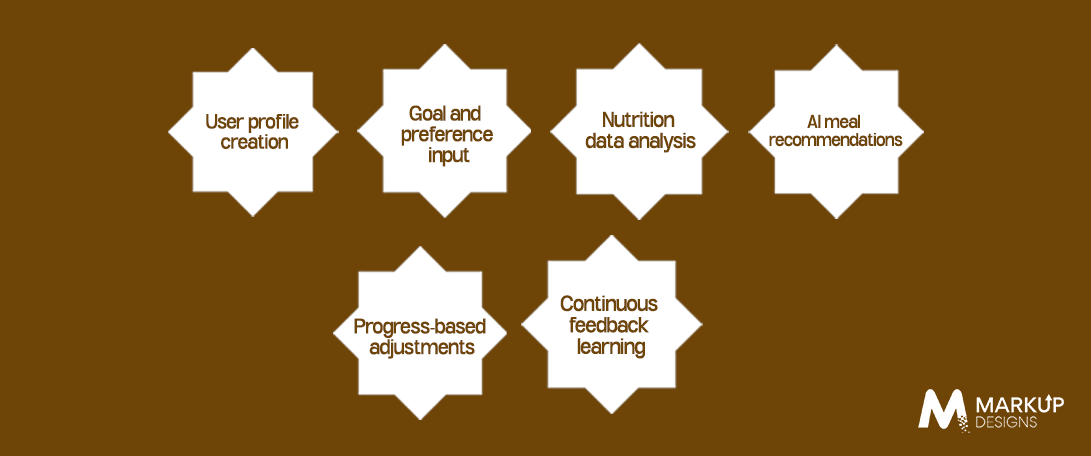
The AI diet help app functions by collecting user data, analyzing that data through AI, and providing nutrition suggestions to the user. Generally, there are several steps involved:
User profile creation
The user provides information about their age, eating preferences, health goals, food intolerances, and eating habits.
Goal and preference input
It is understood why the user needs the app – for weight control, better nutrition, developing healthy eating habits, and so on.
Nutrition data analysis
AI analyzes all the information provided by the user about their profile, nutrition, previous meals, activity, and whatever else is needed.
AI meal recommendations
AI makes personalized suggestions regarding meals, recipes, foods, portions, or substitutes.
Progress-based adjustments
The user can track his progress and give feedback through the application.
Continuous feedback learning
AI learns new information about the user and makes better recommendations further on.
Read Also: AI-Powered Nutrition App Development: Cost, Features, and Key Considerations
Why Businesses Are Investing in AI Diet Assistant Apps?
As people seek personalized digital wellness solutions, they are opening up new business perspectives in healthcare, fitness, nutrition, and wellness. AI-powered diet assistants can help businesses deliver those solutions effectively by making sure that the interaction stays interactive.
These are some of the most important benefits of AI diet assistant apps in business:
- Personalization: The recommendations provided by AI will be tailored to the needs of each particular user rather than to pre-defined diet programs.
- Increased user engagement: Through AI assistant assistance and reminders, as well as suggestions, AI can encourage regular use of the app.
- Scalability: One AI assistant can take care of many users’ nutrition-related questions and recommendations at once.
- Revenue generation opportunities: Premium plans, AI coaching, nutritional consultations, subscription services, and many other business models.
- Data insights: Information about user interactions and preferences can be used by businesses to analyze engagement patterns.
- Competitive advantage: The inclusion of practical AI features can help nutrition and wellness platforms stand out in the market.
For businesses, the goal is not simply to add AI to an existing app. It is to use AI to create a more useful, personalized, and sustainable nutrition experience.
Key Features of an AI Diet Assistant App
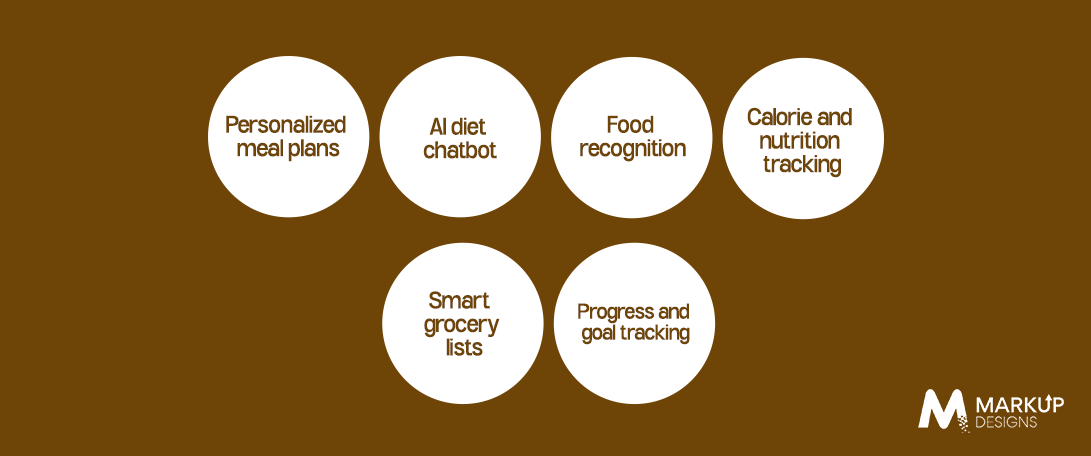
The efficiency of an AI diet assistant lies in the efficiency of its functions in solving users’ problems. A good application should integrate the capabilities of artificial intelligence technologies with simple tools for tracking and engagement.
- Personalized Meals Plan
The application will be able to generate a meal plan for each particular user based on the information about his/her goals, preferences, allergies, nutritional restrictions, and way of life.
- AI Diet Chatbot
The application will be able to respond to questions about nutrition and give recommendations for healthy eating.
- Food Recognition
Users will be able to upload images of their food to use AI-based computer vision to recognize food.
- Calorie and nutrition tracking
Users will be able to track their meals, calories, nutritional value, water consumption, and other information regarding their dietary habits.
- Smart Groceries Lists
The application will be able to create a list of groceries from recommended meals.
- Progress and goal tracking
Dashboards will reflect users’ dietary habits, progress toward goals, and other important metrics.
Looking to Build an AI Diet Assistant?
Build an AI-powered diet assistant that delivers personalized experiences while giving your business room to scale and grow.

AI Diet Assistant App Development Process
Developing a diet assistant application that utilizes AI does not merely entail embedding an AI model in a mobile app. The entire development process should incorporate all the necessary elements from the get-go.
- Requirement Analysis
The first step in developing the app is identifying the target audience, the business model, app features, AI abilities, and requirements.
- UI/UX Design
UI/UX designers will design a straightforward journey for the user while signing up, planning meals, monitoring their progress, chatting with the AI model, and using other app features.
- AI & Data Strategy
The developers pick relevant Enterprise AI models, nutrition databases, APIs, and data sources to ensure accurate recommendations.
- App Development
Developers will develop the frontend, backend, database, APIs, user accounts, dashboard, and AI capabilities.
- AI Integration
The developers will integrate various capabilities of the AI model, including personal recommendations, conversational assistance, food recognition, and meal planning.
- Testing & Deployment
The app will be thoroughly tested for functionality, performance, security, quality of the AI model’s response, and usability.
After launch, the platform can be continuously monitored and improved based on user feedback, new data, and changing business requirements.
AI Diet Assistant App Development Cost
The cost of developing an AI diet assistant application depends greatly on its features, complexity of AI integration services, platforms, integrations, and security. An elementary application that offers individualized meal suggestions requires an entirely different budget than a sophisticated solution with computer vision, conversational AI, integration with wearables, and custom AI.
In general, the development of an AI diet planner might cost you between $40,000 and $400,000, depending on the level of functionality and development scope.
| Development Level | Estimated Cost |
| Basic MVP | $40,000–$100,000 |
| Growth-Stage App | $120,000–$200,000 |
| Enterprise-Level Platform | $250,000–$400,000 |
Several factors can influence the final cost:
- AI complexity: Personalized recommendation algorithms and AI functionality entail additional effort in development.
- Data requirements: Nutrition databases, nutrition datasets, and data preparation are extra cost factors.
- Integration: Integrating wearable devices, healthcare software, payments, and third-party API requires more effort in development.
- Multiple platforms: Developing applications for iOS, Android, and web may add to the cost.
- Privacy and compliance: Health applications demand top-level data privacy and compliance.
- Post-launch AI costs: Infrastructure, predictions, monitoring, retraining, and maintenance must be accounted for.
The recommended path here is to develop an MVP and add advanced AI functionality after it is launched.
AI Diet Assistant App Development Timeline
The duration needed to build an AI dietary assistant depends on the features of the app, the capabilities of the AI software, integration processes, and customizations involved. An MVP version would take less time compared to an enterprise-level software solution with enhanced AI.
A typical development timeline can look like this:
| Development Stage | Estimated Timeline |
| Planning & Requirements | 1–2 weeks |
| UI/UX Design | 2–4 weeks |
| MVP Development | 6–10 weeks |
| AI Integration & Testing | 3–6 weeks |
| Security & Final Testing | 2–3 weeks |
| Deployment | 1–2 weeks |
Overall, a basic AI diet assistant MVP may take around 8–12 weeks, while a more advanced platform can take several months.
The timeline would also depend on whether the business is using the existing AI and nutrition APIs or developing its own capabilities for AI. A good strategy could be to use a limited MVP and slowly build up capabilities.
How to Build a Safe & Reliable AI Diet Assistant
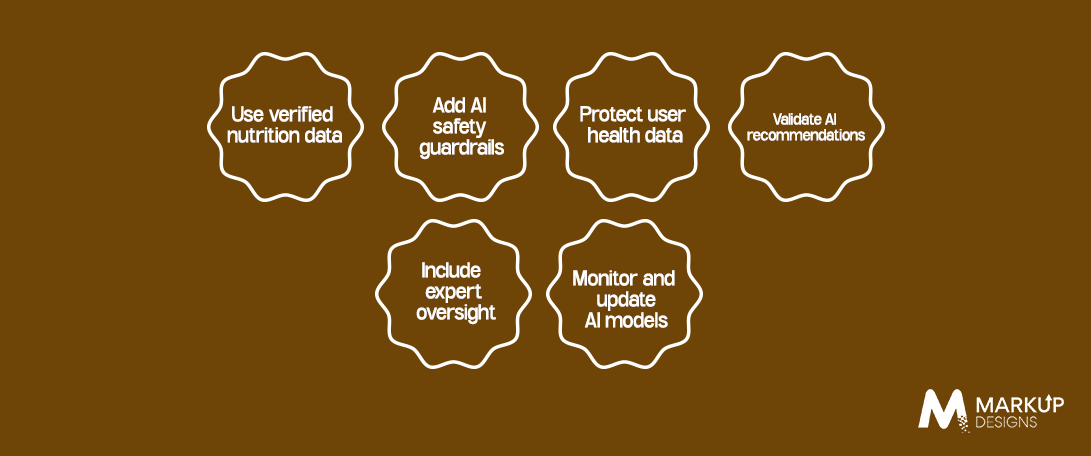
Personal nutrition data is involved in an AI diet assistant, which means that accuracy, privacy, and responsible AI use must be top priorities in this situation. Organizations have to develop the system with these principles in mind, as opposed to developing an open-ended source of health advice powered by AI.
The following measures must be employed:
Use verified nutrition data
Create recommendations with trusted databases of food and nutrition information.
Add AI safety guardrails
Define clear restrictions on what can be recommended and when.
Protect user health data
Implement data encryption, secure authentication, access control, and proper data management policies.
Validate AI recommendations
Regularly validate the accuracy and consistency of AI-generated information as well as potential dangers it may pose.
Include expert oversight
Ensure that recommendations can be checked or supplemented by certified nutrition experts.
Monitor and update AI models
Evaluate responses, user feedback, inaccuracies, changing data, and any other issues in AI behavior.
An effective AI diet assistant is supposed to help users, but not by giving out information generated by AI as an alternative to medical and nutrition professionals’ assistance.
Why Choose Markup Designs for AI Diet Assistant App Development
Creating a diet assistant using artificial intelligence demands more than just the development of a mobile application. It requires proper integration of artificial intelligence know-how, secure architecture, scalable technologies, and an understanding of business needs. Markup Designs can do all of these things in order to assist businesses in materializing their ideas for nutrition apps.
We craft solutions with an easy-to-use interface, high performance, and scalability. We can include artificial intelligence recommendations, AI chatbot services, third-party API integrations, secure backend solutions, and many other things depending on your product specifications. We oversee every stage of the development process from strategy and UI/UX design to development itself, testing, release, and maintenance of an app.
We provide our clients with services that allow them to build a scalable, secure solution using artificial intelligence for creating an effective diet assistant. This includes custom development, scalable architecture, data protection, and optimization. We are ready to assist our clients in choosing technology and development methodology when creating their diet assistants.
Ready to Turn Your Nutrition App Idea Into Reality?
Build an AI-powered diet assistant that delivers personalized experiences while giving your business room to scale and grow.

Conclusion
AI is changing the approach to nutrition by increasing the degree of personalization and interactivity. There are many different ways to develop an AI-powered diet assistant. An AI diet assistant will be able to assist users in meal planning, explaining food choices, tracking progress, and providing recommendations for nutrition improvement according to personal user needs.
In terms of business application, such a product allows creating a platform with more interactive features for the improvement of users’ nutrition and wellness. Yet, the development of such products is not just about adding an AI assistant in the chat. In fact, reliable nutrition data, personalization, security, AI guardrails, and continuous monitoring matter a lot.
It is possible to achieve success only with the correct app development strategy and product vision. The best way to create such a product will be to create an MVP and gradually expand the functionality of the platform depending on user needs and requirements.
FAQs
1. What is an AI diet assistant app?
An AI diet assistant app uses artificial intelligence to provide personalized nutrition support, including meal recommendations, food tracking, dietary suggestions, and conversational assistance.
2. How much does it cost to develop an AI diet assistant app?
The cost can range from around $40,000 to $400,000, depending on the app’s features, AI complexity, integrations, platforms, and security requirements.
3. How long does it take to build an AI diet assistant app?
A basic MVP can take around 8–12 weeks, while a more advanced AI-powered platform may require several months depending on its scope and complexity.
4. What AI features can be added to a diet assistant app?
Common options include AI meal recommendations, diet chatbots, food image recognition, smart meal planning, food substitutions, and personalized nutrition insights.
5. Can an AI diet assistant integrate with wearable devices?
Yes. The app can integrate with compatible wearable and health platforms to use relevant activity, fitness, and health data for more personalized experiences.
Author's Perspective
AI diet assistants are becoming a practical way to bring personalization into digital nutrition services. The real opportunity for businesses is not simply to add AI features, but to create an experience that users can trust and use consistently.
A successful platform should combine reliable nutrition data, useful AI recommendations, simple design, strong privacy controls, and continuous improvement. Starting with a focused MVP can help validate the concept before investing in more advanced capabilities.
As AI technology continues to evolve, businesses that focus on useful personalization and responsible implementation will be better positioned to build nutrition products that deliver lasting user value.
Discuss Your Project NowJupinder Singh Arora
Founder and CEO
Related Posts
How to Choose the Right AI Chatbot Development...
How eCommerce AI Chatbots Turn Customer Conversations Into...
Best Strategies to Hire Machine Learning Engineers for...
Insights Are Valuable & Execution is Priceless
You’ve read about the digital future. Now, let’s build the infrastructure to take you there. Move your strategy from the page to the product.
Design Your Solution Now
Contact Us
Schedule The Appointment At Your Convenience Date And Time.
30 Min
Web Conference
Time Zone
Indian standard time (08:30pm)

Thanks For Getting In Touch!
You’ve Taken The First Step Toward Transforming Your Digital Presence. Our Experts Will Reach Out Shortly To Take It Forward.
Launch Your Dream Project
Provide a brief overview of your project, and our specialists will evaluate your requirements. We will connect with you to explore how the right digital solutions can help you launch faster.