
In Brief
- Artificial intelligence is helping businesses automate operations, analyze data, personalize customer experiences, and improve decision-making.
- Key technologies such as machine learning, generative AI, predictive analytics, NLP, and AI agents are expanding how businesses can use AI.
- Successful AI adoption starts with identifying high-value business problems, assessing AI readiness, and selecting the right technology and implementation approach.
- Businesses must address data quality, cybersecurity, integration, compliance, implementation costs, and workforce adoption when deploying AI.
- A well-planned AI strategy can improve operational efficiency, reduce costs, create new revenue opportunities, and deliver a measurable return on investment.
Artificial intelligence is becoming a core part of how businesses operate, compete, and grow. From automating repetitive processes and analyzing large volumes of data to powering personalized customer experiences and predictive decision-making, AI enables organizations to turn technology into measurable business value. Generative AI, machine learning, predictive analytics, and AI-powered automation are further expanding these capabilities across industries and business functions.
However, adopting AI is not simply about adding an AI tool to existing operations. Businesses need to identify the right use cases, prepare their data, evaluate infrastructure and workforce readiness, and establish appropriate security and governance practices. This guide explores how businesses can harness artificial intelligence effectively, covering its applications, benefits, implementation process, technology requirements, costs, challenges, and future opportunities.
What Is Artificial Intelligence in Business?
Artificial intelligence in business refers to the use of AI technologies to analyze data, recognize patterns, generate insights, automate tasks, and support or execute business decisions. Organizations can apply AI across functions such as sales, marketing, customer service, finance, operations, human resources, cybersecurity services, and supply chain management.
Unlike traditional software that follows predefined rules, AI systems can process large and complex datasets to identify patterns and produce predictions, recommendations, generated content, or other outputs. This makes AI particularly valuable for business processes that involve large amounts of data, repetitive tasks, changing variables, or personalized interactions.
How Does AI Work in a Business Environment?
An AI system typically combines business data, algorithms, models, computing infrastructure, and business rules to produce a specific outcome. The process generally begins with collecting relevant data from sources such as CRM platforms, websites, transaction systems, documents, customer interactions, and connected devices.
The data is then prepared and processed by an AI model trained or configured for a particular business objective. The resulting predictions, recommendations, generated content, or automated actions can be integrated into existing applications and workflows. Businesses can continuously monitor the system’s performance, measure its outcomes, and refine the model as new data and requirements emerge.
For example, an online retailer can analyze purchase history, browsing behavior, and product interactions to recommend relevant products to customers. Similarly, a manufacturer can use AI to identify unusual equipment patterns and predict potential maintenance requirements before a failure occurs.
Key AI Technologies Driving Business Transformation
Businesses use different AI technologies depending on the problem they need to solve. Some technologies focus on prediction and pattern recognition, while others enable content generation, language understanding, visual analysis, or autonomous task execution.
Machine Learning
Machine learning enables software systems to learn patterns from data and use them to make predictions or recommendations. Businesses commonly use machine learning for customer churn prediction, fraud detection, demand forecasting, customer segmentation, pricing optimization, and risk assessment.
Generative AI
Generative AI creates new content based on patterns learned from large datasets. It can generate text, images, code, summaries, reports, and other forms of content. Businesses can use it for marketing, software development, knowledge management, customer support, and internal productivity.
Natural Language Processing
Natural language processing (NLP) enables AI systems to understand and process human language. It supports applications such as chatbots, voice assistants, sentiment analysis, automated email classification, document analysis, and conversational search.
Computer Vision
Computer vision enables AI systems to analyze and interpret visual information from images and videos. Applications include quality inspection, medical image analysis, object detection, security monitoring, inventory tracking, and automated visual verification.
Predictive Analytics
Predictive analytics uses historical and real-time data to estimate future outcomes. Businesses can apply it to sales forecasting, demand planning, customer churn, equipment maintenance, financial risk assessment, and inventory management.
AI Agents and Autonomous Systems
AI agents development are designed to perform multi-step tasks based on a defined objective rather than simply generating a single response. When connected with business applications, APIs, databases, and workflow systems, AI agents can retrieve information, make decisions within defined parameters, perform actions, and coordinate different steps of a process.
Why Is Artificial Intelligence Important for Business Success?
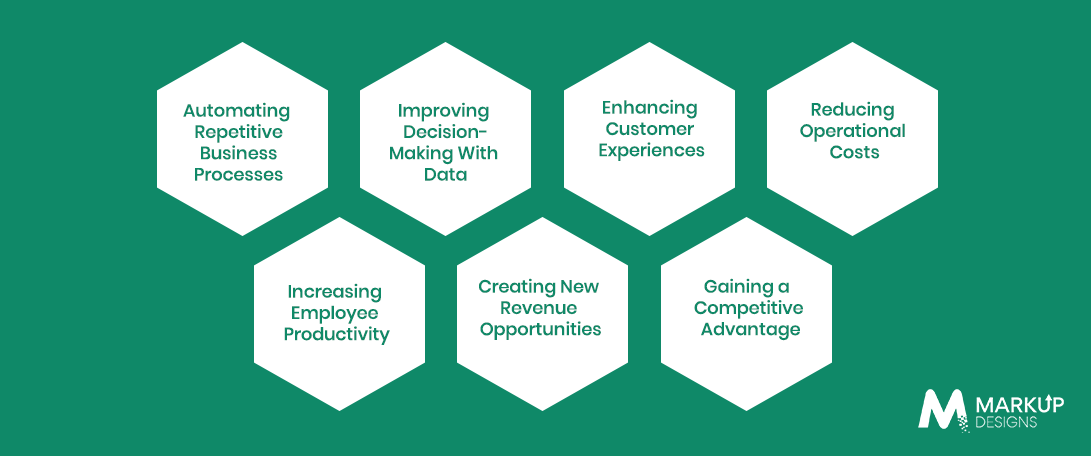
AI is becoming strategically important because businesses are under pressure to operate faster, make better use of data, deliver personalized experiences, and control operating costs. AI can address these requirements by combining automation with data-driven intelligence.
However, AI does not automatically create business value. Its impact depends on whether the technology is applied to the right processes, supported by reliable data, integrated effectively, and measured against meaningful business outcomes.
Automating Repetitive Business Processes
AI can automate repetitive activities such as data entry, document classification, customer queries, invoice processing, appointment scheduling, and routine reporting. This reduces the amount of manual work required for processes that follow predictable patterns.
More advanced AI systems can also handle parts of workflows that require interpretation, such as extracting information from unstructured documents or routing customer requests to the appropriate department.
Improving Decision-Making With Data
Businesses generate data from transactions, customers, employees, websites, applications, and operational systems. AI can analyze this information at a scale that would be difficult to manage manually.
AI-powered analytics can identify patterns, detect anomalies, forecast outcomes, and provide recommendations that help business leaders make more informed decisions.
Enhancing Customer Experiences
AI allows businesses to deliver faster and more personalized customer interactions. Chatbots can handle common queries, recommendation engines can suggest relevant products, and predictive models can help identify customer needs or potential churn.
AI can also analyze customer interactions across multiple channels to identify recurring issues and opportunities for improving the overall customer journey.
Reducing Operational Costs
Automation can reduce the time and resources required to complete repetitive processes. Predictive systems can also help businesses avoid unnecessary expenses by identifying potential equipment failures, optimizing inventory, and improving resource allocation.
The actual savings depend on the process being automated, implementation costs, integration requirements, and the scale of deployment.
Increasing Employee Productivity
AI can support employees rather than simply replace manual work. AI assistants can summarize documents, generate first drafts, retrieve information, analyze datasets, prepare reports, and assist with routine tasks.
This allows employees to spend more time on activities requiring judgment, creativity, communication, and strategic decision-making.
Creating New Revenue Opportunities
AI can support the development of new products, services, and business models. Companies can use AI to create personalized offerings, intelligent digital services, recommendation systems, predictive solutions, and AI-powered features within existing products.
AI can also help identify previously overlooked customer segments and market opportunities by analyzing behavioral and commercial data.
Gaining a Competitive Advantage
Businesses that integrate AI effectively can respond faster to customer needs, automate operations, identify market trends, and make data-driven decisions. This can create an advantage in markets where speed, personalization, and operational efficiency directly influence customer acquisition and retention.
The advantage, however, comes from effective execution rather than simply adopting AI. A company using AI strategically can outperform one that merely adds AI features without a clear business objective.
Read Also: How Much Does AI Development Cost? Complete Pricing Guide
What Are the Top Applications of AI in Business?
AI applications vary significantly by industry and business function. The most valuable implementations typically address measurable problems such as high operational workload, slow decision-making, customer service bottlenecks, fraud exposure, or inefficient resource allocation.
AI-Powered Customer Service and Chatbots
AI-powered chatbot development services can answer frequently asked questions, assist customers with basic requests, collect information, and route complex issues to human agents. NLP allows these systems to understand natural language and maintain more conversational interactions. Businesses can also use AI to analyze support conversations and identify recurring complaints, service gaps, or opportunities to improve customer experience.
Sales and Lead Generation Automation
AI can analyze customer behavior, historical sales data, and lead information to identify promising prospects and prioritize sales opportunities. It can also automate lead qualification, follow-ups, email personalization, and sales forecasting. This helps sales teams focus on prospects with a higher likelihood of converting instead of manually reviewing every lead.
Personalized Marketing and Recommendations
AI can analyze browsing behavior, purchase history, demographics, and engagement patterns to personalize marketing campaigns and product recommendations. Businesses can use these insights to segment audiences, recommend relevant products, customize offers, and optimize campaign timing.
Predictive Analytics and Demand Forecasting
AI models can analyze historical sales, seasonal patterns, market conditions, and other relevant variables to forecast demand. This can help businesses plan inventory, staffing, production, and purchasing more effectively. Forecasting accuracy depends heavily on data quality and the relevance of the variables included in the model.
Fraud Detection and Risk Management
AI can identify unusual transaction patterns and flag potentially fraudulent activity. Financial institutions, e-commerce companies, insurers, and other organizations can use machine learning to evaluate transactions and customer behavior in real time. AI can also support broader risk management by identifying patterns associated with financial, operational, or cybersecurity risks.
Intelligent Document Processing
AI can extract, classify, summarize, and validate information from invoices, contracts, forms, applications, reports, and other business documents. This reduces manual document handling and can accelerate workflows in areas such as finance, insurance software development, legal operations, healthcare administration, and procurement.
Business Process Automation
AI can enhance traditional automation by adding capabilities such as language understanding, prediction, classification, and decision support. This enables businesses to automate workflows that involve more variability than simple rule-based processes. For example, an AI-enabled workflow could classify incoming customer requests, extract relevant information, determine the appropriate next step, and route the request to the correct team.
AI-Powered Cybersecurity
AI can analyze network activity, user behavior, system events, and security logs to identify unusual patterns. Security teams can use these capabilities to detect potential threats, prioritize alerts, and accelerate incident response. AI should complement, not replace, established security controls, since poorly configured AI systems can introduce security and privacy risks.
Supply Chain and Inventory Optimization
AI can analyze demand patterns, supplier performance, inventory levels, transportation data, and other operational variables to improve supply chain planning. Businesses can use AI to forecast demand, optimize stock levels, identify potential disruptions, and improve logistics planning.
Human Resources and Talent Management
AI can support recruitment, employee engagement, workforce planning, training recommendations, and retention analysis. For example, organizations can use AI to match candidates with job requirements or identify workforce trends. HR applications require careful oversight because AI-based decisions involving employees or candidates can create fairness, privacy, and compliance risks.
How Can Businesses Use Generative AI?
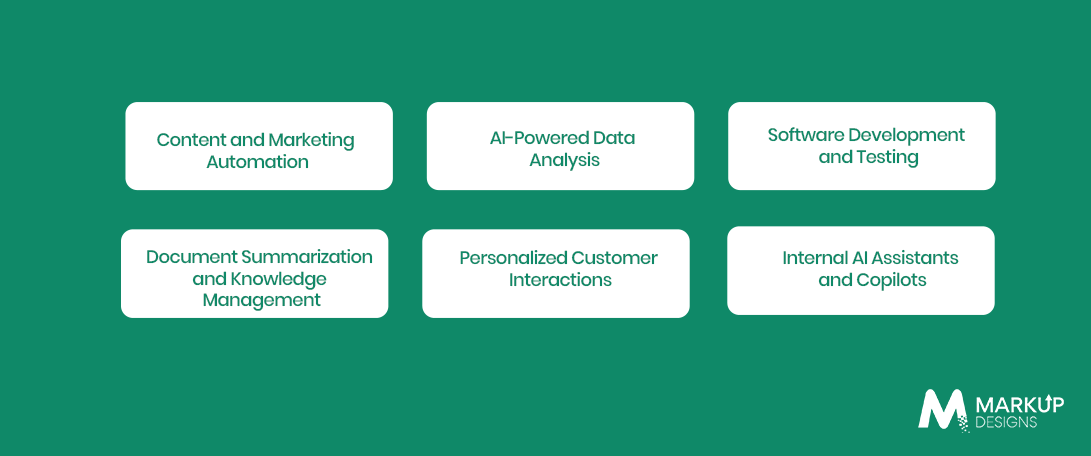
Generative AI has expanded business use cases beyond traditional prediction and automation. Businesses can use large language models and other generative models to create content, analyze information, interact with users, and support employees.
Content and Marketing Automation
Generative AI can help create product descriptions, social media content, email drafts, campaign ideas, ad variations, and other marketing materials. Human review remains important, particularly for brand-sensitive, factual, regulated, or customer-facing content.
AI-Powered Data Analysis
Generative AI interfaces can make business data easier to query and interpret by letting users interact with information in natural language. For example, an employee could ask an AI system to summarize sales performance, identify unusual changes, or explain trends instead of manually reviewing multiple reports. The underlying data and access controls still need to be reliable.
Software Development and Testing
Generative AI can assist developers with code generation, documentation, debugging, test creation, code explanation, and refactoring. It can accelerate development workflows, but generated code still requires human review for correctness, security, performance, and compatibility.
Document Summarization and Knowledge Management
Businesses often have large volumes of contracts, reports, policies, meeting notes, research documents, and internal knowledge. Generative AI can summarize these materials, extract key information, answer questions, and help employees locate relevant knowledge. When used with enterprise data, appropriate access controls and data protection mechanisms are essential.
Personalized Customer Interactions
Generative AI can create more context-aware customer interactions by using relevant customer information, previous conversations, product details, and business policies. Applications can include AI shopping assistants, personalized product guidance, conversational support, and automated email responses.
Internal AI Assistants and Copilots
Businesses can deploy internal AI assistants to help employees search company knowledge, draft documents, summarize meetings, analyze information, and complete routine tasks. When integrated with enterprise software development systems, these assistants can become interfaces for accessing approved business information and workflows rather than functioning only as standalone chatbots.
What Are the Benefits of AI Adoption for Businesses?
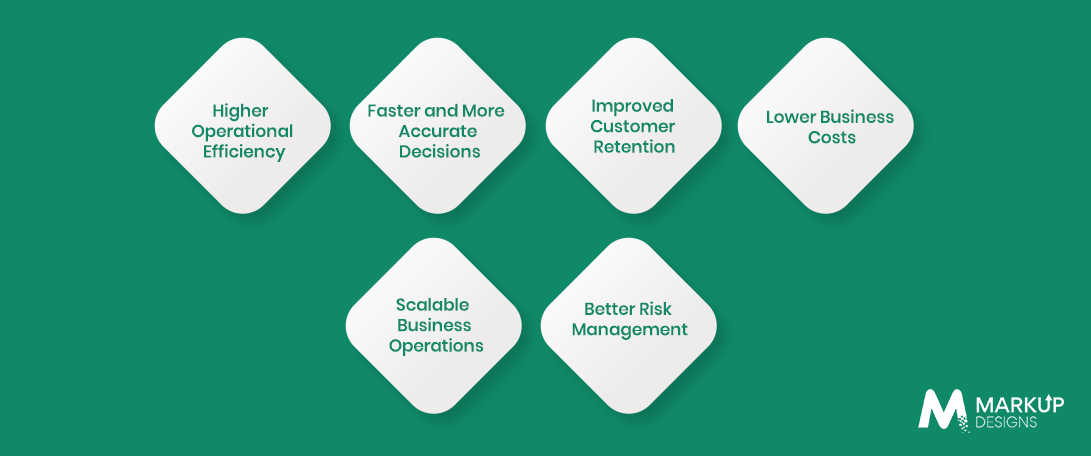
The benefits of AI depend on the use case, quality of implementation, and ability to integrate AI into existing operations. Businesses should therefore evaluate benefits against measurable metrics rather than assuming that AI adoption automatically produces savings or growth.
Higher Operational Efficiency
AI can reduce manual effort, accelerate workflows, and process large volumes of information faster. This can improve the overall efficiency of business operations.
Faster and More Accurate Decisions
AI can process large datasets and identify patterns that may be difficult to detect manually. Predictive models and decision-support systems can provide timely insights while reducing dependence on purely intuition-based decisions. Accuracy still depends on data quality, model performance, and appropriate human oversight.
Improved Customer Retention
Personalized experiences, faster support, proactive engagement, and better understanding of customer behavior can contribute to stronger customer relationships and retention. AI can also identify customers who show signs of dissatisfaction or potential churn, allowing businesses to take action earlier.
Lower Business Costs
Automation can reduce the time and resources required for repetitive tasks, while predictive systems can help reduce waste, errors, downtime, and inefficient resource allocation. Businesses should calculate these savings against AI development services, infrastructure, integration, maintenance, and training costs.
Scalable Business Operations
AI-powered systems can process increasing volumes of transactions, customer requests, documents, or data without requiring a proportional increase in manual effort. This can make it easier for businesses to expand operations while maintaining consistent processes and service levels.
Better Risk Management
AI can identify anomalies, forecast potential risks, and analyze large datasets to support risk assessment. Businesses can apply these capabilities to fraud, cybersecurity, financial risk, supply chain disruptions, and operational issues.
What Challenges Should Businesses Consider Before Adopting AI?
AI adoption involves more than selecting a model or purchasing an AI platform. Businesses need to consider technical, financial, operational, legal, and human factors before deploying AI at scale.
Data Quality and Availability
AI systems depend heavily on the quality and relevance of their underlying data. Incomplete, outdated, duplicated, biased, or inconsistent data can produce unreliable results. Businesses should establish appropriate data collection, cleaning, governance, and validation processes before relying on AI-generated outputs for important decisions.
Data Privacy and Security
AI systems may process sensitive customer, employee, financial, or business information. Poorly designed implementations can expose this data or create unauthorized access risks. Businesses should implement appropriate encryption, access controls, data handling policies, monitoring, and security testing based on the nature of the AI application and the information it processes.
AI Implementation Costs
AI implementation costs can include consulting, data preparation, model development, software licenses, cloud infrastructure, APIs, integration, security, Qa-testing, employee training, and ongoing maintenance. The cost can vary substantially depending on whether a business uses an existing AI service, customizes an existing model, or develops a custom AI service and solution from the ground up.
Lack of Skilled AI Professionals
Successful AI projects may require expertise across areas such as machine learning, data engineering, software development, cloud infrastructure, cybersecurity, and AI governance consulting services. Businesses without these capabilities may need to train existing employees, hire specialized professionals, or work with an experienced AI development partner.
Integration With Existing Systems
AI rarely operates in isolation. It often needs to exchange data with CRM systems, ERP software, payment systems, databases, websites, mobile applications, or internal software. Poor integration can create data silos, workflow disruptions, security vulnerabilities, and additional maintenance requirements. Businesses should therefore evaluate their existing technology architecture before implementation.
AI Accuracy and Reliability
AI systems can produce incorrect predictions, inaccurate classifications, or misleading generated content. Generative AI systems can also produce plausible-sounding information that is factually incorrect. Businesses should establish testing procedures, performance metrics, human oversight, and monitoring mechanisms appropriate to the risk level of each AI application.
Regulatory and Compliance Requirements
AI applications may be subject to privacy, cybersecurity, industry-specific, consumer protection, employment, or other regulatory requirements. The applicable requirements depend on factors such as the business’s location, industry, data types, and intended AI use. Organizations should identify relevant obligations before deployment and build compliance requirements into the AI system’s architecture rather than treating compliance as a final-stage activity.
Employee Adoption and Change Management
Employees may resist AI adoption if they do not understand how the technology affects their roles or if they believe AI is being introduced without adequate training and safeguards. Businesses should communicate the purpose of AI adoption, define responsibilities, train employees on appropriate usage, and establish clear policies for human oversight. The objective should be to integrate AI into workflows in a way that improves employee effectiveness rather than introducing technology without a clear operational purpose.
How to Implement Artificial Intelligence in Your Business?
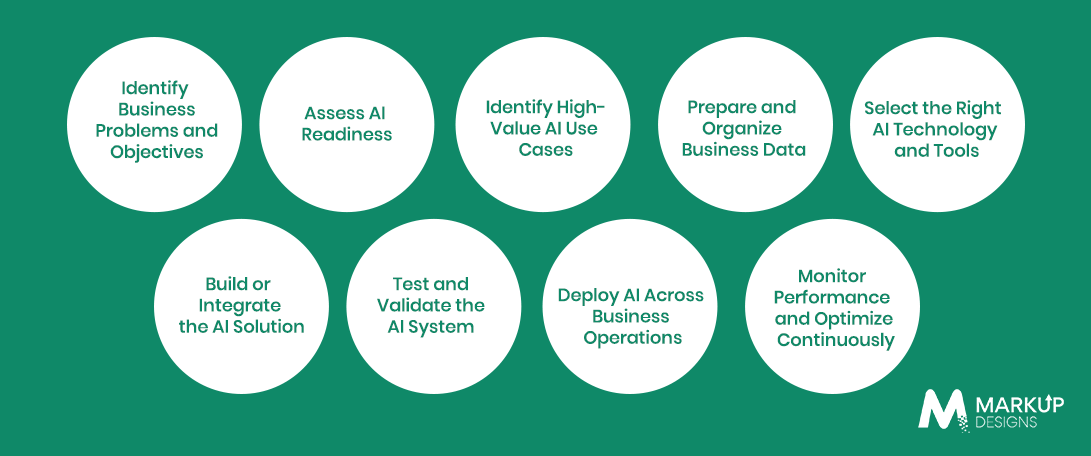
Successful AI implementation starts with a clear business objective rather than the technology itself. Businesses should identify where AI can create measurable value, evaluate their existing capabilities, choose an appropriate solution, and introduce it gradually. A structured approach helps reduce implementation risks and makes it easier to measure whether the investment is delivering the expected results.
Identify Business Problems and Objectives
Start by identifying specific business problems that AI can realistically solve. These could include high customer support volumes, inefficient workflows, inaccurate forecasting, excessive manual work, or difficulty analyzing large datasets. Define measurable objectives such as reducing processing time, improving conversion rates, or lowering operational costs.
Assess AI Readiness
Evaluate your data, technology infrastructure, workforce capabilities, budget, and existing workflows before starting an AI project. This assessment helps identify gaps that could affect implementation and determines whether your organization is ready for AI adoption.
Identify High-Value AI Use Cases
Not every business process needs AI. Prioritize use cases based on potential business impact, feasibility, available data, implementation complexity, and expected ROI. Starting with a focused, high-value use case can make AI adoption easier to validate and scale.
Prepare and Organize Business Data
AI requires reliable and relevant data. Businesses should collect, clean, structure, and validate the data required for the selected use case while establishing appropriate access and governance controls.
Select the Right AI Technology and Tools
Choose AI technologies based on the business requirement rather than following the latest trend. Depending on the use case, this could involve machine learning models, generative AI, computer vision, predictive analytics, or AI APIs.
Build or Integrate the AI Solution
Businesses can develop a custom AI solution, integrate existing AI services, or combine both approaches. The right option depends on factors such as customization requirements, data sensitivity, scalability, budget, and existing technology infrastructure.
Test and Validate the AI System
Before deployment, test the AI system using relevant data and real-world scenarios. Evaluate accuracy, reliability, security, performance, and potential risks, and address issues before exposing the system to wider business operations.
Deploy AI Across Business Operations
Once validated, integrate the AI solution into relevant workflows and business systems. Deployment can be phased, allowing teams to monitor adoption and performance before expanding the technology across additional functions.
Monitor Performance and Optimize Continuously
AI systems require ongoing monitoring because business data, customer behavior, and operational requirements change over time. Track relevant performance and business metrics, collect user feedback, and continuously improve the system.
What Technology Stack Is Used for AI in Business?
The technology stack for an AI solution varies according to its purpose, data requirements, scale, and integration needs. A typical enterprise AI stack can include machine learning frameworks, generative AI models, data platforms, cloud infrastructure, APIs, databases, and MLOps tools.
AI and Machine Learning Frameworks
Frameworks such as TensorFlow, PyTorch, and scikit-learn support the development, training, and deployment of machine learning models for tasks such as classification, prediction, and pattern recognition.
Generative AI and Large Language Models
Large language models and generative AI platforms can power chatbots, content generation, AI assistants, document analysis, and other conversational applications. Businesses can use third-party models or customize models according to their requirements.
Data Engineering and Analytics Technologies
Data engineering tools help collect, process, transform, and analyze the information required by AI systems. Analytics platforms then turn this data into insights that support business decisions.
Cloud AI Platforms
Cloud platforms provide scalable computing resources, AI services, storage, and model deployment capabilities. They allow businesses to scale AI workloads without maintaining all infrastructure in-house.
APIs and Business Integrations
APIs connect AI systems with existing CRM, ERP, payment, communication, analytics, and other business applications. Effective integration allows AI outputs to become part of existing workflows rather than remaining isolated tools.
Databases and Data Storage
AI applications may use relational databases, NoSQL databases, data warehouses, data lakes, or vector databases depending on their data and search requirements.
MLOps and DevOps Tools
MLOps and DevOps practices support model deployment, version control, monitoring, testing, security, and continuous updates. They help organizations manage AI systems reliably as they move from development into production.
How Much Does It Cost to Implement AI in a Business?
AI implementation costs vary significantly based on the complexity of the solution, the type of AI technology used, data requirements, integrations, infrastructure, and ongoing support. A simple AI-powered feature may require considerably less investment than a custom enterprise AI platform.
Factors Affecting AI Implementation Cost
Key factors include the complexity of the AI model, amount and quality of data, number of integrations, development time, cloud infrastructure, security requirements, and the level of customization required.
AI Solution Development Cost
Custom AI development generally costs more than integrating an existing AI service because it may involve data preparation, model development, application development, testing, and specialized expertise. The final cost depends heavily on the solution’s scope.
AI Integration and Infrastructure Costs
Businesses may need to budget for cloud computing, AI APIs, databases, third-party software, system integrations, cybersecurity, and data infrastructure in addition to development costs.
Maintenance and Optimization Costs
AI systems require ongoing monitoring, updates, security improvements, model optimization, infrastructure management, and technical support. These recurring costs should be included when calculating the total cost of ownership.
How to Calculate AI ROI
AI ROI can be evaluated by comparing the financial value generated by the solution with its total implementation and operating costs. Metrics can include productivity gains, reduced operational expenses, increased revenue, improved conversion rates, reduced errors, or lower customer service costs.
What Are the Best Practices for Successful AI Adoption?
AI adoption is more likely to succeed when businesses treat it as a long-term operational strategy rather than a one-time technology project. Clear objectives, reliable data, appropriate governance, and continuous measurement are essential.
Start With a Clearly Defined Business Objective
Define what the AI system is expected to achieve and establish measurable success criteria before development begins.
Prioritize High-Impact Use Cases
Focus resources on AI applications that solve significant business problems and have a realistic path to measurable ROI.
Establish Strong Data Governance
Create clear processes for data quality, access, security, privacy, retention, and ownership to ensure AI systems work with reliable and appropriately managed information.
Keep Humans in the Decision-Making Loop
Human oversight remains important for decisions involving significant financial, legal, operational, or customer impact. AI should support decision-making where appropriate rather than operate without accountability.
Build Responsible and Explainable AI
Businesses should consider fairness, transparency, reliability, and accountability when designing AI systems, particularly when AI influences important decisions.
Prioritize Security and Compliance
Security and regulatory requirements should be considered from the beginning of AI development. Access controls, encryption, monitoring, and appropriate compliance measures should be built into the solution.
Continuously Measure AI Performance
Track both technical metrics and business outcomes to determine whether the AI system is delivering value. Use these insights to improve the solution over time.
Real-World Examples of AI in Business
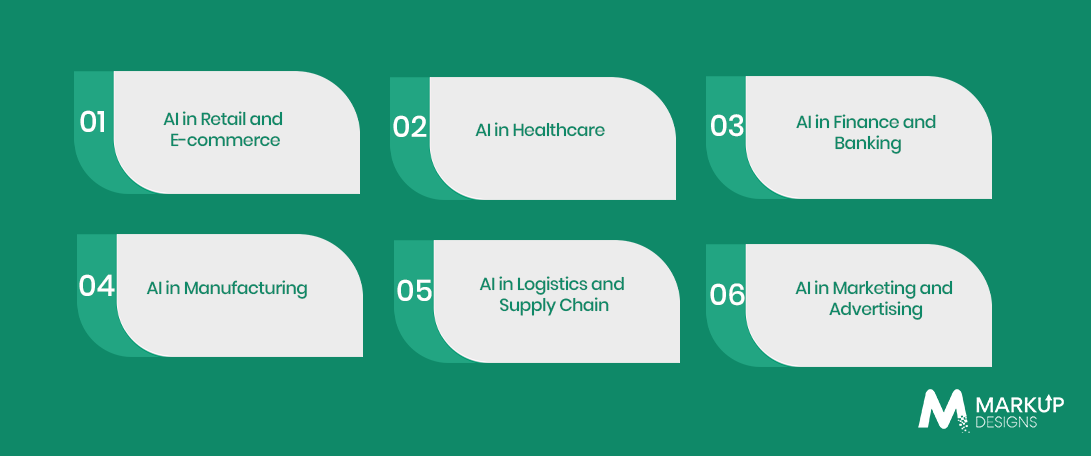
AI is already being applied across industries to automate processes, improve customer experiences, optimize resources, and support business decisions.
AI in Retail and E-commerce
Retailers use AI for product recommendations, demand forecasting, customer personalization, inventory optimization, visual search, and automated customer support.
AI in Healthcare
Healthcare organizations use AI for medical image analysis, patient support, administrative automation, clinical decision support, and predictive analytics.
AI in Finance and Banking
Banks and financial institutions use AI for fraud detection, credit risk assessment, customer service, transaction monitoring, and personalized financial services.
AI in Manufacturing
Manufacturers apply AI to predictive maintenance, quality inspection, production optimization, demand forecasting, and equipment monitoring.
AI in Logistics and Supply Chain
AI helps logistics companies forecast demand, optimize routes, manage inventory, predict disruptions, and improve delivery planning.
AI in Marketing and Advertising
Marketing teams use AI for audience segmentation, content generation, campaign optimization, personalization, customer analysis, and predictive targeting.
What Is the Future of Artificial Intelligence in Business?
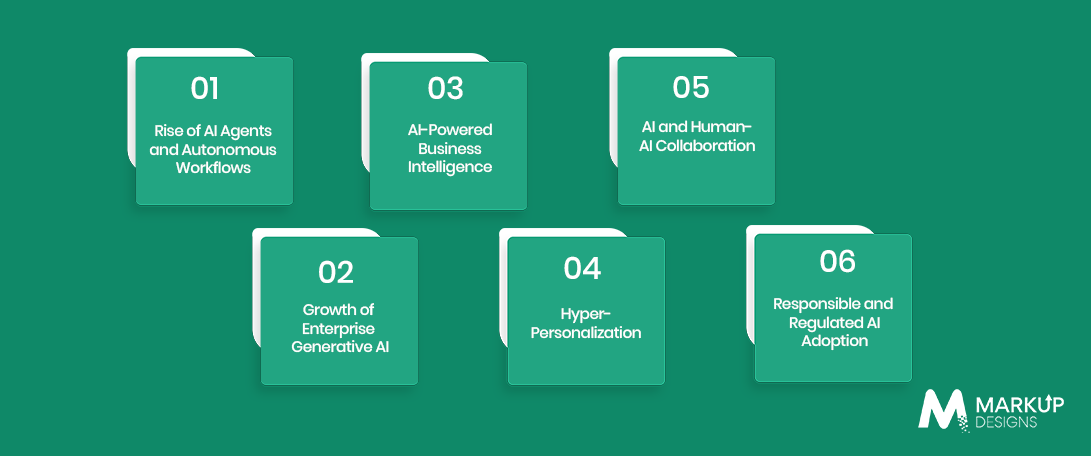
AI is moving beyond individual tools and isolated automation toward systems that can understand business context, work across applications, and complete increasingly complex tasks. As these technologies mature, businesses are likely to focus more on integrating AI into core operations while establishing stronger governance around its use.
Rise of AI Agents and Autonomous Workflows
AI agents can perform multi-step tasks and interact with business systems, creating opportunities for more automated workflows across customer service, sales, operations, and administration.
Growth of Enterprise Generative AI
Businesses are increasingly adopting generative AI for internal knowledge, customer interactions, content, software development, and productivity while placing greater emphasis on security and controlled access to enterprise data.
AI-Powered Business Intelligence
AI will make business analytics more accessible by allowing users to interact with data using natural language and receive automated insights, forecasts, and recommendations.
Hyper-Personalization
AI can combine customer behavior, preferences, and contextual data to deliver increasingly personalized products, recommendations, communications, and experiences.
AI and Human-AI Collaboration
The future of business AI is unlikely to be purely human or purely automated. AI will increasingly handle data-heavy and repetitive work while employees focus on judgment, creativity, relationships, and strategic decisions.
Responsible and Regulated AI Adoption
As AI becomes more deeply integrated into business processes, organizations will face greater expectations around privacy, transparency, security, accountability, and responsible AI governance.
How Can Markup Designs Help Businesses Harness AI?
Markup Designs helps businesses turn AI opportunities into practical, scalable solutions aligned with their operational and growth objectives. Our services cover the complete AI development lifecycle, from identifying suitable use cases and defining an implementation strategy to developing, integrating, deploying, and optimizing AI-powered solutions. We can build custom AI software tailored to specific workflows and data requirements, develop generative AI applications such as AI assistants, conversational platforms, content generation systems, and intelligent document processing solutions, and integrate AI capabilities with existing business applications and APIs to automate repetitive processes. Businesses can also leverage AI-powered predictive analytics, recommendation engines, intelligent automation, and personalized customer experiences to improve efficiency and decision-making. With ongoing monitoring, optimization, security updates, and technical support, we help ensure AI solutions continue to perform effectively as business needs, technologies, and data evolve.
Turn AI Opportunities Into Business Outcomes
Move beyond AI experimentation with solutions built around your business goals. From AI strategy and custom development to integration and optimization, Markup Designs can help you build and scale practical AI solutions.

Conclusion
Artificial intelligence is no longer limited to experimentation or isolated automation. Businesses can use AI to streamline operations, improve decision-making, personalize customer experiences, and create new opportunities for growth. However, successful adoption depends on choosing the right use cases, preparing reliable data, selecting appropriate technologies, and addressing security, compliance, and workforce requirements. A focused implementation strategy allows businesses to move from simply adopting AI tools to building AI capabilities that deliver measurable and sustainable value.
FAQ
1. How can AI help a business succeed?
AI can help businesses automate repetitive work, improve decision-making, personalize customer experiences, reduce operational inefficiencies, and identify new opportunities. Its actual impact depends on selecting relevant use cases and implementing them effectively.
2. What are the most common uses of AI in business?
Common applications include customer service chatbots, predictive analytics, personalized recommendations, fraud detection, document processing, marketing automation, cybersecurity, demand forecasting, and workflow automation.
3. How much does it cost to implement AI in a business?
There is no fixed AI implementation cost. The investment depends on the solution’s complexity, data requirements, integrations, infrastructure, AI technology, development effort, and ongoing maintenance.
4. How long does it take to implement an AI solution?
The timeline depends on the scope and complexity of the project. A focused AI feature using existing models can be implemented faster than a custom enterprise AI platform requiring extensive data preparation, integrations, and testing.
5. Is AI suitable for small and medium-sized businesses?
Yes. SMEs can use AI for practical applications such as customer support, marketing automation, data analysis, sales assistance, and workflow automation. They do not necessarily need to build large custom AI platforms; starting with a focused use case can be more cost-effective.
Author's Perspective
AI adoption should not be driven by the pressure to follow the latest technology trend. The real opportunity lies in identifying where intelligence can solve a genuine business problem and deliver measurable improvement. Businesses that approach AI with clear objectives, strong data practices, human oversight, and a willingness to continuously optimize will be better positioned to turn AI investment into long-term operational and competitive value.
Discuss Your Project NowJupinder Singh Arora
Founder and CEO
Related Posts
How AI is Revolutionising Industrial Automation in Australia
How UK Enterprises Can Build an Effective AI...

AI Voice Agent for Real Estate: Features, Benefits,...
Insights Are Valuable & Execution is Priceless
You’ve read about the digital future. Now, let’s build the infrastructure to take you there. Move your strategy from the page to the product.
Design Your Solution Now
Contact Us
Schedule The Appointment At Your Convenience Date And Time.
30 Min
Web Conference
Time Zone
Indian standard time (08:30pm)

Thanks For Getting In Touch!
You’ve Taken The First Step Toward Transforming Your Digital Presence. Our Experts Will Reach Out Shortly To Take It Forward.
Launch Your Dream Project
Provide a brief overview of your project, and our specialists will evaluate your requirements. We will connect with you to explore how the right digital solutions can help you launch faster.