

In Brief
- Starting at around $25,000, the development prices of enterprise blockchain can soar over $150,000 given the complexity of the solution as well as the architecture of the blockchain, features, integrations, and security demands.
- Different types of blockchains, such as private, public, consortium, and hybrid, will change the costs of development and infrastructure.
- The use of smart contracts, integration of enterprise applications, compliance, and security checks may greatly increase the overall budget as well.
- Apart from development, companies will need to consider infrastructure expenses, transaction costs, and ongoing support services, including monitoring and security.
- Having a clear use case, an appropriate blockchain structure, and a phased approach will allow companies to keep costs at a reasonable level while preparing for future scalability.
While enterprise blockchain development makes it possible to create secure and decentralised systems for various kinds of processes, including supply chain management, payment, digital identity, tokenisation of assets, and multi-party data sharing, enterprise blockchain solutions are more complex than ordinary application software, as the overall solution can be complicated by the architecture of the network, smart contracts, integration with other systems, security measures, compliance requirements, and unique infrastructure.
The total amount spent on enterprise blockchain development in 2026 will differ widely between projects. The various blockchain types, the complexity of the product specifications, the technological aspects, and the specification of the needs will influence the price. The company needs to consider these cost aspects in order to create a budget that is realistic.
The degree of intricacy in your blockchain solution greatly impacts the number of hours spent developing it, the infrastructure required for it, the testing procedures employed in utilizing it and the manpower needed to implement it.
How Much Does Enterprise Blockchain Development Cost in 2026?
The cost of building an enterprise blockchain product varies from $25,000 to over $150,000 depending on the complexity of the project, the type of blockchain platform, the features, and integrations. The analysis of the cost makes it obvious that, apart from the above-mentioned factors, it is important to consider the size of the agency, the type of application, etc.
When we speak about enterprise projects, however, the number presented is average rather than fixed. A simple blockchain business solution will introduce limited features, while a sophisticated enterprise solution will imply creating a custom blockchain structure, carrying out the development of many smart contracts, performing numerous integrations, and ensuring the highest level of security. The characteristic features of these products may greatly influence the overall costs.
Enterprise Blockchain Development Cost by Complexity Level
Basic Enterprise Blockchain Solution
The basic enterprise blockchain solution usually entails nothing more than the basic functionalities of blockchain technology, with minimal users, limited smart contracts, a traditional application programming interface, and an easy-to-use administration dashboard. Costs for such development may start from $25,000 to $50000 depending on the platform and requirements of the business.
Mid-Level Enterprise Blockchain Solution
Medium-level enterprise blockchain solutions require more advanced smart contracts, various user roles, external integration of third parties, improved security features, a customized dashboard, and thorough testing procedures. Costs involved in such projects are usually in the range of $50000 to $100000, depending on the number of features and the complexity of integrations required.
Advanced Enterprise Blockchain Solution
Complex enterprise blockchain solutions will most probably require development from scratch, with complex consensus mechanisms used, numerous smart contracts created, complete integration into the business, processing numerous transactions, improved security, compliance, and infrastructure, with potential costs exceeding $100,000 and going beyond $150,000.
Enterprise Blockchain Development Cost by Solution Type
The type of business being pursued affects development expenses, as each solution requires a distinct mix of blockchain features, smart contracts, integrations, security measures, and user interfaces.
Supply Chain Blockchain
Ether-based supply chain management connects manufacturers with suppliers, shippers, storage facilities, distributors, and retailers through distributed ledgers. If the platform requires IoT integration, real-time monitoring, automated smart contracts, ERP integration, and multi-party access control, its costs will increase.
Blockchain-Based Payment Solution
Blockchain-based payment systems need an extensive range of services like secure transaction processing, wallet functionality, payment integration, identity verification, and cryptocurrency exchange development or stablecoin support. Compliance and protection requirements may add to the complexity.
Digital Identity Platform
Blockchain-based identity systems may involve decentralised identity management, authentication, credential authentication, encryption, consent management, and role-based access control based on role. Integrating such systems with the already operating enterprise-level identity systems will increase development costs for the users of distributed ledger technology.
Asset Tokenization Platform
Asset tokenization systems will rely on smart contracts and will use digital asset representation systems, but will require the tracking of ownership with the help of all the mechanisms for dealing with compliance issues.
Blockchain-Based Trade Finance Solution
Various organizations may participate in trade finance platforms, data verification, automated contracts, execution of transactions, and connection with current banking/financial systems involved. So, in order to develop the interaction, it is necessary to create complicated smart contracts and execute integrations.
Enterprise Smart Contract Platform
The ability of an enterprise smart contract platform to automate general business processes for participants using chosen external providers. Commercial expenses are determined by the number of contracts, the complexity of contracts, commercial rules, and requirements for integrations and testing.
Blockchain Data Management Solution
Data management solutions based on blockchain allow for common records, tracking of history, and management of access to the data by various stakeholders. Expenses for the development depend on data architecture, storage requirements, permissions, integrations, and the chosen blockchain solution.
What Factors Affect Enterprise Blockchain Development Cost?
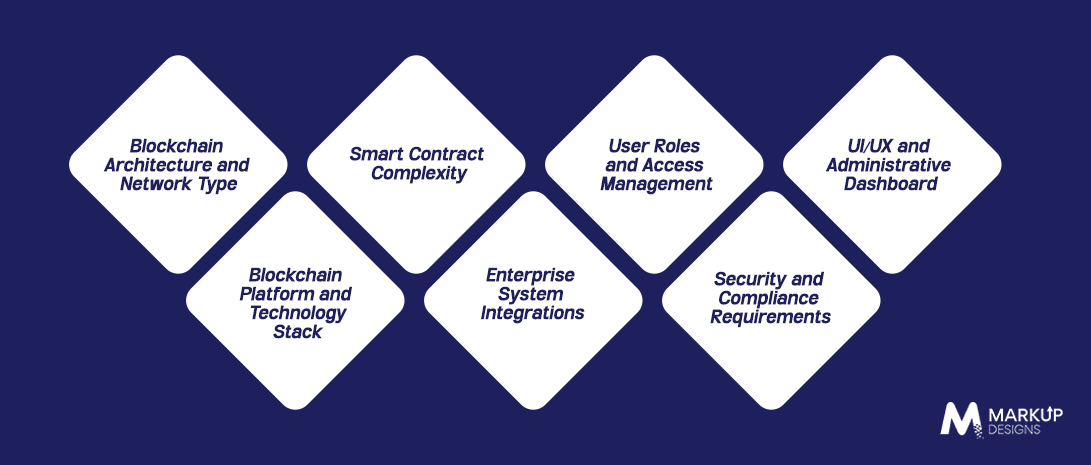
The cost of an enterprise blockchain project depends not only on the total working time. System architecture, technical decisions, the level of security, and integration with other systems after the implementation of the project.
Blockchain Architecture and Network Type
Public Blockchain
A public blockchain is one that allows open access to an entire network, making it suitable for applications that require a high level of decentralization. Expenses incurred include fees associated with transactions or the cost of gas, development of smart contracts, and integration with the chosen public network.
Private Blockchain
A private blockchain limits participation to only approved individuals and institutions. The technology requires building customized infrastructure, managing permits, controlling identities, and constantly administering nodes.
Consortium Blockchain
A consortium blockchain is run by a set of established organizations. Its development may involve difficult governance processes, permission management, consensus methods, and integration efforts.
Hybrid Blockchain
Hybrid systems incorporate a number of elements of public and private networks. The additional complexity of such designs may affect the costs of development, integration, testing, and infrastructure.
Blockchain Platform and Technology Stack
The choice of blockchain platforms has a direct impact on the technologies and tools available for the creation of a blockchain and its infrastructure, which can affect the amount of expertise required, scalability, and number of integrations.
Ethereum
Ethereum technology is scalable enough to host smart-contract-based applications while taking into account the transaction cost and system architecture.
Hyperledger Fabric
Hyperledger Fabric is for enterprise networks that need controlled use by participants and allow private transactions.
R3 Corda
The architecture of R3 Corda is based on business transactions between known parties, which makes its design suitable for certain enterprises and financial use cases.
Polygon
Polygon may be a good choice for applications within the Ethereum ecosystem that look for other scalability and transaction cost specifics.
Enterprise Blockchain Frameworks
An enterprise framework may be chosen based on requirements such as permission support, interoperability, scalability, privacy, and governance. The framework is only one part of the expense, as the expertise is also significant.
Smart Contract Complexity
Smart contracts automate business engine logic on a blockchain, but the effort necessary for the development of smart contracts increases with the complexity of contracts.
Number of Smart Contracts
The more contracts one has, the more effort is required for development, integration, testing, documentation, and maintenance.
Contract Logic and Automation
The implementation of contracts with complex business logic or business rules, with workflow, automatic transactions, or group approval, is much more complicated than simple transaction logic.
Smart Contract Audits and Testing
Smart contracts require continuous testing due to the probability of errors that may impact a transaction or a business process. Independent security audits can entail a further increase in expenses for the development process.
Integrating Enterprise Systems
Integrating blockchain technology with already existing enterprises can be one of the most significant cost drivers.
Integrating ERP
ERP integration can combine blockchain workflows with the data and processes of enterprise resource planning.
Integrating CRM
CRM integration can enable blockchain-based workflows to work with customer accounts and information.
Integrating Payment Gateway
Payments integration requires correct transaction processing, which might lead to additional costs regarding customer authentication, compliance, and reconciliations.
Cloud and DB Integration
Enterprise blockchain solutions often have to deal with cloud technologies and databases.
Integrating Third-Party APIs
Third-party APIs may be needed for identity verification, financing, logistics, information delivery, and many other functions.
User Roles and Access Management
Enterprise systems usually need to limit access levels for users, not just assign one level of access.
Role-Based Access Control
Various users need different access based on their duties and responsibilities in the network.
Identity Management
Identity management connects users and organisations to verified credentials and authorised blockchain access.
Permission Management
Granular permissions determine who can view, submit, approve, or modify specific information and transactions.
Security and Compliance Requirements
Security is a core cost consideration for enterprise blockchain because vulnerabilities can affect sensitive business data and transactions.
Data Encryption
Encryption protects sensitive information during storage and transmission.
Identity Verification
Identity verification helps ensure that only authorised participants can access enterprise blockchain services.
Transaction Security
Transaction validation, secure smart contracts, key management, and monitoring contribute to the overall security budget.
Regulatory Compliance
Industry and geographic requirements can introduce additional development, documentation, audit, and monitoring expenses.
Audit Trails
Enterprises may require detailed records of transactions, user activity, approvals, and system events for governance and auditing purposes.
UI/UX and Administrative Dashboard
Enterprise blockchain applications still require practical interfaces for administrators, employees, partners, and other authorised users. Dashboard complexity, data visualisation, workflow management, and role-specific interfaces can affect design and development costs.
Development Team Expertise
Blockchain development requires specialised knowledge across distributed systems, smart contracts, cryptography, security, backend development, and enterprise integrations. Hiring developers with relevant blockchain and industry expertise can therefore increase development costs compared with a conventional application development team.
Testing and Quality Assurance
Testing can cover blockchain transactions, smart contracts, APIs, integrations, user permissions, performance, security, and failure scenarios. Enterprise implementations generally require broader testing because multiple systems and organisations may depend on the platform.
Deployment and Infrastructure
Deployment costs can include cloud infrastructure, blockchain nodes, databases, storage, monitoring, networking, security tools, and environment configuration. The number of nodes and participating organisations can further affect infrastructure requirements.
Enterprise Blockchain Development Cost Breakdown
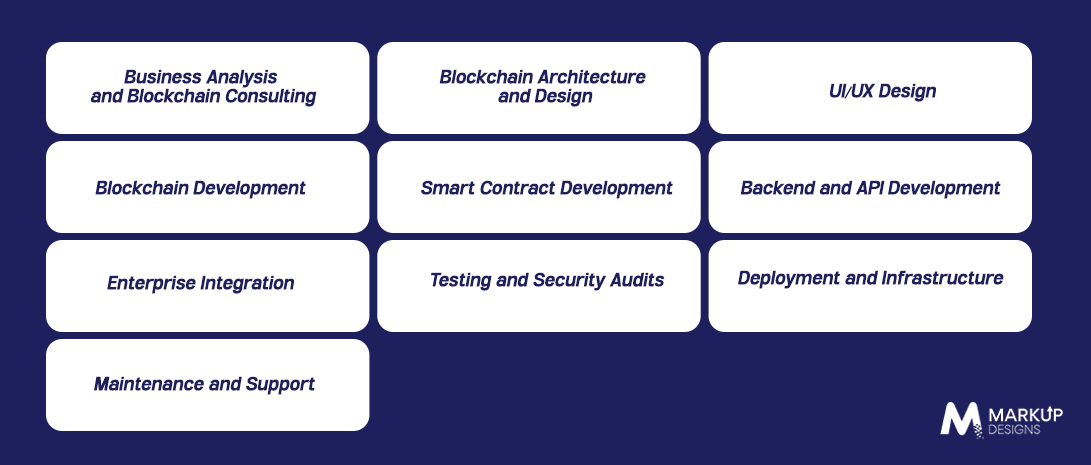
The total budget becomes easier to estimate when the project is divided into individual development activities.
Business Analysis and Blockchain Consulting
This stage identifies the business problem, evaluates whether blockchain is appropriate, defines requirements, and establishes the solution’s technical and functional scope.
Blockchain Architecture and Design
Architects determine the network model, consensus mechanism, blockchain platform, data architecture, integrations, security model, and scalability strategy.
UI/UX Design
Design covers user journeys, dashboards, workflows, administrative interfaces, and role-specific experiences required by different enterprise users.
Blockchain Development
Developers build the blockchain components, network functionality, transaction workflows, and application logic required by the solution.
Smart Contract Development
Smart contracts encode business rules and automate predefined transactions or workflows. Their cost depends on the number, complexity, testing requirements, and audit needs of the contracts.
Backend and API Development
Backend development connects the blockchain layer with application interfaces, databases, authentication systems, external APIs, and enterprise applications.
Enterprise Integration
Integration connects the blockchain platform with systems such as ERP, CRM, payment platforms, cloud services, databases, and other business applications.
Testing and Security Audits
Testing validates functionality, performance, integrations, permissions, and security. Smart contract and application security audits can add another layer of specialised review.
Deployment and Infrastructure
This includes configuring blockchain nodes, cloud environments, databases, networking, monitoring, security controls, and production environments.
Maintenance and Support
Post-launch costs can include bug fixes, security updates, smart contract changes, infrastructure management, performance optimisation, platform upgrades, monitoring, and technical support. These recurring expenses should be included in the enterprise blockchain budget rather than treated as an afterthought.
How Much Does It Cost to Develop Different Enterprise Blockchain Solutions?
The cost varies considerably by use case because each enterprise blockchain solution has different workflows, integrations, security requirements, and scalability needs.
Supply Chain Management Blockchain
A blockchain-based supply chain solution can connect suppliers, manufacturers, distributors, and retailers while providing shared transaction records and product traceability.
Enterprise Payment and Settlement Platform
Enterprise payment solutions use blockchain to facilitate secure transactions, settlement, reconciliation, and transfers between businesses or financial participants.
Digital Identity Management Platform
Blockchain-based identity platforms can securely manage digital credentials, authentication, identity verification, and controlled access across multiple organisations.
Asset Tokenization Platform
Asset tokenization platforms represent physical or digital assets on a blockchain, enabling businesses to manage ownership, transfers, transactions, and related compliance requirements.
Trade Finance Blockchain
Blockchain can streamline trade finance by connecting banks, buyers, sellers, and other participants while automating document verification, approvals, and transaction workflows.
Blockchain-Based Document Management
Blockchain-based document management solutions can provide tamper-resistant records, document verification, timestamps, and controlled access for sensitive business documents.
Enterprise Data-Sharing Platform
These platforms enable multiple organisations or departments to share verified data through a controlled blockchain network while maintaining transparency and access permissions.
Read Also: Scalable Web3 Solutions with Custom Blockchain Development Services
What Are the Hidden Costs of Enterprise Blockchain Development?
The initial development estimate does not represent the complete investment. Enterprises also need to budget for infrastructure, security, integrations, compliance, training, and ongoing maintenance.
Blockchain Infrastructure and Node Hosting
Running blockchain nodes and maintaining the network infrastructure can create recurring costs for hosting, configuration, monitoring, and resource management.
Cloud Computing and Storage
Cloud services may be required for application servers, databases, storage, backups, analytics, and other components supporting the blockchain ecosystem.
Smart Contract Audits
Smart contract audits help identify vulnerabilities and logic errors before deployment, adding a specialised security expense to the development budget.
Security Monitoring
Continuous monitoring helps detect suspicious activity, vulnerabilities, access issues, and other security threats after the blockchain solution goes live.
Third-Party API and Service Costs
External services for payments, identity verification, analytics, notifications, data feeds, and other functions can introduce recurring API or subscription costs.
Blockchain Transaction and Gas Fees
Solutions operating on public blockchain networks may incur transaction or gas fees, with the total expense depending on network usage and transaction volume.
Compliance and Legal Costs
Enterprise blockchain projects may require legal consultation, regulatory assessments, compliance documentation, audits, and industry-specific controls.
Data Migration
Moving existing business records into a blockchain-based ecosystem can require data cleansing, transformation, validation, and migration work.
Employee Training and Change Management
Employees and business partners may require training to adopt new workflows, blockchain-enabled processes, access controls, and operational procedures.
Post-Launch Maintenance
Ongoing expenses can include bug fixes, security updates, infrastructure management, performance optimisation, platform upgrades, and technical support.
Enterprise Blockchain Development Cost by Development Approach
The development model affects the overall cost, access to specialised talent, level of control, and flexibility available throughout the project.
In-House Blockchain Development
Building an internal team provides greater direct control but requires investment in blockchain developers, architects, security specialists, infrastructure, tools, and employee benefits.
Outsourced Blockchain Development
Outsourcing allows businesses to access specialised blockchain expertise without maintaining a full-time internal development team, with costs typically based on project scope or engagement model.
Dedicated Blockchain Development Team
A dedicated development team gives businesses access to developers and specialists working specifically on their blockchain project, making it suitable for complex or long-term initiatives.
Hybrid Development Model
A hybrid approach combines internal business and technology teams with external blockchain specialists, allowing enterprises to retain strategic control while accessing specialised expertise.
How Long Does Enterprise Blockchain Development Take?
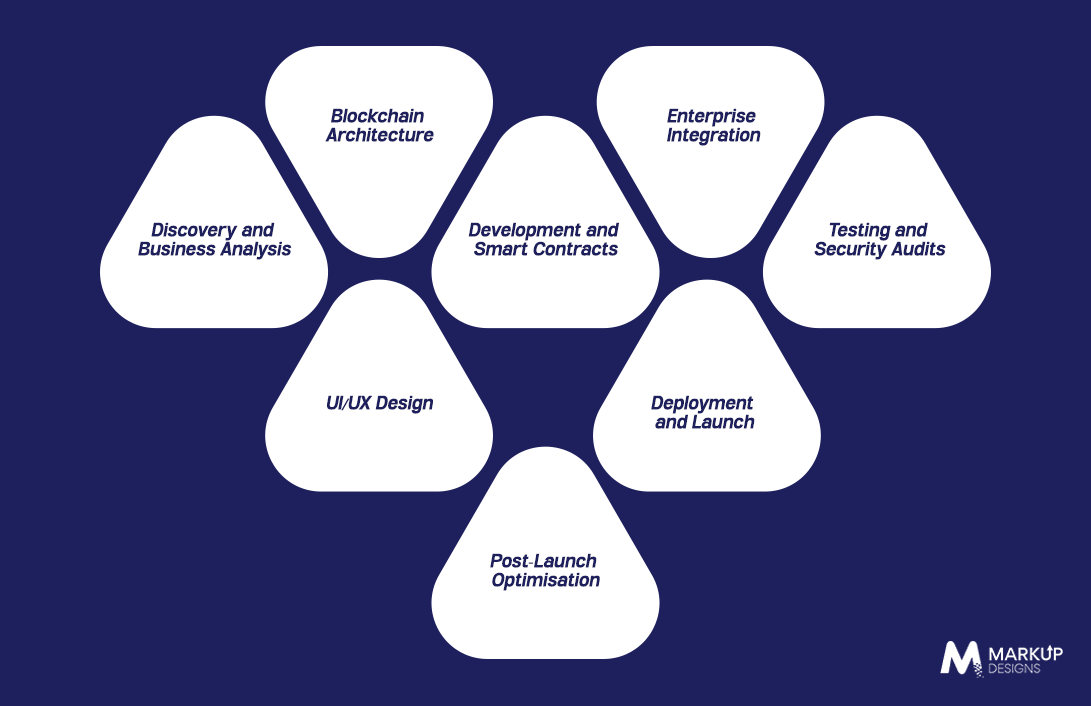
The timeline depends on the solution’s complexity, number of integrations, blockchain architecture, security requirements, and testing scope.
Discovery and Business Analysis
The team defines the business problem, stakeholders, workflows, technical requirements, and blockchain use case before development begins.
Blockchain Architecture
Architects determine the network type, consensus mechanism, blockchain platform, data structure, security model, and scalability requirements.
UI/UX Design
Designers create user journeys, dashboards, workflows, and interfaces for administrators, employees, partners, and other authorised users.
Development and Smart Contracts
Developers build the blockchain components, backend functionality, smart contracts, APIs, and application features required by the solution.
Enterprise Integration
The blockchain platform is connected with existing ERP, CRM, payment, database, cloud, and third-party systems.
Testing and Security Audits
The solution undergoes functional, performance, integration, security, and smart contract testing before deployment.
Deployment and Launch
The production environment, blockchain nodes, infrastructure, security controls, and monitoring systems are configured before the solution goes live.
Post-Launch Optimisation
After launch, the system is monitored and optimised based on performance, user feedback, security requirements, and changing business needs.
How to Reduce Enterprise Blockchain Development Costs
Cost optimisation should focus on controlling unnecessary development and operational expenses rather than simply selecting the cheapest development team.
Start With a Clearly Defined Business Use Case
Clearly defining the problem and expected business outcome prevents organisations from investing in blockchain features that do not provide meaningful value.
Build an MVP Before Full-Scale Deployment
An MVP allows businesses to validate the core concept, workflows, and technical feasibility before committing to a larger enterprise-wide implementation.
Choose the Right Blockchain Architecture
Selecting an appropriate public, private, consortium, or hybrid architecture can prevent unnecessary infrastructure and development costs.
Use Existing Blockchain Frameworks
Established blockchain frameworks can reduce the time and effort required to build core infrastructure from scratch.
Reuse Tested Smart Contract Components
Reusable and properly tested smart contract components can reduce development effort while maintaining consistency across related functions.
Prioritize Critical Enterprise Integrations
Businesses should integrate the systems essential to the initial use case first instead of attempting to connect every enterprise platform at the beginning.
Automate Testing and Deployment
Automated testing and deployment can reduce repetitive manual work and help identify development issues earlier in the lifecycle.
Plan Scalability From the Beginning
Designing for future transaction volumes, users, integrations, and network participants can reduce the expensive architectural changes that may otherwise be required later.
How to Choose the Right Enterprise Blockchain Development Partner
The qualities of the right partner should be the following: first and foremost, they should possess blockchain knowledge plus knowledge of enterprise systems and security, integrations, and technology needs from a long-term perspective.
Evaluate Blockchain Architecture Expertise
The first thing to do is to check if a partner can offer blockchain architecture development based on the specifics of the case, not a one-size-fits-all approach.
Check Enterprise Blockchain Experience
Check partner’s experience on a large scale: the implemented workflows, number and variety of the stakeholders involved and systems that have been used.
Review Smart Contract Development Capabilities
Check the team’s experience in developing and deploying smart contracts and their audit.
Assess Security and Compliance Expertise
The partner should have knowledge in the following areas: blockchain security, encryption, identity management, access controls, audits, and relevant compliance.
Examine Previous Enterprise Projects
It is insightful to examine previous projects done by the partner, case studies, and evaluate results.
Verify Integration Capabilities
It is highly recommended to check if a partner can provide integrations with ERP, CRM, payment systems, cloud services, databases, and other systems.
Compare Development and Maintenance Models
Compare the proposed development approach, team structure, pricing model, post-launch support, maintenance, and scalability options before making a decision.
What Is the Enterprise Blockchain Development Process?
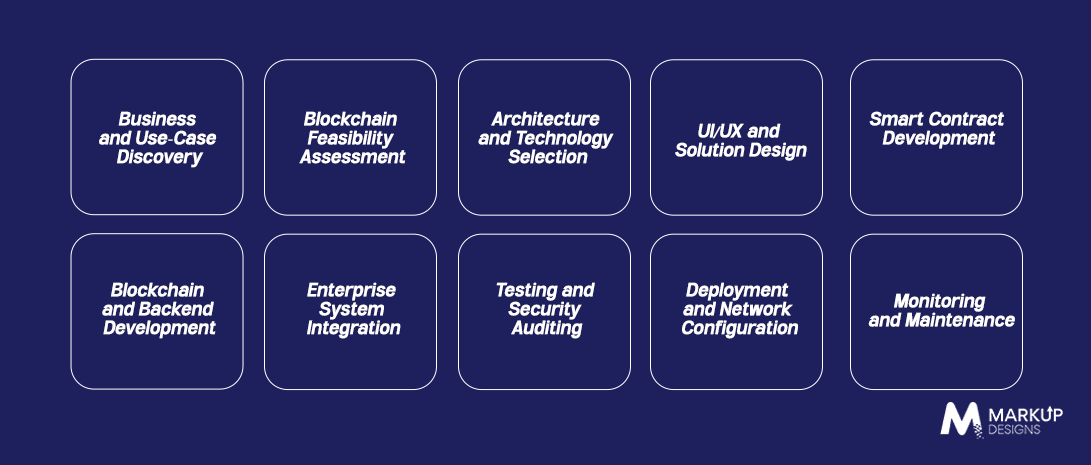
A structured procedure enables businesses to validate their use case, build the suitable architecture, mitigate development threats, and manage expenses during implementation.
Step 1: Business and Use-Case Discovery
The team analyzes business needs, existing processes, stakeholders, pain points, and identifies where blockchain offers real value.
Step 2: Blockchain Feasibility Assessment
The proposed use case is assessed in order to check if blockchain can technically and commercially suit the business problem.
Step 3: Architecture and Technology Selection
The team chooses the blockchain network, platform, consensus protocol, technology stack, infrastructure, and security architecture.
Step 4: UI/UX and Solution Design
User workflows, interfaces, dashboards, permissions, and the entire application architecture are designed in accordance with the enterprise requirements.
Step 5: Smart Contract Development
Smart contracts are written to automate regulations, transactions, approvals, and other defined processes.
Step 6: Blockchain and Backend Development
Programmers create the blockchain layer, backend services, APIs, databases, authentication, and functionalities of the application.
Step 7: Enterprise System Integration
The solution is integrated into the company’s existing business applications, databases, payment systems, APIs, and cloud infrastructure.
Step 8: Testing and Security Auditing
The platform undergoes functional, integration, performance, security, and smart contract testing before production deployment.
Step 9: Deployment and Network Configuration
Blockchain nodes, production environments, access controls, monitoring systems, and infrastructure are configured for the live environment.
Step 10: Monitoring and Maintenance
The deployed solution is continuously monitored and maintained to address security updates, performance issues, infrastructure requirements, and future enhancements.
How to Calculate Your Enterprise Blockchain Development Budget
A realistic budget should account for both the initial development effort and the recurring costs required to operate and scale the solution.
Define Business Requirements
Start by documenting the business objectives, users, workflows, features, integrations, compliance requirements, and expected transaction volumes.
Identify Blockchain Components
Determine which components are required, including the blockchain network, smart contracts, APIs, wallets, identity systems, dashboards, and supporting infrastructure.
Estimate Development Hours
Estimate the development effort across architecture, design, blockchain development, backend development, integrations, testing, and deployment.
Calculate Infrastructure Costs
Include blockchain nodes, cloud hosting, storage, databases, networking, monitoring, backups, and other infrastructure expenses.
Add Security and Compliance Expenses
Account for security audits, smart contract reviews, encryption, identity management, compliance assessments, and other regulatory requirements.
Include Integration and Data Migration Costs
Estimate the effort required to connect existing enterprise systems and migrate or transform relevant business data.
Account for Maintenance and Scalability
Include post-launch support, infrastructure management, security updates, performance optimisation, upgrades, and future scaling requirements.
Add a Contingency Budget
Set aside a contingency for unforeseen technical challenges, scope changes, integration issues, security requirements, or additional development work.
What Are the Business Benefits of Enterprise Blockchain?
Enterprise blockchain offers tangible advantages when it is necessary to have several parties work together on matters such as coordinating work processes or creating and maintaining secure records of transactions.
Process Automation
Smart contracts facilitate the process of applying certain business requirements and conditions and the automatic processing of necessary operations.
Shared Data and Transparency
Blockchain allows granting access to a unified database for transferring transactions.
Reduced Reconciliation
Since each member of the organization gets proof of transactions, they do not need to reconcile data with different databases.
Improved Traceability
Blockchain ensures the availability of a full and trustworthy history of transactions, which are traceable at different stages of development.
Secure Digital Transactions
Blockchain systems enable the creation of transactions protected with the help of cryptographic tools.
Multi-Party Collaboration
Permissioned blockchain provides the necessary environment for effective cooperation between organizations.
Build an Enterprise Blockchain Solution That Fits Your Business
Enterprise blockchain requires the right architecture, security strategy, integrations, and development approach to keep costs aligned with business goals. Our blockchain experts can help you assess your use case, select the right technology stack, and build a scalable solution around your requirements.

Conclusion
Enterprise blockchain development costs depend on the solution type, complexity, custom blockchain architecture, smart contracts, integrations, security, compliance, infrastructure, and development approach. The initial build is only one part of the investment; businesses must also account for deployment, transaction costs, audits, maintenance, and future scalability.
A well-defined use case, appropriate blockchain architecture, phased implementation, and realistic budgeting can help enterprises avoid unnecessary development expenses while building a blockchain solution aligned with their operational requirements.
FAQ
1. What may be the cost for enterprise blockchain development in 2026?
Enterprise blockchain development can begin at $25,000 and may even go beyond $150,000. Various factors determine the cost, such as the level of complexity of the solution, the architecture of the blockchain, presence of smart contracts, number of integrations involved, level of security required, and the expertise possessed by the developer.
2. Can we know the average cost of enterprise blockchain development?
The average cost of developing an enterprise solution can’t be determined easily since it can vary on a large scale based on the specifications of the project. While the cost may range on the lower side for simpler implementations, complex solutions may require spending large amounts.
3. What is the timeline required for building an enterprise blockchain platform?
The timeline for the development of a solution depends on various conditions like the scope of the project, architecture, number of smart contracts and integrations required, testing needs, and security checks. In case of simple implementations, the development may take only a few months but in case of complex enterprise solutions, it might take much longer.
4. What factors impact the costs of enterprise blockchain development?
Among the compelling reasons behind what determines the cost of developing an enterprise-grade blockchain are the type of blockchain network, technology stack, the complexity of the solution, smart contracts, integration processes both with existing systems used in the enterprise, compliance and security requirements, and the competence of the development team needed.
5. Is private blockchain more expensive than public one?
Not necessarily. Private blockchain solutions may require investment in additional infrastructure, permission systems, identity management, and administration of the blockchain network while public blockchain technology may involve transaction fees, gas expenses, and other costs coming from the use of the network.
Author's Perspective
Though blockchain technology is getting a lot of coverage these days, businesses should not start viewing it as some sort of technology. What companies should first evaluate is whether they really need a shared, verifiable, and tamper-proof system involving several participants. Once it is clear that it is really beneficial to have such an installation in the organization, one can move to the next stage in which the architecture and necessary features of the system are determined.
Businesses that properly evaluate the use case and plan for the complete technology lifecycle are better positioned to control costs and build an enterprise solution that supports their actual operational requirements.
Discuss Your Project NowJupinder Singh Arora
Founder and CEO
Related Posts

Crypto Trading Bot Development: Architecture, Features & Cost...

Cost to Develop a Cryptocurrency Exchange App Like...

How to Build a Secure Crypto Payment Gateway...
Insights Are Valuable & Execution is Priceless
You’ve read about the digital future. Now, let’s build the infrastructure to take you there. Move your strategy from the page to the product.
Design Your Solution Now
Contact Us
Schedule The Appointment At Your Convenience Date And Time.
30 Min
Web Conference
Time Zone
Indian standard time (08:30pm)

Thanks For Getting In Touch!
You’ve Taken The First Step Toward Transforming Your Digital Presence. Our Experts Will Reach Out Shortly To Take It Forward.
Launch Your Dream Project
Provide a brief overview of your project, and our specialists will evaluate your requirements. We will connect with you to explore how the right digital solutions can help you launch faster.