

In Brief
- Social media apps are evolving around niche communities, short-form content, messaging, and personalised user experiences.
- A clear app concept, target audience, core features, and monetisation model should be defined before development begins.
- AI, real-time communication, social commerce, AR, and recommendation systems are shaping modern social platforms.
- Social media app develop
- ment involves planning, UI/UX design, development, integrations, testing, security, deployment, and maintenance.
- Development cost and timeline depend on the app’s complexity, features, platforms, technology stack, and overall requirements.
Social media apps have moved beyond simple platforms for sharing posts and connecting with friends. Today, they support communities, real-time communication, video content, shopping, creator interactions, and personalised content discovery. This creates opportunities for businesses to build social platforms focused on specific audiences, interests, or use cases.
However, developing a successful social media app requires more than adding familiar features. Businesses need to define their audience, choose the right technology, create an engaging user experience, plan for security and scalability, and select a suitable monetisation model. This guide covers the key features, development process, technology stack, cost, timeline, and trends to consider when building a social media app in 2026.
What is a Social Media App?
A social media app is a digital platform that allows users to create profiles, share content, communicate, and interact with others online. Depending on its purpose, it can support activities such as networking, messaging, content sharing, community building, entertainment, or social commerce.
Types of Social Media Apps You Can Build
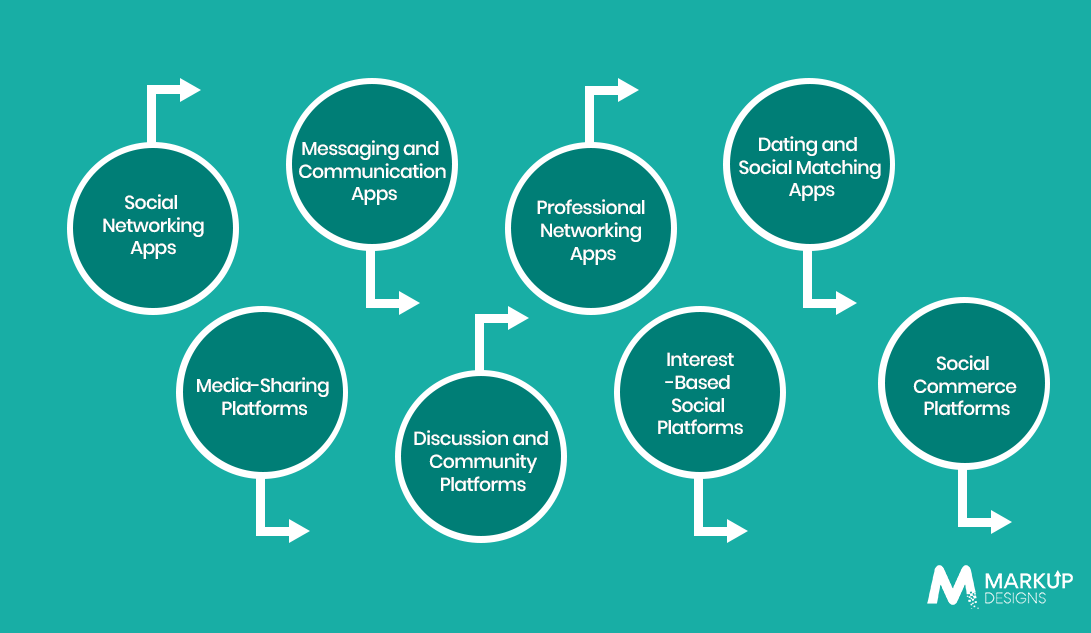
Social Networking Apps
Connect users through profiles, posts, follows, reactions, and personal networks.
Media-Sharing Platforms
Focus on sharing and discovering photos, videos, live streams, or other multimedia content.
Messaging and Communication Apps
Enable private or group conversations through text, voice, video, and media sharing.
Discussion and Community Platforms
Bring users together around specific topics, interests, questions, or communities.
Professional Networking Apps
Help professionals connect, share industry content, discover opportunities, and build business relationships.
Interest-Based Social Platforms
Create focused communities around hobbies, interests, lifestyles, or specific user groups.
Dating and Social Matching Apps
Use profiles, preferences, matching, and communication features to help users discover potential connections.
Social Commerce Platforms
Combine social interactions with product discovery, recommendations, creator content, and shopping experiences.
Essential Features of a Social Media App
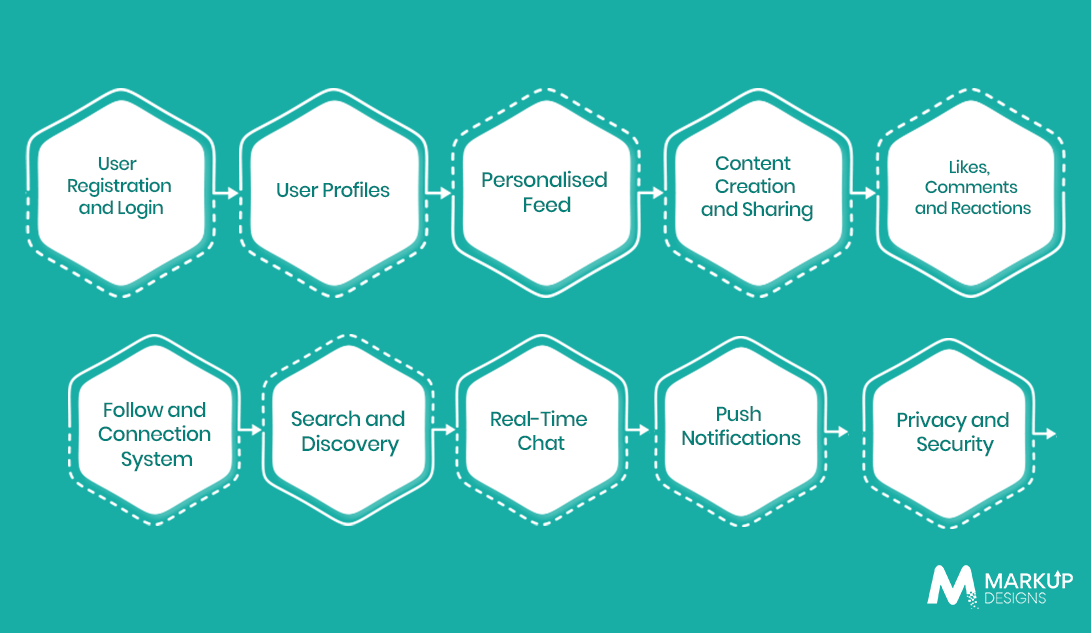
User Registration and Login
Provide secure signup and login options, including email, phone number, or supported social authentication methods.
User Profiles
Allow users to create profiles with personal information, profile images, interests, and other relevant details.
Personalised Feed
Display relevant posts, videos, updates, and recommendations based on user interests and interactions.
Content Creation and Sharing
Enable users to create, upload, edit, and share text, images, videos, stories, or other content.
Likes, Comments and Reactions
Give users simple ways to respond to content and encourage interaction.
Follow and Connection System
Allow users to follow accounts, send connection requests, or build networks based on the platform’s purpose.
Search and Discovery
Help users find people, content, groups, topics, and communities through search and discovery tools.
Real-Time Chat
Support one-to-one and group conversations with text, media sharing, and other communication options.
Push Notifications
Keep users updated about messages, interactions, connections, content activity, and other relevant events.
Privacy and Security
Include account controls, privacy settings, secure authentication, data protection, and tools for reporting or blocking unwanted activity.
Advanced Features to Make a Social Media App Stand Out
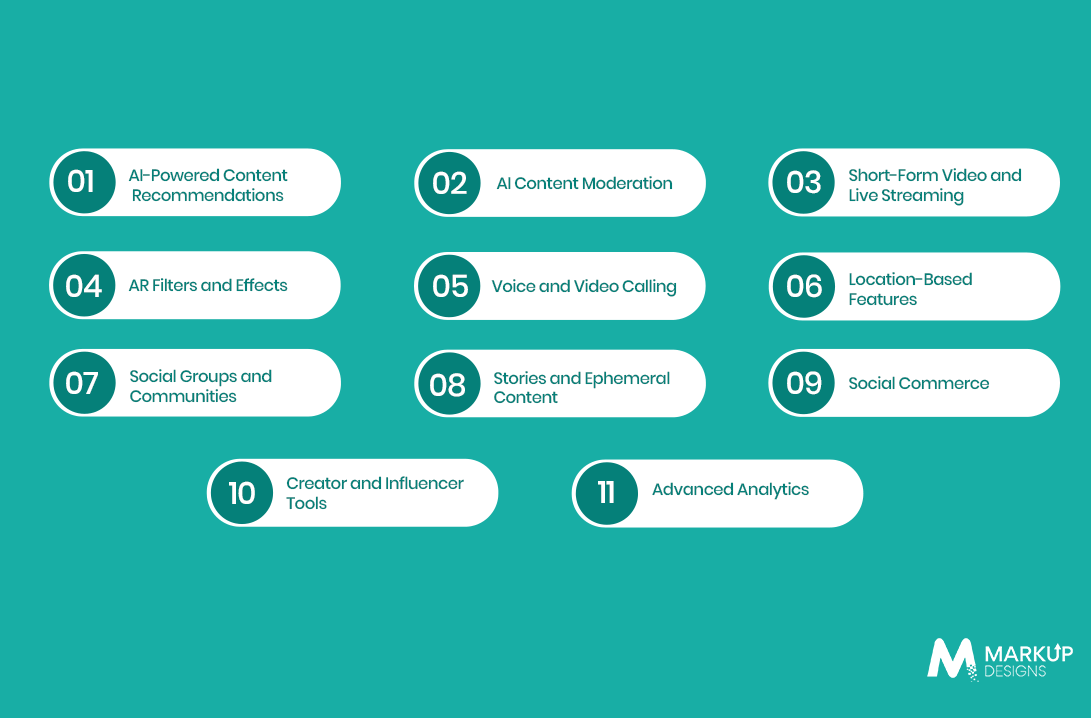
AI-Powered Content Recommendations
Use AI to analyse user interactions and deliver more relevant content and recommendations.
AI Content Moderation
Identify potentially harmful, inappropriate, spam, or policy-violating content and support moderation workflows.
Short-Form Video and Live Streaming
Support engaging video formats and real-time broadcasts for entertainment, education, communities, or creator-focused platforms.
AR Filters and Effects
Add interactive effects and augmented reality experiences to photos, videos, and live content.
Voice and Video Calling
Enable users to communicate through private or group voice and video calls.
Location-Based Features
Use location capabilities to support local discovery, nearby communities, events, or location-based content where relevant.
Social Groups and Communities
Allow users to create or join focused groups based on shared interests, professions, locations, or activities.
Stories and Ephemeral Content
Let users share temporary photos, videos, or updates that disappear after a defined period.
Social Commerce
Integrate product discovery, social recommendations, creator-led promotions, and purchasing experiences into the platform.
Creator and Influencer Tools
Provide tools for content creators to manage audiences, analyse performance, collaborate with brands, and monetise their content.
Advanced Analytics
Track engagement, content performance, user behaviour, retention, and other metrics to support product and business decisions.
How to Monetise a Social Media App?
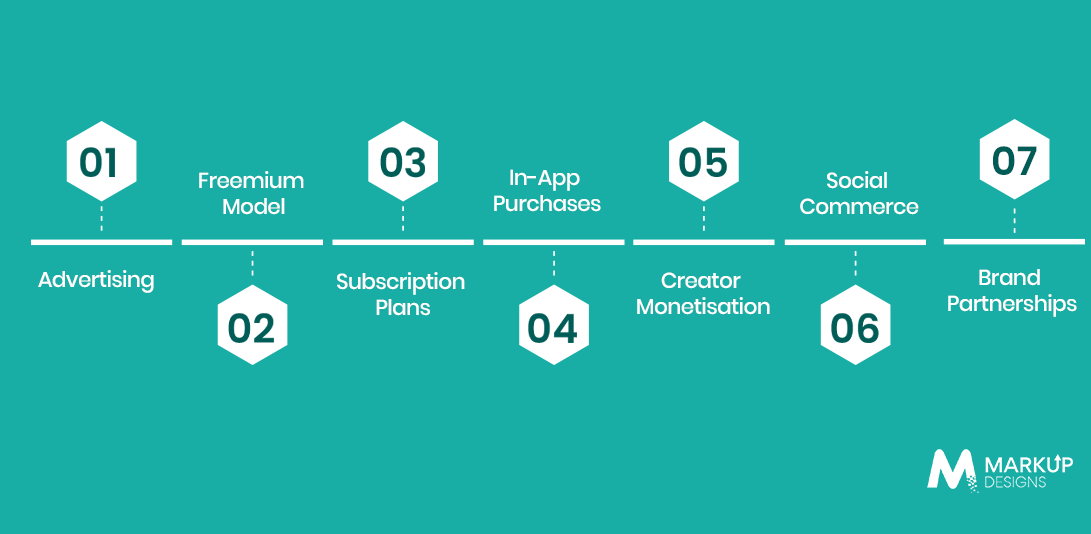
The right monetisation model depends on the platform’s audience, content type, engagement model, and overall business strategy.
Advertising
Generate revenue by displaying targeted advertisements across feeds, stories, videos, or other suitable areas of the platform.
Freemium Model
Offer core features for free while charging users for premium functionality, additional tools, or enhanced experiences.
Subscription Plans
Provide recurring paid access to exclusive content, advanced features, ad-free experiences, or premium communities.
In-App Purchases
Allow users to purchase digital items, virtual goods, content, or other platform-specific offerings.
Creator Monetisation
Generate revenue through creator subscriptions, paid content, virtual gifts, memberships, or revenue-sharing models.
Social Commerce
Earn through product sales, transaction fees, affiliate commissions, or integrated shopping experiences.
Brand Partnerships
Collaborate with brands through sponsored content, campaigns, creator partnerships, or customised platform experiences.
How to Develop a Social Media App?
Developing a social media app requires a structured approach that connects the platform’s purpose, user needs, technology, and long-term scalability. The following steps cover the key stages from initial planning to post-launch growth.
1. Define the App Concept and Target Audience
Start by identifying the problem the app will address, the audience it will serve, and the type of social interaction it will enable. Define the niche, value proposition, and key differentiators before moving into development.
2. Conduct Market and Competitor Research
Analyse existing social media platforms, user expectations, competing features, monetisation approaches, and market gaps. This research can help identify opportunities to create a more relevant and differentiated user experience.
3. Define the MVP Features
Determine the core features needed to launch and validate the app concept. Prioritising essential functionality helps control initial development efforts while leaving room to introduce advanced capabilities based on user feedback.
4. Plan the UI/UX Design
Map key user journeys and create wireframes, prototypes, and a scalable design system. The interface should support intuitive navigation, content discovery, interaction, and consistent engagement across the platform.
5. Choose the Technology Stack
Select the frontend, backend, database, cloud infrastructure, APIs, real-time communication tools, and AI technologies based on the app’s functionality and technical requirements. The stack should also support security, scalability, and future feature expansion.
6. Develop the Backend and Frontend
Build the application architecture and develop the core functionality, including APIs, user accounts, profiles, content management, feeds, messaging, notifications, and other required features.
7. Integrate Advanced Technologies
Add technologies that support the app’s specific requirements, such as AI-powered recommendations, content moderation, AR-VR app development features, analytics, payment systems, or social commerce capabilities.
8. Test Security, Performance and Usability
Test the application across functionality, security, performance, compatibility, and usability. Identify and resolve issues before launch to improve reliability and protect user data.
9. Launch and Monitor the App
Deploy the application across the required platforms and monitor performance, engagement, user behaviour, and technical issues. User feedback can help identify improvements and guide future releases.
10. Maintain and Scale
Continue improving the platform through regular updates, performance optimisation, security enhancements, and feature improvements. As the user base grows, scale the infrastructure and application architecture to support increased traffic and data volumes.
Technology Stack for Social Media App Development
| Technology Area | Common Options / Applications |
| Frontend | React Native, Flutter, Swift, Kotlin |
| Backend | Node.js, Python, Java |
| Database | PostgreSQL, MySQL, MongoDB |
| Cloud | AWS, Microsoft Azure, Google Cloud |
| Real-Time Communication | WebSockets, Socket.IO |
| AI/ML | Recommendations, moderation, personalisation |
| APIs | Social login, maps, payments, media, and third-party integrations |
| Security | Encryption, MFA, identity and access management |
The right technology stack depends on the platform’s functionality, expected scale, security requirements, target platforms, and long-term development strategy.
Security and Privacy Considerations for Social Media Apps
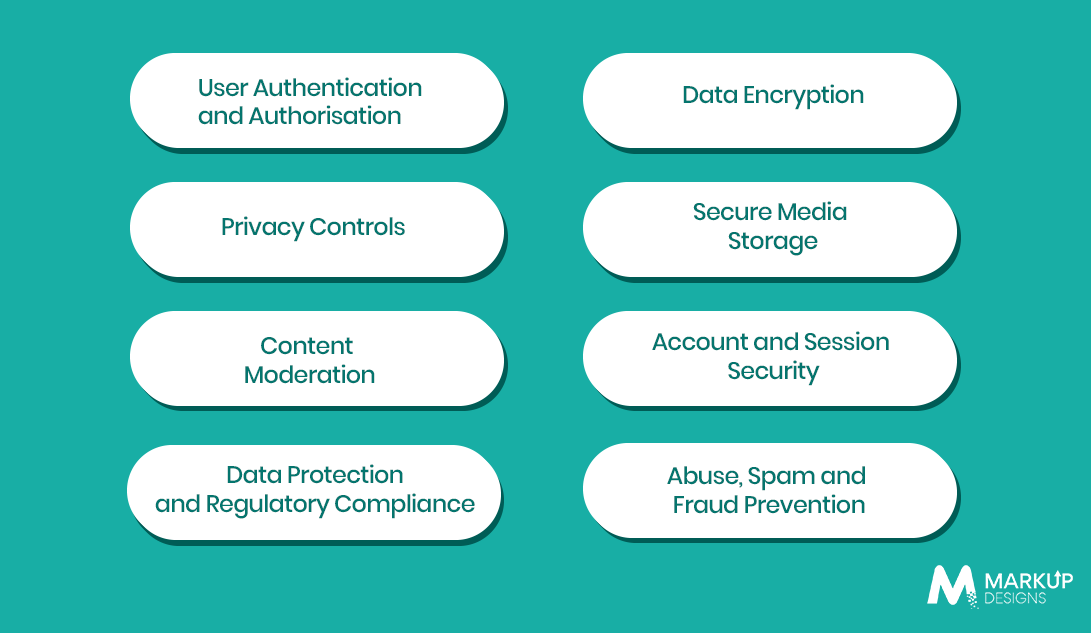
Security and privacy should be considered throughout social media app development, particularly because these platforms handle user profiles, messages, media, and other personal information.
User Authentication and Authorisation
Implement secure registration, login, access controls, and appropriate authentication mechanisms to protect user accounts and restrict unauthorised access.
Data Encryption
Protect sensitive information during transmission and storage using appropriate encryption mechanisms and secure communication protocols.
Privacy Controls
Give users control over profile visibility, content sharing, messaging, location access, and other privacy-related settings according to the app’s functionality.
Secure Media Storage
Protect uploaded photos, videos, documents, and other media through secure storage, access controls, and appropriate file-handling practices.
Content Moderation
Use moderation workflows and, where appropriate, AI-assisted tools to identify harmful, inappropriate, or policy-violating content and support timely review.
Account and Session Security
Protect accounts and active sessions through secure token management, multi-factor authentication where appropriate, session controls, and monitoring for suspicious activity.
Data Protection and Regulatory Compliance
Identify and address applicable data protection and privacy requirements based on the app’s users, markets, data practices, and business model.
Abuse, Spam and Fraud Prevention
Implement mechanisms to detect and manage fake accounts, spam, malicious activity, scams, and other forms of platform abuse.
How Much Does It Cost to Develop a Social Media App?
The cost of developing a social media app depends on its features, supported platforms, technical architecture, and scalability requirements. A practical estimate can be divided into three levels:
| App Type | Estimated Cost | Typical Scope |
| Simple Social Media App | $30,000–$60,000 | Profiles, feeds, content sharing, reactions, notifications, search, and basic messaging |
| Medium-Complexity App | $60,000–$120,000 | Advanced media sharing, messaging, communities, richer discovery, analytics, and stronger moderation |
| Advanced Social Platform | $120,000–$300,000+ | AI recommendations, AI moderation, live streaming, AR, social commerce, creator tools, and scalable infrastructure |
These ranges are indicative and can change significantly based on the product scope and technical requirements. Markup’s current social media app development estimates similarly place basic, mid-level, and advanced platforms across progressively higher cost and development ranges.
Key Factors Affecting Social Media App Development Cost
App Complexity
The number and technical complexity of features directly influence development effort, infrastructure, and testing requirements.
Number of Platforms
Developing for iOS, Android, or both can affect the project scope, particularly when native development is required.
Feature Set
Core functionality such as profiles and feeds generally requires less development effort than advanced features such as live streaming, real-time messaging, AI recommendations, or social commerce.
UI/UX Requirements
Custom interfaces, personalised feeds, interactive elements, animations, and complex user journeys can increase design and development effort.
Backend Architecture
Social media apps need backend systems that can manage users, content, media, interactions, notifications, and growing traffic volumes.
Third-Party Integrations
Payment gateways, social login, maps, analytics, communication services, advertising platforms, and media tools can add integration and maintenance requirements.
AI, AR and Video Functionality
AI-powered recommendations, automated moderation, AR effects, video processing, and live streaming require additional development and infrastructure.
Security and Compliance
Authentication, encryption, privacy controls, security testing, content moderation, and applicable regulatory requirements can affect the overall scope.
Development Team Location
Development rates can vary based on the team’s location, expertise, engagement model, and project requirements.
Maintenance and Infrastructure
Post-launch costs can include cloud hosting, media storage, monitoring, security updates, bug fixes, feature enhancements, and infrastructure scaling.
How Long Does It Take to Build a Social Media App?
The development timeline depends on the app’s complexity, number of platforms, integrations, technical architecture, and testing requirements. The major stages typically include:
| Development Stage | Typical Activities |
| Planning | Product discovery, requirements, MVP definition, architecture planning |
| UI/UX Design | User flows, wireframes, prototypes, interface design |
| Development | Frontend, backend, APIs, databases, core features |
| Integration | AI, payments, APIs, real-time communication, media services |
| Testing | Functional, security, performance, compatibility, and usability testing |
| Deployment | App store preparation, production deployment, monitoring setup |
Estimated Development Timeline
- MVP: Around 3–5 months for a focused platform with essential social features.
- Medium-Complexity App: Around 5–8 months with richer media, messaging, communities, analytics, and moderation capabilities.
- Advanced Social Platform: Around 8–12+ months when the platform includes AI, live streaming, advanced moderation, social commerce, real-time functionality, or large-scale media processing.
Markup’s current social-media development guidance follows similar timeline ranges, with additional time potentially required for complex architecture, integrations, security validation, and scalability testing.
Key Social Media App Development Trends in 2026
Social media platforms in 2026 are increasingly combining AI, video, commerce, creator tools, and community-driven experiences. Industry research also points to stronger integration among social discovery, creators, messaging, and commerce.
AI-Powered Personalisation
AI is being used to improve content recommendations, search, discovery, feeds, and user experiences. For social media apps, personalisation can help deliver content based on user interests, behaviour, interactions, and preferences.
AI Content Moderation
AI-assisted moderation can help identify potentially harmful, inappropriate, spam, or policy-violating content at scale. Combining automated detection with human review can support more consistent content management.
Short-Form Video and Live Content
Short-form video continues to play a major role in social discovery and engagement. Current 2026 research from Meta highlights the continued growth of video-first behaviour in India, while social platforms are also expanding creator and commerce features around video.
Social Commerce
Social platforms are increasingly connecting content discovery, creators, conversations, and purchasing experiences. Social commerce features can include shoppable content, product discovery, creator recommendations, payments, and in-app transactions.
Private and Niche Communities
Alongside large public networks, social products can focus on smaller communities built around specific interests, professions, locations, or shared activities. These platforms can use groups, private spaces, discussion tools, and personalised discovery to support more focused interactions.
AR and Immersive Experiences
AR filters, effects, virtual experiences, and interactive media can add new ways for users to create and engage with content. Their usefulness depends on the app’s audience and core experience rather than simply adding immersive features for their own sake.
Creator Economy Features
Social platforms are expanding tools that help creators build audiences and generate revenue through subscriptions, paid content, virtual gifts, commerce, and other monetisation options. Adobe’s 2026 creator research found that 85% of surveyed Indian creators who use creative AI consider it integrated or essential to their workflow, highlighting the growing connection between AI tools and creator activity.
Privacy-Focused Social Platforms
Privacy, account security, age assurance, content controls, and transparent data practices are becoming increasingly important areas for social platforms. Regulatory developments in 2026, including proposed EU measures focused on child safety and platform design, further highlight the need to consider privacy and online safety during product development.
Challenges in Social Media App Development
Building an AI social media platform involves challenges beyond application development. Businesses need to consider user growth, content management, security, infrastructure, and long-term engagement.
Building and Retaining an Active User Base
A social media platform depends on regular participation. Businesses need to create meaningful user experiences, relevant content discovery, and community features that encourage users to return and interact.
Managing High Volumes of User-Generated Content
Photos, videos, messages, comments, and other user-generated content can create significant storage, processing, and moderation requirements. The platform needs infrastructure that can handle growing content volumes efficiently.
Content Moderation and Online Safety
Managing harmful, inappropriate, misleading, or abusive content becomes more difficult as a platform grows. Effective moderation may require automated detection, reporting mechanisms, human review, and clearly defined platform policies.
Protecting User Data and Privacy
Social platforms handle personal profiles, communications, media, and behavioural information. Strong authentication, encryption, access controls, privacy settings, and appropriate data governance are essential.
Scaling Infrastructure
Growing users and traffic can place significant demands on databases, APIs, media storage, content delivery, and real-time services. Scalable cloud infrastructure and appropriate architecture help the platform handle increasing demand.
Preventing Spam, Bots and Fake Accounts
Fake accounts, automated activity, spam, scams, and coordinated abuse can affect platform trust and user experience. Account verification, behavioural monitoring, rate limits, reporting tools, and fraud detection can help address these risks.
Maintaining User Engagement
User expectations and content preferences continue to change. Social platforms need ongoing product improvements, relevant recommendations, new content formats, community features, and performance optimisation to maintain engagement.
How Markup Designs Can Help You Build a Social Media App
Markup Designs can support social media app development from product planning and UI/UX design through development, integration, testing, deployment, and ongoing optimisation. The team can work across core and advanced requirements based on the platform’s audience, business model, and scalability goals.
Social Media App Development
Build custom social platforms with profiles, feeds, content sharing, messaging, communities, notifications, discovery, and other social functionality.
UI/UX Design
Design intuitive user journeys, interfaces, navigation systems, and interaction patterns focused on usability and engagement.
iOS and Android Development
Develop applications for iOS and Android based on the target audience, platform requirements, and AI product development service.
Cross-Platform Development
Use technologies such as React Native or Flutter where cross-platform app development is suitable for the project.
Backend Development
Build scalable backend architecture, APIs, databases, authentication systems, content management, and real-time services.
AI Integration
Integrate AI-powered recommendations, personalisation, content moderation, search, analytics, and other intelligent capabilities based on the platform’s requirements.
Real-Time Communication
Develop real-time messaging, notifications, live interactions, and communication capabilities using appropriate technologies and infrastructure.
Cloud and API Integration
Connect cloud services and third-party APIs for storage, payments, authentication, analytics, media processing, and other platform requirements.
Testing and Maintenance
Support functional, security, performance, compatibility, and usability testing, followed by ongoing maintenance, updates, optimisation, and scalability improvements.
Build Your Social Media App for the Next Generation
Turn your social platform idea into a scalable digital product with the right features, technology, and user experience.

Conclusion
Developing a social media app requires more than combining profiles, feeds, messaging, and content-sharing features. Businesses need to define a clear product concept, understand their target audience, choose the right technology, build for security and scalability, and create a user experience that supports meaningful interaction.
From AI-powered personalisation and content moderation to short-form video, social commerce, private communities, and creator-focused features, social platforms continue to evolve. A structured development approach can help businesses introduce the right capabilities at the right stage while leaving room for future growth.
FAQs
1. How much does it cost to develop a social media app in 2026?
The cost can range from around $30,000 to $300,000+, depending on the app’s complexity, features, platforms, technology stack, integrations, security requirements, and development team. A simple MVP generally costs less than a platform with advanced AI, video, AR, live streaming, or social commerce capabilities.
2. How long does it take to build a social media app?
A focused MVP can take around 3–5 months, while a medium-complexity app may require 5–8 months. Advanced social platforms with complex features and integrations can take 8–12+ months, depending on the scope and development requirements.
3. What features should a social media app have?
Core features can include user registration, profiles, personalised feeds, content creation and sharing, reactions, comments, connections, search, messaging, notifications, and privacy controls. Advanced platforms may also include AI recommendations, content moderation, live streaming, AR, social commerce, communities, and creator tools.
4. What technology stack is used to build a social media app?
The technology stack depends on the app’s functionality, scale, and platform requirements. Common choices include React Native, Flutter, Swift, Kotlin, Node.js, Python, Java, PostgreSQL, MongoDB, AWS, Microsoft Azure, Google Cloud, WebSockets, and Socket.IO, along with AI/ML and third-party APIs where required.
5. How can a social media app make money?
Common monetisation models include advertising, subscriptions, freemium plans, in-app purchases, creator monetisation, social commerce, and brand partnerships. The appropriate model depends on the target audience, content strategy, user behaviour, and overall business model.
6. How do I build a social media app like Instagram or TikTok?
Start by defining your target audience, niche, value proposition, and core user experience rather than simply replicating an existing platform. Then define the MVP, design the UI/UX, select the technology stack, develop and test the application, launch it, and continuously improve the platform using user feedback and performance data.
Author's Perspective
A successful social media app starts with a clear reason for users to join, interact, and return. Instead of trying to replicate every feature of established platforms, businesses should focus on their target audience, core value proposition, and the experiences that differentiate their product. Building a focused MVP, validating it with real users, and expanding the platform based on measurable needs can create a more practical path towards long-term growth.
Discuss Your Project NowGaurav Goyal
Global Sales- VP
Related Posts

How to Build an App Like Yuka: Features,...
10 Key Factors to Choose the Right Mobile...

Mobile App Development in Kuwait: Cost, Process, Features...
Insights Are Valuable & Execution is Priceless
You’ve read about the digital future. Now, let’s build the infrastructure to take you there. Move your strategy from the page to the product.
Design Your Solution Now
Contact Us
Schedule The Appointment At Your Convenience Date And Time.
30 Min
Web Conference
Time Zone
Indian standard time (08:30pm)

Thanks For Getting In Touch!
You’ve Taken The First Step Toward Transforming Your Digital Presence. Our Experts Will Reach Out Shortly To Take It Forward.
Launch Your Dream Project
Provide a brief overview of your project, and our specialists will evaluate your requirements. We will connect with you to explore how the right digital solutions can help you launch faster.