
In Brief
- Modern logistics will be required by Australian retailers to handle rapid delivery times, escalating shipping expenses, complex inventories, return procedures, and the wide expanse of Australia.
- Effective techniques will comprise the use of distributed warehouses, omnichannel fulfillment, automated inventory control, multiple carriers for shipping, effective last-mile delivery, and efficient return policies.
- Technologies like artificial intelligence (AI), Internet of Things (IoT), warehouse automation, cloud technologies, data analytics, and real-time monitoring are being utilized by Australian retailers to enhance visibility, automate, and make logistics decisions faster.
- An efficient modernization strategy is an evaluation of present logistical practices, analysis of customer and order data, selection of a proper fulfillment strategy, integration of logistics systems, automation of processes, and continuous monitoring of performance.
- Modernized logistics can ensure cost savings, fast delivery, effective inventory control, reliable delivery services, customer satisfaction, and scalability of operations.
In today’s world, the logistics for Australian retailers have moved far beyond simply having an online shop. Consumers expect fast deliveries, timely order notifications, flexible delivery, and hassle-free return policies. All these factors require a logistics strategy that would be able to adapt to changing consumer demands and wide geographical distances within the country.
From inventory management and warehousing through order fulfillment to last-mile delivery, every single component of the logistics chain impacts on the quality of consumers’ experience. At the same time, increasing costs of delivery and the growing competition push retailers to look for new ways of optimizing their business processes.
Modern technology can be used to address the problems described above. Automation, AI, real-time tracking, cloud platforms, and analytics can help optimize logistics.
In this blog post, we will look into modern logistics practices in eCommerce in Australia, issues that companies have, technology used in this process, ways to implement logistics in business, and advantages of implementing logistics.
Why eCommerce Logistics Matters for Australian Retailers
An efficient logistics system is very important for Australian retail businesses since there is more than the consumer is going to look at besides the product when shopping online. These could include delivery time, accuracy, and even return policies that might help determine if the consumer comes back to shop.
Another issue is that Australia is a large country geographically. This means that it is very possible for the retailer to be serving consumers from both cities and rural areas while still managing to keep delivery costs low.
E-commerce logistics may also contribute to maintaining better inventory management and preventing any unnecessary delays. The cooperation between orders, inventory, warehouses, and logistics providers allows companies to react to demand much faster.
As competition increases, modern logistics may turn into an advantage in business. In this chapter, we will examine the reasons for the importance of logistics for satisfying customers and achieving efficiency, economy, and growth in the Australian e-commerce industry.
Key eCommerce Logistics Challenges in Australia
The Australian retail sector has certain logistics problems owing to the nation’s large size, varied customer base, and growing delivery demands. As demand for products bought online keeps growing, firms require efficient and flexible logistics processes.
Here are the biggest challenges retailers commonly face:
Long-distance deliveries: Delivery can take longer and be costlier as a result of serving metro, regional, and distant places.
Increasing costs of delivering products: Fuel costs, among other transportation costs, affect profitability.
Inventory visibility: Inventory management can become difficult as a result of selling out of stock and stock surplus.
Last-mile delivery: Fast delivery without compromising reliability is still a key problem.
Returns management: Efficiently managing returns and exchanges is important for customer satisfaction.
Seasonal demand spikes: Managing orders during peak buying times is a necessity to ensure there are no delays.
Addressing all of the above problems requires the implementation of new, tech-driven logistics processes.
Read Also: Why Mobile Apps are Essential for Every eCommerce Startup
Modern eCommerce Logistics Strategies for Australian Retailers
The Australian retail sector requires logistics systems that will accommodate shifts in customer expectations while maintaining efficiency. There is potential for such a system to benefit businesses through reduced downtime, effective inventory management, and improved shopping experience.
Here are some modern strategies retailers can consider:
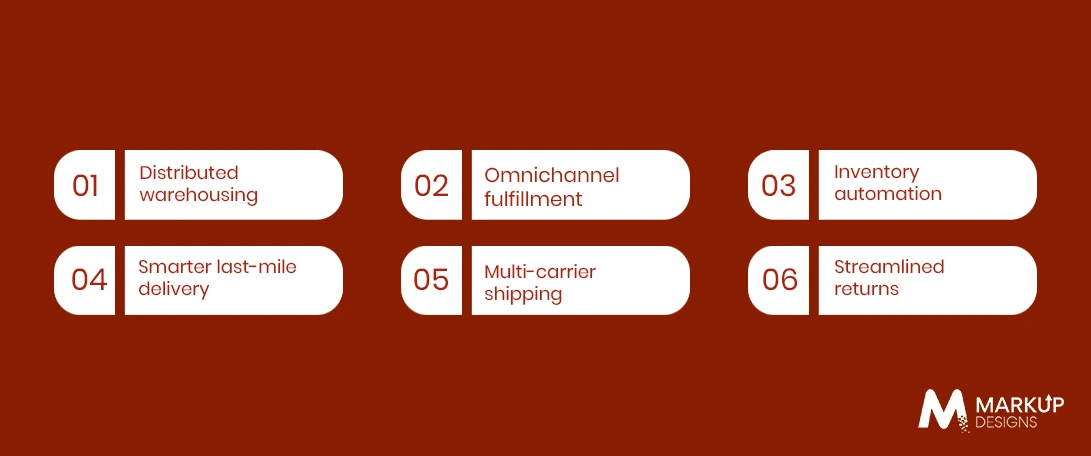
Distributed warehousing
Placing products in various geographical points may enable products to be nearer to customers and shorten the delivery distance, especially when catering to various parts of Australia.
Omnichannel fulfillment
Linking the online shop with the offline point may allow retailers to provide such services as pick-and-ship from store and store fulfillment.
Inventory automation
Automatic stock tracking, automatic notifications, and demand forecasting are some of the ways that retailers can use to manage their inventory effectively.
Multi-carrier shipping
Using various delivery service providers allows flexibility according to the location, speed of delivery, service provision, and cost of shipping.
Smarter last-mile delivery
Route optimization, delivery tracking, and order scheduling can increase delivery efficiency and, at the same time, manage transportation costs effectively.
Streamlined returns
Simplifying the return process by having a system of tracking, notifications, and reverse logistics makes it easier for both consumers and retailers.
Such strategies will prove most effective in their integration within a central technology ecosystem. Rather than handling logistics as discrete functions, retailers will be able to implement an integrated system whereby inventory, orders, warehouses, carriers, and customers stay connected throughout the process.
How Technology is Transforming eCommerce Logistics
Technology is influencing how AI in logistics in Australian retail stores operates, right from stock planning to the ultimate delivery process. This means that instead of depending on manual processes, companies have an opportunity to utilize connected digital processes that allow them to make timely decisions and minimize errors.
- AI and machine learning: AI will play an important role in predicting future demand for products, recognizing inventory trends, route optimization, and predicting possible delays.
- IoT: IoT can be used to offer timely information about inventories, transportation, warehouse status, and delivery processes.
- Automated Warehouses: Automated processes like picking, sorting, scanning, and packing can help accelerate the process and reduce repetitive work.
- Cloud Computing: Using Cloud computing in Logistics makes it possible for retailers to have access to all the information regarding orders, inventory, warehouses, delivery partners, and the business team in one place.
- Logistics Data Analytics: Logistics data will help businesses to analyze the cost of shipping, performance in delivery, the movement of inventory, and customers’ behavior.
- Real-Time Monitoring: Real-time updates on the order and shipment status can be accessed by the customer and retailer.
The main benefit of using all these technologies will be enhanced visibility. With visibility of everything that happens in the logistics of retailing, it becomes easier for the business to make decisions.
Strategies for Faster and Cost-Effective Last-Mile Delivery
The last mile is one of the most critical processes in eCommerce logistics, where the customer encounters the delivery process. For Australian retailers, managing the last mile effectively can pose difficulties because customers can be located in big cities, rural areas, and remote locations. A good last-mile delivery process can enable retailers to increase the speed of deliveries without having to incur unnecessary costs.
Here are some practical strategies:
- Use various delivery carriers: Retailers may take advantage of working with several delivery partners and choose one based on geographic proximity, delivery time, and costs.
- Use route optimization technology: Route optimization software can be used to optimize drivers route planning and avoid inefficient driving.
- Enable real-time tracking: Customers will be able to track their order and get information about the delivery in real-time.
- Offer flexible delivery options: Click-and-collect, scheduled delivery, pick-up points, as well as regular and express delivery services can be offered to customers.
- Make regional fulfillment better: Popular items can be fulfilled from warehouses closer to the delivery destination area to shorten delivery time.
- Analyze delivery statistics: The delivery process can be analyzed by delivery time, failed delivery attempts, shipping costs, and the performance of delivery partners.
It is not about making deliveries faster; it is about providing an efficient and flexible last-mile delivery experience for both retailers and consumers.
Step-by-Step Approach to Modernizing eCommerce Logistics
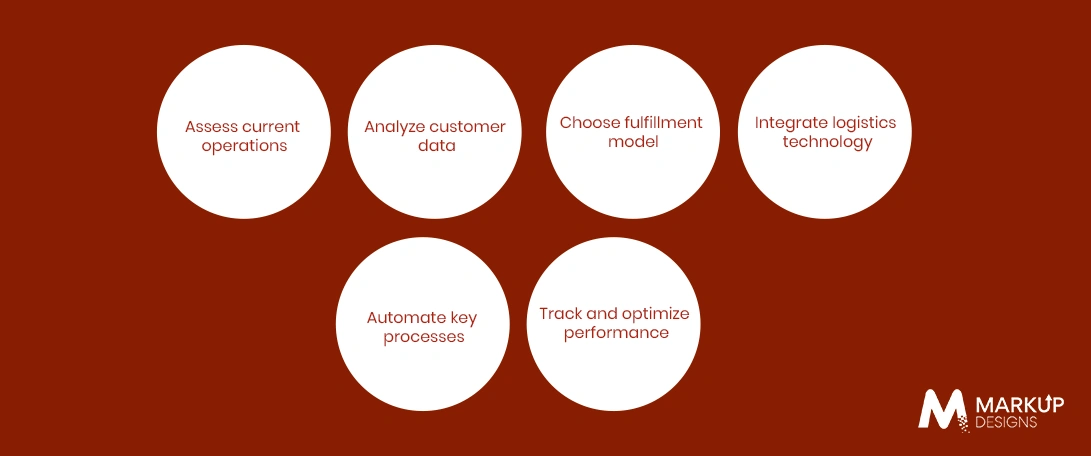
Modernizing eCommerce logistics is not about making changes overnight. An incremental process of updating the technology and business processes of Australian eCommerce businesses could start with analyzing what is currently being done.
Assess current operations
Examine the existing operations in terms of delays, cost, and operational inefficiencies within the inventory, warehousing, fulfillment, shipping, and returns.
Analyze customer data
Investigate the number of orders, geographic regions, customer preferences, seasonality, and popular goods to improve logistics planning.
Choose fulfillment model
Consider what the optimal type of centralized, decentralized, third-party, or hybrid fulfillment strategy is for the business.
Integrate logistics technology
Combine eCommerce software with the inventory system, warehouse facilities, order management system, ERP systems, and delivery carriers.
Automate key processes
Automate processes like updating inventory information, routing orders, delivery notifications, stock alerts, and handling returns.
Track and optimize performance
Evaluate delivery time, fulfillment cost, inventory accuracy, return rate, and delivery carrier performance to improve logistics operations continuously.
The process will help retailers develop a logistics structure that is more integrated, efficient, and scalable as their eCommerce operations grow.
Common eCommerce Logistics Mistakes to Avoid
Even with modern technologies, improper planning will result in unnecessary logistics issues. Here are some typical mistakes Australian retailers need to avoid:
- Dependence on one logistics provider: One company may cause difficulties with rising demands or in case of delivery interruptions.
- Ignoring inventory visibility: The inaccuracy of stock levels may cause overselling and delays in shipment.
- Underestimating returns: Unfavorable returns procedure may have a negative effect on customer trust and loyalty.
- Concentration on speedy delivery only: It is very important to deliver fast, however, reliability and transparency are no less essential.
- Using separate systems: If eCommerce, inventory, warehousing and logistics systems cannot communicate with each other, it will be more time-consuming and error-prone.
- Lack of growth strategy: Logistics system which suits a small business, may be not appropriate for a large one.
Read Also: How Much Does It Cost to Develop a Shopify Plus eCommerce Store?
Benefits of Modern eCommerce Logistics Strategies
Modern eCommerce logistics solutions will not only aid in optimizing the operations of Australian merchants but also enhance the consumer experience. The implementation of a streamlined approach to the management of inventory, order fulfillment, delivery, and return services will result in enhanced efficiency.
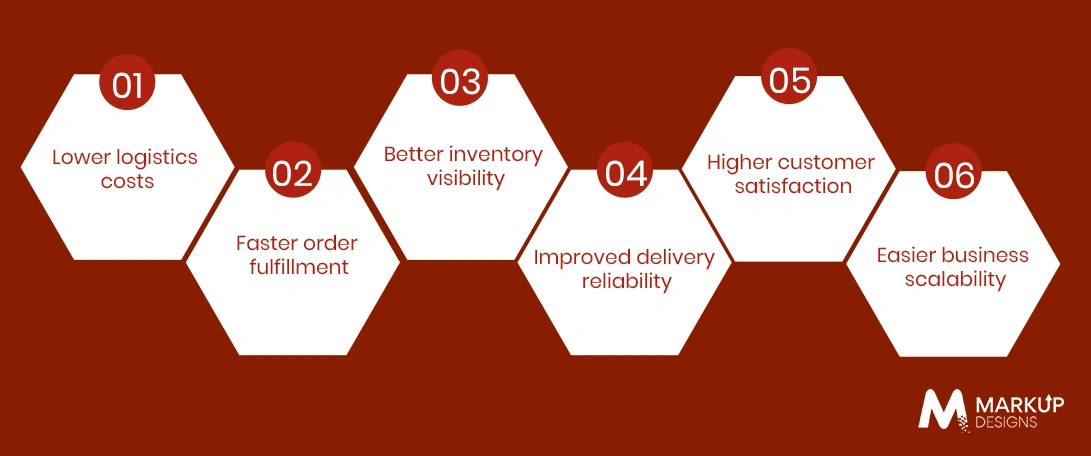
1. Lower logistics costs
Proper inventory management, route optimization, and automation could contribute to lowering unnecessary costs related to transportation and logistics.
2. Faster order fulfillment
Enhanced processes would help retailers process, package, and send orders faster.
3. Better inventory visibility
With real-time stock data, the business could have an idea about its stock, location, and possible need for replenishment.
4. Improved delivery reliability
Multiple delivery carriers, tracking, and optimization could ensure retailers provide reliable deliveries across Australia.
5. Higher customer satisfaction
Reliable delivery estimates, tracking, flexible delivery options, and return processes would provide customers with a good experience.
6. Easier business scalability
Integration of the logistics processes would facilitate scalability of the order volume, new locations, and additional product lines without any extra complexity.
In addition to these advantages, the logistics offered by the present time enables the retailer to have better control over the business. The data provided by order, inventory, shipment, and returns can be used to pinpoint problems and make decisions. Thus, the Australian retailer is able to establish logistics that will be efficient in the future as well.
How Markup Designs Helps Australian Retailers Modernize eCommerce Logistics
The process of modernizing logistics involves getting the right balance between technology, integration, and business strategies. Markup Designs works with retailers in Australia and assists them in building a digital environment to integrate different elements of eCommerce and logistics.
Our capabilities include:
- Custom eCommerce logistics solutions to fit business needs
- Intelligent solutions to help with forecasting, automation, and operations analysis
- Integration of inventory and order management systems
- Integration with warehouses and third-party logistics solutions
- Cloud environments to make operations more connected and scalable
- Analytics solutions for monitoring of the logistics process and making better decisions
By integrating different aspects of eCommerce, inventory, order fulfillment, warehouses, and delivery services, businesses can improve the entire logistics ecosystem. The goal here is not just to introduce new technologies but to address business needs and achieve sustainable growth.
Build a Smarter Logistics Ecosystem
Take your eCommerce operations to the next level with connected technology, automation, and data-driven logistics solutions.

Conclusion
For Australian retail firms, eCommerce logistics has become an important factor in creating a competitive customer experience due to high order volumes, numerous customer locations, higher delivery expectations, and increased cost of logistics.
The application of advanced logistics strategies may help Australian retailers deal with the problems mentioned above via better inventory management, distributed fulfillment, omnichannel approach, multi-carrier shipping, efficient return processing, and effective last-mile delivery. Modern technology will allow retail firms to benefit from such capabilities as automation, real-time visibility, AI, and better data management.
However, modernization of the logistics processes is a long-term process. Retailers have to start with identification of their current logistics challenges, choosing a proper fulfillment model, integration of key systems, and performance measurement.
By applying an appropriate strategy and using relevant technology, Australian retailers will be able to create an efficient, flexible, customer-centric, and scalable logistics operation.
FAQs
1. What are modern eCommerce logistics strategies?
Modern eCommerce logistics strategies include automated inventory management, distributed fulfillment, omnichannel operations, multi-carrier shipping, real-time tracking, and streamlined returns.
2. How can Australian retailers reduce eCommerce logistics costs?
Retailers can reduce costs through better inventory planning, route optimization, multiple carrier options, warehouse automation, and data-driven fulfillment decisions.
3. How does AI improve eCommerce logistics?
AI can help retailers forecast demand, optimize routes, identify inventory patterns, automate repetitive processes, and predict potential delivery issues.
4. Why is last-mile delivery important for Australian retailers?
Last-mile delivery directly affects the customer experience. Efficient delivery strategies can improve reliability, reduce costs, and provide customers with better delivery visibility.
5. How can retailers improve inventory management?
Retailers can use real-time inventory systems, automated stock alerts, demand forecasting, and integrated order management to maintain better control over their inventory.
Author's Perspective
Modern eCommerce logistics is about connecting inventory, technology, fulfillment, transportation, and customer experience. For Australian retailers, this is especially important due to the country’s geographic spread and varied delivery needs. Businesses should focus on automation, visibility, flexible fulfillment, and data-driven decisions. The goal is not to adopt technology for its own sake, but to solve real operational challenges and build a logistics system that supports efficiency, customer satisfaction, and sustainable growth.
Discuss Your Project NowJupinder Singh Arora
Founder and CEO
Related Posts

How to Build an Ecommerce App Like Noon?
Cost of Developing E-commerce Mobile Apps in 2026
Insights Are Valuable & Execution is Priceless
You’ve read about the digital future. Now, let’s build the infrastructure to take you there. Move your strategy from the page to the product.
Design Your Solution Now
Contact Us
Schedule The Appointment At Your Convenience Date And Time.
30 Min
Web Conference
Time Zone
Indian standard time (08:30pm)

Thanks For Getting In Touch!
You’ve Taken The First Step Toward Transforming Your Digital Presence. Our Experts Will Reach Out Shortly To Take It Forward.
Launch Your Dream Project
Provide a brief overview of your project, and our specialists will evaluate your requirements. We will connect with you to explore how the right digital solutions can help you launch faster.